Written by Sulaiman Razvi
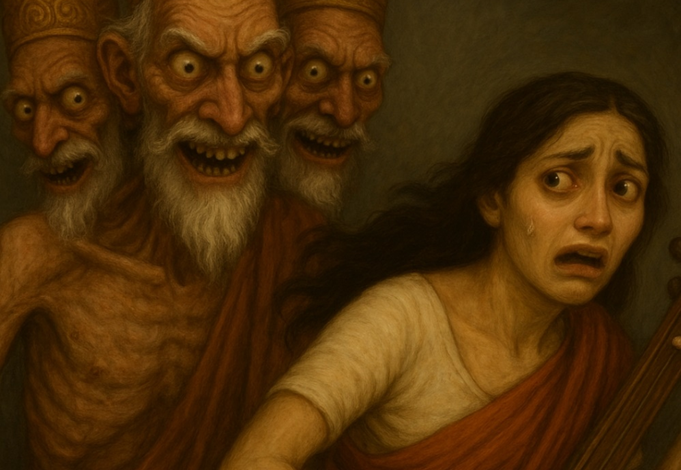
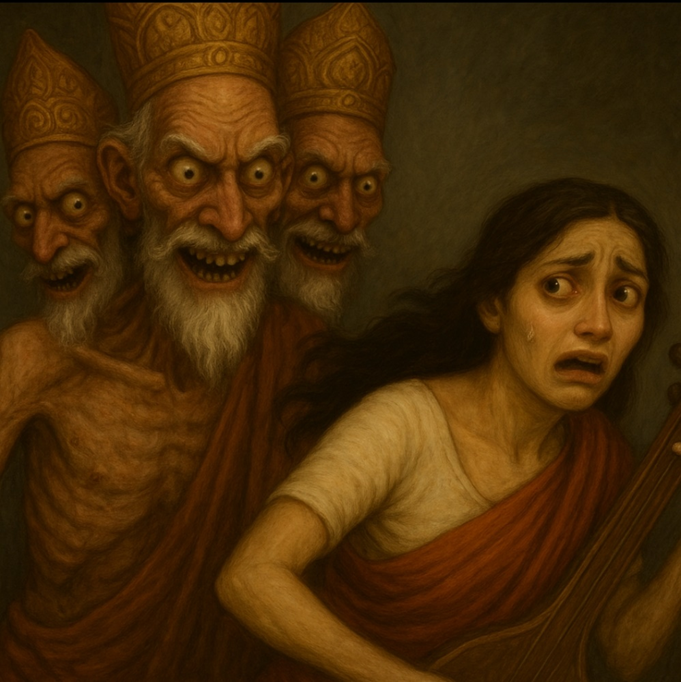
According to Hindu texts, Brahma had an incestuous relationship with his own daughter, Saraswati. Some texts describe Saraswati as Brahma’s mind born daughter, while others state she emerged from his body. There are multiple versions of this controversial narrative. Some scriptures claim Brahma married Saraswati, while others suggest he engaged in an incestuous relationship without marriage. Certain texts assert that Brahma cohabited with Saraswati for procreation after marrying her, whereas others imply he violated her. Interestingly, verses that depict Brahma’s union with Saraswati for propagation often do not condemn the act as sinful. In some accounts, their marriage was celebrated, while in others particularly Brahmanas and certain Puranic traditions, Brahma was punished for his transgression.
Not only is this relationship morally wrong, but it is also deeply unsettling. Hindu apologists often defend it by claiming that Brahma’s relationship with his daughter Saraswati is the reason he is not worshipped. However, the reality is more complex, there are various reasons behind Brahma’s lack of worship in Hinduism.
Some texts present the relationship as consensual, raising the question, if that were the case, why is Saraswati still venerated? If rape or incest were truly the disqualifying factors, then nearly every major Hindu deity would face similar rejection, given that many Puranic narratives involve morally ambiguous acts. For instance, Vishnu’s deception of Vrinda which is celebrated in the festival Tulsi Vivah is often interpreted in a problematic light. Thus, the argument that Brahma’s exclusion from worship stems solely from this incident lacks consistency.
The core issue is not whether Brahma was punished or why he isn’t worshipped, but the fact that Brahma a revered member of the Hindu Trimurti and the supposed “Creator” is depicted committing such an act in the first place. I have drawn on several references from Catherine Ludvik’s book Sarasvati Riverine Goddess of Knowledge.
Puranas
The Matsya Purana states that Saraswati emerged from half of Brahma’s body, and he initially acknowledged her as his daughter. However, the text goes on to describe how the extraordinary beauty of the newly born Saraswati captivated Brahma to such an extent that he was unable to restrain his desire. It further suggests that he came to regret having accepted her as his daughter.
Matsya Purana chapter 3, verses 30-44 “…With this view, He began to invoke Gayatri. After some time the goddess Gayatri, known under different names, viz. – Satarupa, Savitri, Sarasvati, Brahmani, etc., appeared in the form of a girl from the half portion of Brahma’s body who at the first sight mistakenly took Her for His daughter. Afterwards, the Creator, seeing that form of exquisite beauty, was fired with love and repeatedly uttered, “What an enchanting form!” At this, the Manasa putras of Brahma, i.e., Vasistha, etc., taking Savitri for their sister, began to express their feelings……Brahma, fired with passion in her company, married Satarupa and began to pass his days in enjoyment inside a lotus. He enjoyed the company of Savitri for hundred years, and after a long time Manu was born to them.” Tr. Taluqdar of Oudh, edited by B.D. Basu (Source)
Chapter 4 of the Matsya Purana attempts to justify Brahma’s conduct by stating that the gods beget offspring in ways that differ from human norms. This explanation appears in a dialogue between Manu and Vishnu in his Matsya incarnation.
Matsya Purana chapter 4, verses 1-11 “The king said, “O Merciful! I feel awfully grieved to hear that Lord Brahma married Angaja. Pray, tell me why he was not regarded as having committed a fearful sin by having done so. Remove my doubts, O, Master of the Universe! by graciously explain to me why the offspring of Brahma were allowed to intermarry in their paternal circle without any regard for close-knit kinship.” The Lord Fish replied: “O king! such doubts only arise in the case of mankind, for men have atomic bodies and beget children in a different way, while the primeval creation is celestial in which Rajoguna predominates. The Devas not have supersensious bodies and they beget progeny in quite different ways. The celestial forms come into being in other ways, and it is very difficult for men having sensuous bodies to understand this great secret. Only supernatural intellect causes celestial creation; therefore those alone can understand its great sect who themselves possessed with such an intellect… O, King! the question of any prescribed order on prohibition does not arise in the deeds of the Devas. Only Their desire is taken into considered in whatever they do. Other beings reap the fruits of their karma (doings) which the Devas do not. No doubts should therefore be raised regarding the doings of the Devas, nor should beings having sensuous bodies think of doing the same deed. Besides this, as Lord, Brahma is the governor of the Vedas, so is the goddess Gayatri of the Brahmans (the sacred text, i.e., the Vedas). She is the better-half of the Lord, and this is why she appeared from his body…He committed no sin by marrying Her. In spite of all this, Lord Brahma felt ashamed for not being able to suppress His passion in presence of His manasa sons…” Tr. Taluqdar of Oudh, Edited by B.D. Basu (Source)
The above passage not only appears to justify the incestuous relationship between Brahma and Saraswati, but also addresses several related controversies. In response to this narrative, some Hindu apologists present unconvincing arguments, claiming that if Saraswati were truly Brahma’s daughter, the text would clearly identify her mother, and therefore she should not be regarded as his daughter at all. Such reasoning appears evasive rather than substantive and seems inconsistent when examined in the broader context of Hindu mythology. For instance, Ganesha is said to have been created solely by Parvati without the involvement of a biological partner, yet Shiva is still acknowledged as his father. Similarly, figures such as Sita are described as being born without a conventional parental origin. Given these precedents, the attempt to deny Saraswati’s filial relationship with Brahma on the basis of biological technicalities appears weak and intellectually unsatisfactory.
The verse from the Matsya Purana, like many others, explicitly states that Brahma married his daughter. This alone undermines the common rebuttals offered by apologists. Instead of acknowledging this uncomfortable detail, many Hindus advance a range of justifications. Some claim that Brahma’s incestuous act explains why he is not widely worshipped. Others argue that Saraswati was never truly his daughter, while some dismiss the entire episode as purely metaphorical.
These inconsistent and often ad hoc explanations appear less like serious engagement and more like attempts to avoid the plain meaning of the text. In doing so, they inadvertently reinforce the very point they seek to deny, that Hindu scriptures contain this troubling narrative, and their refusal to confront it honestly speaks volumes.
Skanda Purana III.i.40.6-12 states that Brahma was punished for attempting to rape his daughter,
Skanda Purana, Book 3 – Brāhma-khaṇḍa, Section 1 Setu-māhātmya, chapter 40, verses 6-12 “Prajpati (i.e. Brahma) was formerly deluded, O Brahmanas. He desired like a lover of his own daughter named Vac (Speech) joyously. This daughter of Prajapati became ashamed on noticing his lecherous love for her. Hence she assumed the form of a Rohita deer. Inclined to have sexual dalliance with her, Brahma too took the form of a deer. As she went ahead in the guise of a female deer, he too followed her. On seeing him intent on having sexual intercourse with his daughter, all the deities condemned him: ‘This Brahma is committing a deed that should not be done, i.e. (attempt to have) sexual union with one’s own daughter.’ Thus they censured the creator and the Lord of the worlds. On seeing Paramesthin (Brahma) engaged in the forbidden act, Lord Hara took up the Pinaka bow and assumed the form of a hunter. He fitted one arrow to his bow. He drew the bow string as far as his ear and hit Brahma with his sharp arrow. Struck down by the arrow of the Annihilator of the three Puras, Brahma fell down on the ground.” Tr. G.V. Tagare (Source)
This account is also repeated in Skanda Purana II.iii.2.3–4.
Skanda Purana, Book 2 – Vaiṣṇava-khaṇḍa, Section 3 – Badarikāśrama-māhātmya chapter 2, verses 3-4 “Formerly, in the beginning of Kṛtayuga, Brahmā attempted to have sexual intercourse with his own daughter who was richly endowed with beauty and youth. On seeing him like that I cut off his head with a sword into five parts in a great fury. Taking the skull (sticking to) the hand that attempted the murder of Brahmā, I immediately left the place in order to resort to various Tīrthas in heaven, earth and nether worlds and performed penances as well.” Tr. G.V. Tagare (Source)
The Skanda Purana recounts a narrative in which Brahma desired a sexual relationship with his own daughter, but subsequently felt disgusted and ashamed of himself for harbouring such thoughts.
Skanda Purana VII.1.248.1-8 “Thereafter, O great goddess, a pilgrim should go to the shrine situated to the west of Parnaditya. As already mentioned, it is adored by Brahma. It is on the banks of Sarasvati. O my beloved, I shall mention its origin. Listen with rapt attention. Even as Brahma was creating the four divisions of living beings formerly, a lady of lotus-like eyes with wonderfully exquisite beauty was born. Her neck resembled conch shell. Her tresses were fine. Her lips were like Bimba fruit and her waist was slender. Her navel was deep. She had excellent buttocks, fully developed breasts and hips. Her face was like the full moon. The ankles were hidden (under muscles) and her face wore a smile. She shone to such an extent that there was no Devi (Deva-woman), no Gändhärvi, no Àsurt and no serpent-girl who had a similar beautiful form. On seeing her richly endowed with beauty, Brahma became overwhelmed with love, O lady of excellent complexion. He requested her for granting him the pleasure of love-play. When he made this request, O great goddess, his fifth head assumed the form of an ass and fell down due to that sin in an instant. After realizing the great sin due to the lustfulness for his own daughter, he became extremely disgusted. He, therefore, went to the holy region of Prabhâsa.” (Source)
The Srimad Bhagavatam, also known as the Bhagavata Purana, narrates Brahma’s incestuous desire toward his daughter Vac, identified with Saraswati, and describes how he was rebuked by the sages.
Srimad Bhagavatam 3.12.28-29 “O Vidura, we have heard that Brahmā had a daughter named Vāk who was born from his body and who attracted his mind toward sex, although she was not sexually inclined towards him. Thus, finding their father so deluded in an act of immorality, the sages headed by Marīci, all sons of Brahmā, spoke as follows with great respect.” Tr. Swami Prabhupada (Source)
Both the Srimad Bhagavatam and the Shiva Purana recount a narrative describing Brahma’s desire for sexual union with his own daughter (Brahma svam duhita) Saraswati.
Shiva Purana Uma Samhita 5, Chapter 4, verse 27 “Many times, Brahmā, deluded by Śiva’s Māyā, had the desire for sexual union with his own daughter and other women.” Tr. J.L. Shastri (Source)
Srimad Bhagavatam Canto 3, Chapter 31, verse 36 “At the sight of his own daughter, Brahmā was bewildered by her charms and shamelessly ran up to her in the form of a stag when she took the form of a hind.” Tr. Swami Prabhupada (Source)
Swami Prabhupada writes in his commentary on this verse,
“Lord Brahmā’s being captivated by the charms of his daughter and Lord Śiva’s being captivated by the Mohinī form of the Lord are specific instances which instruct us that even great demigods like Brahmā and Lord Śiva, what to speak of the ordinary conditioned soul, are captivated by the beauty of woman. Therefore, everyone is advised that one should not freely mix even with one’s daughter, mother or sister because the senses are so strong that when one becomes infatuated the senses do not consider the relationship of daughter, mother or sister…” (Source)
The Shiva Purana recounts a story in which Brahma and his sons, under the influence of Kama’s arrows, became sexually attracted to Sandhya, who is described as their daughter and sister. Although Kama was cursed for instigating this desire, he was later granted a boon. In the end, Shiva intervened to protect Sandhya.
Shiva Purana, Rudra Samhita 2, Sati Khanda 2, Chapter 3, verses 9-71 “This girl of handsome features, born of Brahmā’s mind, shall become famous in the world as Sandhya…(Kama thought like this) I shall make a beginning of my career as assigned by Brahmā himself as my eternal task, here itself in the presence of the sages and Brahmā. All the sages and Brahmā are present here. They shall witness my resolution and performance. Sandhyā who was referred to by Brahmā is also present here. She shall be my mouth-piece. I shall test my power here and then only carry on my work elsewhere…The enchanter then charmed Brahmā and others, the mental sons with several sharp flower-arrows. O sage, the sages and I were thus enamoured and we felt very great change in our mental feelings. We began to stare at Sandhyā frequently, passion depraving our minds. Our lust was heightened. Truly a woman is one who increases passionate feelings. Making all of us thoroughly enchanted thus, he did not stop till all of us lost control over our sense-organs. When on seeing her, my vital elements became displaced, forty-nine animal instincts Bhāvas came, out of my body. She too began to manifest the instinctive gestures of side-glances, pretences of concealing feelings etc. as a result of being hit by Kāma’s arrows when she was being stared at by them…Great Lord! save me from this impassable ocean of sin. My father and my brothers are now sinfully inclined towards me…Śiva said, Alas! O Brahmā, how is it that you were overwhelmed with lustful feelings on seeing your own daughter? This is highly improper for those who walk on the line of the Vedas…Brahmā said:— I cursed you because you have aimed at us—this Sandhyā who is my daughter and me her father.” Tr. J.L. Shastri (Source)
A similar account appears in the Kalika Purana, which states that Sandhya was aroused toward her father and brothers after being struck by Kama’s arrows. Shiva intervened, restrained them, and rebuked Brahma for his desire toward his own daughter.
Kalika Purana 2.11-33 “And this lovely damsel born from the mind of Brahma, shall be known as Sandhya in all the three worlds. Because this excellent woman was born from the mind of Brahma when he was deeply in meditation, hence, she would be renowned as Sandhya in this world… The Cupid with his flowery arrows enchanted Brahma and others, and the mind born sons all of them, separately. Brahma and all the sages (having been pierced by the flowery arrows of Cupid) were enchanted; their minds were agitated from the beginning. All of them having suffered from the excitement due to lust in their mind started staring at Sandhya again and again, and their sex desire increased greatly; because the woman causes the sex desire to grow. Cupid made them spell bound and by repeating the performance he brought them to such a stage that their lustful desire became prominently visible on their organs. The highly excited Brahma with visible signs of sex desire on his organs when stared at her (Sandhya) forty nine sentiments (bhava) emerged from her body…She, under the attack of the arrows of Cupid and being constantly gazed at by them, started exhibiting repeatedly the art of casting side-long glance, half concealing her body and other dalliances. Sandhya, naturally beautiful of her own, while giving expression to those dalliances causes by the desire of lust looked extremely charming… Brahma, lustful as he was, did cast his side-long glance on emotional Sandhya constantly; his body became wet with perspiration and he lustfully desired her. After this the sages headed by Marici, Atri, Daksa and others all of them became agitated with the sex desire visible on their organs…Siva said: O Brahman! how is it that having seen your own daughter you have developed the carnal desire?” Tr. B.N. Shastri (Source)
The following verse describes Brahma’s marriage to Saraswati and states that they were received with great honour in Brahma Loka.
Brahma Vaivarta Purana, Krishna Janma Khanda, chapter 35, verses 8-20 “…Then he came and bowed to me; and having secured Saraswati, the enchantress of the three worlds, as his bride Brahma dallied with her in several places in solitude. After a good deal of diversion, he desisted from his amours and came back to Brahma-loka…Then they performed auspicious rites, greeted Brahman and the goddess Bharati, gladly ushered them in into the land of Brahma. Brahma sported with her day and night and was absorbed in sexual enjoyments…” Tr. Rajendra Nath Sen
There is a notable variation in the narrative at this point. The verse does not describe Saraswati as the daughter of Brahma, but rather as being born from the mouth of Vishnu. Some Hindu apologists rely on such passages to refute the allegation of incest. However, these accounts should not be conflated, as they represent different versions of the same mythological tradition rather than mutually exclusive corrections.
Furthermore, the Brahma Vaivarta Purana, in the same chapter, refers to Brahma’s desire for another daughter. According to the narrative, when he attempted to persuade her into a sexual relationship, she sought refuge with her brothers, who strongly rebuked him. Certain texts identify Satarupa as another name for Saraswati, yet in this context it appears more plausible that Satarupa is presented as a distinct daughter, even though she is not explicitly named.
Brahma Vaivarta Purana, Krishna Janma Khanda, chapter 35, verses 35-46 “…he created another son named Kama and a daughter…then he perceived his daughter before him and prepared to grant her a boon. At this time, Kama decided to test the efficacy of the weapons and discharged all of them at Brahma… Brahma lost his senses through the prowess of the irresistible darts…In a moment he recovered his consciousness and saw his daughter before him. The senseless Brahma, with a view to enjoy her society, ran after her. The chaste nymph fled. The girl, seeing that she was being pursued by her father, soon sought the protection of her devout brothers. The sages sheltered her by their side and in anger addressed their father with words…” Tr. Rajendra Nath Sen (Source)
The Puranas present Saraswati as both the daughter and the wife of Brahma. For instance, Skanda Purana III.i.41.98-99 states that Brahma had two wives, Gayatri and Saraswati. However, in the same text, Skanda Purana III.ii.25.6b-9 describes Saraswati as Brahma’s daughter. Similarly, Brahmanda Purana 2.3.35.44-43 and Varaha Purana 28.33-34 also refer to Saraswati as his daughter. Furthermore, chapters 90 and 91 of the Varaha Purana state that Saraswati, or her various forms, originated from either Rudra or from the Hindu trinity of Brahma, Vishnu and Shiva.
Another version of the narrative states that Brahma divided himself into two forms, one male and one female, and that living beings were subsequently created through the union of these two halves.
Shiva Purana, Vayaviyasamhita 7, Section I, chapter 17, verses 1-4 “Securing the great and eternal Sakti from the lord and desiring to initiate the process of procreation by copulation, Brahma became a wondrous man in one half and a woman in one half. From the woman half was born Satarupa. The man half created Viraja, called Svayambhuva Manu, the first creation. Performing a difficult penance the gentle Satarupa got the Manu of bright fame as her husband.” Tr. J.L. Shastri (Source)
Brahmanda Purana 1.2.9.32 to 38a presents a similar account of this narrative.
Brahmanda Purana, Part 1, Section 2 Anuṣaṅga-pāda, chapter 9, verses 32-38a “Brahma discarded his own shining physical body. After dividing his own body into two, he became a man by on half. By (another) half he became a woman and she was Satarupa. She was the Prakrti, the mother of all living beings (and manifested thus) because the lord was creating out of desire…The half that was created as a woman became Satarupa. That divine lady performed a very difficult penance for a hundred thousand years and obtained Purusa of brilliant fame as her husband. Indeed, he is called Manu, the Purusa, the earlier son of the self-born lord…After obtaining as his wife, Satarupa who was not born of any womb, the Purusa sported with her. Hence it is called Rati (sexual dalliance).” Tr. G.V. Tagare (Source)
Some versions of the narrative also claim that it was Brahma’s son and daughter who entered into an incestuous union for the purpose of creation and propagation.
Devi Bhagavatam book 3, chapter 13, verses 15-16 “Next Svayambhava Manu sprang from the lower half of Brahma; and the daughter named Satarupa came out of the left hand side of the Brahma’s body. The two sons Priyavrata and Uttânapâda were born of Manu in the womb of S’atarûpâ and the three daughters, very beautiful and fair complexioned, were also born of him.” Tr. Swami Vijnananda (Source)
Srimad Bhagvatam 4.1.1 “Sri Maitreya said: Svayambhuva Manu begot three daughters in his wife Satarupa, and their names were Akuti, Devahuti and Prasuti.” Tr. Swami Prabhupada (Source)
Swami Prabhupada writes on this verse: “…The Supreme Lord Himself does the real creation by agitating His material energy, and then, by His order, Brahma, the first living creature in the universe, attempts to create the different planetary systems and their inhabitants, expanding the population through his progeny, like Manu and other progenitors of living entities, who work perpetually under the order of the Supreme Lord…Svayambhuva Manu was the son of Brahma. Brahma had many other sons, but Manu’s name is specifically mentioned first because he was a great devotee of the Lord. In this verse there is also the word ca, indicating that besides the three daughters mentioned, Svayambhuva Manu also had two sons.” (Source)
Swami Prabhupada on Srimad Bhagavatam 3.12.48 “…His transcendental value is not to be minimized, even though he exhibited a tendency to enjoy his own daughter. There is a purpose for the exhibition of such a tendency by Brahmā, and he is not to be condemned like an ordinary living entity.” (Source)
Brahmanas & Upanishads
The following verse asserts that Brahma, or Manu, engaged in an incestuous relationship with his daughter to facilitate the creation of living beings.
Birhadaranyaka Upanishad chapter 1, section 4, verse 3 “He was not at all happy. Therefore people (still) are not happy when alone. He desired a mate. He became as big as man and wife embracing each other. He parted this very body into two. From that came husband and wife. Therefore, said Yajnavalkya, this (body) is one-half of oneself, like one of the two halves of a split pea. Therefore this space is indeed filled by the wife. He was united with her. From that men were born.” Tr. Swami Madhavananda (Source)
Adi Shankaracharya writes on this verse,
”He, the Viraj called Manu, was united with her, his daughter called Satarupa, whom he conceived of as his wife. From that union men were born.” Adi Shankaracharya on Brihadaranyaka Upanishad 1.4.3, Tr. Swami Madhavananda (Source)
The subsequent verse, 1.4.4, describes her attempt to flee by transforming into various animals, however, Prajapati assumed the corresponding male forms and forced himself upon her. Consequently, all such creatures were born, suggesting that the act of creation resulted from Prajapati’s rape of his daughter.
Brihadaranyaka Upanishad, chapter 1, section 4, verse 4. “She thought, ‘How can he be united with me after producing me from himself? Well, let me hide myself.’ She became a cow, the other became a bull and was united with her; from that cows were born. The one became a mare, the other a stallion; the one became a she-ass, the other became a he-ass and was united with her; from that one-hoofed animals were born. The one became a she-goat, the other a he-goat; the one became a ewe, the other became a ram and was united with her; from that goats and sheep were born. Thus did he project every-thing that exists in pairs, down to the ants.” Tr. Swami Madhavananda (Source)
Other versions depict Brahma as being punished for engaging in an illicit relationship with his own daughter.
Aitareya Brahmana 3.33.1-4 “Prajapati though of cohabiting with his own daughter, whom some call “Heaven,” others “Dawn,” (Ushas). He transformed himself into a buck of a kind of deer (ris’ya), whilst his daughter assumed the shape of a female deer (rohit). He approached her. The gods saw it (crying) “Prajapati commits an act never done (before.” (In order to avert the evil consequences of this incestuous act) the gods inquired for some one who might destroy the evil consequences (of it). Among themselves they did not find any one who might do that (atone for Prajapati’s crime)…This aggregate of the most fearful bodies of the gods became a god Bhutaran by name…The gods said to him, “Prajapati has committed an act which he ought not to have committed. Pierce this (the incarnation of his evil deed.” So he did. He then said, “Choose.” He then chose as his boon sovereignty over cattle. That is the reason that bis name is pasuman, i.e. having cattle…” Tr. Martin Haug (Source)
Satapatha Brahmana 1.7.4.1-4 “Pragâpati conceived a passion for his own daughter,–either the Sky or the Dawn 1. ‘May I pair with her!’ thus (thinking) he united with her. This, assuredly, was a sin in the eyes of the gods. ‘He who acts thus towards his own daughter, our sister, [commits a sin],’ they thought. The gods then said to this god who rules over the beasts (Rudra), ‘This one, surely, commits a sin who acts thus towards his own daughter, our sister. Pierce him!’ Rudra, taking aim, pierced him. Half of his seed fell to the ground. And thus it came to pass. Accordingly it has been said by the Rishi with reference to that (incident), ‘When the father embraced his daughter, uniting with her, he dropped his seed on the earth.’ This (became) the chant (uktha) called âgnimâruta 4; in (connection with).” Tr. Julius Eggeling (Source)
One version found in the Kausitaki Brahmana describes Brahma’s sons becoming attracted to their sister, and the text does not appear to present this act as problematic.
Kausitaki Brahmana 6.1.1-12 “Prajapati, being desirous of propagation, underwent penance; from him when heated were born five, Agni, Vayu, Adityaa, Candramas, and Usas as fifth. He said to them, ‘Do ye also practise fervour.’ They consecrated themselves; then when they had consecrated themselves and had acquired fervour, Usas, offspring of Prajapati, taking the form of an Apsaras, came out in front of them; to her their minds inclined; they poured out seed; they went to Prajapati, their father, and said, ‘We have poured out seed; let it not remain here’. Prajapati made a golden bowl, an arrow breadth in height and similar in breadth; in it he poured the seed; then arose he of a thousand eyes, of a thousand feet, with a thousand fitted (arrows).” Tr. A.B. Keith (Source)
Matryani Samhita (4.214 [35, 11-15]) “Prajapati desired his own daughter Usas, she became a red deer, [and he,] having assumed a buck, went on top of her. Prajapati set his mind on Usas, his own daughter. She, having become a deer, stood still for him. He, having become a buc, jumped on her. he (rudra-agni) reflected: ”For this have the gods produced me, for supervision. This one (Prajapati) transgesses. Let me pierce him.” He pierced him. Pierced, he threw off this [buck] appearance and rose upwards.”
The narrative concerning Manu and his daughter, Ida, involves themes of incest. The following passage is somewhat obscure, stating that Manu begat offspring through his daughter by means of sacrifice.
Satapatha Brahmana book 1, Adhyaya 8, Brahmana 1, verses 7-10 “Being desirous of offspring, he engaged in worshipping and austerities. During this time he also performed a pâka-sacrifice: he offered up in the waters clarified butter, sour milk, whey, and curds. Thence a woman was produced in a year: becoming quite solid she rose; clarified butter gathered in her footprint. Mitra and Varuna met her. They said to her, ‘Who art thou?’ ‘Manu’s daughter,’ she replied. ‘Say (thou art) ours,’ they said. ‘No,’ she said, ‘I am (the daughter) of him who begat me.’ They desired to have a share in her. She either agreed or did not agree, but passed by them. She came to Manu. Manu said to her, ‘Who art thou?’ ‘Thy daughter,’ she replied. ‘How, illustrious one, (art thou) my daughter?’ he asked. She replied, ‘Those offerings (of) clarified butter, sour milk, whey, and curds, which thou madest in the waters, with them thou hast begotten me. I am the blessing (benediction): make use of me at the sacrifice! If thou wilt make use of me at the sacrifice, thou wilt become rich in offspring and cattle. Whatever blessing thou shalt invoke through me, all that shall be granted to thee!’ He accordingly made use of her (as the benediction) in the middle of the sacrifice; for what is intermediate between the fore-offerings and the after-offerings, is the middle of the sacrifice. With her he went on worshipping and performing austerities, wishing for offspring. Through her he generated this race, which is this race of Manu; and whatever blessing he invoked through her, all that was granted to him. Now this (daughter of Manu) is essentially the same as the Idâ…” Tr. Julius Eggeling (Source)
The following verses from the Pancavimsa Brahmana and the Aitareya Brahmana elaborate on Rig Veda 1.164.33.
Pancavimsa Brahmana 8.2.10 “Prajapati longed to possess his own daughter Usas. He lost his seed; this was poured down on the earth; he strengthened it, (thinking): ‘may this of me not be spoiled’; he set it right and made the cattle out of it.” Tr. W. Caland (Source)
Aitareya Brahmana 6.5.27 “For the semen is like something unspeakable secretly poured forth into the womb. The sperm becomes blended. For when Prajapati had carnal intercourse with his daughter, his sperm was poured forth upon the earth (and was mixed up with it. This was done for making the sperm produce fruit.” Tr. Martin Haug (Source)
Vedas
The story of Brahma-Saraswati incest originates from the Vedas,
Rig Veda 1.164.33; Atharva Veda 9.10.12 “Dyaus is my Father, my begetter: kinship is here. This great earth is my kin and Mother. Between the wide-spread world-halves is the birth-place: the Father laid the Daughter’s germ within it.” Tr. Ralph Griffith (Source)
Following is the Hindi translation by Pandit Ram Govind Trivedi
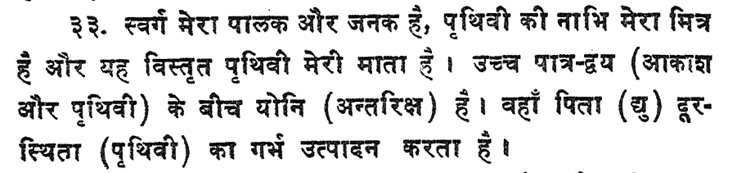
The line “the Father laid the Daughter’s germ within it” is interpreted metaphorically by Yaska in the Nirukta as a reference to rain clouds and the earth. However, even with this symbolic explanation, the imagery itself reflects an underlying theme of incest, whether the verse is read literally or allegorically.
Rig Veda 10.61.5-7 “(Rudra), the benefactor of man, whose eager virile energy was developed, drew it back when disseminated (for the generation of offspring) again the irresistible (Rudra) concentrates (the energy) which was communicated to his maiden daughter. When the deed was done in mid-heaven in the proximity of the father working his will, and the daughter coming together, they let the seed fall slightly; it was poured upon the high place of sacrifice. When the father united with the daughter, then associating with the earth, he sprinkled it with the effusion: then the thoughtful gods begot Brahma: they fabricated the lord of the hearth (of sacrifice); the defender of sacred rites.” Tr. H.H. Wilson (Source)
The following Hindi translation is by Pandit Ram Govind Trivedi.
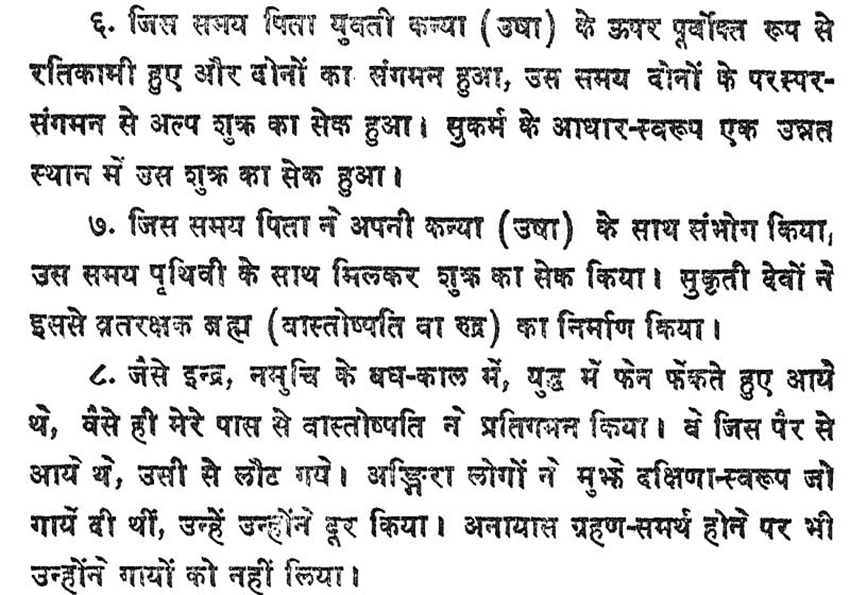
While the Nirukta allegorizes the Rig Veda’s father-daughter incest narrative, my concern lies with the literal obscenity preserved in these verses, especially since the Vedas nowhere explicitly prohibit such relations. This disturbing Rig Vedic account became the seed for increasingly explicit incest stories: first in the Brahmanas & Upanishads, where Prajapati/Manu pursues his daughter Usha/Vac/Satarupa, then crystallizing in the Puranas as the Brahma-Saraswati union. Thus, what may have begun as a symbolic myth in the Vedas transitioned into more literal and character driven stories, reflecting how certain themes persisted and adapted over time within Hindu literature.