Written by Sulaiman Razvi
Gambling is a vice that leads to the loss of wealth, destroys families, and gives rise to many other social evils. It encourages dependence on luck rather than hard work, as people turn to it as a shortcut to gain riches. Yet this practice has found sanction within Hindu tradition. When Hinduism and gambling are mentioned together, the first image that often comes to mind is the Mahabharata episode in which Shakuni casts the dice. However, gambling in India predates the Mahabharata, and references to it can be found even in the Vedas.
The Agni Purana, in Chapter 91, describes a superstitious ritual involving the preparation of a gambling board and the casting of dice to foretell the future. Moreover, it was not only money, property, cows, or horses that were wagered in such games, but even human beings, especially wives. Some examples include the staking of Draupadi by the Pandavas and the episode involving Urvashi and Indra. Gambling is therefore not an unfamiliar or marginal practice in Hindu society. Even today, many Hindus spend the night of Diwali engaged in various forms of gambling, reflecting the continuity of this tradition.
Dr. B.R. Ambedkar writes in his book Riddles in Hinduism, “The Aryans were a race of gamblers. Gambling was developed to science in very early days of the Aryan Civilization so much so that they had even devised certain technical terms. The Hindus used the words Krita, Treta, Dwapara and Kali as the names of the four Yugas or periods into which historical times are divided. As a matter of fact originally these are the names of the dices used by the Aryans at gambling. The luckiest dice was called Krita and the unluckiest was called Kali. Treta and Dwapara were intermediate between them. Not only was gambling well developed among the ancient Aryans but the stakes were very high. Gambling with high money stakes have been known elsewhere. But they are nothing as compared with those which are known to have been offered by the Aryans. Kingdoms and even their wives were offered by them as stakes at gambling. King Nala staked his kingdom and lost it. The Pandavas went much beyond. They not only staked their kingdom they also staked their wife Draupadi and lost both. Among the Aryans gambling was not the game of the rich. It was a vice of the many. So widespread was gambling among the Ancient Aryans that the burden of all the writers of the Dharma Sutras (Shastras?) was to impress upon the King the urgency of controlling it by State Authorities under stringent laws”.
Dr. Ambedkar further writes, “Coming to Kali it is one of the cycles made up of four Yugas: Krita, Treta, Dwapar and Kali. What is the origin of the term Kali? The terms Krita, Treta, Dwapar and Kali are known to have been used in the three different connections. The earliest use of the term Kali as well as of other terms is connected with the game of dice. From the Rig-Veda it appears that the dice piece that was used in the game was made of the brown fruit of the Vibhidaka tree being about the size of a nutmeg, nearly round with five slightly flattened sides. Later on the dice was made of four sides instead of five. Each side was marked with different numerals 4, 3, 2 and 1. The side marked with 4 was called Krita, with 3 Treta, with 2 Dwapara and with 1 Kali.”
As Dr. Ambedkar observed, the four Yugas are said to derive their names from throws of dice. The dice were four sided, with the side marked four called Krita, three Treta, two Dwapara, and one Kali. According to Chandogya Upanishad 4.1.4, the highest or winning throw was known as Krita, which is also another name for Satya Yuga, while the lowest throw was called Kali. The game of Chaupar was among the most popular forms of gambling.
The Sanskrit word Aksha, also spelled Aksa, is commonly used in Hindu texts to refer to dice. In the Vedic period, dice were also called Babhru, meaning brown, because they were made from the nuts of the Vibhidaka tree. Later, cowries were used, and oblong stick shaped dice known as Pasa became more common. Rig Veda 1.41.9 indicates that four dice were used in play, while Satapatha Brahmana 5.4.4.6 mentions the use of five dice during the Rajasuya ceremony. Gambling appears to have been a form of amusement particularly associated with the Kshatriya class. Matsya Purana 61.32–33 states that King Nimi played dice with women, and Markandeya Purana 20.1 to 5 refers to King Satrujit, who enjoyed himself both in gambling and in the practice of various weapons.
One of the Vedic Rishis, Kavasa Ailusa, is described as being addicted to gambling in the Aitareya Brahmana 2.19 and the Kausitaki Brahmana 12.3, indicating that the practice was not merely theoretical but socially embedded.
According to Gaudiya Vaishnavite (ISKCON) texts, Kalidasa is said to have played dice in jest.
CC Antya Lila 16.6-7 “Kālidāsa was a very advanced devotee, yet he was simple and liberal. He would chant the holy name of Kṛṣṇa while performing all his ordinary dealings. When he used to throw dice in jest, he would chant Hare Kṛṣṇa while throwing the dice.” (Source)
In Kalki Purana 33.23, the Kalki avatar is described as holding a conch, dice, club, lotus, and bow in his hands. These figures are not the only religious personalities in Hinduism associated with gambling. Several other gods are also depicted as enjoying gambling, and some are even described as being addicted to it.
Gods Playing Game of Dice
Shiva & Parvati
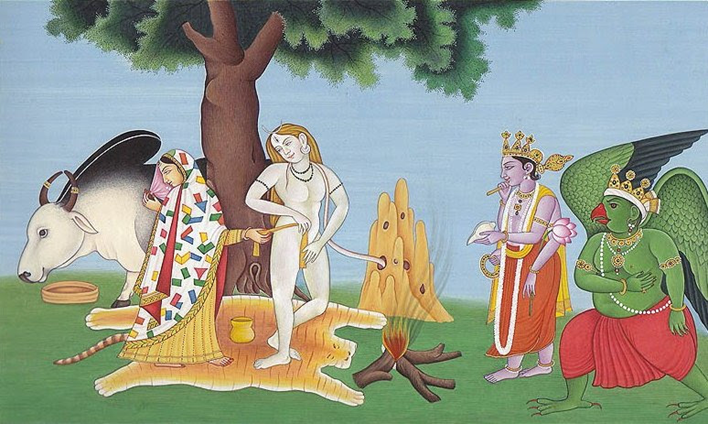
Have you ever wondered why Hindus gamble during the festival of Diwali? To understand this, one must turn to traditional texts. It is said that the practice began with Shiva and his wife Parvati. Before the game started, Parvati invoked Lakshmi, who is believed to have helped her win. Shiva, on the other hand, lost everything he possessed, and the final stake required him to remove his clothes. Having lost the last bet as well, he was left denuded. Following this, Parvati declared that gambling on this Pratipada is auspicious, and that those who gamble on this day would prosper and accumulate wealth throughout the year.
Skanda Purana Book II, Section IV, Chapter 10, verse 20 “Sankara and Bhavani played the game of dice by way of fun formerly. Sambhu was defeated by Gauri in the game and let off naked. For that reason Sankara became miserable while Gauri was ever happy.” Tr. G.V. Tagare (Source)
Parvati also stated that gambling is permitted only on the eve of Diwali. The story of Shiva and Parvati playing dice is similarly mentioned in Skanda Purana I.i.34.66-69 and Padma Purana VI.122.21–32, as cited below.
Padma Purana Section VI, Chapter 122, verses 21-32 “…Siva and Bhavani took to playing with dice as a sport. Laksmi, propitiated by Bhavani remained in the form of a cow. Formerly Parvati vanquished Siva in the game of dice, and sent him away naked. So this Siva is unhappy. Gauri always remains happy. He who gets victory first (passes) the year happily…On the first day, when the sun has risen, Govardhana should be worshipped in the morning and one should play the game of dice at night. Then cows should be decorated…” Tr. N.A. Deshpande (Source)
Skanda Purana 1.1.34.66-69 “On hearing those words, Satī (chaste lady) Girijā laughingly spoke to him: “You know everything, O Baṭu. See, I shall play the game of dice today with Maheśa in front of you.” After saying thus, the daughter of the Lord of Mountains, the most beautiful lady in the world, took up the dice cubes. Even as the great sage stood witness, she stayed there and played the game with Bhava. The couple earnestly engaged in the game were observed by the sage Nārada. With his mind (pleasantly) influenced by surprise, the learned sage went on observing (the game) and he was extremely gratified. The chaste goddess engrossed in the game of dice was surrounded by her friends and attendants. She clashed with Śiva and played the game of dice fraudulently.” Tr. G.V. Tagare (Source)
Krishna
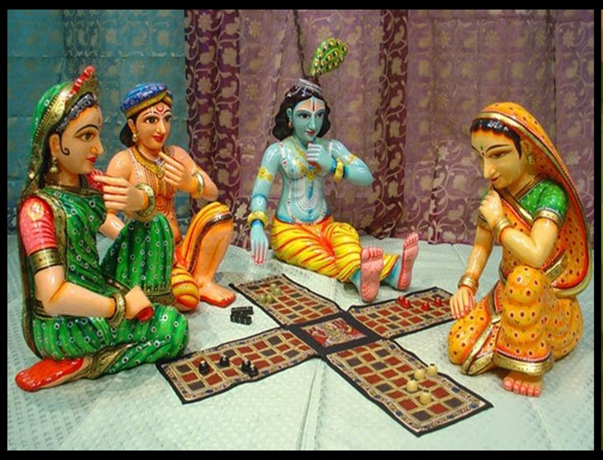
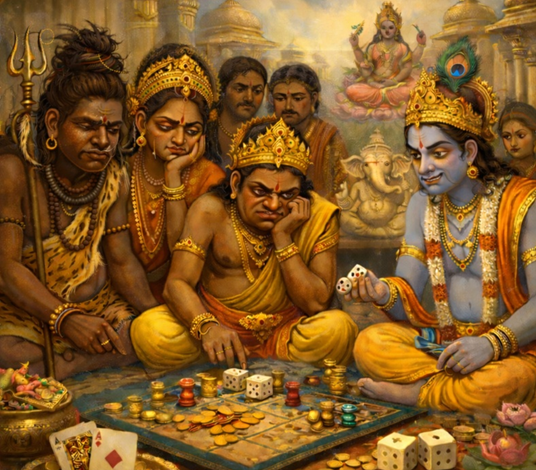
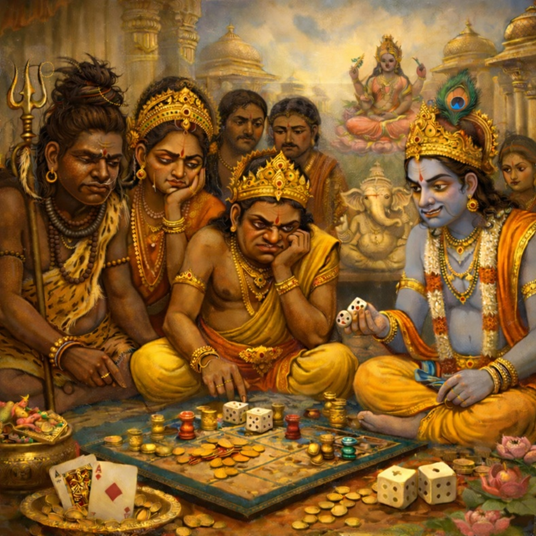
The episode of Draupadi’s Cheerharan naturally raises the question of why Krishna did not intervene, or why he did not prevent the Pandavas and Kauravas from gambling in the first place. Interestingly, certain texts suggest that Krishna was not merely fond of women or indulgent in liquor, but was also portrayed as being addicted to gambling. He is said to have gambled with his wives, concubines, and friends, which complicates the perception of his role as a moral guide in these narratives.
Srimad Bhagavatam 10.69.19-22 “Nārada then entered the palace of another of Lord Kṛṣṇa’s wives, my dear King. He was eager to witness the spiritual potency possessed by the master of all masters of mystic power. There he saw the Lord playing at dice with His beloved consort and His friend Uddhava.” Tr. Swami Prabhupada (Source)
Srimad Bhagavatam 10.56.5 “As the people looked at Satrājit from a distance, his brilliance blinded them. They presumed he was the sun-god, Sūrya, and went to tell Lord Kṛṣṇa, who was at that time playing at dice.” Tr. Swami Prabhupada (Source)
Srimad Bhagavatam 10.66.36 “Distraught with fear, the people cried out to the Supreme Personality of Godhead, who was then playing at dice in the royal court: “Save us! Save us, O Lord of the three worlds, from this fire burning up the city!”.” Tr. Swami Prabhupada (Source)
Varaha Purana 160.52-53 “At Uttarakoti (the northern end), there is again Ganesa. Here Lord Krsna was playing dice with the Gopis. Merrily playing with them, the Lord won all of them and their wealth in the game. He gave them all to the Gopas who commemorated the event there.” Tr. Venkitasubramonia Iyer (Source)
Aniruddha, the son of Krishna, is also described in the texts as being fond of gambling.
Srimad Bhagavatam 10.62.28-31 “Very agitated to hear of his daughter’s corruption, Bāṇāsura rushed at once to the maidens’ quarters. There he saw the pride of the Yadus, Aniruddha. Bāṇāsura saw before him Cupid’s own son, possessed of unrivaled beauty, with dark-blue complexion… As He sat opposite His most auspicious lover, playing with her at dice, there hung between His arms a garland of spring jasmines that had been smeared with kuṅkuma powder from her breasts when He had embraced her. Bāṇāsura was astonished to see all this. Seeing Bāṇāsura enter with many armed guards, Aniruddha raised His iron club and stood resolute, ready to strike anyone who attacked Him.” Tr. Swami Prabhupada (Source)
Balrama
Balarama, sometimes regarded as an avatar of Vishnu, is also depicted in Hindu texts as being addicted to gambling. He is said to have played dice with Rukmi, the brother-in-law of Krishna. According to the narrative, Rukmi sought to avenge the elopement of his sister Rukmini by Krishna and challenged Balarama to a game of dice. Although Balarama was not particularly skilled, he accepted the challenge without hesitation. He lost several early bets but ultimately won the final, high-stakes game. A dispute then arose, with Rukmi accusing Balarama of cheating and claiming that he was the true winner. Unable to tolerate this insult, Balarama killed Rukmi over the petty argument, highlighting the extreme consequences of gambling and the volatility of the characters involved.
Srimad Bhagavatam 10.61.27-28 “After the wedding, a group of arrogant kings headed by the King of Kaliṅga told Rukmī, “You should defeat Balarāma at dice. He’s not expert at dice, O King, but still He’s quite addicted to it.” Thus advised, Rukmī challenged Balarāma and began a gambling match with Him. In that match Lord Balarāma first accepted a wager of one hundred coins, then one thousand, then ten thousand. Rukmī won this first round, and the King of Kaliṅga laughed loudly at Lord Balarāma, showing all his teeth. Lord Balarāma could not tolerate this. Next Rukmī accepted a bet of one hundred thousand coins, which Lord Balarāma won. But Rukmī tried to cheat, declaring “I’m the winner!”.” Tr. Swami Prabhupada (Source)
The same episode is recounted in Brahma Purana 92.11–22 and is also mentioned in the Vishnu Purana, reinforcing the narrative of Balarama’s gambling, the dispute with Rukmi, and the violent outcome.
Brahma Purana 92.11-22 “Balarāma is not perfectly conversant with the game of dice; his indulgence in it is however, very great. Hence, O extremely lustrous one, we shall conquer him in the game of dice alone. “So be it” said Rukmin who possessed great strength, to those kings. He played the game of dice with Rāma, in the assembly. A stake of a thousand Niṣkas (gold coins) was won by Rukmin from Bala. On the second day another thousand was won by Rukmin. Then Rukmin the most excellent one among those who were conversant with the game of dice, put up a stake of ten thousand gold coins againts Baladeva who was desirous of victory. Then, O brahmins, exhibiting all his teeth, the foolish overlord of Kaliṅga laughed at Bala. The haughty Rukmin spoke then: O members of the assembly, this Balarāma devoid of learning has been defeated by me in the game of dice. He is not conversant with either the manner of fighting or the lore of the game. On seeing the king of Kaliṅga with the teeth in his mouth fully exhibited, and Rukmin indulging in harsh words, Balarāma became infuriated. With his mind full of fury Balarāma put up the stake at a crore of gold coins. Rukmin too accepted it. He threw the dice for that purpose. Baladeva won the stake. He said to him loudly “This is won by me”. “The victory is mine” loudly proclaimed Rukmin to Bala in false words. “It is true that this stake was announced by you. But it had not been accepted or approved of by me. That being the case if (you say) you have won how (can’t I say that) I have won? Then loud resonant words rose up in the sky aggravating the fury of noble Baladeva. The speech in the firmament said: “The stake is won by Baladeva. What is uttered by Rukmin is false. Certain things are accepted through actions even without mentioning words.” Tr. G.P. Bhatt (Source)
Vishnu Purana 5.28.10-28 “After the wedding had been solemnized, several of the kings, headed by him of Kalinga, said to Rukmin, “This wielder of the ploughshare is ignorant of the dice, which may be converted into his misfortune: why may we not contend with him, and beat him, in play?” The potent Rukmin replied to them, and said, “So let it be:” and he engaged Balaráma at a game of dice in the palace. Balaráma soon lost to Rukmin a thousand Nishkas: he then staked and lost another thousand; and then pledged ten thousand, which Rukmin, who was well skilled in gambling, also won. At this the king of Kalinga laughed aloud, and the weak and exulting Rukmin grinned, and said, “Baladeva is losing, for he knows nothing of the game; although, blinded by a vain passion for play, he thinks he understands the dice.” Halayudha, galled by the broad laughter of the Kalinga prince, and the contemptuous speech of Rukmin, was exceedingly angry, and, overcome with passion, increased his stake to ten millions of Nishkas. Rukmin accepted the challenge, and therefore threw the dice. Baladeva won, and cried aloud, “The stake is mine.” But Rukmin called out as loudly, that he was the winner. “Tell no lies, Bala,” said he: “the stake is yours; that is true; but I did not agree to it: although this be won by you, yet still I am the winner.” A deep voice was then heard in the sky, inflaming still more the anger of the high-spirited Baladeva, saying, “Bala has rightly won the whole sum, and Rukmin speaks falsely: although he did not accept the pledge in words, he did so by his acts (having cast the dice).” Balaráma thus excited, his eyes red with rage, started up, and struck Rukmin with the board on which the game was played, and killed him… When Krishńa heard that Rukmin had been killed by his brother, he made no remark, being afraid of Rukminí on the one hand, and of Bala on the other…” Tr. H.H. Wilson (Source)
Indra
Indra, the king of the gods, is said to have staked the celestial nymph Urvashi in a game of gambling against Pramati.
Brahma Purana, Gautami Mahatmya 101.9-12 “Indra said to Pramati: ‘In the same manner, give as requital your virtuous right hand along with its protecting cover as well as arrows. We shall gamble.’ After entering into an agreement like this both of them began to play at dice. Pramati won the stake, viz., Urvasi, the divine damsel. After winning her Pramati said to Indra audaciously. Pramati said: (Offer) something else as requital. I shall then, O lord, play at dice with you. Indra said: O king, (I offer as stake) the thunderbolt worthy of Devas and the excellent chariot famous for having been used in various campaigns.” Tr. G.P. Bhatt, edited by J.L. Shastri (Source)
Hindu Scriptures on Gambling
Certain Hindu legal texts not only permit gambling but also regulate and institutionalise it. They describe the establishment of licensed gambling houses that are subject to state control and taxation. The winner is required to allocate a portion of his gains to the king, thereby integrating gambling into the fiscal system. These establishments are overseen by a superintendent responsible for supervising the games and maintaining order.
In the event of a dispute between players, the matter is to be resolved either by the superintendent or by other gamblers present. However, if those individuals are partial or hostile to either party, the dispute must be adjudicated by the king. Some texts further state that gamblers must obtain permission from the ruler before engaging in such activities, and those who gamble without official authorisation are subject to punishment. Strict regulations are also outlined, with severe penalties imposed on those who cheat, including, in some cases, expulsion from the kingdom.
Manu was a critic of gambling. However, other lawgivers such as Yajnavalkya, Vasistha, Narada, and Kautilya, along with commentators like Vijnaneswara and Haradatta, not only permitted gambling but even allowed gambling houses to operate under state supervision. The Puranas generally appear unfavourable toward gambling, yet they also prescribe certain rituals and spells intended to ensure success in it. A similar tension is visible in the Vedas. The Rig Veda seems to censure gambling, while the Atharva Veda contains hymns seeking victory in gambling. This contrast suggests that while the early Aryans of the Rigvedic period may have been critical of gambling, a greater acceptance or even enthusiasm for it developed during the Atharvavedic period.
Swami Prabhupada, the founder of ISKCON, implied in his commentary that gambling is permissible for Kshatriyas,
“A kṣatriya is not supposed to refuse to battle or gamble when he is so invited by some rival party…” Swami Prabhupada on Gita 1.37-38 (Source)
Yajnavalkya Smriti Chapter II, Verses 199-203 “The keeper of a gambling-house shall take from a gambler five per cent. When the wager is a hundred [panas or upwards], and ten per cent, in other cases. Being well protected [by the king], he shall give the promised share [of his gains] to the king; he shall recover the wager, and pay it to the winner, [and] being over patient, [shall speak] the truth. [Payment of] that which has been won publicly in an assembly of gamesters in the presence of the master of a gaming house, and when the king’s share has been paid, shall be enforced, but not otherwise. The superintendents and witnesses in [gaming] transactions [should be] gamblers themselves. A man who plays with false dice, or by deceit, shall be branded and banished by the king. Gaming should be allowed under one supervision, as being a means of detecting thieves. This very law should be understood to apply in the case of Samahvaya [prize-fighting].” Tr. Vishwanath Narayan Mandlik (Source)
Vijnanesvara, in his Mitakshara, provides commentary on the above verses, “The officer of the gambling house, for whom provision has thus been made-he being protected from rogues and gamesters by the king-shall pay to the king a portion as agreed upon. Similarly, he should recover the amount of the wager i.e., should recover it from the losing party, by accepting a pledge or by arrest etc. And having recovered that amount, he, the keeper, should pay it to the winner i.e., the successful party. Also, being (ever) patient, he should always declare a true decision to the gamblers. That has been stated by Narada: ‘The master of the gaming house shall arrange the game, and pay the stakes won therein’.” Tr. J.R. Gharpure (Source)
Nilkantha Bhatta discusses gambling in his Vyavahara Mayukha, a traditional legal text outlining laws and regulations for Hindus.
Vyavahara Mayukhi XXI.1 “Yājñavalkya [ch. ii., v. 201]:— “[Payment of] that which has been won publicly in an assembly of gamesters in the presence of the master of a gaming house, and when the king’s share has been paid, shall be enforced, but not otherwise.” Prasiddhé [means] not in secret. Dhúrta-maṇḍale [means] in a gaming house. Sabhikah [means] a superintendent of gambling appointed by the king. The meaning is that the king should cause to be paid whatever was won under the [just mentioned] circumstances, and nothing else. The same (author) lays down the punishment for one guilty of fraud in gambling [ch. ii., v. 202] :— “A man who plays with false dice or by deceit, shall be branded and banished by the king.” Upadhih [means] fraud. Manu declares the punishment for gambling without permission from the king [ch. ix., v. 224]:— “The king should punish all those who [themselves] gamble or cause [others] to gamble whether with inanimate or animate things, and the Śūdras who adopt the marks of the twice-born.” Dvijalingam (the marks of the twice-born) is [wearing] the sacred thread, reading the Vedas, or the like. Yājñavalkya thus declares the law of gambling (dyúta) to apply to prize-fights [ch. ii., v. 203] :— “This very law should be understood to apply in the case of Samāhvaya (prize-fighting).” The [term] práṇi-dyúta (gambling with animals) is an adjective qualifying Samāhvaya, and means the same thing. End of ‘Gambling and Prize-fighting.’” Tr. Vishwanath Narayan Mandlik (Source)
Apastamba Dharma Shastra, Prasna 2, Patala 10, Khanda 25, verses 12-13 “In the midst of the assembly-house, (the superintendent of the house) shall raise a play-table and sprinkle it with water, turning his hand downwards, and place on it dice in even numbers, made of Vibhîtaka (wood), as many as are wanted. Men of the first three castes, who are pure and truthful, may be allowed to play there.” Tr. Georg Buhler (Source)
Commenting on Apastamba, Haradatta states that gambling should be conducted only in designated gambling houses, and that the king is expected to punish those who engage in it elsewhere. The translator of the Apastamba Dharma Shastra also cites Haradatta’s commentary in the footnotes. Haradatta writes as follows:
“Having played there, they shall give a fixed sum to the gambling-house keeper and go away. The latter shall, every day or every month or every year, give that gain to the king. And the king shall punish those who play elsewhere or quarrel in the assembly-house” Haradatta on Apasatama Dharma Shastra 2.10.25.13 (Source)
Narada declares gambling to be a lawful form of amusement when it is conducted in a public gaming house with the prior permission of the king.
Narada Smriti 17.2-8 “The master of the gaming-house shall arrange the game and pay the stakes which have been won; the profit of such a conductor of games shall amount to ten percent. When the dice on being thrown fall twice in a game at dice, those acquainted with (playing at) dice allot the victory to the adversary and the defeat to the gambler. When a dispute has arisen among gamblers, let (other) gamblers be appealed to; they shall act both as judges and as witnesses in a dispute of this sort. No gambler shall ever enter into another gaming-house before having paid his debt; he must not disobey the master of the gaming-house, and must pay of his own accord what he owes to him. Wicked men who play with false dice shall be driven out of the gaming-house, after a wreath of the punishment ordained for them. If a man gambles with dice, without authorization from the king, he shall not get his stake, and shall have to pay a fine. Or let the gamblers pay to the king the share due to him and play in public, thus no wrong will be committed.” Tr. Julius Jolly (Source)
Brihaspati explains why Manu prohibits gambling, and then proceeds to outline regulations governing gamblers and gambling houses.
Brihaspati Smriti 26.1-8 “Gambling has been prohibited by Manu, because it destroys truth, honesty, and wealth. It has been permitted by other (legislators) when conducted so as to allow the king a share (of every stake). It shall take place under the superintendence of keepers of gaming-houses, as it serves the purpose of discovering thieves. The same rule has to be observed in bets on prize-fights with animals…A wager (or game) shall be made in public; false gamblers shall be banished. When there is a point at issue between the two parties (in a game or wager, other) gamblers shall examine (and decide) the matter; if they are enemies (of either party), the king shall decide the dispute…The keeper of the gaming-house shall receive the stakes and pay the victorious gambler and the king; he shall also act as witness in a dispute, assisted by three other gamblers.” Tr. Julius Jolly (Source)
Katyayana Smriti verse 935-943 “If it (gambling) has to remain (has to be allowed) he (the king) should allow it to be done openly with an (ornamental) arcch erected near the door (of the gambling hall) in order that respectable people may not mistaken (about its real nature) and he should make it yield revenue (tax). The keeper of the gaming house should make the gambling go on and should himself pay to the king (the latter’s) dues. He (the keeper) should take from the defeated party ten percent as his profit. The keeper should give to the winner his money (out of his own pocket) and he should recover from the defeated gambler within three fortnights or at once; there is no doubt (about this rule). Where (the throw) of a man playing with dice in gambling is the same or double (of the previous throw) there the (former) gambler is the winner and his protection (from the other gamblers) is to be arranged for. Or the gambler (himself), after giving to the king his share (of revenue) as declared, should carry on gambling openly. In this way he will be guilty of no fault. The keeper of the gaming house should make the defeated gambler forcibly pay what (the defeated) has to pay in the same place (i.e. in the gaming hall) and not elsewhere; since the procedure (in gambling matters) entirely rests with the keeper of the gaming house. A person ignorant (of gambling) if defeated (in gambling) should be released (from his liability), but one who knows gambling should not be released if he is defeated in secret (gambling); when one knowing gambling has lost his all (in a wager), he should not be made to pay his all. In disputes (among gamblers), in (deciding on) victory, in the matter of the gain (to the winner), and as regards the means (i.e. dice) of those who are (alleged to be) playing with false dice, the keeper of the gaming house, if he is honest, is the final authority.” Tr. P.V. Kane (Source)
Kautilya’s Arthashastra permits gambling and suggests that it can serve practical purposes for the state. It notes that gambling halls may help in identifying thieves, as such individuals are more likely to appear there in an attempt to gamble away stolen money. In addition, the text specifies the percentage that superintendents should collect from the winnings and outlines penalties for those who engage in cheating during play.
Kautilya Arthashastra, Book 3, Chapter 20, Verses 12-14 “With a view to find out spies or thieves, the Superintendent of gambling shall, under the penalty of a fine of 12 panas if played elsewhere, centralise gambling…The Superintendents of gambling shall, therefore, be honest and supply dice at the rate of a kakani of hire per pair. Substitution by tricks of hand of dice other than thus supplied shall be punished with a fine of 12 panas. A false player shall not only be punished with the first amercement and fines leviable for theft and deceit, but also be made to forfeit the stakes he has won. The Superintendent shall take not only 5 per cent of the stakes won by every winner, and the hire payable for supplying dice and other accessories of dice play, but also the fee chargeable for supplying water and accommodation, besides the charge for license…” Tr. R. Shamasastry (Source)
Apart from the Smritis, the Puranas also lay down guidelines concerning gambling. The Matsya Purana, for instance, provides instructions to servants of the state regarding the supervision and regulation of such activities.
Matsya Purana 216.8 “In course of gambling and at the game of dice one should show his skill to the king but make the latter win.” Tr. Taluqdar of Oudh, edited by B.D Basu (Source)
The Agni Purana permits gambling with the prior approval of the king and also prescribes specific fines and punishments for those who engage in cheating during play.
Agni Purana 253.13-30 “…Gambling (divine) consists in playing with dice, rods and Vajra, while the play known as human gambling consists in playing the game, known as the Panchakrida. A non-conformity to the king’s law or an act in direct contravention of a royal edict or order, constitutes an offence…” Tr. M.N. Dutt (Source)
Agni Purana 257.47-53 “In duels or in gambling, the king shall receive five percent., of the fine imposed, while the king’s due is ten percent., on all fines realised from cheats and swindlers. Witnesses wilfully perjuring themselves in courts of justice, or gamblers winning any stake by foul play, should be banished from the country, branded with the insignia of the king.” Tr. M.N. Dutt (Source)
Dice were also played as part of the Rajasuya ceremony, the royal consecration ritual of the king. Although this was not gambling in the conventional sense, it appears to have been a form of ritualised play incorporated into the ceremony.
Satapatha Brahmana 5:4:4:6-23 “He then throws the five dice into his hand, with (Vâg. S. X, 28), ‘Dominant thou art: may these five regions of thine prosper!’–now that one, the Kali, is indeed dominant over the (other) dice, for that one dominates over all the dice: therefore he says, ‘Dominant thou art: may these five regions of thine prosper!’ for there are indeed five regions, and all the regions he thereby causes to prosper for him…Thereupon the tribesman and the Pratiprasthâtri, with that sacrificial sword, prepare the gaming-ground, (close) by the original fire, with the puroruk verse of the Sukra. The Sukra is the eater: he thereby makes (him) the eater…The Adhvaryu then takes clarified butter in four ladlings, places a piece of gold on the gaming-ground, and offers with (Vâg. S. X, 29), ‘May ample Agni, the lord of rites, delighted,–may ample Agni, the lord of rites, accept of the butter, hail!’ He (the Adhvaryu) throws down the dice, with, ‘Hallowed by Svâhâ, strive ye with Sûrya’s rays for the middlemost place among brethren!’ For that gaming-ground is the same as ‘ample Agni,’ and those dice are his coals, thus it is him (Agni) he thereby pleases; and assuredly in the house of him who offers the Râgasûya, or who so knows this, the striking 1 of that cow is approved of. On those dice he says, ‘Play for the cow!’ The two draught oxen of the original (hall-door) fire are the sacrificial fee.” Tr. Julius Eggeling (Source)
Satapatha Brahmana 5:3:1:10 “And on the following day, having brought together gavedhukâ (seeds) from the houses of the Keeper of the dice (akshâvâpa) and the Huntsman (govikartana), he prepares a gavedhukâ pap for Rudra at the house of him who is consecrated. These two, while being two jewels (of the king), he makes one for the purpose of completeness. And as to why he performs this offering,–Rudra is hankering after that (cow) which is killed here in this hall; now Rudra is Agni (fire), and the gaming-board being fire, and the dice being its coals, it is him (Rudra) he thereby pleases. And verily whosoever, that knows this thus, performs the Râgasûya, in his house that approved (cow) is killed. And he, the keeper of dice, and the huntsman, are (each of them) assuredly one of his (the king’s) jewels: it is for these two that he is thereby consecrated, and these two he makes his own faithful followers. The sacrificial fee for this (jewel) is a bicoloured bullock–either one with white fore-feet, or a white-tailed one,–a claw-shaped knife, and a dice-board with a horsehair band; for that is what belongs to those two.” Tr. Julius Eggeling (Source)
Eggeling writes in the footnotes, “In Taitt. Br. I, 7, 10 the game at dice, at the Râgasûya, is referred to as follows:–With, ‘This king has overcome the regions,’ he hands (to the king) five dice; for these are all the dice: he thereby renders him invincible. They engage (to play) for a dish of rice (odana), for that is (a symbol of) the chief: he thus makes him obtain every prosperity. He addresses them (with the epithets of) ‘far-famed, most prosperous, true king.’ The Commentary and Sûtras then supply the following explanations:–The keeper of the dice (akshâvâpa), having (marked off and) raised the gambling-ground (by means of the wooden sword), and sprinkled it, throws down more than a hundred–or more than a thousand–gold dice. From them he takes five dice and hands them to the king: these, as representing the five regions, are taken to include all those dice.”
Charm/Talisman/Ritual to secure success in Gambling
Some Hindu texts even provide instructions on how to secure success in gambling. They prescribe various spells, talismans, and ritual practices that are believed to increase one’s chances of winning. This may reasonably be interpreted as further evidence that certain Hindu scriptures not only acknowledge gambling but also accommodate and regulate it within a religious framework.
Skanda Purana VII.I.345.1-3 “Thereafter, O great goddess, one should go to the Linga Hatakesvara situated at a distance of one hundred eighty Dhanus to the east of Jaradgavesvara. Knowing that it is an excellent Kestra, a Linga called Nalesvara was installed by Nala along with Damayanti. Visiting it and by worshipping it as per procedure, O goddess, a being (man) is freed from Kali and becomes victorious in gambling.” Tr. G.V. Tagare (Source)
Agni Purana 259.76-80 “…a man should mentally recite the Rik, running as ‘Prabeyam, etc.’ By reciting the Rik, running as Ma ‘Pragama, etc.,’ in the morning and with the rise of the god of day, a man is sure to win in gambling, or to find out a path…” Tr. M.N. Dutt (Source)
Agni Purana 312.22-25 “The above-said mystic diagram, bedecked with the marks of thunder-bolt, delineated in Rochona on a piece of Bhruja bark, and put in an amulet of gold, should be worn round the arm, by which all evils that would otherwise have invaded the body, would be averted. Such an amulet is a safe-guard against death, brings good luck to the wearer of such an amulet, is sure to return victorious from a battle, or from a gambling table…” Tr. M.N. Dutt (Source)
The Agni Purana lists certain substances and states that a person who wears garments smeared with specific drugs will assuredly achieve victory in gambling.
Agni Purana 139.14-17 “…A man is sure to win in a game of dice by putting on a cloth besmeared with the seventh, tenth, eighth and the ninth drugs of the above-said list…” Tr. M.N. Dutt (Source)
Apastamba Dharma Shastra 2.7.16.7-13 “(A funeral-oblation) offered on any day of the latter half of the month gladdens the Manes. But it procures different rewards for the sacrificer according to the time observed…(If he performs it) on the fifth day, sons (will be born to him). He will have numerous and distinguished offspring, and he will not die childless. (If he performs it) on the sixth day, he will become a great traveller and gambler.” Tr. Georg Buhler (Source)
Narada Purana III.68.56-58 “The idol of Ganesa is to be made of ivory, or of a margosa tree (branch) broken by a monkey or an elephant or of a white arka plant. After installing prana in it and invoking Ganesa there and worshipping him properly when the moon is in eclipse, he should touch it without taking any food and should carry it in the sikha (the sacred hair on the hair). Thereby he shall be victorious in gambling, battles and legal disputes.” Tr. G.V. Tagare (Source)
Narada Purana III.74.186-191 “I shall clearly recount the yantra of Hanuman that is extremely protective and in power. He shall draw the diagram of a lotus with eight petals. In the pericarp the name of the sadhya (the person intended) shall also be written. After inscribing an octagon in the petal, he shall envelop it with the Malamantra (a garland of mantras). After enveloping its exterior with the Maya he shall perform the pranapratistha rite (installation of the vital breath). The yantra shall be written in an excellent birch bark with a golden pen immersed in saffron and yellow pigment Rocana. The yantra shall be enclosed with three meters. The devotee shall wear this yantra strenuously achieved, either on his arm or on his head. He shall be victorious in the battle, in the game of dice, in arguments as well as in discussions…” Tr. G.V. Tagare (Source)
Narada Purana III.87.29 “By meditating on the goddess and repeating the mantra, the repeater attains victory in the game of dice, in the forest, at the palace door, in the battle and during emergency brought about by the enemies.” Tr. G.V. Tagare (Source)
Vedas
It is not only the Puranas and Dharma Shastras that provide such details. The Atharva Veda contains dedicated hymns intended to ensure success in gambling. In these prayers, Apsaras are frequently invoked as divine figures capable of granting victory. In total, there are four hymns, along with several additional verses, that are specifically directed toward securing success in gambling.
Atharva Veda 4.38.1-4 “Hither I call the Apsaras, victorious, who plays with skill, Her who comes freely fort to view, who wins the stakes in games of dice. Hither I call that Apsaras who scatters and who gathers up. The Apsaras who plays with skill and takes her winnings in the game. Dancing around us with the dice, winning the wager by her play. Hither I call that Apsaras, the joyous, the delightful one—Those nymphs who revel in the dice, who suffer grief and yield to wrath.” Tr. Ralph T.H. Griffith (Source)
Following is the Hindi translation by Dr. Ganga Sahay Sharma,
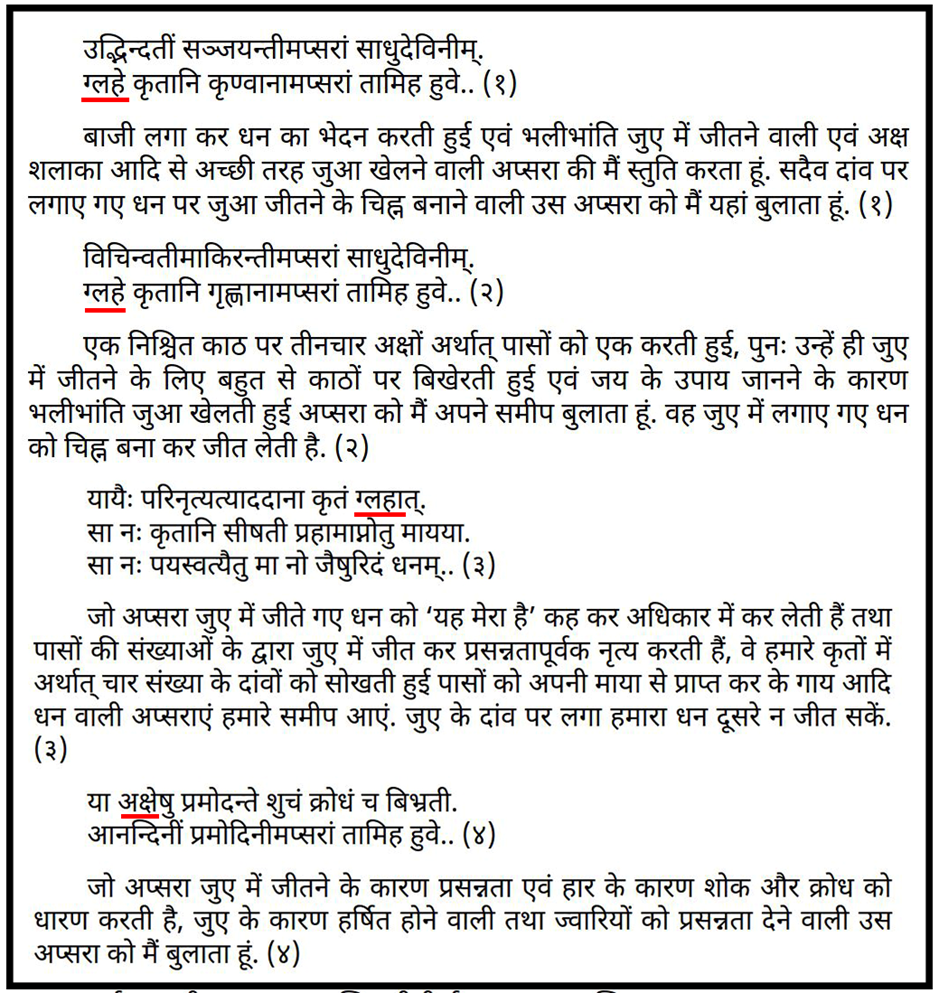
The Sanskrit term used in these passages is Glaha (ग्लह), which denotes gambling. It can also refer to the place where dice are thrown, that is, a gambling board, and may further signify the stake involved in the game. The verses additionally employ the word Aksha, meaning dice. The following is a snapshot of the definition of the term Glaha as given in V. S. Apte’s lexicon.
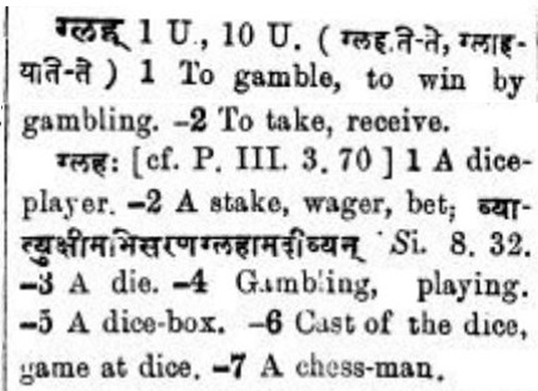
[The Practical Sanskrit-English Dictionary, p.474, by Vaman Shivaram Apte, Published by Shiralkar, Poona, 1890]
Panini defines the term as follows,
Asthadhyaya Panini, Book III, Ch III, Verse 70 “The word ‘glaha‘ is irregularly formed, when the sense of the root refers to gambling.” Tr. Srisa Chandra Vasu (Source)
Sayana Acharya comments on Atharva Veda 4.38.1-4 as follows.
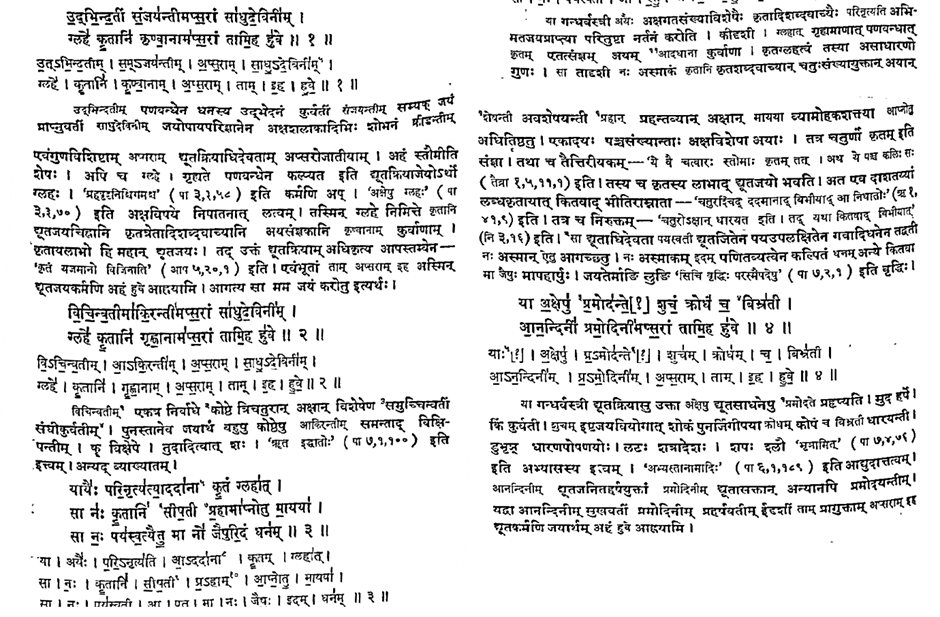
“Udbhindatīm [means] bringing about the manifestation of wealth through the binding of a wager. Saṃjayantīm [means] obtaining victory in a complete and thorough manner. Sādhudeviniṃ [means] playing excellently with dice, rods, and similar instruments through a knowledge of the strategies for victory. [The implied completion of the sentence is]: I praise the Apsaras, the presiding deity of the activity of gambling, who belongs to the race of Apsaras and is distinguished by such qualities.
Moreover, regarding glahe: glaha refers to the object to be won in the activity of gambling, which is grasped or determined by the wagering bond. The affix ap is utilized in the passive sense per the rule ‘grahavṛdṛniścigamaśca’ (Pāṇini 3.3.58). The substitution of l [for r] occurs specifically in the context of dice per the rule ‘akṣeṣu glahaḥ’ (Pāṇini 3.3.70). In the cause of that glaha, she is kṛtāni kṛṇavānām—creating the numbers known as kṛta (the winning throws), which represent the openings for victory in gambling. For the gain of a hundred is a great victory that is famous. This has been stated by Āpastamba with authority over the activity of gambling: “The sacrificer wins the kṛta” (Āp. Śr. 5.20.1).
Huve—meaning I invoke—that such an Apsaras here in this act of winning at gambling. The meaning is: having arrived, may she bring about my victory.
Vicinvatīm [means] specifically collecting or piling together three or four dice in one unobstructed compartment. Ākirantīm [means] scattering or throwing those very same dice all around in many compartments again for the sake of victory. The root kṛ is used in the sense of throwing. The affix śa is used because the root belongs to the Tudādi class. The change to i occurs per the rule ‘ṛta id dhātoḥ’ (Pāṇini 7.1.100). The rest has been explained previously…[That] Gandharva woman who parinṛtyati [dances around] with the ayaiḥ—which are specific numbers residing in the dice denoted by terms such as kṛta—meaning she performs a dance, being fully satisfied by the attainment of the desired victory. Of what nature is she? [She is] ādadānā—taking [or making] the kṛta—which bears this name—from the glaha [stake] that is being grasped. The state of having the kṛta as the glaha is her extraordinary quality. May she, being of such a nature, āpnotu [pervade/preside over] naḥ (our) kṛtāni—the throws denoted by the word kṛta and possessed of the number four… [text obscure]… dīvyantī [playing] and avaśeṣayantī [causing to remain] the grahān—the dice that are to be struck [or taken]—through māyā, the power of delusion.
The ayāḥ are specific dice outcomes ending in the number five, beginning with one. Among them, the designation for the collection of four is kṛta. And likewise, the Taittirīya text states: “Those which are four stomas, that is kṛta; then those which are five, that is kali” (TB 1.5.11.1). And victory in gambling occurs through the gain of that kṛta. Therefore, in the Dāśatayī (Ṛgveda), fear is recorded regarding a gambler who has obtained the kṛta: “One should fear the one holding four [dice] until the fall” (RV 1.41.9). And therein the Nirukta states: “He holds four dice. Just as one might fear a gambler…” (Nirukta 3.16).
May that presiding deity of gambling, who is payasvatī—possessed of that [wealth] in the form of cattle and grain characterized as ‘milk’ [essence] won through gambling—come (aitu), meaning arrive, to naḥ (us). May other gamblers mā jaiṣuḥ (not conquer) or take away this wealth of naḥ (ours) which has been designated as the object to be wagered. The vowel elongation (vṛddhi) in jaiṣuḥ—which is the aorist of the root ji with the negative particle mā—occurs per the rule ‘sici vṛddhiḥ parasmaipadeṣu’ (Pāṇini 7.2.1).
That Gandharva woman who is spoken of in the context of gambling activities pramodate—meaning rejoices—in the akṣeṣu (dice), the instruments of gambling. The root mud implies joy. Doing what? Bibhratī—meaning bearing or holding śucam—grief arising from the separation from a desired victory—and krodham—anger arising from the desire to conquer again. The root is du-bhṛñ in the meanings of holding and nourishing. The śatṛ affix replaces laṭ. In the context of Śap and Ślu, the change of the reduplicate to i occurs per ‘bhṛñāmit’ (Pāṇini 7.4.76). The accent falls on the first syllable per ‘abhyastānām ādiḥ’ (Pāṇini 6.1.189).
Ānandinīm [means] filled with joy generated by gambling. Pramodinīm [means] causing delight even to others who are addicted to gambling. Alternatively, ānandinīm means ‘happy’ and pramodinīm means ‘possessing great joy’. I huve—meaning I invoke—such an aforementioned Apsaras here in the act of gambling for the sake of victory.” Sayana on Atharva Veda 4.38.1-4
Various other Sanskrit terms, such as Div, Dev, Dyut, and Ghrt, are also employed in the Vedas in the context of gambling. Another hymn, which takes the form of a prayer for success in gambling, reads as follows,
Atharva Veda, Kanda 7, Adhyaya 50, contains a gambler’s prayer seeking success in gambling.
Atharva Veda 7.50.1-9 “As evermore the lightning flash strikes, irresistible, the tree, So, irresistible, may I conquer the gamblers with the dice…Yea, by superior play one gains advantage: in time he piles his spoil as doth a gambler…I would that I were winner of cattle and horses, wealth and gold. Dice, give me play that bringeth fruit as ’twere a cow with flowing milk! And, as the bowstring binds, the bow, unite me with a stream of gains.” Tr. Ralph T.H. Griffith (Source)
Following is the Hindi translation by Dr. Ganga Sahay Sharma,
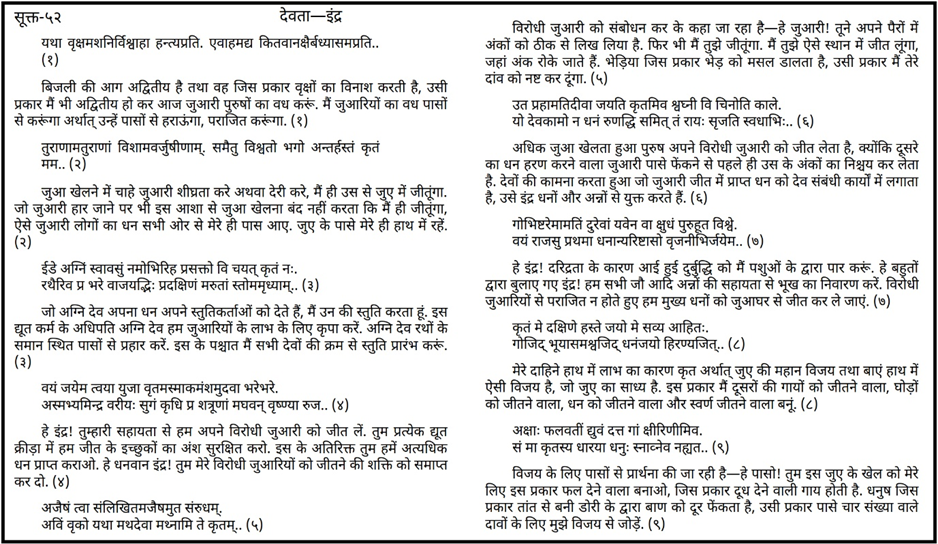
Sayana comments on the above verses as follows.
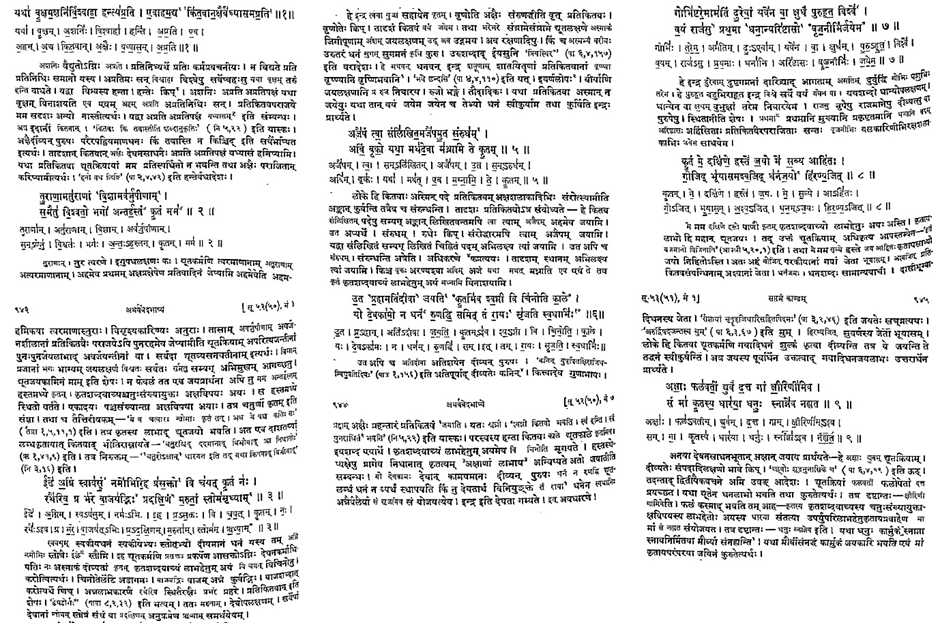
“Just as the thunderbolt—specifically lightning—strikes a tree and destroys it, in this very manner, I strike this gambler today with dice; that is, I vanquish him. The term aprati denotes one for whom there is no pratinidhi (counterpart) or opponent; it refers to a gambler who is universally irresistible. Alternatively, it implies that since no other gambler in the assembly stands as my equal, I am the aprati—the matchless man. I strike down such a gambler. The word kitavam (gambler) is derived from the phrase “What is yours?” (kiṃ tava), implying one who constantly asks this question to wager. This etymology is cited from the Nirukta (5.22). The term amrāti signifies a hostile or attacking enemy; I destroy him completely. The grammatical form is the first-person singular of the verb han (to kill) in the present tense, where the root badh is substituted for han in the context of the Liṅ mood [grammar note: referring to the specific verbal conjugation rules]…
“I have conquered you (ajaiṣam).” Saṃlikhitam refers to the gambler who has been recorded or marked by the other gamblers. Saṃrudham refers to the one who obstructs or withholds the stake. Just as a gambler gathers the kṛta (the winning total or the spoils of the game), so too do I gather wealth. Then, addressing the deity directly: “O Indra, with your assistance, I have conquered the saṃrudham (the obstructing enemy).”…
Uta is a particle meaning “and” or “also.” Prahām refers to the excellent or winning throw (jayam). Atidivā refers to one who plays with excess (atiśayena dīvyati) or surpasses others in the game. Jayāti means he conquers. The successful gambler or warrior conquers his relatives and rivals (jñātīn) and appropriates their wealth for himself. The word kṛtam appears again, reinforcing the notion of the “done” or “winning” deed.
Gobhiḥ means “with cattle.” Tarem means “we shall cross over” or overcome misfortune and poverty. Ayajvan refers to those who do not perform sacrifices (the impious or the enemy). The text explains that by means of the cattle seized from the non-sacrificing enemies, we overcome all difficulties. Rājasu refers to the kings or rulers; we stand prominent among them. The term prathamā (first/primary) implies that we retain the primary share of the wealth, such as cattle and gold (dhanāni), having conquered the non-sacrificing rivals.
Regarding the terms turāṇām (the swift) and aturāṇām (the non-swift): turāṇām is those hastening in a single action (ekakarmani tvaramāṇānām), and aturāṇām as those who are not hastening (atvaramāṇānām). It states: “I alone, being the foremost (prathamam), shall conquer the opponent by the display of the dice.” Furthermore, regarding the nature of the winning throw, the text specifies: “And so the Taittiriya states: ‘Verily, those four stomas (forms/chants) are the Krita.'” (Cited as Tai. Sam. 1.5.11.1). Therefore, by the acquisition of the Krita (the four-count throw), one becomes a victor born of gambling (dyūtajo bhavati). For this very reason, it is said that they fear the holder of the Krita (kṛtavād), just as the Rig Veda states: ‘…they fear the gambler holding the Krita'” (Cited as Rv. 10.34.8).
Akṣāḥ (The dice) are compared to a phalavatīm (fruitful) entity, like a cow yielding milk. Dhanuḥ (bow) is mentioned in the simile. “Just as a bowstring launched from a bow strikes the target, so do the dice strike the gambler.” The phrase saṃ mā kṛtasya suggests that the dice gather or collect wealth for the player, just as a bow gathers enemies for the warrior. The commentary concludes by explaining that the dice serve as the instrument for binding or securing the wealth of the opponent.” Sayana on Atharva Veda 7.50.1-9
Atharva Veda 7.109.1-7 “My homage to the strong, the brown, the sovran lord among the dice! Butter on Kali I bestow: may he be kind to one like me. Bear butter to the Apsarases, O Agni, and to the Dice bear dust and sand and water…Evil be mine opponent’s luck! Sprinkle thou butter over us. Strike, as a tree with lightning flash, mine adversary in the game. The God who found for us this wealth for gambling, to cast the dice and count the winning number…As I invoke the Gods at need, as I have lived in chastity, May these, when I have grasped the Dice, the brown, be kind to one like me.” Tr. Ralph T.H. Griffith (Source)
Following is the Hindi translation by Dr. Ganga Sahay Sharma,
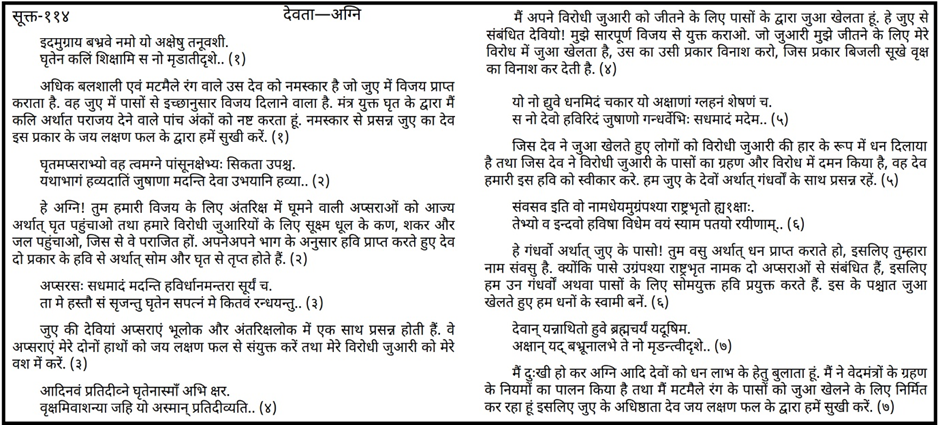
Sayana comments on above verses as follows.
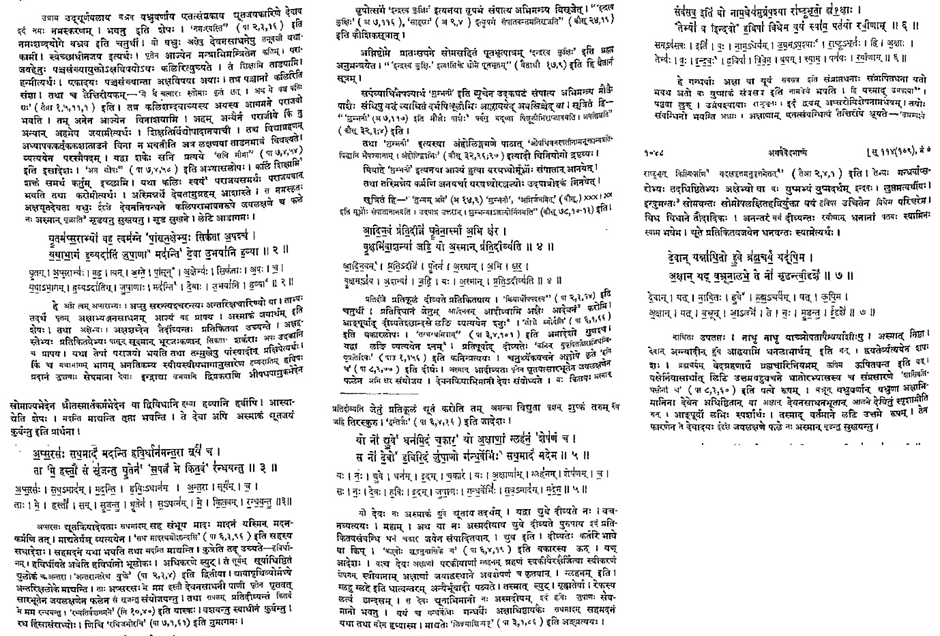
““I invoke the Apsarasas.” The term “invoke” implies a respectful calling or summoning. For what purpose? For the destruction of the “Kali.” “Kali” here signifies the specific die or throw that causes defeat. “I destroy” means I annihilate the adverse outcome. “I establish the Krita.” The “Krita” signifies the winning throw or the favorable time. By removing the Kali, I establish the Krita, meaning I secure the era of victory. The phrase “Let the Apsarasas go to the river” implies a dismissal of the adverse forces to a place where they can cause no harm, such as a flowing stream. Sun-skinned.” This adjective describes the Apsarasas. It signifies those whose skin or form is as brilliant as the sun. Or, it may imply those who are illuminated by the sun. “Ghee-loving.” They are fond of clarified butter (Ghrita). Therefore, the offering of ghee is made to propitiate them. “They play.” This denotes their inherent nature of engaging in the game. The Apsarasas are the presiding deities of the gambling hall; thus, their favor is the primary cause of success. “Those who create the game.” This indicates their power to generate the conditions of the gamble. “Dancing.” The Apsarasas are described as dancing, which signifies their state of agitation or excitement during the game. “With the dice.” This means they are accompanied by the dice, or they revel in the sound of the dice. “Taking the stakes.” The commentary explains that they have the capacity to seize the wealth of the opponent. “May they assign.” This is a prayer that they may allocate the winnings to the sacrificer. “The winnings.” This refers to the wealth that is at stake. The intent is: May the Apsarasas, being pleased, transfer the opponent’s wealth to us. The Adinava.” The term “Adinava” signifies “fault,” “misfortune,” or “bad luck.” “I strike away.” This means I remove or dispel the misfortune associated with the gambling act. “Like dust.” Just as one shakes off dust from a garment, so too is the bad luck shaken off. “The debt.” This refers to the obligation or loss incurred in gambling. The ritual is intended to nullify the debts and transfer the burden of loss to the adversary. “To the opponent.” The misfortune is explicitly directed toward the enemy or the rival gambler. “He who rules.” This refers to the supreme controller of the dice. “The Lord.” This denotes the deity who has mastery over the game. “He knows.” The deity possesses the knowledge of the fall of the dice. “May he favor.” A supplication for the deity’s grace. “With truth.” This implies that the deity’s favor should be manifested in reality, not just in hope…“The Gandharva.” He is the husband or protector of the Apsarasas. “The path.” This refers to the way of the dice or the course of the game. “May he protect.” The Gandharva is invoked to guard the winnings once they are acquired. While the Apsarasas facilitate the winning, the Gandharva ensures the retention of the wealth. “We invoke.” We call upon him for stability. “The wealth.” Specifically, the wealth won in the gamble. “United.” This means the Apsarasas and Gandharvas acting in unison. “For us.” For the benefit of the sacrificer. “Do not destroy.” A plea that the fierce nature of the deities should not turn against the practitioner. “The winnings.” Again, referring to the stakes. Both the Apsarasas and the Gandharva—act solely for the benefit of the one who performs the ritual, turning the game from a matter of chance into a matter of ritual certainty.” Sayana on Atharva Veda 7.109.1-7
The fourth verse of the Atharva Veda 7.109.1-7 mentioned above is further elaborated in Kausiki Sutra 41.13. The following is a snapshot of the Sanskrit text along with the Hindi translation by Uday Narayan Singh.
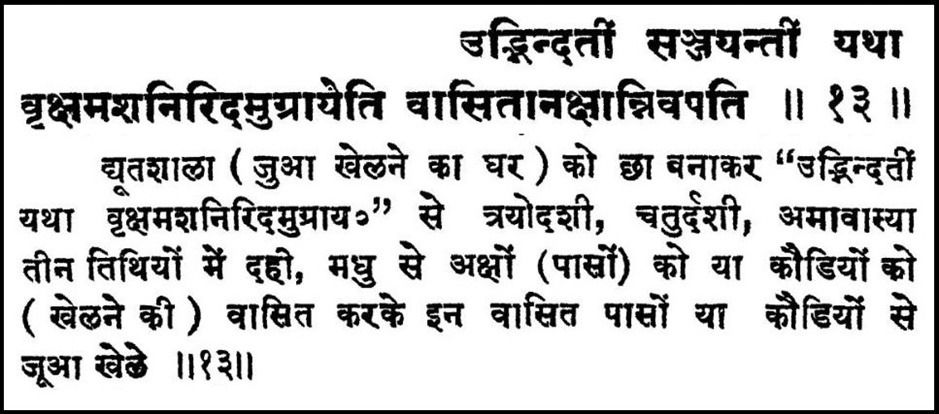
The following is the English retranslation of the above Hindi translation.
“Having prepared the gambling hall (the house for playing gambling) as a shelter, one should gamble with these steeped dice or cowrie shells after steeping the dice (pāsoṃ) or cowries (for playing) in curd and honey on the three lunar dates—Trayodashi, Chaturdashi, and Amavasya—while reciting the mantra, ‘Splitting, conquering, as the lightning [strikes] the tree, this fierce…'”
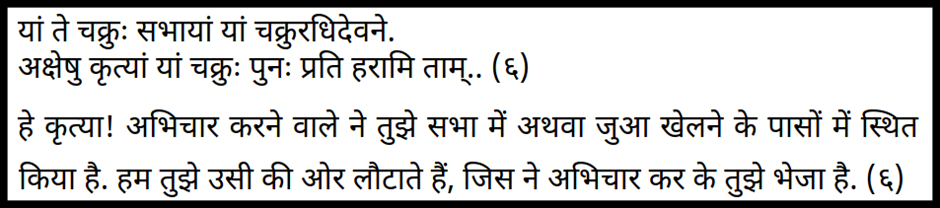
The following is a prayer intended to remove a spell cast upon the dice and the gambling board. The term Adhidevana refers to the gambling board, and this word also appears in Satapatha Brahmana 5.4.4.20. The word Aksha, on the other hand, denotes dice.
Atharva Veda 5.31.6 “The spell that they have cast upon thy public room thy gambling-board, Spell they have cast upon thy dice, this I strike back again on them.” Tr. Ralph Griffith (Source)
Following is the Hindi translation by Dr. Ganga Sahay Sharma,