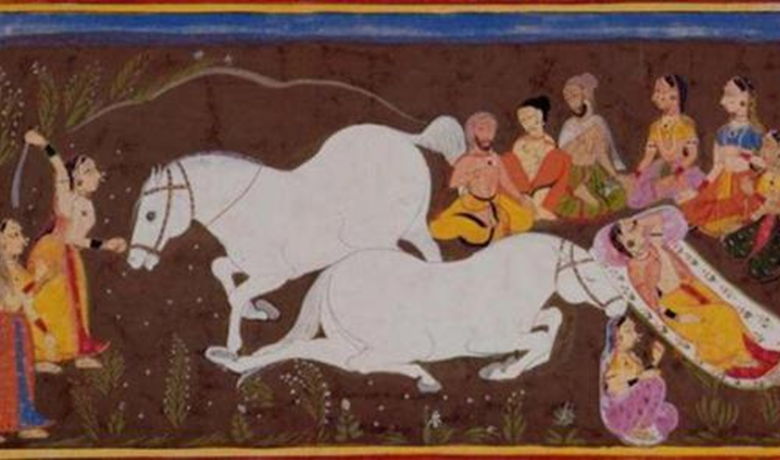
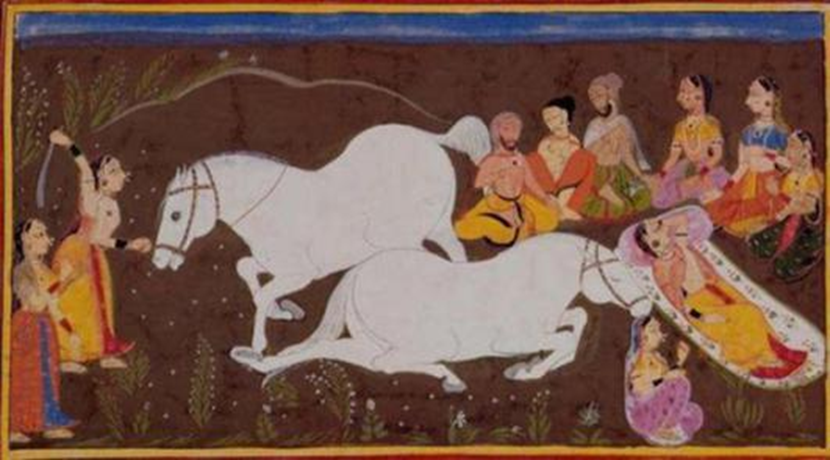
Written by Sulaiman Razvi
The Ashvamedha Yajna, a Vedic horse sacrifice ritual, is portrayed in Hindu texts as a means of ensuring fertility and royal sovereignty. The ritual is described in the Veda, Harivamsa Purana, Apastamba Srauta Sutra, Satapatha Brahmana, and other sources, detailing the role of the chief queen in the ritual. These texts suggest that the queen engaged in intercourse with the sacrificial horse, an act meant to confer power and prosperity upon the kingdom.
The Ashvamedha Yajna is an extensive ritual that includes several significant stages. The Ashvamedha Yajna ritual extended over approximately a year. At the beginning, a fine horse was selected and released to roam freely, guarded by soldiers. Every place the horse travelled was claimed as part of the king’s realm. The horse was stopped from having sexual intercourse. If the horse entered lands outside king’s control, the rulers of those lands had to either accept his authority or prepare for battle. Then starts the sacrificial slaughter of the horse, followed by a ritual involving the sexual act of the queen with the slain horse. The ceremony concludes with the horse being cut into pieces and cooked as part of the ritual. This article will not delve into the broader details of the horse sacrifice ritual, but will focus specifically on the queen’s actions involving the dead horse. In the Ashvamedha ritual, queen sleeps naked with the horse, both of them are covered up with a cloth, then she places the penis in her private part, she then asks the dead horse to release semen in her, asking the horse to release semen is symbolic as the dead horse can’t release semen but the insertion of penis of dead horse into the vagina of queen is literal. Some references are taken from books like On Hinduism by Wendy Doniger and Sacrificed Wife/Sacrificer’s Wife by Stephanie W. Jamison.
Hindu apologists attempt to sanitize these texts, arguing that the references to sexual acts are metaphorical. They claim that these rituals were symbolic, aiming to bring prosperity and divine favor, rather than involving actual physical acts. However, these reinterpretations are nothing but attempts to align Vedic practices with contemporary moral standards, disregarding the literal descriptions provided in the primary sources.
It is mentioned in Apastamba Srauta Sutra 20.17.12-18 that the Chief Queen recites some Mantras (mentioned in Yajurved) and then all the wives of the king circumambulate the horse, fan it, tie their hairs on the right side of their head. According to the Valmiki Ramayana, Bala Kanda 1, Sarga 14, verses 33 to 35, Kaushalya, the mother of the Hindu god Rama, is described as spending a night with the sacrificial horse during the Ashvamedha Yajna. The passage further states that Dasaratha’s other queen and his concubine were also present during the rite.
The ritual in question is referenced in both the Krishna and Shukla Yajur Vedas. However, the account in the Krishna Yajur Veda is obscure due to omissions by the translator.
Krishna Yajur Veda 7.4.19 The wicked horse is sleeping. O fair one, clad in fair raiment in the world of heaven be ye two covered…. {…several verses omitted from original translation…} Source
I am quoting the Indologist’s translation of the Krishna Yajur Veda.
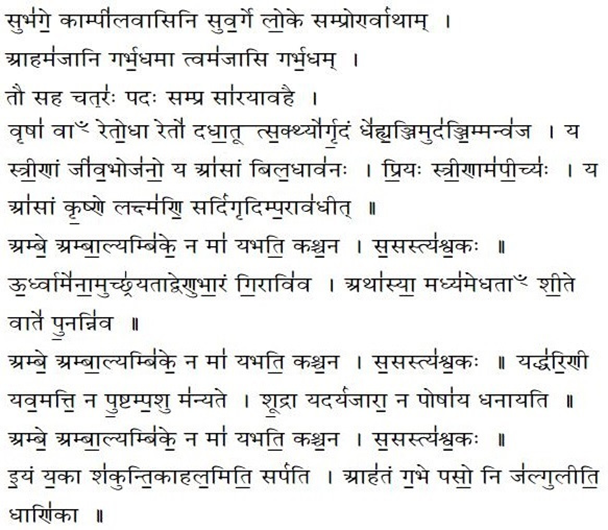
Krishna Yajur Veda 7.4.19 In the heavenly world be you two completely covered. [Queen says]- I will urge on the impregnator, you will urge on the impregnator; let the two of us stretch out our four legs. [Adhvaryu says]- Let the stallion, semen-producer, produce semen Bring the penis into the two thighs, drive along the erect and unctuous one which is women’s living enjoyment, which is their hole-runner [cleaner], women’s dear secret (pleasure) which has hit the sardigrdi (clitoris?) in their black (haired) mark… This little bird which creeps around saying ‘ahalam’ knocks the penis into the slit; the vulva devours it.
The Khila Rig Veda likewise contains an explicit reference.

Khila Rig Veda 5.22.5 “The Great Naked One (Mahanagni) articulates: “The horse’s penis is well-inserted.” We obtain the winnowing basket of the Bilva tree, or the vessel of the fruit-bearing tree.” (Source)
The Shukla Yajur Veda preserves a clearer version of the ritual.
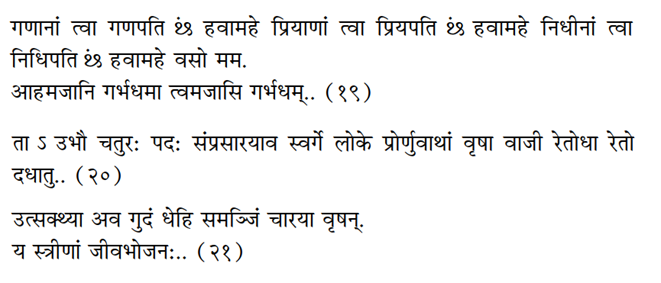
Yajur Veda 23.19-21 “We invoke you, the Commander of Hosts among the multitudes; we invoke you, the Master of the Beloved among the cherished; we invoke you, the Lord of Treasures among wealth. O my Treasure! May I recognise the impregnator of the womb; you are indeed the impregnator of the womb. Let us both extend our four limbs; may we be enveloped within the heavenly realm. May the virile steed, the depositor of seed, place the seed. Elevate the thighs and position the loins; insert the procreative organ, O vigorous one that which constitutes the vital sustenance of women.”
Mahidhara, a renowned commentator on the Vedas, provided an accurate explanation that modern Hindus often avoid mentioning due to its potential embarrassment.
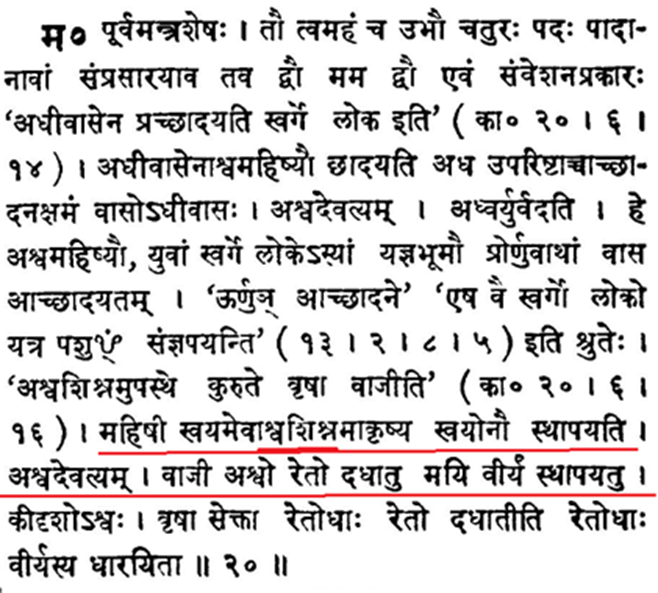
“…Since the horse is dead, the chief queen herself takes the penis [Shishan] of the dead horse and places it into her Vagina [Yoni]. She asks the horse to release semen in her [by saying] ‘May the vigorous male [horse], layer of semen, release semen in me’…” Commentary by Mahidhara on Yajur Veda 23.20
Dr. B.R. Ambedkar also addressed this issue, stating,
“Another instance of obscenity which disfigured the religion of the Ancient Aryans is connected with the Ashvamedha Yajna or the horse sacrifice. A necessary part of the Ashvamedha was the introduction of the Sepas (penis) of the Medha (dead horse) into the Yoni (vagina) of the chief wife of the Yajamana (the sacrificer) accompanied by the recital of long series of Mantras by the Brahmin priests. A Mantra in the Vajasaneya Samhita (xxiii. 18) shows that there used to be a competition among the queens as to who was to receive this high honour of being served by the horse. Those who want to know more about it will find it in the commentary of Mahidhara on the Yejur-Veda where he gives full description of the details of this obscene rite which had formed a part of the Aryan religion.” Dr. B.R. Ambedkar, Riddle no 23, p.295, Vol 4, Riddles in Hinduism
https://www.mea.gov.in/Images/attach/amb/Volume_04.pdf
Swami Parmeswaranand, a Hindu scholar, makes a brief reference to the Ashvamedha Yajna.
“Mahanagni says, ‘Well is the membrum virile entered; of the ‘tree having such fruit’ may we gainbasket after basket’ (AV XX.136. 9 = RV V.22. 5, with the difference that in RV at ab we have ‘the organ of the horse has entered’)…
In the form aspect there must be a human; in the latter a ritual-beast, and it is here that the horse comes in the Horse-sacrifice; for some of the mantras that precede were actually sung at the Horse-sacrifice; for some of the mantras that percede were actually sung at the Horse-sacrifice; and, under this later influence can be explained the reading in RV-Khila ‘the organ of the horse has entered’ (asvasvavesitam pasah), which we do not have at the AV.”
Encycolpaedic Dictionary of Vedic Terms by Swami Parmeshwaranand, Vol 2, p.356-8, Published by Sarup & Sons, 2006 Reprint (Source)
Madhavacharya discusses in his book the critical view of Brihaspati’s Charvaka philosophy on the Ashvamedha Yajna.
Sarva Darsana Samgraha chapter 1 Carvaka System, verses 6-7 “The three authors of the Vedas were buffoons, knaves, and demons. All the well-known formulae of the pandits, jarpharī, turpharī, &c. And all the obscene rites for the queen commanded in the Aśvamedha, these were invented by buffoons, and so all the various kinds of presents to the priests, While the eating of flesh was similarly commanded by night-prowling demons.” Translated by E.B. Cowell & A.E. Gough (Source)
Swami Vivekananda also alludes to the Ashvamedha Yajna, but he refrains from detailing it explicitly due to its obscenity.
“And in the Vedic Ashvamedha sacrifice worse things would be done…. All the Brahmanas mention them, and all the commentators admit them to be true. How can you deny them?
What I mean by mentioning all this is that there were many good things in the ancient times, but there were bad things too.” The Complete Works of Swami Vivekananda, Volume 6/Epistles – Second Series/LXXI Rakhal (Source)
The question, therefore, is what Swami Vivekananda meant by “worse things.” When his remark is read in light of the Brahmana literature and its traditional commentaries on the Ashvamedha Yajna, it becomes evident that he was referring to the ritual act involving sexual intercourse with the dead horse described in these texts. This interpretation aligns with his assertion that the details are explicitly recorded in the Brahmanas and openly acknowledged by their commentators.
It is unlikely that Swami Vivekananda was merely referring to the killing of the horse, since he addressed animal sacrifice directly and unambiguously in other lectures and writings. His emphasis here on practices that commentators themselves could not deny suggests a reference to rituals considered more disturbing than animal slaughter. Thus, his statement reflects a candid recognition that certain Vedic rites contained elements that even later Hindu thinkers found deeply problematic.
In the absence of the detailed explanations preserved in the Satapatha Brahmana and Srauta Sutras, these verses from the Yajur Veda would likely have been reinterpreted or denied by Hindu apologists. The Satapatha Brahmana and the Srauta Sutras validate these explicit verses, reinforcing their significance within the ritual context. Following is the English translation of Baudhayana Srauta Sutra by a Hindu scholar C.G Kashikar.
Baudhayana Srauta Sutra chapter 15 verse 29 “The Adhvaryu escorts the senior queen fully decorated, making amends, being reproached (and addresses the three queens) “O Ambā, O Ambāli O Ambikā” (The senior queen says) “No person leads me. The poor horse is sleeping.” Having lain down by the side of the horse towards the north, she draws a piece of cloth over her head. The Adhvaryu covers both of them with the piece of linen with the formula, “O fair one, clad in a fair garment, do you two be covered together in the heaven.” The senior queen lays the horse’s penis on her lap with the formula, “I have clasped the impregnatory; do thou clasp me for impregnation. Let us together spread out our four legs.” The Adhvaryu follows her with the formulas, “Let the impregnator out of you deposit the seed. O horse, do thou press thy region of male organ upon the thighs (of the queen) and insert into the queen’s genitals thy penis which is the means of enjoyment of women, which dashes into their womb, and which, when entered into the genitals pleases them, and which attacks the central part of genitals within the black spot.” The senior queen censures the horse.” Tr. Dr. Chintaman Ganesh Kashikar
Following are the English translations of Apastamba and Katyayana Srauta Sutras by Hindu scholar G.U. Thite.
Apastamba Srauta Sutra 20.18.4 “After (the Adhvaryu) has connected her genital organ with the genital organ (of the horse) with utsakhtyor grdam dhehi…, the chief queen censures the horse with ambe ambalyambike…” Tr. Ganesh Umakant Thite
Katyayana Srauta Sutra 20.6.16 “(The Mahisi) puts the male organ of the horse in her female organ, with vrsa vaji…(VS XXIII.20).” Tr. Ganesh Umakant Thite
Following is another translation of above verse by a Hindu translator H.G. Ranade.
Katyayana Srauta Sutra 20.6.16 “The Mahisi (the) takes the penis of the horse in her lap with ‘vrsa vaji etc. (VS 23.21).” Tr. H.G. Ranade (Source)
Following is the English translation of Sankhayana Srauta Sutra by W. Caland.
Sankhayana Srauta Sutra XVI.3.33-36 “When the horse has been quietened (slaughtered) they cause the first consort of the king to lie down near it. They cover them both (horse and consort) with an upper-garment. To these two the sacrificer addresses the obscene (verse). ‘Put the penis (?) into (the space between the) thighs, bring the sleek one down, which is the life and delight of women’.” Tr. W. Caland (Source)
It is also mentioned in Varaha Srauta Sutra.
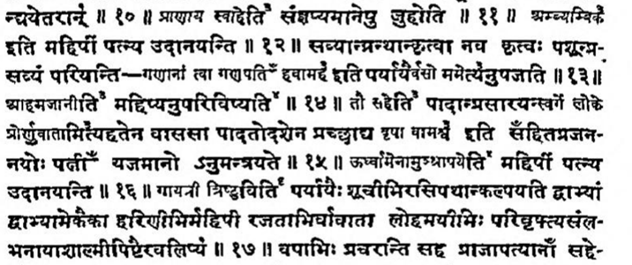
Varaha Srauta Sutra 3.4.4.11-15 “With the mantra ‘O Mother, O Little Mother’ (Ambe Ambike), the wives lead the Chief Queen (Mahishi) near [the horse]. Having made knots on the left [side of their garments], they go around the animals nine times in a counter-clockwise direction. Reciting the rounds ‘We invoke thee, O Lord of Troops’ (Gananam tva…), he [the priest] connects [the recitation] with ‘O my Treasure’ (Vaso mama). With the mantra ‘I will generate’ (Ahamajani…), the Chief Queen lies down alongside [the horse]. With the mantra ‘Let the two of us stretch out [our feet]’ (Tau saha…) and with the mantra ‘May you two cover yourselves in the heavenly world’ (Svarge loke…), having covered [themselves] with an unwashed garment from the feet up, the Sacrificer (Yajamana) recites the mantra over the Wife at the moment when their two generative organs have been put together (samhita-prajanayoh): ‘O vigorous male, the placer of seed, place the seed; spread the two thighs apart; place the organ into the opening; drive in the slippery, erect one; he who is the life-enjoyment of women, he who is the runner into their clefts, the beloved, secret one of women, he who has thrust into their black pubic region with a squelching motion’. With the mantra ‘Raise her up high’ (Urdhvam enam…), the wives lead the Chief Queen up [away from the horse].”
It is mentioned in Satapatha Brahmana.
Satapatha Brahmana 13.5.2.1-10 A cloth, an upper cloth, and gold is what they spread out for the horse, and on that they ‘quiet’ him. When the sacrificial animals have been ‘quieted’, the (king’s) wives come up with water for washing the feet — four wives, and a maiden as the fifth, and four hundred women attendants. When the water for washing the feet is ready, they make the chief queen (Mahishi) lie down next to the horse, and they cover the two of them up with the upper cloth as they say the verse, ‘Let the two of us cover ourselves in the world of heaven’, for the world of heaven is where they ‘quiet’ the sacrificial animal. Then they draw out the penis of the horse and place it in the vagina of the chief queen, while she says, ‘May the vigorous virile male, the layer of seed, lay the seed’; this she says for sexual intercourse. While they are lying there, the sacrificer insults the horse by saying, ‘Lift up her thighs and put it in her rectum.’ No one insults (the sacrificer) back, lest there should be someone to act as a rival against the sacrificer. The officiant (Adhvaryu) then insults the maiden: ‘Hey, maiden, hey, maiden, the little female bird …’ and she insults him back: ‘Hey, officiant, hey, officiant, that little bird….’ And then the overseer (Brahman) insults the chief queen: ‘Hey, chief queen, hey, chief queen, your mother and father climb to the top of a tree….’ She has as her attendants a hundred daughters of kings; they insult the overseer in return: ‘Hey, overseer, hey, overseer, your mother and your father play in the top of a tree….’ Then the cantor (Udgatri) insults the king’s favorite wife: ‘Hey, favorite, hey, favorite wife, raise her up erect….’ She has as her attendants a hundred royal women; they insult the cantor in return: ‘Hey, cantor, hey, cantor, raise him up erect….’ Then the invoker (Hotri) insults the rejected wife: ‘Hey, rejected wife, hey, rejected wife, when inside her tight crack….’ She has as her attendants a hundred daughters of bards and village headmen; they insult the invoker in return: ‘Hey, invoker, hey, invoker, when the gods see that miserable penis….’ Then the carver (Kshatri) insults the fourth wife: ‘Hey, fourth wife, hey, fourth wife, when the deer eats the barley, (the farmer) does not hope to nourish the animal….’ She has as her attendants a hundred daughters of carvers and charioteers; they insult the carver in return: ‘Hey, carver, hey, carver, when the deer eats the barley, (the farmer) does not hope to nourish the animal….’ These insulting speeches are for all kinds of attainment, for through the horse sacrifice all desires are achieved. Thinking, ‘With all kinds of speech we will achieve all kinds of desires’, they make the chief queen get up. Then the women walk back the way they came, and the others utter at the end a sweet-smelling verse, the verse that begins, ‘I praise Dadhikravan.’ For the life-span and the gods go out of those who speak impure speech in the sacrifice. Thus they purify their speech to keep the gods from going out of the sacrifice.”
Following is the Hindi translation of first two verses by a Hindu scholar named Pandit Ganga Prasad Upadhyaya.
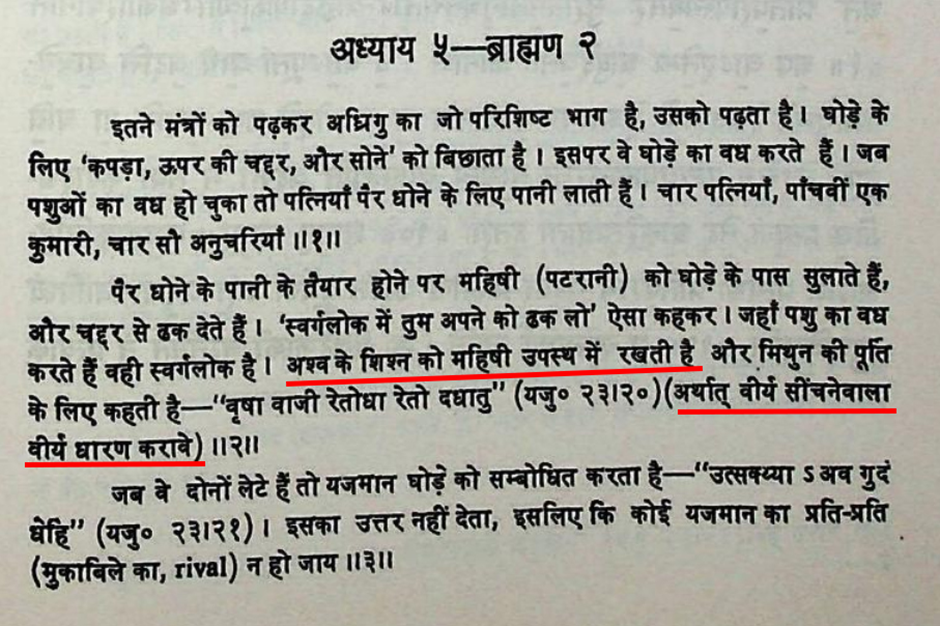
Satapatha Brahmana verses align with those of the Yajur Veda, supporting their authenticity. It is noteworthy that Griffith excluded certain explicit verses from the Yajur Veda, which involve explicit necrophiliac elements, from his translation. He addressed this omission in his commentary.
“This and the following nine stanzas are not reproducible even in the semi obscurity of a learned European language…- Ralph T.H Griffith on Yajur Veda 23.20, p.213. 1899 Edition.
Ralph Griffith’s translation is based on the commentaries of renowned Hindu scholars, and these classical interpretations consistently align. Due to the explicit nature of certain verses, Griffith chose to omit them rather than translate them directly. For a partial translation of these verses, you may refer to the Satapatha Brahmana translated by Julius Eggeling, available at sacred-texts.com, where ellipses are used to indicate omissions. The translator’s decision was based on the perceived vulgarity of these verses.
The Harivamsa Purana narrates the story of Indra violating Vapushtama the daughter of King Janamejaya by entering the body of the dead horse during Ashvamedha Yajna sacrifice.
Harivamsa Purana, Bhavishya Parva 3.5.11-13 “After the passage of some time, king Janamejaya, who offers plenty of tributes (in sacrifices) observed the horse sacrifice as ordained. Devi Vapushtama, the daughter of the king of Kashi, went and slept with the slain horse, according to the ritual as prescribed. Seeing the queen with beautiful limbs, Vsava (Indra) desired her. Entering the body of the dead horse, Indra had intercourse with the queen.” Tr. A. Purushothaman and A. Harindranath. (Source)
One may also refer to the English translation by Manmath Nath Dutt available on Wisdomlib, though it lacks the clarity of the translation cited above.
These verses raise an unavoidable question. If the Ashvamedha Yajna did not involve ritualized sexual contact with the horse, why does the narrative insist that Indra entered the horse’s body rather than approaching the queen openly in his own form? The choice of the horse’s corpse as the medium is not incidental. It directly reflects the ritual setting and its prescribed actions.
Indra’s decision to enter the carcass of the horse to satisfy his lust proves that the ritual environment provided a sanctioned cover for copulation. If the rite were merely symbolic, Indra would have had no cause to inhabit the horse’s body, he did so precisely because the ritual mandated an intimate physical union between the Queen and the animal.
The account also notes that those present became aware of something unusual only when the dead horse began to move. This detail strongly implies that the queen lay concealed with the horse under a covering, and that a sexual act was taking place as part of the ceremony. The narrative does not present this episode as symbolic or metaphorical, but as an accepted component of the ritual context. Taken together, these verses reinforce the conclusion that the Ashvamedha ritual included an explicit sexual element involving the queen and the slain horse.
The conclusive evidence presented in this article has thwarted any attempts by Hindu apologists to refute the arguments made. Instead, they have resorted to superficial explanations, contending that the verses in question were recited rather than performed. On the contrary, the passages from Srauta Sutras mentioned above doesn’t indicate that these verses to be only recited as a mock ritual, they clearly state that the chief queen was required to put the penis of the dead horse into her vagina and then she was supposed to recite explicit verses like “‘May the vigorous male [horse], layer of semen, release semen in me”, “I have clasped the impregnatory; do thou clasp me for impregnation. Let us together spread out our four legs.” The verses clearly delineate the actions required from the recitations, demonstrating that both elements were integral to the ritual, they clearly separate what needs to be done from what needs to be recited.
Despite all this concrete evidence, some Hindu apologists continue to offer their own interpretations of these texts. Below, I will present and critically address the explanations provided by two such apologists. These apologists attempt to refute the obscenity by misinterpreting the Vedas.
First Rebuttal:
Here is the Sanskrit verse and its translation for Yajur Veda 23/20
tau ubhau chaturah padah samprasarayava swarga
lokam prasuvava vrshavaaji raghu rathau dadati Yajur Veda 23/20
tau = we two ; ubhau = both ; chaturah = intelligent ; padah = subject ; samprasarayava = reach out ; swarga lokam = heavenly planet ; prasuvava = command ; vrshavaaji = horse ; raghu = Lord ; rathau = chariots ; dadati = provides
Translation: We both command the intelligent horse as our subject to reach out for heaven (where) the Lord provides (us) the chariots.
The real meaning here is that by performing Ashwamedha yajna, one can get the blessings (written as chariots) of the heavenly King, Indra.
And then he goes on to write how the British distorted the meaning and concocted the currently widespread meaning
Let me explain how the verse in Yajurveda 23.20 is distorted to satisfy the whims and fancies of the fabricators. The word rathao (chariots) is replaced by retau, which means ‘semen’. Next, dadati (gives) is replaced by dadhatu, which means ‘insert’. Finally, raghu (King) is strangely replaced by retaudha, which means ‘conception’. Even in the fabricated verse, it should be retaudheya and not retaudha for the sentence to be grammatically correct. This is how charlatans get caught when they distort the meaning of the verses.
Second Rebuttal:
Yajurveda 23.20: O ruler and the subject! You should expand bliss for everyone by putting efforts for benevolent actions, developing resources, achieving desires of soul and hence obtaining salvation. May the subject support and strengthen the ruler so that he can control the criminals.
The mantra can be interpreted for Ishwar. Ishwar is the ruler and we are the subject. We should cooperate with Ishwar in his mission to bring bliss to all of us. Only in this manner is purpose of creation justified.
My Response:
I will respond to the first rebuttal. Below, I present screenshots of Sanskrit verses 19 and 20.

He translated the term “reto” as “rathau” (meaning “chariots”), which is incorrect. The term in verse 20 is “रेतो” (reto), not “रथौ” (rathau). The word “reto,” “reta,” or “retas” refers to semen, while “rath” (chariot) is written as “रथ” in Sanskrit and Hindi. This discrepancy can be verified using translation tools such as Google Translate.
Similarly, he incorrectly translated “Retodha” (रेतोधा) by altering the Sanskrit terms. For reference, “Raghu” in Sanskrit is written as “रघु.” To provide clarity, I will quote the Sanskrit version of verse 23.20 and include the definition from the renowned lexicon by V.S. Apte.

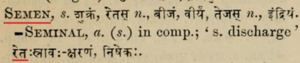
[The Student’s English-Sanskrit Dictionary, page 384, by V.S. Apte, Published in 1893]
The apologist has deliberately distorted the Sanskrit wording to serve his agenda. Despite these distortions, his work was widely appreciated, as many Hindus did not take the trouble to examine or verify these apparent inaccuracies.
With regard to the second rebuttal, an explanation is required as to which Sanskrit words in verse 20 have been rendered as “criminals,” “Ishwar,” “cooperate,” and “developing resources.” Such renderings are not grounded in the original text.
The inconsistencies found across different apologetic translations arise because each translator imposes a personal interpretation rather than adhering to the explanations preserved in the Brahmanas, Puranas, and traditional commentaries. This wide variation in translations strongly suggests a deliberate attempt to obscure the original meaning of the text rather than to convey it faithfully.
To know more about obscenity in Hinduism, read the article Hinduism and Lust.