Written by Sulaiman Razvi
The caste system is one of the most persistent and harmful features of Hindu religion that continues to shape Indian society. It functions primarily as a mechanism for isolating and marginalising lower castes, dividing people within the Hindu fold itself. Historically, the condition of lower caste communities was deeply miserable, marked by sustained Brahminical oppression. Under the rule of the Peshwas and Marathas, Untouchables were barred from entering the city limits of Pune. In Gujarat, they were forced to wear horns as markers of humiliation, while in Bombay they were prohibited from wearing clean or intact clothing. Low caste women were not permitted to cover their breasts, a practice temporarily abolished under Tipu Sultan but later reinstated after his death. In the eighteenth century, this oppression culminated in the Channar revolt, which led many lower caste Hindus to convert to other religion. Systematic discrimination and social exclusion also pushed large numbers of lower caste Hindus to embrace Islam. As Swami Vivekananda himself observed,
“Why amongst the poor of India so many are Mohammedans? It is nonsense to say, they were converted by the sword. It was to gain their liberty from the . . . zemindars and from the . . . priest” (Source)
Discrimination of Lower Castes in Modern India
Historically, Islam entered India as a liberating force for lower castes, offering a doctrine of egalitarianism that stood in stark contrast to the birth based discrimination inherent in Hinduism. Despite the Indian Constitution guaranteeing equality, the systemic oppression of the caste system persists. Modern instances of this bigotry are evident when a temple underwent a “purification” ritual following a visit by former Bihar Chief Minister Jitan Ram Manjhi, a Dalit. Furthermore, systemic exclusion often drives Dalits to threaten conversion to Islam as a protest against temple bans. The physical brutality of this hierarchy is underscored by cases where a Dalit man was immolated for using a communal hand pump and another was murdered for a ringtone honoring Dr. B.R. Ambedkar. These atrocities, alongside the prevalence of caste-based honor killings, highlight a deep-seated resistance to social reform within the Hindu framework.
“As many as 1,89,945 cases of crime against Dalits were registered in four years beginning 2018, the Union government told Parliament on Tuesday, citing a National Crime Records Bureau report published in 2021.” (Source)
The National Human Rights Commission Report on the Prevention of Atrocities against Scheduled Castes says that, “every 18 minutes a crime is committed against a Dalit. Every day 3 Dalit women are raped, 2 Dalits are murdered and 2 Dalits Houses are burnt in India, 11 Dalits are beaten. Every week: 13 Dalits are murdered, 5 Dalits home or possessions are burnt, 6 Dalits are kidnapped or abducted.” (IndiaToday; TheCitizen.in)
“…in 27.6% of India’s villages, Dalits are prevented from entering police stations. In 25.7% of the country’s villages, Dalits are prevented from entering ration shops. In 35% of villages, Dalits are barred from selling produce in local markets. In 47% of villages with milk cooperatives, Dalits are prevented from selling milk, and in 25% of such villages, they are prevented from buying milk altogether.
Further, according to official Indian crime statistics, 27 atrocities against Dalits are committed every day. 13 Dalits are murdered every week. 3 Dalit women are raped every day. A crime is committed against a Dalit every 18 minutes. This, despite the Scheduled Castes and Scheduled Tribes (Prevention of Atrocities) Act, 1989. Worse, these crimes are on the rise. According to data released by NACDOR, a total of 3,198 cases related to atrocities on dalits have been registered between 2004 and 2013 as against 1,305 from 1994 to 2003. These crimes rose by another 19 percent in 2014. According to statistics compiled by the National Crime Records Bureau (NCRB), crimes against SCs rose to 47,064 in 2014 from 39,408 in 2013. In 2012 there were 33,655 crimes against dalits, about the same as in 2011…” Source: TheCitizen
There have been thousands of incidents of caste related violence in India, as documented in sources such as Wikipedia’s article on caste related violence in India. These acts of violence, largely perpetrated by dominant castes against lower castes, are deeply rooted in religious doctrine. Hindu mythology itself contains narratives that legitimise caste oppression, such as the story of Rama beheading a Shudra named Shambuka solely for performing religious austerities. Stories of this nature are bound to inspire radical and exclusionary attitudes.
Some Hindu apologists claim that caste does not exist in Hinduism and argue that it is merely a system based on profession rather than birth. This portrayal of equality is often advanced not out of concern for historical accuracy or social justice, but to project Hinduism as a morally superior and egalitarian religion before a global audience. Such claims would be commendable if they were made with genuine intent to emancipate oppressed castes. However, this narrative often serves ulterior motives. Politicians court Dalits primarily for electoral gains or to mobilise them during communal unrest, while religious leaders seek to expand their follower base, knowing that increased numbers bring greater donations and influence.
One such reformer was Dayanand Saraswati, who asserted that the Vedas treat all castes equally. Yet this claim appears strategic rather than transformative. He neither abolished caste distinctions nor rejected caste hierarchy. On the contrary, he upheld the system by asserting that the duty of a Shudra was to serve the Dvijas and by treating the Manu Smriti as an authoritative text. His views clearly reflect caste discrimination, as discussed in the article Mulshankar and Casteism.
As expected, Hindus often seek to deflect blame onto other religions, particularly Muslims, for oppressive and barbaric practices that are deeply rooted within Hinduism itself. Ashok Singhal of the militant outfit VHP once claimed that Islamic invasions of India were responsible for the caste system. Such assertions are common among Hindus who are poorly informed about their own scriptures and historical traditions.
Hindutva forces and other Hindu extremist organisations frequently organise Ghar Wapsi campaigns and rallies targeting religious minorities, yet they rarely, if ever, undertake comparable initiatives for the social upliftment or equal status of lower caste Hindus. This selective activism reveals a clear reluctance to confront entrenched caste hierarchies while projecting reformist and nationalist intentions outward.
Moreover, the Purusha Sukta of the Rig Veda 10.90.12, often cited as the ideological foundation of the caste system, is an integral part of the Vedic corpus and explicitly describes the Brahmin as emerging from the mouth, the Kshatriya from the arms, the Vaishya from the thighs, and the Shudra from the feet, reinforcing the argument that caste hierarchy is embedded within Hindu religious thought rather than being a later distortion.
Some verses are discussed in more than one section because they are relevant to multiple categories.
Birth based Caste System
As is well established, the caste system in Hinduism is determined by birth rather than by the profession an individual acquires. Medhatithi writes on Manu Smriti 2.148, “Jati stands for ‘Janma’, birth.” (Source)
Apastamba Dharma Shastra 1.1.1.4-5 “[There are] four castes Brahmana, Kshatriyas, Vaishya, and Shudra. Among these, each preceding (caste) is superior by birth to the one following.” Tr. Georg Buhler (Source)
Mahabharata 13.143.6 “The illustrious one said, ‘The status of a Brahmana, O goddess, is exceedingly difficult to attain. O auspicious lady, one becomes a Brahmana through original creation or birth. After the same manner the Kshatriya, the Vaisya, and the Sudra, all become so through original creation.” Tr. K.M. Ganguli (Source)
Kisari Mohan Ganguli writes,
“Nisargat is literally through creation or original nature, or birth. Of course, what is implied is that one becomes a Brahmana, or Kshatriya, or Vaisya or Sudra, through original creation as such, by the Self-born, that is, birth.” [ Source ]
Narada Purana I.24.7-9 “Those castes are said to be four, viz., the Brahmans, Ksatriyas, Vaisyas and Sudras. Among these the Brahmana is the foremost. The Brahmanas, Ksatriyas and Vaisyas- these three are called Dvijas (the twice-born), because at first they are born of their mothers and later on, they are consecrated by means of sacred thread with due repetition of the Mantras (which constitute the second birth). Thus twice-born-ness is attained by these three classes. All holy rites and duties must be performed by these castes in accordance with the specific duties prescribed for their castes. By failing to perform the holy duties prescribed for one’s own caste, one is called a heretic by learned men.” Tr. G.V. Tagare (Source)
Bhagavat Purana states,
Srimad Bhagavatam 11.5.5 “But Brahmanas, Ksattriyas and Vaisyas, by virtue of their original birth, and second birth through their Upanayana (investiture of the sacred thread) ceremony (become eligible for studies, performance of sacrifices, etc.) …” Tr. G.V. Tagare, edited by J.L. Shastri (Source)
Srimad Bhagavatam 10.86.53 “By his very birth, a brahmana is the best of all living beings in this world, and he becomes even more exalted when he is endowed with austerity, learning and self-satisfaction, what to speak of devotion to me.” Tr. Swami Prabhupada (Source)
Shiva Purana, Uma Samhita 5, chapter 44, verse 13 “O excellent sage, birth as a man is very difficult to obtain; especially that as a Brahmin…” Tr. J.L. Shastri (Source)
Padma Purana II.38.20b-24 “[The Sages said:] The three castes viz. brahmanas, ksatriyas and vaissyas are twice born. This (i.e. the Veda) is an ancient sacred text meant for all the castes. The beings behave according to the Vedic practices; therefor they (continue to) live. You are born in the family of Brahman. (So) you are a brahmana only.” Tr. N.A. Deshpande (Source)
Manu Smriti 8.20-21 “The Judicial officer of a king must be a Brahmana even if he be a mere Brahmana by birth (and bereft of the virtues of his order), or a mere professional adjudicator of issues, and not a Sudra under any circumstances whatsoever.” Tr. M.N. Dutt (Source)
Agni Purana 162.3-7 “…By reading the Vedas and practicing equally to all, a man enters the region of paradise. This is the prerogative of the twice born castes, specifically belonging to a Brahamana as his birth right, as he might read the Vedas and realise the truths inculcated therein by living any of the four orders of life. A Brahmana by dwelling in this world, may attain the Supreme Brahma.” Tr. M.N. Dutt (Source)
The following verse undermines the entire argument of modern apologists, as it explicitly promotes a birth based caste system and simultaneously excludes Shudras from access to knowledge.
Vasistha Dharma Shastra 4.1-3 “The four castes are distinguished by their origin and by particular sacraments. There is also the following passage of the Veda, ‘The Brâhmana was his mouth, the Kshatriya formed his arms, the Vaisya his thighs; the Sûdra was born from his feet.’ It has been declared in (the following passage of) the Veda that (a Sûdra) shall not receive the sacraments, ‘He created the Brâhmana with the Gâyatrî (metre), the Kshatriya with the Trishtubh, the Vaisya with the Gagatî, the Sûdra without any metre.’ Tr. Georg Buhler (Source)
The Skanda Purana explicitly states that a Shudra must not study or perform sacrifices and must remain in the same status into which he is born, directly contradicting the apologetic claim that a Shudra can become a Brahmin through Vedic study.
Skanda Purana V.iii.122.16 “A separate duty has not been assigned by Paramesthin to the Sudra. He need not have any Mantra, consecration or pursuit of lores. He need not have any conventional study of the science of words (i.e. Grammar) and special worship of deities. He has to be, day and night, in the same state as at birth.” Tr. G.V. Tagare (Source)
Manu Smriti 10.3 “On account of his pre-eminence, on account of the superiority of his origin, on account of his observance of (particular) restrictive rules, and on account of his particular sanctification the Brahmana is the lord of (all) castes (varna).” Tr. Georg Buhler (Source)
Manu Smriti 1.98-99 “The very birth of a Brahmana is an eternal incarnation of the sacred law; for he is born to (fulfil) the sacred law, and becomes one with Brahman. A Brahmana, coming into existence, is born as the highest on earth, the lord of all created beings, for the protection of the treasury of the law.” Tr. Georg Buhler (Source)
Katyayana Samhita 8.6 “Many wives of the same caste and of other castes existing, the rite of churning, for producing the Fire, should be done by the chaste wives of the same caste, on account of the superiority of birth.” Tr. Manmatha Nath Dutt (Source)
Mahabharata, Santi Parva 12 Section 72 “…Matariswan answered, ‘The Brahmana, O best of kings, has sprung from the mouth of Brahman. The Kshatriya has sprung from his two arms, and the Vaisya from his two thighs. For waiting upon these three orders, O ruler of men, a fourth order, viz., the Sudra, sprung into life, being created from the feet (of Brahman). Originally created thus, the Brahmana takes birth on earth as the lord of all creatures, his duty being the keep of the Vedas and the other scriptures. Then, for ruling the earth and wielding the rod of chastisement and protecting all creatures, the second order, viz., the Kshatriya was created. The Vaisya was created for supporting the two other orders and himself by cultivation and trade, and finally, it was ordained by Brahman that the Sudra should serve the three orders as a menial.’ “Pururavas said, ‘Tell me truly, O god of Winds, to whom, this earth righteously belong. Does it belong to the Brahmana or to the Kshatriya?’ “The god of Winds said, ‘Everything that exists in the universe belongs to the Brahmana in consequence of his birth and precedence. Persons conversant with morality say this. What the Brahmana eats is his own. The place he inhabits is his own. What he gives away is his own. He deserves the veneration of all the (other) orders. He is the first-born and the foremost. As a woman, in the absence of her husband, accepts his younger brother for him, even so the earth, in consequence of the refusal of the Brahmana, has accepted his next-born, viz., the Kshatriya, for her lord…” Tr. K.M. Ganguli (Source)
Impossible for Lower Castes to attain Brahminhood
Devi Bhagavatam 9.29.68-69 “A Kshatriya or a Vaishya can never obtain Brahmanahood, even if he performs asceticism for one Koti Kalpas. This is stated in the Shrutis. Without enjoying the fruits, no Karma can be exhausted even in one hundred Koti Kalpas.” Tr. Swami Vijnananda (Source)
Mahabharata 13.27.3-6 “O best of kings, how may one, if he happens to be a Kshatriya or a Vaisya or a Sudra, succeed in acquiring the status of a Brahmana? It behoveth thee to tell me the means. Is it by penances the most austere, or by religious acts, or by knowledge of the scriptures, that a person belonging to any of the three inferior orders succeeds in acquiring the status of a Brahmana? Do tell me this, O grandsire!’ “Bhishma said, ‘The status of a Brahmana, O Yudhishthira, is incapable of acquisition by a person belonging to any of the three other orders. That status is the highest with respect to all creatures. Travelling through innumerable orders of existence, by undergoing repeated births, one at last, in some birth, becomes born as a Brahmana.” Tr. K.M. Ganguli (Source)
Caste Is Based on the Karma of the Previous Life
According to Hindu doctrine, a person is born into a particular caste as a consequence of deeds performed in a previous life, as stated by Krishna.
Gita 18.41 “Brāhmaṇas, kṣatriyas, vaiśyas and śūdras are distinguished by the qualities born of their own natures in accordance with the material modes, O chastiser of the enemy.” Tr. Swami Prabhupada (Source)
Ramanuja Acharya commented on this verse as follows,
“The character of Brahmanas, Ksatriyas, Vaishyas, and Sudras arise from their various inherent dispositions. In other words their past Karma is the cause of their being born in a specific social group…” (Source)
Swami Swarupananda commented on this verse as follows,
“According to the Karma or habits and tendencies formed by desire, action, and association in the past life manifesting themselves in the present as effects. Or, nature (Svabhava) may here mean the Maya made up of three Gunas, the Prakriti of the Lord” (Source)
It is mentioned in Brahma Vaivarta Purana,
Brahma Vaivarta Purana, Krishna Janma Khanda 74.10 “According to Karma, some go to heaven or are severally born in the houses of a Brahmin, Ksatriya, Vaisya or a Sudra.” Tr. Rajnedra Nath Sen (Source)
Chandogya Upanishad 5.10.7. ‘Those whose conduct has been good, will quickly attain some good birth, the birth of a Brahmana, or a Kshatriya, or a Vaisya. But those whose conduct has been evil, will quickly attain an evil birth, the birth of a dog, or a hog, or a Kandala.” Tr. Swami Nikhilanda (Source)
Caste is Inherited from One’s Parents
Caste is hereditary, Brahmin parents beget Brahmin children, and Shudra parents beget Shudra children.
Manu Smriti 10.5 “In all castes (varna) those (children) only which are begotten in the direct order on wedded wives, equal (in caste and married as) virgins, are to be considered as belonging to the same caste (as their fathers).” Tr. Georg Buhler (Source)
Medhatithi commented on above verse as follows,
“‘Among all castes,’— the definition that is applicable is that those born of women ‘0f equal status’—of the same caste as the husband,—these women being the ‘wives’—lawfully wedded consorts,—are to be regarded as the same. That is, in most cases, the caste of the child born of parents legally married is the same as that of its parents.
Since the term ‘wife’ is a relative term, it follows that the person who has married her is the ‘father’ of the child. So that the meaning comes to be that the child is of the same caste as the parents, when it is born of the woman from that same person who has wedded her.” Medhatithi on Manu Smriti 10.5 (Source)
Mahbharata 13.48 “The Brahmana may take four wives, one from each of the four orders. In two of them (viz.,the wife taken from his own order and that taken from the one next below), he takes birth himself (the children begotten upon them being regarded as invested with the same status as his own)… A Kshatriya may take three wives… The Vaisya may take two spouses…The Sudra can take only one wife, viz., she that is taken from his own order. The son begotten by him upon her becomes a Sudra….” Tr. K.M. Ganguli (Source)
If the parents belong to different castes, the child does not fully belong to either the father’s or the mother’s caste, and in some cases is assigned to the mother’s caste.
Vishnu Smriti 16.1-3 “Sons [begotten] on women equal in caste [to their husbands] are equal in caste [to their fathers]. [Sons begotten] on women of lower castes, become of the caste of their mothers. Sons begotten on women of higher castes are despised by the twice-born.” Tr. Julius Jolly (Source)
Agni Purana 150.9-11 “The duties which appertain to the Shudra caste, O thou best of the Bhrigus, are to serve the Brahmins and to practice the handicrafts. Since the investiture with the holy thread, a member of the twice born caste is supposed to take a second spiritual birth, and I shall describe the castes which children born of parents not members of the same caste, would respectively belong to. A child born of parents belonging to different castes would get the caste of its mother, but on the contrary a child born of a Shudra father by a Brahmin mother would be a Chandala.” Tr. M.N. Dutt (Source)
Manusmriti 10.6–23 enumerates the castes said to arise from various forms of inter-caste marriages.
Manusmriti 10.6-23 “Sons, begotten by twice-born man on wives of the next lower castes, they declare to be similar (to their fathers, but) blamed on account of the fault (inherent) in their mothers. Such is the eternal law concerning (children) born of wives one degree lower (than their husbands); know (that) the following rule (is applicable) to those born of women two or three degrees lower. From a Brahmana a with the daughter of a Vaisya is born (a son) called an Ambashtha, with the daughter of a sudra a Nishada, who is also called Parasava. From a Kshatriya and the daughter of a Sudra springs a being, called Ugra, resembling both a Kshatriya and a Sudra, ferocious in his manners, and delighting in cruelty. Children of a Brahmana by (women of) the three (lower) castes, of a Kshatriya by (wives of) the two (lower) castes, and of a Vaisya by (a wife of) the one caste (below him) are all six called base-born (apasada). From a Kshatriya by the daughter of a Brahmana is born (a son called) according to his caste (gati) a Suta; from a Vaisya by females of the royal and the Brahmana (castes) spring a Magadha and a Vaideha. From a Sudra are born an Ayogava, a Kshattri, and a Kandala, the lowest of men, by Vaisya, Kshatriya, and Brahmana) females, (sons who owe their origin to) a confusion of the castes. As an Ambashtha and an Ugra, (begotten) in the direct order on (women) one degree lower (than their husbands) are declared (to be), even so are a Kshattri and a Vaidehaka, though they were born in the inverse order of the castes (from mothers one degree higher than the fathers). Those sons of the twice-born, begotten on wives of the next lower castes, who have been enumerated in due order, they call by the name Anantaras (belonging to the next lower caste), on account of the blemish (inherent) in their mothers. A Brahmana begets on the daughter of an Ugra an Avrita, on the daughter of an Ambashtha an Abhira, but on a female of the Ayogava (caste) a Dhigvana. From a Sudra spring in the inverse order (by females of the higher castes) three base-born (sons, apasada), an Ayogava, a Kshattri, and a Kandala, the lowest of men; From a Vaisya are born in the inverse order of the castes a Magadha and a Vaideha, but from a Kshatriya a Suta only; these are three other base-born ones (apasada). The son of a Nishada by a Sudra female becomes a Pukkasa by caste (gati), but the son of a Sudra by a Nishada female is declared to be a Kukkutaka. Moreover, the son of by Kshattri by an Ugra female is called a Svapaka; but one begotten by a Vaidehaka on an Ambashtha female is named a Vena. Those (sons) whom the twice-born beget on wives of equal caste, but who, not fulfilling their sacred duties, are excluded from the Savitri, one must designate by the appellation Vratyas. But from a Vratya (of the) Brahmana (caste) spring the wicked Bhriggakantaka, the Avantya, the Vatadhana, the Pushpadha, and the Saikha. From a Vratya (of the) Kshatriya (caste), the Ghalla, the Malla, the Likkhivi, the Nata, the Karana, the Khasa, and the Dravida. From a Vratya (of the) Vaisya (caste) are born a Sudhanvan, an Akarya, a Karusha, a Viganman, a Maitra, and a Satvata.” Tr. Georg Buhler (Source)
It is mentioned in Yajnavalkya,
Yajnavalkya Smriti verse 90 “Sons of the same caste are begotten by [person of the same] caste upon [wives of the] same caste. Sons [begotten] in unblamable marriages (such as Brahma etc.,) multiply the race.” Tr. M.N. Dutt (Source)
Like Manu, Yajnavalkya also proceeds to enumerate various castes from verse 91 onward. However, this scheme does not appear to apply in cases of Niyoga. According to the tradition, when Kshatriya men were exterminated, Kshatriya women approached Brahmins for Niyoga, yet the sons born from these unions were still regarded as Kshatriyas.
Mahabharata 1.104 “And the illustrious scion of Bhrigu’s race, by means of his swift arrows annihilated the Kshatriya tribe one and twenty times. “And when the earth was thus deprived of Kshatriyas by the great Rishi, the Kshatriya ladies all over the land had offspring raised by Brahmanas skilled in the Vedas. It has been said in the Vedas that the sons so raised belongeth to him that had married the mother. And the Kshatriya ladies went in unto the Brahamanas not lustfully but from motives of virtue. Indeed, it was thus that the Kshatriya race was revived.” Tr. K.M. Ganguli (Source)
Sons born to a father of a higher caste, such as a Brahmin, are described in the Manusmriti as possessing Brahminical qualities, even though they are assigned a caste lower than that of their father.
Manu Smriti 10.67-69 “The decision is as follows: ‘He who was begotten by an Aryan on a non-Aryan female, may become (like to) an Aryan by his virtues; he whom an Aryan (mother) bore to a non-Aryan father (is and remains) unlike to an Aryan.’ The law prescribes that neither of the two shall receive the sacraments, the first (being excluded) on account of the lowness of his origin, the second (because the union of his parents was) against the order of the castes. As good seed, springing up in good soil, turns out perfectly well, even so the son of an Aryan by an Aryan woman is worthy of all the sacraments.” Tr. Georg Buhler (Source)
Some scholars interpret the term “sacraments” here as referring to minor rites, such as the Pakayajnas, which may also be performed by lower castes. It is mentioned in Mahabharata,
Mahabharata 13.48.5 “The son that is begotten by a Brahmana upon a Sudra wife is called Parasara, implying one born of a corpse, for the Sudra woman’s body is as inauspicious as a corpse. He should serve the persons of his (father’s) race. Indeed, it is not proper for him to give up the duty of service that has been laid down for him.” Tr. K.M. Ganguli (Source)
This is yet another indication that caste is determined by birth within a particular family. A child born to Brahmin parents is a Brahmin by birth, while a child born to Shudra parents is a Shudra by default, with this status treated as permanent for the entire lifetime.
Caste Transition Restricted to Successive Lives
Hindu apologists often misinterpret texts to suggest that certain individuals attained a higher caste within the same lifetime. In fact, the scriptures consistently indicate that caste elevation or degradation occurs only in subsequent births. According to the consensus of Hindu law texts, a person’s caste in a given life is fixed by birth, with changes in future incarnations only.
Apastamba Dharma Sutra 2.5.11.10-11 “In successive births men of the lower castes are born in the next higher one, if they have fulfilled their duties. In successive births men of the higher castes are born in the next lower one, if they neglect their duties.” Tr. Georg Buhler (Source)
Manu Smriti 10.42 “By the power of austerities and of the seed (from which they sprang), these (races) obtain here among men more exalted or lower rank in successive births.” Tr. Georg Buhler (Source)
Manu Smriti 9.334-5 “But to serve Brahmanas (who are) learned in the Vedas, householders, and famous (for virtue) is the highest duty of a Sudra, which leads to beatitude. (A Sudra who is) pure, the servant of his betters, gentle in his speech, and free from pride, and always seeks a refuge with Brahmanas, attains (in his next life) a higher caste.” Tr. Georg Buhler (Source)
Mahabharata, Anusasana Parva, 13.28 “…If born as human being, he is sure to take birth as a Pukkasa or a Chandala. Verily, one having taken birth in that sinful order of existence, viz., Pukkasa, one, O Matanga, has to wander in it for a very long time. Passing a period of one thousand years in that order, one attains next to the status of a Sudra. In the Sudra order, again, one has to wander for a long time. After thirty thousand years one acquire the status of a Vaisya. There, in that order, one has to pass a very long period. After a time that is sixty times longer than what has been stated as the period of Sudra existence, one becomes a person of the fighting order. In the Kshatriya order one has to pass a very long time. After a time that is measured by multiplying the period last referred to by sixty, one becomes born as a fallen Brahmana. In this order one has to wander for a long period. After a time measured by multiplying the period last named by two hundred, one becomes born in the race of such a Brahmana as lives by the profession of arms. There, in that order, one has to wander for a long period. After a time measured by multiplying the period last named by three hundred, one takes birth in the race of a Brahmana that is given to the recitation of the Gayatri and other sacred Mantras. There, in that order, one has to wander for a long period. After a time measured by multiplying the period last named by four hundred, one takes birth in the race of such a Brahmana as is conversant with the entire Vedas and the scriptures…” Tr. K.M. Ganguli (Source)
Thus, irrespective of personal conduct or achievement, an individual is required to perform only the duties prescribed for their birth-based caste, with the prospect of attaining a higher caste deferred to future births, often after many lifetimes.
Some examples illustrating caste change only across births, not within the same life:
Skanda Purana V.ii.22 states that a Kshatriya king had been born as a Shudra named Somaka in a previous life.
Srimad Bhagavatam 1.13.15 records that Yama, having been cursed by Sage Manduka, was born as a Shudra.
Srimad Bhagavatam 7.15.72–73 narrates that Sage Narada was cursed to be born as a Shudra from the womb of a maidservant, and only after serving Brahmins in that life was he reborn as a Brahmana.
Shiva Purana, Kotirudra Samhita 4.9.3 mentions that a Brahmin woman named Saumini became an outcaste in her next birth.
Mahabharata 13.10 states that a Shudra, by acquiring merit through prescribed conduct, was reborn in his next life in the family of a great king and eventually attained great splendour.
Prabhupada writes on Srimad Bhagavatam 4.30.48 “In this connection the word mahad-avajñānāt is significant. King Dakṣa was the son of Lord Brahmā; therefore in a previous birth he was a brāhmaṇa. But because of his behaving like a non-brāhmaṇa (abrāhmaṇa) by insulting or disrespecting Lord Mahādeva, he had to take birth within the semen of a kṣatriya — that is to say, he became the son of the Pracetās.” (Source)
These examples demonstrate that, individuals attain a higher caste or are degraded to a lower one only in a subsequent birth, never within the same lifetime. This position is explicitly stated in Apastamba Dharma Sutra 2.5.11.10–11, which holds that advancement or degradation in caste occurs solely through successive births. This raises a deeper question, why should divine order operate in this way at all? Why does Hindu theology depict God as assigning rigid, birth based occupations, as if social roles were predetermined appointments rather than matters of aptitude or choice? Dr. B. R. Ambedkar, born into a Dalit family, rose through education and determination to become India’s first Law Minister and the chief architect of its Constitution. Human societies recognise that individuals have diverse talents and aspirations. The insistence that one must remain confined to the occupation of birth suggests not divine wisdom, but a denial of human potential.
Discrimination on the Basis of Caste
These verses from the Mahabharata explain a physical and mythical reason for the caste hierarchy. They assign specific skin colors to each Varna to establish social divisions. Furthermore, they present the vanishing of the sacred Sarasvati River as a sign of divine disdain for Shudras. This illustrates how religious stories were used to create and justify the exclusion of marginalized groups.
Mahabharata 12.188.5 “The complexion the Brahmanas obtained was white; that which the Kshatriyas obtained was red; that which the Vaisyas got was yellow; and that which was given to the Sudras was black.” Tr. K.M. Ganguli (Source)
Mahbharata 9.38.1-2 “Vaishampayana said, “Then Valadeva, O king, proceeded to Vinasana where the Sarasvati hath become invisible in consequence of her contempt for Sudras and Abhiras. And since the Sarasvati, in consequence of such contempt, is lost at that spot, the Rishis, for that reason, O chief of the Bharatas, always name the place as Vinasana.” Tr. Kisari Mohan Ganguli (Source)
Swami Prabhupada, the founder of ISKCON, explicitly argued that Shudras should not be given freedom or treated as social equals.
Swami Prabhupada said, “Śūdra is to be controlled only. They are never given to be freedom. Just like in America. The blacks were slaves. They were under control. And since you have given them equal rights they are disturbing, most disturbing, always creating a fearful situation, uncultured and drunkards. What training they have got? They have got equal right? That is best, to keep them under control as slaves but give them sufficient food, sufficient cloth, not more than that. Then they will be satisfied.” Room Conversation Varṇāśrama System Must Be Introduced — February 14, 1977, Māyāpura Source
Swami Prabhupada said that Shudras have no brain and made several casteist remarks.
“Sudras [black people] have no brain,” he said. “In America also, the whole [of] America once belonged to the Red Indians. Why they could not improve? The land was there. Why [did] these foreigners, the Europeans, came and improved [it]? So sudras cannot do this. They cannot make any [improvements].” (Source)
“The real aim is tam abhyarcya, how to become Kṛṣṇa conscious. Everyone is…. Brāhmaṇa is guiding, kṣatriya is ruling, and vaiśya is producing food, and śūdra, they have no brain; they are helping.” Swami Prabhupada, Morning Walk — April 9, 1976, Vṛndāvana (Source)
Swami Prabhupada said Shudras are ignorant,
“Those who are completely in ignorance are called śūdras. And those who are less than that are animals or animal life.” Swami Prabhupada, Room Conversation — November 3, 1976, Vṛndāvana (Source)
Speaking with Lower Castes Is Prohibited
Despite being often described as a tolerant religion, Hinduism explicitly prohibits a Dvija from conversing with members of lower castes.
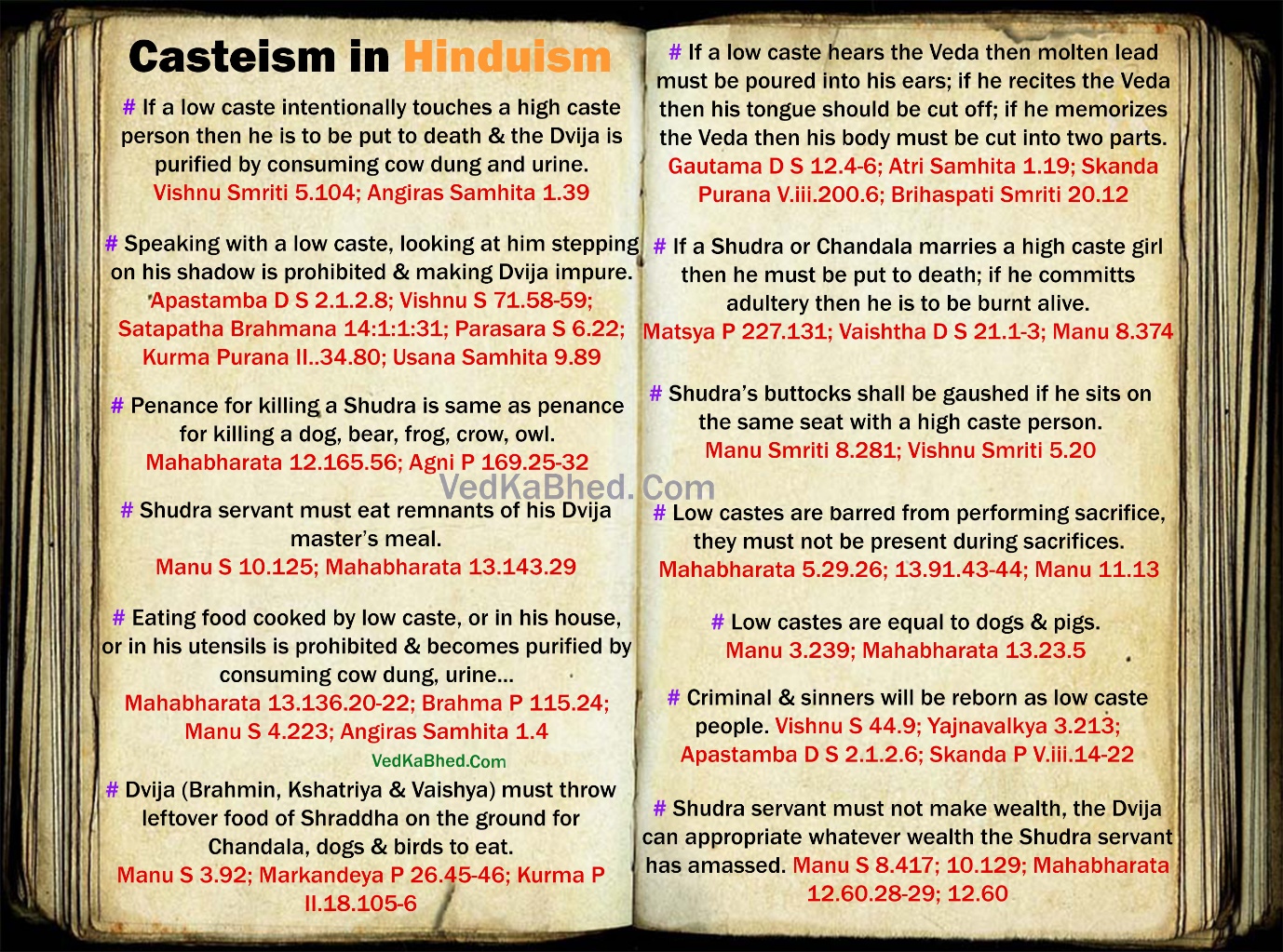
Apastamba Dharma Shastra 2.1.2.8. “As it is sinful to touch a Candala, [so it is also sinful] to speak to him or to look at him. The penance for these [offences will be declared].” Tr. Georg Buhler (Source)
Vyasa Smriti 1.10-12 “To the third kind belong the sons begotten by Sudra fathers on mothers who are Brahmanis. Vardhakis (carpenters), Napitas (barbers), Gopas (milkmen), Ashapas, Kumbhakaras (potters), Vanik (traders), Kayasthas (Userers), Malakaras (flower-men), Varatas, Medas, Chandalas, Dasas, Shvapachas, Kolas and beef eaters belong to the lowest castes of men. Even a conversation with a person of any of these castes should be expiated by an ablution and a sight of the sun.” Tr. M.N. Dutt (Source)
Usana Samhita Chapter 2, Verse 4-6 “After conversing with a Chandala or a Mlechchha, after talking with abandoned women or with Sudras…drinking or touching urine and excreta, one should rinse his mouth again, even if he has rinsed it once…” Tr. Manmatha Nath Dutt (Source)
Vishnu Smriti 71.58-59 “He must not speak to a woman in her courses; Nor to barbarians or low-caste persons.” Tr. Julius Jolly (Source)
Vishnu Smriti 64.15 “He must not converse, (after having bathed,) with barbarians, low-caste persons, or outcasts.” Tr. Julius Jolly (Source)
Satapatha Brahmana 3:1:1:10 “Let him not commune with every one; for he who is consecrated draws nigh to the gods, and becomes one of the deities. Now the gods do not commune with every one, but only with a Brahman, or a. Râganya, or a Vaisya; for these are able to sacrifice. Should there be occasion for him to converse with a Sûdra, let him say to one of those, ‘Tell this one so and so! tell this one so and so!’ This is the rule of conduct for the consecrated in such a case.” Tr. Julius Eggeling (Source)
The following verse forbids speaking to a person who has married a Shudra woman.
Narada Purana I.23.26 “The observer of the holy rite should never talk to one who nourishes his progeny through a Sudra woman, to the husband of a Sudra woman and to one who performs sacrifices on behalf of those who are not eligible for the same.” Tr. G.V. Tagare
Greeting a low caste person is prohibited.
Atri Samhita 1.308 “He, who unknowingly salutes a lowcaste person, should immediately bathe and get [himself] purified by taking clarified butter.” Tr. Manmatha Nath Dutt (Source)
One shouldn’t even Look at a Low Caste Person
Satapatha Brahmana 14:1:1:31 “And whilst not coming into contact with Sûdras and remains of food; for this Gharma is he that shines yonder, and he is excellence, truth, and light; but woman, the Sûdra, the dog, and the black bird (the crow), are untruth: he should not look at these, lest he should mingle excellence and sin, light and darkness, truth and untruth.” Tr. Julius Eggeling (Source)
Usana Samhita 9.53 “By taking food, out of ignorance, after seeing a Mahapatakin, a Chandala, or a woman in [her] menses, one is purified [by fasting] for three nights.” Tr. Manmatha Nath Dutt (Source)
Parashara Smriti 6.22 “Having seen a Chandala, a Brahmana should cast look at the sun; having touched a Chandala a Brahaman should bathe with all his wearing apparels on.” (Source)
Brahma Purana 113.140-147 “This selfsame purificatory rite should be performed by intelligent persons after looking at the following persons etc. : a woman in her monthly course, a dead body that has been left abandoned and lying (unattended), persons devoid of righteousness or persons of other religions, a woman who has given birth to a child, a eunuch, a naked man, a man of the lowest caste, persons who have carried a dead body and those who are enamoured of other men’s wives.” Tr. J.L. Shastri (Source)
One should avoid undertaking a journey if one sees a Chandala.
Agni Purana 230.1-4 “…A pregnant woman, a widow, drugs such as the Pinyaka, etc., a Chandala, a member of the Shvapacha or any other vile caste, a butcher, or a killer of birds, should be removed from the presence of a man, about to start a journey…” Tr. M.N. Dutt (Source)
Hinduism also states that one should avoid the sight of a person who cooks for a Shudra or who cremates the body of a Shudra or a Chandala, and it equates such persons with bastards, thieves, and similar outcasts.
Brahma Vaivarta Purana, Krishna Janma Khanda 78.33-41 “O father, now I am going to describe to you things whose sight is sinful. Bad dream is the root of sin and sole cause of calamity. The sight of the following…the cook of a S’udra, one who burns the corpse of a S’udra, a Brahmin who eats food prepared in connexion with the funerals of a S’udra…a S’udra, a widow, a Candal…a bastard, a thief, a liar…a Brahmin who is the husband of a barren woman, a S’udra who commits adultery with a Brahmin woman…” Tr. …” Tr. Rajendra Nath Sen (Source)
Manu Smriti explicitly restricts social interaction and travel by prohibiting a Brahmin from journeying in the company of Shudras.
Manu Smriti 4.140 “Let him not journey too early in the morning, nor too late in the evening, nor just during the midday (heat), nor with an unknown (companion), nor alone, nor with Sudras.” Tr. Georg Buhler (Source)
Even stepping on the Shadow of a Lower Caste is Prohibited
Dr. B.R. Ambedkar writes, “Under the rule of the Marathas and the Peshwas the Untouchables were not allowed within the gates of Poona city, the capital of the Peshwas between 3 p. m. and 9 a. m. because, before nine and after three, their bodies cast too long a shadow; and whenever their shadow fell upon a Brahmin it polluted him, so that he dare not taste food or water until he had bathed and washed the impurity away. So also no Untouchable was allowed to live in a walled town; cattle and dogs could freely enter but not the Untouchables.”
The dehumanizing practices documented by Dr. Ambedkar are not mere historical aberrations, but the logical implementation of scriptural mandates that classify the very shadow of a marginalized person as a ritual contaminant.
Usana Samhita 9.89 “By getting on the shadow of a lowcaste person, one should drink clarified butter after bathing. By looking at the Sun in an impure state, one should recite the Mantram Agnindraja.” Tr. Manmatha Nath Dutt (Source)
Kurma Purana II.34.80 “…On treading the shadow of a Candala, one shall take bath and drink ghee.” Tr. G.V. Tagare (Source)
Prohibited for a Shudra Servant to Make Wealth
Mahabharata 12.60.28-29 “A Sudra should never amass wealth, lest, by his wealth, he makes the members of the three superior classes obedient to him. By this he would incur sin. With the king’s permission, however, a Sudra, for performing religious acts, may earn wealth.” Tr. K.M. Ganguli (Source)
The following verse explicitly denies Shudras any ritual autonomy and even legitimises the confiscation of their wealth.
Mahabharata 12.166.8 “The Shudra is not competent to celebrate a sacrifice. The king should, therefore, take away (wealth for such a purpose) from a Shudra’s house.” Tr. M.N. Dutt (Source)
A Shudra servant is not permitted to accumulate wealth independently and must instead seek the king’s approval even to acquire property or resources.
Mahabharata 12.60.36 “The Sudra should never abandon his master, whatever the nature or degree of the distress into which the latter may fall. If the master loses his wealth, he should with excessive zeal be supported by the Sudra servant. A Sudra cannot have any wealth that is his own. Whatever he possesses belongs lawfully to his master.” Tr. K.M. Ganguli (Source)
Manu Smriti 8.417 “Let a Brahmana unhestitangly appropriate to himself whatever (his) Sudra (Slave) has earned, inasmuch as nothing can be belong to the latter, he being himself an enjoyable good of the Brahmana.” Tr. M.N. Dutt (Source)
Manu Smriti 10.129 “No collection of wealth must be made by a Sudra, even though he be able (to do it); for a Sudra who has acquired wealth, gives pain to Brahmanas.” Tr. Georg Buhler (Source)
Touching a Low Castes makes one Impure
Hindu texts prohibit a Dvija, that is a Brahmin, Kshatriya, or Vaishya, from touching low castes, especially Chandalas, and prescribe expiatory rites for such contact. One such penance is the consumption of Panchagavya, a mixture of cow urine, cow dung, milk, curd, and clarified butter, which effectively places low castes as more defiling than cow dung and cow urine themselves. Hinduism recognises only four varnas, and groups such as Chandalas and Musahars fall outside this framework as outcastes, commonly termed Achoots or Untouchables, a designation rooted in the prohibition against physical contact with them. The texts further equate low castes with menstruating women, dogs, and pigs, declaring that contact with any of these necessitates ritual purification for a Dvija. Some passages go so far as to state that a low caste person who intentionally touches a higher caste individual is liable to be put to death.
Vishnu Smriti 5.104 “If one who (being a member of the Kandala or some other low caste) must not be touched, intentionally defiles by his touch one who (as a member of a twice-born caste) may be touched (by other twice-born persons only), he shall be put to death.” Tr. Julius Jolly (Source)
Another translation,
Vishnu Smriti 5.103 “A man belonging to a caste that is not touched, and willingly touching the three [higher] castes, shall be killed.” Tr. Manmatha Nath Dutt (Source)
Angiras Samhita 1.39 “When [a Brahmana] is touched by a woman in [her menses], by a dog or by a Sudra, he becomes purified by the Panchagavya after fasting for a night.” Tr. Manmatha Nath Dutt (Source)
Narada Purana I.14.60b-62a “If one is touched by persons belonging to Candala and Svapaca castes, ablution (for purification) is enjoined even at night, but he shall not stay there with those low castes, at night, he will regain purity immediately after taking bath. If unknowingly a person had been careless enough to stay there (with low castes) at night, his sin is increased a hundred-fold.” Tr. G.V. Tagare (Source)
Garuda Purana 1.222.20-21 “…A brahmin defiled by the touch of a dog or a Sudra defiled by Ucchista shall fast for a night and drink Pancagayva. He shall become pure. Touched by an outcaste he shall fast for five nights.” Tr. J.L. Shastri (Source)
Garuda Purana chapter 231 “…A Brahmana having touched a dog, a S’udra, or any other beast, or a woman in her menses, before washing his face after a meal, shall regain his purity by fasting for a day, and by taking Panchagavyam…” Tr. M.N. Dutt (Source)
Apastamba Dharma Shastra 2.1.2.8. “As it is sinful to touch a Candala, [so it is also sinful] to speak to him or to look at him. The penance for these [offences will be declared].” Tr. Georg Buhler (Source)
Narada Purana I.26.30-31 “If he touches a wet bone, leavings of food, a Sudra, a fallen man, a serpent or a dog, he should bath along with the clothes he is wearing. After touching the funeral pyre, a piece of wood thereon, the sacrificial pole, a Candala and a professional worshipper of idols, he should plunge into water along with the clothes he is wearing.” Tr. G.V. Tagare (Source)
Vamana Purana 15.19 “By touching a woman in menses, a dog, a naked man, a woman recently delivered, and untouchables, one should take a bath for purification, as also those that carry dead bodies.” Tr. Anand Swarup Gupta (Source)
Angiras Samhita 1.9-10 “If he on any occasion, touched by a Sudra who has not washed his mouth after taking meals, he should bathe and recite [the Gayatri] and shall become purified by [fasting for] half a day. If a Vipra is [similarly] touched by a Vaisya, a dog or a Sudra, he shall after fasting for one night become purified with the Panchagavya” Tr. Manmatha Nath Dath
Parasara Smriti 7.22 “A Brahmana, who touched a dog, or a Sudra before washing his mouth, after eating, should fast for a day, and take the compound known as Panchagavyam in order to recover his cleanness.” Tr. Manmatha Nath Dutt (Source)
Yama Samhita verse 41 “A twice-born person, who has the leavings of food in his mouth, on being touched by such a person, a dog, or a Sudra become purified with the Panchagavya, after fasting for a night.” Tr. Manmatha Nath Dutt (Source)
Apastamba Samhita 5.1-2 “What would be the form of expiatory penance for a twice-born one, who, touched by a Chandala, drinks water before performing an A’chamanam? A Brahmana under the circumstance, should regain his purity by fasting for three nights and by taking Panchagavyam, while the term of the penance is two days only for a Kshatriya, its other factors remaining the same.” Tr. Manmatha Nath Dutt (Source)
Apastamba Samhita 7.5 “A woman in her menses, happened to be touched by a S’vapak or a Chandala, should fast for three nights and recover her purity by taking Panchagavyam, thereafter.” Tr. Manmatha Nath Dutt (Source)
Apastamba Samhita 7.19 “A Brahmana-woman in her menses, happening to be touched by a S’udra woman, similarly circumstanced as herself, should regain her purity by fasting for a whole day and night, and by taking Panchagavyam.” Tr. Manmatha Nath Dutt (Source)
Usana Samhita 9.75-76 “By touching a Chandala, a woman who has given birth to a Child, a dead body, a woman in [her] menses or those touched by her, or any outcaste, one should bathe for purification. If, out of mistake, one touches an article touched by a Chandala, a woman who has given birth to a child, or a dead body, purification is attained by bathing, rinsing the mouth and [thereafter] reciting the Gayatri.” Tr. Manmatha Nath Dutt (Source)
Atri Samhita 1.263-4 “By touching a Chandala, an outcaste, a Mlechchha, a wine-bowl, or a woman in [her] menses, a twice-born person should not take his meals. If [he is touched by any of these] while taking [his] meals, [he must at once stop.] Thereafter he should not take his meals; and giving up his food, he should bathe. And being commanded by the Brahmanas, he should fast for three nights. And taking Yavaka (food prepared from barley) together with clarified butter, he should complete the sacrifice” Tr. Manmatha Nath Dutt (Source)
Atri Samhita 1.185 “…if a twice-born person being anointed with oil or clarified butter, touches a Chandala; he should, after fasting for a day and night, purify [himself] with the Panchagavya.” Tr. Manmatha Nath Dutt (Source)
Atri Samhita 1.233 “The foremost of the twice-born, when, having still the leavings of food in his mouth, touched by a caste outside [the pale of the recognised castes], should, after fasting for five nights, get purified with the Panchagavya.” Tr. Manmatha Nath Dutt (Source)
Atri Samhita 1.273 “By being touched by dogs, Chandalas, or crows, a woman in her menses should remain fasting till [the menstrual period] and should get herself purified by bathing in time.” Tr. Manmatha Nath Dutt (Source)
Samvarta Samhita verses 178 “By touching Chandala, an outcaste, a dead-body, a lowcaste, a woman in her menses, and a woman in a state of impurity consequent on child-birth, one should bathe with the cloth on.” Tr. Manmatha Nath Dutt (Source)
Apastamba Samhita 4.5 “…While the term of the penance should be extended to six days in case where he might have touched a Chandala before rinsing his mouth with water, after a meal.” Tr. Manmatha Nath Dutt (Source)
Usana Samhita 5.30-32 “…One should not touch a person of grim visage, a Mlechchha and a woman in menses.” Tr. Manmatha Nath Dutt (Source)
Angiras Samhita 1.37-38 “One does not become of pure conduct so long as the menstrual flow continues. When the menses is stopped, a woman may be employed in domestic works and known for sexual purpose. On the first day [of the menses], she is a Chandala woman; on the second, she is the murderer of a Brahmana; on the third, she is called a washer-woman; and on the fourth day, she becomes purified.” Tr. Manmatha Nath Dath (Source)
Narada Purana I.14.2-3 “I shall mention the atonement to the person who, while taking food, touches an impure or a fallen person or a Candala, either out of anger or due to ignorance. Such a person shall perform bath three times a day (trisavana snana) either for three days or for six days. A Brahmana becomes pure by sipping paca-gavya (the five products of the cow taking collectively, viz. milk, curds, clarified butter, urine, and cowdung).” Tr. G.V. Tagare (Source)
Vishnu Smriti 23.41 “Mire and water in the ruts on a high road, defiled by the touch of a dog, of a crow, or of a low caste person, as well as buildings constructed of baked bricks are purified by the winds.” Tr. M.N. Dutt (Source)
Kurma Purana II.34.65 “A Brahmana, while Ucchista (with particles of food in the mouth or on hand) willfully touches Candalas or fallen persons (outcastes) should observe the Prajapatya vow for purification.” Tr. G.V. Tagare (Source)
Shudras cannot become Kings
Hindu scriptures also prohibit Hindus from residing in regions ruled by or predominantly inhabited by Shudras. In addition, some texts state that the final avatar of Vishnu, Kalki, will persecute Shudra kings.
Shrimad Bhagavatam 11.4.22 “In his incarnation as Buddha, He shall bewilder by his arguments of ahimsa (non-injury) the Daityas performing sacrifices, though not entitled to the performance thereof. Then in the Kali Yuga, incarnating himself as Kalki He shall slay the Shudra kings.” Tr. G.V. Tagare (Source)
Kurma Purana II.16.23-24 “On shall never stay in a village surrounded by unrighteous persons or afflicted by many pestilences. One shall never stay in the kingdom of a Sudra, or in a place inhabited by heretics. A Brahmana should not stay in any other except in the land between the mountains Himavan and the Vindhya and between the Eastern and Western oceans. [26-27] An excellent Brahmana shall not stay anywhere else except within half a Krosa of the holy river (1 Krosa=3 Km). He shall not stay near the village of the Sudras. He should not live in the same place with that of fallen castes, Candalas, Pukkasas, foolish fellows, arrogant persons, Sudras and the people of the lowliest castes called Antavasayins.” Tr. G.V. Tagare
Vayu Purana I.58.76-83 “He will be called Pramiti. He was born of a part of Visnu formerly in the Svayambhuva Manvantara. He wandered over the earth for full twenty years. He led an army consisting of cavalry, chariots and elephants. He was surrounded by hundreds and thousands of Brahmanas armed with weapons. He killed Mlecchas in thousands. He went everywhere. After killing the kings born of Sudra women, he exterminated the heretics. He killed thousands of persons who were not religious and righteous. He killed those born of mixed castes as well as those who depended on them. He killed the Udicyas (northerners), Madya Desyas (people of the Middle Land), mountain-dwellers, easterners, westerners, dwellers in Vindhya and Aparanta. He killed the southerners, Dravidas, Simhalas, Gandharas, Paradas, Pahlavas, Yavanas, Tusaras, Barbaras, Cinas, Sulikas, Daradas, Khasas, Lampakas, Ketas, and the different tribes of Kratas.” Tr. G.V. Tagare, edited by G.P. Bhatt (Source)
Shudras should not be Respected
Tusli Ramayana, Aranya Kanda, Doha 33.1 “A Brahmana, even though he curse you, beat you or speak harsh words to you, is still worthy of adoration; so declare the saints. A Brahmana must be respected, through lacking in amiability and virtue; not a Sudra, though possessing a host of virtues and rich in knowledge.” Tr. Gita Press Gorakhpur (Source)
Parasara Smriti 8.25 “Even a Brahman of a bad character deserves respect; but not so a Shoodra, even though his passions may have been subdued by him. Who would quit a wicked cow, and try to milk a docile female ass?” (Source)
Manu Smriti 3.112 “Even a Vaisya and a Sudra who have approached his house in the manner of guests, he may allow to eat with his servants, showing (thereby) his compassionate disposition.” Tr. Georg Buhler (Source)
Acharya Medhatithi writes on the above verse, “…This last clause has been added with a view to show that those here mentioned are not objects of respect…” (Source)
The following verses from Baudhayana and Apastamba correspond to Manusmriti 3.110; 3.112, which states that if a Shudra is invited as a guest, he should first be made to perform some work and then be fed along with servants. This provision clearly reflects the humiliation and subordination imposed on Shudras, even in situations where they are formally invited as guests.
Baudhayana Dharma Shastra 2.3.5.14 “If a Sûdra (has come as) a guest, he shall order him (to do some) work, (and feed him afterwards).” Tr. Georg Buhler (Source)
Apastamba Dharma Shastra 2.2.4.19 “If a Sûdra comes as a guest (to a Brâhmana), he shall give him some work to do. He may feed him, after (that has been performed).” Tr. Georg Buhler (Source)
Even a Brahmin child commands greater respect than an elderly Kshatriya.
Manu Smriti 2.135 “Know that a Brahmana of ten years and Kshatriya of a hundred years stand to each other in the relation of father and son; but between those two the Brahmana is the father.” Tr. Georg Buhler (Source)
Mahabharata 13.8.21 “If there be a Kshatriya of full hundred years of age and a good Brahmana child of only ten years, the latter should be regarded as a father and the former as a son, for among the two, verily, the Brahmana is superior.” Tr. K.M. Ganguli (Source)
An elderly Shudra is required to salute even a much younger Brahmin. By contrast, one need only rise without offering salutation to an elderly Shudra, as age alone is considered the sole basis of respect accorded to him.
Gautama Dharma Shastra 6.10-11 “In like manner (any) other aged fellow-citizen, even a Sûdra of eighty years and more, (must be honoured) by one young enough to be his son, (And) an Ârya, though (he be) younger, by a Sûdra.” Tr. Georg Buhler (Source)
Torturing the Low-Caste
These verses collectively reveal a rigid and brutal caste hierarchy in which Shudras are subjected to mutilation, torture, and death for acts as minor as speech or proximity, while higher castes receive lenient or no punishment for similar offences. They expose a legal and moral framework that normalises extreme violence against lower castes and institutionalises inequality as religious law.
Brutal Punishment for Insulting Dvijas
Manu Smriti 8.270-1 “A once-born man (a Sudra), who insults a twice-born man with gross invective, shall have his tongue cut out; for he is of low origin. If he mentions the names and castes (gati) of the (twice-born) with contumely, an iron nail, ten fingers long, shall be thrust red-hot into his mouth.” Tr. Georg Buhler (Source)
Apastamba Dharma Shastra 2.27.14-17 “If a Sudra hurls abusive words at a virtuous Arya, his tongue shall be cut out. If, while he is speaking, walking on the road, lying in bed, or occupying a seat, a Sudra pretends to be equal to Aryas, he should be flogged. If a Shudra kills a man, steals, or appropriates land, he should be executed and his property confiscated. If a Brahmin is guilty of these crimes, however, he should be blindfolded.” Tr. Patrick Olivelle (Source)
The irony lies in the fact that a Shudra is subjected to corporal punishment for verbally abusing a Dvija or Twice born individual, whereas a Brahmin or members of other higher castes face no such penalty for similar conduct.
Gautama Dharma Shastra 12.11-13 “But a Brahmana (who abuses) a Kshatriya (shall pay) fifty (Karshapanas), One half of that (amount if he abuses) a Vaisya, (and if he abuses) a Sudra, nothing.” Tr. Georg Buhler (Source)
Matsya Purana 227.67-68 “A Ksatriya who abuses a Brahmana should be fined 100 Panas, a Vaisya doing so should be fined 200 Panas, and a Sudra if he does so should be sentenced to capital punishment. A Brahmana who abuses a Ksatriya should be fined 50 Panas, if he abuses a Vaisya, he should be fined 25 Panas and if he abuses a Sudra the fine should be 12 Panas.” Tr. Taluqdar of Oudh, edited by B.D. Basu (Source)
No Corporal Punishment for Brahmin
Baudhayana Dharma Shastra 2.4.1 “Everybody except a Brahmin is subject to corporal punishment for Adultery.” Tr. Georg Buhler (Source)
Manu Smriti 8.379 “Tonsure (of the head) is ordained for a Brahmana (instead of) capital punishment; but (men of) other castes shall suffer capital punishment.” Tr. Georg Buhler (Source)
Agni Purana 227.51 “The king should kill (criminals belonging to) śūdra and other (communities) and banish the brahmin sinners. The wealth belonging to great sinners should be offered to (god) Varuṇa (God of righteousness).” Tr. N. Gangadharan (Source)
Apastamba Dharma Shastra 2.10.27.16-17 “In case (a Sûdra) commits homicide or theft, appropriates land (or commits similar heinous crimes), his property shall be confiscated and he himself shall suffer capital punishment. But if these (offences be committed) by a Brâhmana, he shall be made blind (by tying a cloth over his eyes).” Tr. Georg Buhler (Source)
If a Shudra is accused of committing certain offences, he is required to prove his innocence through extreme ordeals such as drinking poison or undergoing trials by fire.
Agni Purana 255.32-47 “The accused should fast and bathe at sunrise with all his clothes on the day of the test, and pass through his ordeal in the presence of the king and the Brahmanas. An old, infant, blind, lame, invalid, or a female accused should be tested with the ordeal by scale, while the innocence of a Shudra, should be ascertained by means of the ordeal by fire, water, or the seven Yava (barley) weights of poison… In the ordeal by fire, the palms of the accused, should be first examined as to whether it had not been plastered over with clay… Then the accused should address the fire god as follows:- “Thy seat is in the inside of all creatures, O Fire, and thou art the witness of acts of merit and demerit. I have held thee in my palms, speak truth, O god, as a witness of my innocence.” Then a red hot iron ball, weighing fifty Palas should be placed on his palms, covered as above and the accused or the person suspected, should be asked to slowly walk over seven Mandalas or rings… In an ordeal by poison, the accused should first address the poison to be imbibed… Thus having addressed the poison (born of a hill), he should imbibe the same in the presence of the assembled Brahmanas. His innocence should be established, if he could assimilate the poison safely without retching or vomiting.” Tr. M.N Dutt (Source)
Punishment for Hurting Dvijas
The following verses prescribe unequal punishments for the same crimes, privileging Brahmins with leniency while subjecting lower castes to harsher and even fatal penalties.
The following verses prescribe brutal punishment for a Shudra who harms members of the upper castes.
Manu Smriti 8.279-280 “With whatever limb a man of a low caste does hurt to (a man of the three) highest (castes), even that limb shall be cut off; that is the teaching of Manu. He who raises his hand or a stick, shall have his hand cut off; he who in anger kicks with his foot, shall have his foot cut off.” Tr. Gerog Buhler (Source)
Manu Smriti 8.282-3 “If out of arrogance he spits (on a superior), the king shall cause both his lips to be cut off; if he urines (on him), the penis; if he breaks wind (against him), the anus. If he lays hold of the hair (of a superior), let the (king) unhesitatingly cut off his hands, likewise (if he takes him) by the feet, the beard, the neck, or the scrotum.” Tr. Georg Buhler (Source)
Agni Purana 227.29 One of a lower caste should without enquiry be severed of the organ by which he had done harm to a member of the (three) higher castes.” Tr. N. Gangadharan (Source)
Agni Purana 227.21-31 “…a Shudra using force to a Kshatriya should have his tongue cut off. A Shudra who would aspire to give moral instructions to a Brahmana, should be punished by the king…” Tr. M.N. Dutt (Source)
Manu Smriti 9.248 “But the king shall inflict on a base-born (Sudra), who intentionally gives pain to Brahmanas, various (kinds of) corporal punishment which cause terror.” Tr. Georg Buhler (Source)
Vishnu Smriti 5.19-25 “With whatever limb an inferior insults or hurts his superior in caste, of that limb the king shall cause him to be deprived. If he places himself on the same seat with his superior, he shall be banished with a mark on his buttocks. he shall lose both lips; If he spits on him, If he breaks wind against him, his hindparts; If he uses abusive language, his tongue. If a (low-born) man through pride give instruction (to a member of the highest caste) concerning his duty, let the king order hot oil to be dropped into his mouth. If a (low-born man) mentions the name or caste of a superior revilingly, an iron pin, ten inches long, shall be thrust into his mouth (red hot).” Tr. Julius Jolly (Source)
Narada Smriti 15.25 “With whatever limb a man of low caste offends against a Brahman, that very limb of his shall be cut off; such shall be the atonement for his crime.” Tr. Julius Jolly (Source)
Penance for Killing a Shudra
In many Hindu texts, the penance for killing a Shudra is equated with that for killing animals, while the Manu Smriti prescribes harsher, and in some cases death penalty for killing a Brahmin, exposing a deeply unequal valuation of human life.
Mahabharata 12.165.56 “Having slain a dog or bear or camel, one should perform the same penance that is laid down for the slaughter of a Sudra.” Tr. K.M. Ganguli (Source)
Agni Purana 169.25-32 “…A man having killed a cat, a mongoose, a frog, a dog, a Godha, an owl, and a crow, should practice the penance he ought to have done, if he had killed a Shudra…” Tr. M.N. Dutt (Source)
The following describes the punishment prescribed for a Shudra if he kills a Brahmin.
Narada Purana I.30.17-18 “On killing an ordinary Brahmana (by birth only who has not studied the Vedas, etc.), he should perform the expiatory rite for one year. O Brahmana, thus the mode of expiating for killing a Brahmana has been stated. The expiation for a Ksatriya is twice this and that for a Vaiya is thrice: Learned men know that the Sudra who kills a Brahmana is to be pounded to death with a club.” Tr. G.V. Tagare (Source)
Punishments for Shudras Giving Moral or Religious Instruction to Brahmins
The following verses prescribe extreme and violent punishments for Shudras who speak against, instruct, or offer moral and religious guidance to Brahmins.
Matsya Purana 227.73-75 “A Sudra should be deprived of his tongue if he abuses violently a twice-born, if his offence be moderate; if his offence be highest, he is to be fined Uttama Sahasa. A king should be put a red, hot iron spike twelve Angulas long in the mouth of a Sudra who vilifies violently one, taking his name, caste and house. A Sudra who teaches Dharma to the twice born should also be punished by a sovereign by getting hot oil poured into his ears and mouth.” Tr. Taluqdar of Oudh, edited by B.D. Basu (Source)
Agni Purana 227.21-31 “…a Shudra using force to a Kshatriya should have his tongue cut off. A Shudra who would aspire to give moral instructions to a Brahmana, should be punished by the king…” Tr. M.N. Dutt (Source)
Manu Smriti 8.272 “If he arrogantly teaches Brahmanas their duty, the king shall cause hot oil to be poured into his mouth and into his ears.” Tr. Georg Buhler (Source)
Vishnu Smriti 5.24 “If a (low-born) man through pride give instruction (to a member of the highest caste) concerning his duty, let the king order hot oil to be dropped into his mouth.” Tr. Julius Jolly (Source)
The following verse prescribes hell for those Shudras who oppose Brahmins.
Skanda Purana III.ii.40.63 “The Sudras who become antagonistic to those Brahmanas who were honoured by Brahma, Visnu and Siva go to the Raurava hell.” Tr. G.V. Tagare (Source)
Food based discrimination

Many crimes committed against Dalits are rooted in ideas drawn from Hindu religious texts. There have been numerous incidents in which Dalit cooks were dismissed because upper caste Hindus refused to eat food prepared by them. In some cases, school children have rejected and even thrown away meals cooked by Dalits, while in others, Dalit cooks have been removed following protests by caste Hindu parents. There are also cases of Dalits being violently attacked, such as a Dalit man being set on fire for drawing water from a well, or a Dalit boy being beaten for touching the utensils of upper caste Hindus.
Leaving aside the question of a Shudra eating with upper castes, some texts go so far as to deny him even the right to consume substances like cow dung or cow urine.
Apastamba Samhita 5.4 “Sudras should not be enjoined to drink Panchagavyam, inasmuch as they are not privileged to utter any Mantras. A Sudra, guilty of any delinquency, should regain his purity by confessing it to a Brahmana and by making gifts.” Tr. Manmatha Nath Dutt (Source)
Hindu texts also prohibit a Shudra from drinking the milk of a tawny cow, regarded as the most sacred cow in Hinduism.
Parasara Smriti 1.67 “By drinking the milk of a tawny cow, by cohabiting with a woman of the Brahman caste, by discussing the sense of the words of the Veda, a Shoodra becomes a Chandala (Lowest sect) ” (Source)
Varaha Purana 112.19-21 “Those (Shudras) who drink (the milk of) Kapila make their forefathers eat the filth in the earth for long. Note what happens to the Shudras who feed on the milk, ghee and butter of the Kapila cows. They go to the terrible hell called Raurava.” Tr. S. Venkatasubramania Iyer (Source)
Eating Remnants of Dvija Master’s Meal
According to Hindu texts, a Shudra servant or slave is required to eat the leftovers from his Dvija master’s meal.
Manu Smriti 10.125 “The remnants of their food must be given to him, as well as their old clothes, the refuse of their grain, and their old household furniture.” Tr. Georg Buhler (Source)
Mahabharata 13.143.29 “As regards food, he should eat that which remains after the needs of all persons have been satisfied.” Tr. K.M. Ganguli (Source)
Manu Smriti 5.140 “Sudras who live according to the law, shall each month shave (their heads); their mode of purification (shall be) the same as that of Vaisyas, and their food the fragments of an Aryan’s meal.” Tr. Georg Buhler (Source)
In this context, the term Shudra refers to those who serve as domestic workers in the households of Dvijas and also includes slaves. Moreover, Dvijas are forbidden from sharing the remnants of their food with other Shudras.
Manu Smriti 4.80-81 “Let him not give to a Sudra advice, nor the remnants (of his meal), nor food offered to the gods; nor let him explain the sacred law (to such a man), nor impose (upon him) a penance. For he who explains the sacred law (to a Sudra) or dictates to him a penance, will sink together with that (man) into the hell (called) Asamvrita.” Tr. Georg Buhler (Source)
Vasistha Dharma Shastra 18.14 “Let him not give advice to a Śūdra, nor what remains from his table, nor (remnants of) offerings (to the gods); nor let him explain the holy law to such a man, nor order him (to perform) a penance.” Tr. Georg Buhler (Source)
This represents an extreme level of hypocrisy, a Brahmin is expected to feed his Shudra servant with the leftovers of his own meal, yet if a Brahmin accidentally eats food touched by a Shudra or even dines in a Shudra’s company, he is required to undergo ritual penance.
Manu Smriti 11.153 “But he who has eaten the food of men, whose food must not be eaten, or the leavings of women and Sudras, or forbidden flesh, shall drink barley (-gruel) during seven (days and) nights.” Tr. Georg Buhler (Source)
The Penance for Eating the Remnants of Shudra Meal
The prescribed penance for inadvertently consuming food remnants eaten by a Shudra or a Chandala consists of fasting and the consumption of Panchagavya, a mixture of cow dung, cow urine, milk, ghee, and curd.
Garuda Purana 1.222.2 “If inadvertently a brahmin takes food defiled by the Ucchista (residual of food partaken) of a Sudra he should fast for a day and night and drink Pancagavya. He shall be purified.” Tr. J.L. Shastri (Source)
Atri Samhita 1.72 “By taking forbidden food, the residue of a food partaken of by a Sudra or a woman, or by eating forbidden meat, one should drink the extract of barley for seven nights. [74] By being touched by castes that should not be touched, one should bathe. He, who takes the residue of their food, should perform a distressing penance for six months.” Tr. Manmatha Nath Dutt (Source)
Parasara Smriti 6.32 “When a Brahman through ignorance chances to eat any food that belongs to one of the Chandala caste, he should purify himself by living on half-ripe barley and cow’s urine for ten nights.” (Source)
Vishnu Smriti 51.57-58 “Having eaten the food of a Chandala, one shall fast for three nights. A Paraka penance is the expiation for eating the cooked food of a Chandala.” Tr. Manmatha Nath Dutt (Source)
The remnants of food left by a Shudra are portrayed as so defiling that they require purification through the consumption of cow urine and dung. Ironically, this suggests that Shudras are treated as more impure than even animal waste in Hindu texts. While Apastamba permits a Dvija to consume food cooked by a Shudra, Dayanand Saraswati cited this passage to argue that food prepared by a Shudra in a Brahmin household could be eaten. Yet, accounts suggest that Dayanand himself refused to eat food in a Brahmin’s house if it had been cooked by a Shudra. This contradiction undermines his advocacy and raises questions about its sincerity. As noted earlier, his gestures toward granting rights to lower castes appear more performative than reformist. Rather than dismantling the Vedic caste system, Dayanand ultimately reinforced it. For further discussion, read the article Mulshankar and Casteism. Since Dayanand relied on Apastamba to justify his position, it is also necessary to cite passages from Apastamba that explicitly prohibit such practices.
Apastamba Dharma Sutra 1.6.18 “According to some (food offered by people) of any caste, who follow the laws prescribed for them, except that of Sudras, may be eaten.” Tr. Georg Buhler (Source)
Parasara Smriti 11.16-17 “If a Brahman unwittingly partakes of food belonging “to one who is unclean on account of impurity caused by birth or death,— what should be the expiation having reference to each particular caste? In case of a Shoodra’s food, unclean on account of impurity by birth, — the purification is the recitation of the Gayatri hymn for eight thousand times ; — in case of a Vaishya, five thousand times; — in case of a Kshatriya, three thousand times.” (Source)
The following verse recommends discarding food merely because it has been looked at by a Chandala.
Parasara Smriti 6.67-69 “Articles of food which have been looked at by a dog, or by a person of the Chandala caste, should be thrown away. What food is forbidden, and what the purification is for polluted food, I am going to tell you, just as Parasara has propounded it. If it is food, which has been already cooked, where its quantity equals an Dhaka or a droids a, and is polluted by contact with a crow or a dog, the owner of the polluted food should present himself before a number of Brahmans, and should submissively ask them how the food should be rendered pure. But a quantity of food equal to a drona in measure, though it be touched by the mouth of a crow or a dog-, should never be thrown away as unclean food.” (Source)
Interdining is Prohibited
Eating food in the company or in the house of a low caste is prohibited.
Kurma Purana II.16 28-29 “The following eleven defects caused by mingling of the castes are called sins of intermixture (Samkarya Dosas) viz. sharing the same bed, sharing a common seat, sitting in the same row, sharing of the same vessel, partaking of the cooked food together, presiding over the sacrifices, teaching, marriage alliance, taking of food together, studying together, and jointly presiding over the sacrifices.” Tr. G.V. Tagare (Source)
Vamana Purana, Saromahatmya 28.43-44 “At the time of creation Sankara was worshipped by the Lord on the northern bank of the Sarasvati known by the name Caturmukha. Having saluted Him with faith, a man is absolved of all sins, arising out of lustful intermixture of castes and interdining.” Tr. Anand Swarup Gupta (Source)
Mahabharata 13.136.20-22 “The Brahmana who takes his food in the company of Sudras is purged from all impurity by duly observing the ceremonies of purification. The Brahmana who takes his food in the company of Vaisyas is absolved from sin by living on alms for three successive nights. If a Brahmana takes his food with Kshatriyas, he should make expiation by bathing with his clothes on.” Tr. K.M. Ganguli (Source)
Angiras Samhita 1.4-7 “When one drinks water lying stale in a vessel in the house of a lowcaste person, he should perform a penance. [7] By drinking, unknowingly, water from degraded castes, a Brahmana, fasting for a day and night, becomes purified with the Panchagavya.” Tr. Manmatha Nath Dath (Source)
Likhita Samhita verse 70 “By unwillingly partaking of boiled rice (lit. any kind of food) in a Chandala’s house, as well as of that prepared by a fallen or degraded person, one should live on water alone for a fortnight. The term of the penance should be extended to a month in cases where the delinquency has been knowingly committed.” Tr. Manmatha Nath Dutt (Source)
Parasara Smriti 11.20 “If at a time of distress, a Brahman has eaten in a Shoodra’s house, he becomes pure by repentance; — or he should one hundred times recite the verse of the Veda named the Drupada.” (Source)
Eating Food Cooked by Low Caste
Other Hindu texts do not prohibit a Brahmin from dining in the company of the three upper castes, namely Brahmins, Kshatriyas, and Vaishyas. However, they explicitly forbid Brahmins from partaking of food with Shudras, who are described as Anaryas, as well as with Mlecchas, that is, non-Hindus. Some texts introduce limited exceptions in cases where food is prepared by a Shudra within the household of a Dvija, though such allowances are narrowly defined and contested.
Brahma Purana 115.24 “The food cooked by a Sudra is despised by gods and noble men, O goddess. That which is uttered by Brahma is authoritative.” Tr. J.L. Shastri (Source)
Narada Purana I.26.33 “One should avoid even from a distance, the wind from the winnowing basket, the smoke from the burning corpse, eating the cooked food of a Sudra and the contact with the paramour of a Sudra woman.” Tr. G.V. Tagare (Source)
Mahabharata 13.141.38 “Another duty of the Brahmana consists in avoiding the food prepared by the Sudra.” Tr. K.M. Ganguli (Source)
Angiras Samhita 1.48 “He, who continually partakes of a Sudra’s food for one month, becomes a Sudra in this birth and is born as a dog after death.” Tr. Manmatha Nath Dutt (Source)
Narada Purana I.12.12 “Whatever is given in charity to one who habitually partakes of Sudra’s food or to one who cremates the corpses of Sudras or to one who takes food prepared by an unchaste woman, becomes futile.” Tr. G.V. Tagare (Source)
Manu Smriti 4.223 “A Brahmana who knows (the law) must not eat cooked food (given) by a Sudra who performs no Sraddhas; but, on failure of (other) means of subsistence, he may accept raw (grain), sufficient for one night (and day).” Tr. Georg Buhler (Source)
Garuda Purana 1.115.7 “Women perish due to their beauty, penance due to fury, the way due to an undue length and pious brahmana by taking sudra’s food.” Tr. J.L. Shastri (Source)
Kurma Purana II.17.1 “A Brahmana should not eat food offered by a Sudra whether out of delusion or otherwise. He who eats it, except an emergency, is born as a Sudra.” Tr. G.V. Tagare (Source)
Atri Samhita 1.195-6 “A washerman, a cobbler, an actor, a Varuda, a Kaivarta, a Meda, and a Bhilla these seven are known in the Smriti, as degraded castes. By knowing their women, taking their food and accepting gifts from them, if willingly one should perform Prajapatya for a year; and, if unknowingly, two Chandrayanas.” Tr. Manmatha Nath Dutt (Source)
Atri Samhita 1.168-173 “A twice-born person, who take food from a washer-man or from an actor, or from one who lives on bamboo work, should perform a Chandrayana. By knowing women of lowcastes, taking their meals and lying with them on the same bed, one should get [himself] purified with a Paraka. By drinking the water [that lies’ in a Chandala’s vessel, the foremost of the twice-born should live, for thirty-seven days, on barley and the urine of a cow. A Brahmana, who unknowingly partakes of cooked food touched by outcastes or by women in [their] menses, should perform half a Prajapatya. The [following are the means of] expiation for the four castes when they [happen to] partake of a Chandala’s food. A Brahmana should perform a Chandrayana; and a Kshatriya, a Santapanam. A Vaisya should perform a penance and live on the Panchagavya for six nights. A Sudra should perform [the same] for three nights and purify [himself] by making gifts.” Tr. Manmatha Nath Dutt (Source)
Atri Samhita 1.248 “By knowingly drinking water from the Sudras, a Brahmana should fast for a day and night and [then] after bathing, should get [himself] purified with the Panchagavya.” Tr. Manmatha Nath Dutt (Source)
Atri Samhita 1.208 “The celestials do not partake of the food nor drink the water offered by the foremost of the twice-born, who eats the food of a drunkard or of a Chandala.” Tr. Manmatha Nath Dutt (Source)
Angiras Samhita 1.53-55 “If a twice-born person, being fed by a Sudra’s food, procreates sons, those sons belong to him (i.e., the Sudra who gives the food): for semen originates from food. Any article touched by a Sudra, or any residue of his food, should not be given to a twice-born out of carelessness or with the one palm. So the ascetic Apastamva has said. One may always take a Brahmana’s food; a Kshatriya’s, on Parva-days; a Vaisya’s, in times of calamity; but never a Sudra’s.” Tr. Manmatha Nath Dutt (Source)
A Dvija is Punished for Dying with the Food of a Shudra in his Stomach
Mahabharata 13.143.18 “The food of a Sudra, O goddess, is always disapproved of by the high-souled deities. Even this, I think, is the authority enunciated by the Grandsire with his own mouth. If a Brahmana, who has set up the sacred fire and who performs sacrifices, were to die with any portion of a Sudra’s food remaining undigested in his stomach, he is sure to take birth in his next life as a Sudra.” Tr. K.M. Ganguli (Source)
Vasistha Dharma Shastra 6.27-28 “If a Brahmana dies with the food of a Sudra in his stomach, he will become a village pig (in his next life) or be born, in the family of that (Sudra). For though a (Brahmana) whose body is nourished by the essence of a Sudra’s food may daily recite the Veda, though he may offer (an Agnihotra) or mutter (prayers, neverthless) he will not find the path that leads upwards.” Tr. Georg Buhler (Source)
Vyasa Samhita 4.64 “He, who dies with a Sudra’s boiled rice in his stomach, is sure to be reborn as a hog, and all his progeny will belong to the same genus, after death.” Tr. Manmatha Nath Dutt (Source)
Skanda Purana VII.I.223.50 “If a Brahmana dies with the food offered by a Sudra remaining undigested within his belly he certainly becomes a Preta even if he has learned all the six Angas of the Vedas.” Tr. G.V. Tagare (Source)
Skanda Purana V.iii.11.30-31 “Brahamana’s food is (regarded as) Amrta (Nectar); Ksatriya’s food is remembered as milk; Vaisya’s food is mere food, and Sudra’s food is proclaimed as blood. Those excellent Brahmanas who get nourished with Sudra’s food and juice and later die, become deprived of Tapas and knowledge and are born as crows and vultures.” Tr. G.V. Tagare (Source)
Varaha Purana 174.42 “He who dies with the food given by a Sudra within him, becomes a ghost.” Tr. Venkitasubramonia Iyer, edited by J.L. Shastri (Source)
Vasistha Dharma Shastra 10.31 “A Brāhmaṇa who wears the sacred thread, who holds in his hand a gourd filled with water, who is pure and avoids the food of Śūdras will not fail (to gain) the world of Brahman.” Tr. Georg Buhler (Source)
Vasistha Dharma Shastra 20.17 “The same (penance must be performed) for eating food given by a Cāṇḍāla or by an outcast. Afterwards the initiation (must be performed) once more; but the tonsure and the rest may be omitted.” Tr. Georg Buhler (Source)
Skanda Purana V.iii.50.6-8 “O king, a Brāhmaṇa who eats the cooked food of a Śūdra though consecrated with Mantras is a Karmacāṇḍāla (Cāṇḍāla by acts as against one born as a Cāṇḍāla). If one touches him, one should take bath. He is not worthy of being even touched.” Tr. G.V. Tagare (Source)
Vessels Touched by Low Castes becomes Unclean & Prohibition to use Utensils of Shudras
Samvarta Samhita verse 30 “He, who takes his food or drink from a Sudra’s hands, should get himself purified with the Panchagavya after fasting for a day and night. [32] By taking food in a vessel belonging to a Sudra or in a broken plate, one should get himself purified with the Panchagavya after fasting for a day and night.” Tr. Manmatha Nath Dutt (Source)
Garuda Purana 231 “Articles of Indian bell metal, smelled by kine or defiled by the touch of residue of a Sudra’s meal, or by the contact of a dog or a crow, are purified by being rubbed with ten kinds of ashes. Having partaken his meal out of the saucer of a Sudra, a Brahmana shall regain his purity by fasting for a day, and by taking Panchgavya as well.” Tr. M.N. Dutt (Source)
Narada Purana II.51.42 “O Narada, it is laid down (in Smritis) that the sprinkling of the vessels is for the destruction of defects (defilement) due to the glances of Sudras, the fallen ones and donkeys and other beings (at them).” Tr. G.V. Tagare (Source)
Parasara Smriti 7.24 “Vessels of bell metal, smelled by kine, or defiled by the touch of dogs, crows, etc., or out of which Sudras have taken their food, should be purified by rubbing them with ten kings of ashes.” (Source)
Garuda Purana chapter 231 “Raw meat, clarified butter, honey and seed-oils, kept in the Vessel of a man of vile cast, become pure as soon as they are taken out of it.” Tr. M.N. Dutt (Source)
Vyasa Samhita 3.53 “Boiled rice procured with one’s own earnings, or kept in a vessel which is not defiled by the touch of wine, nor licked by a dog, nor smelled by a cow, nor touched by a crow or a Sudra, is always pure.” Tr. Manmatha Nath Dutt (Source)
Samvarta Samhita verse 194 “By taking food from the vessel of a degraded caste, or from that of a woman in menses, one would become purified, in half-a-month, by living upon barley and the urine of a cow.” Tr. Manmatha Nath Dutt (Source)
The following verse forbids Dvijas from consuming food touched or partaken by lower castes and dehumanizes them by equating their touch with that of pigs and other animals.
Linga Purana Section I.85.216 “He shall not partake of the cooked rice touched and defiled by pigs, Candalas, wicked people and cock. If he eats it he shall repeat the japa hundred and eight times.” Tr. Board of Scholars, edited by J.L. Shastri (Source)
Mahabharata 13.23.5 “Gifts of articles that have been proclaimed before many people or from which a portion has been eaten by a Sudra, or that have been seen or licked by a dog, form portions of Rakshasas.” Tr. K.M. Ganguli (Source)
Agni Purana 168.1-12 “…The boiled rice smelled by a cow, or dedicated to one’s ancestors, as well as that partaken of by a Shudra or a dog, or that prepared by a fallen man, if eaten by a person, would entail the performance of the pencance known as the Taptakrichchha…” Tr. M.N. Dutt (Source)
Prohibited for Lower Castes to use Water Tanks
Dr B. R. Ambedkar led the Mahad Satyagraha in 1927 to secure the right of untouchables to use public water tanks, a form of discrimination that is explicitly reflected in Hindu texts.
Parasara Smriti 6.24 “Having drunk the water of a well which has been defiled by the touch of a Chandalas water pot, a Brahmana should live on barley and cow’s urine for three days, whereby he would regain his personal cleanness.” Tr. Manmatha Nath Dutt (Source)
Samvarta Samhita verses 182 “By drinking well water contaminated by a Chandala’s vessel, one becomes purified by living on barley and the urine of a cow for three nights.” Tr. Manmatha Nath Dutt (Source)
Usana Samhita 9.49 “By drinking water touched by a Chandala, the foremost of the twice-born becomes purified [by fasting] for three nights or by taking the Panchagavyam.” Tr. Manmatha Nath Dutt (Source)
Apastamba Samhita 2.2 “Having drunk water in a Prapa, or that lieing accumulated in a forest or in the furrows of a ploughed field, as well as that which is flowing out of a pond, or is owned by a Svapak or a Chandala, one should regain one’s purity by drinking Panchagavyam. [5] Having drunk water out of, or bathed in, a well or tank, caused to be excavated by another, one should regain one’s purity by drinking Panchagavyam.” Tr. Manmatha Nath Dutt (Source)
Apastamba Samhita 9.40 “A Brahmana, drinking water in touch with a Chandala, should regain his purity by fasting for a day and night and by bathing thrice during the fast.” Tr. Manmatha Nath Dutt (Source)
Leftover Food of Shraddhas to Shudras
Remarkably, Hinduism does not even permit Shudras to consume the remnants of a Shraddha.
Manu Smriti 3.249 “The foolish man who, after having eaten a Sraddha (-dinner), gives the leavings to a Sudra, falls headlong into the Kalasutra hell.” Tr. Georg Buhler (Source)
Brahmanda Purana 2.3.15.56 “The leavings of food from a Sraddha should not be given to women or Sudras.” Tr. G.V. Tagare (Source)
Out of compassion, a Brahmin may offer the remnants of his Shraddha meal to his own Shudra servant, but this concession is strictly limited to that individual and is not extended to other Shudras.
A sacrifice known as Bhuta Yajna may be performed using remaining food, not leftovers, and this offering is prescribed to be given to dogs, pigs, and Chandalas, placing them within the same ritual category.
Markandeya Purana 29.45-46 “Having done reverence to the gods, and the pitri and guests, relatives likewise, and female relations, and gurus also, the griha stha who has substance should scatter the fragments on the ground for both dogs and low caste men and birds.” Tr. F. Eden Pargiter (Source)
Skanda Purana III.ii.5.129 “Food is to be scattered outside for the sake of dogs, fallen persons, Candalas, persons sick with sinful ailments (leprosy etc), crows, worms etc.” Tr. G.V. Tagare (Source)
Kurma Purana II.18.105-6 “With the cooked food that remains after the offering unto Devas, one should offer Bhuta Bali. This should be known as Bhuta Yajna. It is the bestower of prosperity unto all embodied beings. O excellent Brahmanas, the cooked food should be given to dogs, cooker of dogs (i.e. Candalas), fallen persons (i.e. outcastes) and birds, on the ground outside.” Tr. G.V. Tagare (Source)
Manu Smriti 3.92 “Let him gently place on the ground (some food) for dogs, outcasts, Kandalas (Svapak), those afflicted with diseases that are punishments of former sins, crows, and insects.” Tr. Georg Buhler (Source)
Shudra’s Food at Sacrifices
The Shastras state that food offered to the gods and the manes is deemed unacceptable if the sacrifice is assisted by a Shudra wife.
Manu Smriti 3.18 “The oblations, offered by a twice-born one who is assisted by a Sudra woman in the capacity of his principal married wife in the rite of a Pitri or Daivaa Sraddha ceremony, neither the manes, nor the divinity partake of. Even by practicing hospitality to Atithis, he cannot ascend to heaven, after death.” Tr. M.N. Dutt (Source)
Vishnu Smriti 26.7 “The gods and Pitris do not accept the oblations offered to them by (twice born ones), who perform the Daiva and Pritri (sacrifices), or propitiate the Atithis, in the company of their Sudra wives; such men go to hell.” Tr. M.N. Dutt (Source)
Barred from Sacrifices
The Vedas state that Shudras are unfit to participate in sacrificial rituals.
Krishna Yajur Veda 7.1.1.5 “[After it the Anustubh metre] was created, the Vairaja Saman, of men the Çudra, of cattle the horse. Therefore the two, the horse and the Çudra, are dependent on others. Therefore the Çudra is not fit for the sacrifice, for he was not created after any gods.” Tr. Arthur Berriedale Keith (Source)
A Shudra is barred from participating in sacrificial rituals solely because of his birth into a Shudra family. A key justification for this exclusion is that sacrifices require the recitation of Vedic mantras, which Shudras are explicitly forbidden to utter. Adi Shankaracharya writes,
“The Sudra has no competence, since he cannot study the Vedas; for one becomes competent for things spoken of in the Vedas, after one has studied the Vedas and known these things from them. But there can be no reading of the Vedas by a Sudra, for Vedic study presupposes the investiture with the sacred thread, which ceremony is confined to the three castes…But this scriptural ability is denied by the prohibition of the right to study. As for the text, ‘The Sudra is unfit for performing a sacrifice” (Tai. S.VII.i.1.6), since it is based on a logic having common application, it suggests that the Sudra has no right to knowledge as well, for the logic applies both ways.” Shankaracharya on Brahma Sutra 1.3.34, Tr. Swami Gambhiranand (Source)
Pancavimsa Brahmana states,
Pancavimsa Brahmana 6.1.11 “Out of his feet, his firm support, he created the twenty one fold (stoma); along with it of the metres the anustubh came into existence, of the deities none, of the men the Sudra. Therefore the Sudra is, it is true, rich in cattle, but excluded from the sacrifice, for he has no deity, as no deity had come into existence after him.” Tr. W. Caland (Source)
Mahabharata 3.149 “while to serve the twice-born orders is said to be the duty of the Sudra. The Sudras cannot beg alms, or perform homas, or observe vows; and they must dwell in the habitation of their masters.” Tr. K.M. Ganguli (Source)
Shiva Purana, Kailasa Samhita 6, chapter 12, verse 22 “The Vedas enjoin rituals for the first three castes. The Sudras are excluded since their only activity is service.” Tr. J.L. Shastri (Source)
Mahabharata 5.29.26 “The following are the duties declared for a Sudra from the olden times. He should serve the Brahmanas and submit to them; should not study; sacrifices are forbidden to him; he should be diligent and be constantly enterprising in doing all that is for his good. The king protects all these with (proper) care, and sets all the castes to perform their respective duties. He should not be given to sensual enjoyments. He should be impartial, and treat all his subjects on an equal footing.” Tr. K.M. Ganguli (Source)
Manu Smriti 11.13 “(Or) the (sacrificer) may take at his pleasure two or three (articles required for a sacrifice) from the house of a Sudra; for a Sudra has no business with sacrifices.” Tr. Georg Buhler (Source)
Mahabharata 12.165.8 “The Sudra has no competence for performing a sacrifice. The king should, therefore, take away (wealth for such a purpose) from a Sudra house of ours.” Tr. K.M. Ganguli (Source)
Varaha Purana 211.4 “Three castes participate in sacrifices and share their benefits in general. The Sudras are kept out by Brahmins from those that are purified by Vedas.” Tr. Venkitasubramonia Iyer, edited by J.L. Shastri (Source)
Mahabharata 13.91.43-44 “From the place where the Sraddha is being performed, the Chandala and the Swapacha should be excluded, as also all who wear clothes steeped in yellow, and persons affected with leprosy, or one who has been excasted (for transgressions), or one who is guilty of Brahmanicide, or a Brahmana of mixed descent or one who is the relative of an excasted man. These all should be excluded by persons possessed of wisdom from the place where a Sraddha is being performed…” Tr. K.M. Ganguli (Source)
Brahmanda Purana 2.3.11.87 “The following should always be avoided in the Sraddha ceremonies; Sudras, milk of Avi (a variety of sheep), the varieties of grass named Balbaja, Virana and Otuvala, pebbles and Laddus (a sweetmeat?)” Tr. G.V. Tagare (Source)
Kurma Purana I.12.25b-26 “The Almighty Lord created Brahamanas from his mouth and the Ksattriyas from his arms. The Lord created Vaisyas from both of his thighs. The grand-sire of the universe created Sudras from the pain of his feet. Brahma created all castes excepting the Sudras, for the purpose of (performance of) sacrifices.” Tr. G.V. Tagare (Source)
Likhita Samhita verse 6 “The [three] twice-born castes have equal rights in both Ishta and Purtta works. A Sudra is entitled to [perform] Purtta [works] but not Vedic rites.” Tr. Manmatha Nath Dutt (Source)
Prohibition to Perform Sacrifice for the Low Castes
A clear response to apologists is found in the Mahabharata, which condemns those who tolerate violations of caste and ritual rules.
Mahabharata 13.128.5 “That man who thinks it all right when a Sudra ignites the fire upon which he is to pour libations or who does not see any fault when women who are incompetent to assist at Sraddhas and other rites are allowed to assist at them, really becomes stained with sin.” Tr. K.M. Ganguli (Source)
Mahabharata 13.23.16 “Those Brahmanas who pour libations on the sacred fire for Sudras, or who are preceptors of Sudras, or who as servants of Sudra masters, do not deserve to be invited.” Tr. K.M. Ganguli (Source)
Manu Smriti 10.109-111 “On (comparing) the acceptance (of gifts from low men), sacrificing (for them), and teaching (them), the acceptance of gifts is the meanest (of those acts) and (most) reprehensible for a Brahmana (on account of its results) in the next life. (For) assisting in sacrifices and teaching are (two acts) always performed for men who have received the sacraments; but the acceptance of gifts takes place even in (case the giver is) a Sudra of the lowest class. The guilt incurred by offering sacrifices for teaching (unworthy men) is removed by muttering (sacred texts) and by burnt offerings, but that incurred by accepting gifts (from them) by throwing (the gifts) away and by austerities.” Tr. Georg Buhler (Source)
Narada Purana I.15.32b-34 “The Brahman who, on being invited by a Sudra, partakes of his food, should be known as a wine addict. He is excluded from all holy rites. That mean fellow who does the work of an attendant with the permission of a Sudra, incurs a sin equal to drinking of wine…” Tr. G.V. Tagare (Source)
Markandeya Purana 14.83 “By receiving favours from an outcaste, by performing sacrifices for an outcaste, by constant attendance on an outcaste a man ever reaches the condition of an insect that lives among stones.” Tr. F. Eden Pargiter (Source)
Markandeya Purana 15.1 “For accepting anything of value from an outcaste, let a dvija be born an ass; but let him who sacrifices for the outcaste become a worm, on his release from hell.” Tr. F. Eden Pargiter (Source)
Vamana Purana 12.36 “He who accepts Daksina from Candalas or Sudras, the priest and the person employing the priest to perform a sacrifice, every one of them is born as a big insect inside stone slabs.” Tr. Anand Swarup Gupta (Source)
Brahma Purana 108.37 “A Brahmana though well versed in the Vedas is born as an ass if he receives charity from a fallen person. [40-43] If he officiates at a sacrifice performed by a low person, he is born a worm and in the form of a worm he lives for fifteen years. Released from the form of worm he is born an ass and in the form of an ass he lives for five years; in the form of a cock for five years; in the form of a jackal for five years; then he is born in the form of man; then a jealous person; then an animal…” Tr. Board of Scholars, edited by J.L. Shastri (Source)
Yama Samhita verse 29-32 “…one who officiates as a priest for those to whom no such service should be given…all these should be carefully shunned at a Sraddha and [while making gifts].” Tr. Manmatha Nath Dutt (Source)
Gautama Dharma Shastra 20.1 “Let him cast off a father who assassinates a king, who sacrifices for Sudras, who sacrifices for his own sake (accepting) money from Sudras…” Tr. Georg Buhler (Source)
Usana Samhita 4.23-30 “The following are disqualified to be present at the Sraddha ceremony:- Those, who sell the Sruti; those who marry widows; those, who enter in to a locked room without the permission of the owner; and those, who officiate as priests for inferior castes; are described as out-castes.” Tr. Manmatha Nath Dutt (Source)
Usana Samhita 9.56 “By officiating as a priest for servants, [or by helping] others (i.e., other castes) in other rites, by performing rites causing death to another person, and other unworthy deeds, [a Brahmana] becomes purified by three distressing penances.” Tr. Manmatha Nath Dutt (Source)
Proof that Shudras were kept away from Sacrifices
Mahabharata 2.36.8-10 “That (sacrificial) platform, crowded with the celestials, Brahmanas and the great Rishis, all endued with the Vedas, looked as beautiful as the sky studded with the stars. O king there was no sudra or any man without vows near the inner (sacrificial) platform of Yudhisthira’s palace. Seeing the prosperity of the prosperous and intelligent Dharmaraja, which was the result of that sacrifice, Narada became exceedingly happy.” Tr. M.N. Dutt (Source)
Shudras are strictly prohibited from participating in or performing sacrificial rituals. While Hinduism permits them to conduct minor sacrifices, they must do so without reciting any mantras, as they are forbidden from hearing or uttering Vedic mantras, and are therefore kept entirely separate from the central rites.
Mahabharata 12.60 “Sacrifice has been laid down as a duty of the three other orders. It has been ordained for the Sudra also, O Bharata! A Sudra, however, is not competent to utter swaha and swadha or any other Vedic mantra. For this reason, the Sudra, without observing the vows laid down in the Vedas, should worship the gods in minor sacrifices called Paka-yajnas.” Tr. K.M. Ganguli (Source)
Apart from sacrifices dedicated to the manes and minor rituals, Shudras are forbidden from performing any other ritual sacrifices. For them, serving the twice born (Dvijas) is considered equivalent to performing a sacrifice, according to the texts.
Vayu Purana Part 1, 57.50 “Aranbha (expedition or enterprise) was a sacrifice for Ksattriyas. Havis (offering of ghee etc.) was the Yajna of Vaisyas. Sudras had service as Yajna and excellent Brahmanas had Japa (chanting of Mantras) as their Yajna.” Tr. G.V. Tagare (Source)
The above verse from the Vayu Purana refers to the Treta Yuga, the second of the four Yugas or ages of mankind in Hinduism. It states that serving the Dvijas was considered the Yajna of the Shudras, indicating that they were not permitted to perform sacrifices even during that period. This restriction is not confined to the Treta Yuga; it continues into the present Kali Yuga, as affirmed in the Mahabharata.
Mahabharata 12.232 “The growing of corn is the sacrifice laid down for the Vaisyas. Serving the three other orders is the sacrifice laid down for the Sudras.” Tr. K.M. Ganguli (Soruce)
Performing Sacrifice is Permitted Only for Brahmins, Kshatriyas, and Vaishyas
Manu Smriti 2.16 “He, whose all life, from the rite of Nisheka to that of funeral, is governed by the regulations of the Sastras, is alone competent to read, or to hear this Sastra, and no other.” Tr. M.N. Dutt (Source)
Yajnavalkya Smriti verse 10 “The castes are the Brahmanas, the Ksatriyas, the Vaisyas and the Sudras. Only the first three (of these) are twice-born, the performance of the ceremonies beginning with the rite of impregnation and ending (with the funeral rites) in the cremation ground, of these only, is prescribed with sacred formulas.” Tr. Rai Bahadur Srisa Chandra Vidyarnava (Source)
Vishnu Smriti 2.2-3 “The first three of these are (called) twice-born. For them the whole number of ceremonies, which begin with the impregnation and end with the ceremony of burning the dead body, have to be performed with (the recitation of) Mantras.” Tr. Julius Jolly (Source)
Vyasa Samhita 1.5-6 “The term ‘twice-born’ denotes the Brahmanas, Kshatriyas, and Vaishyas. Only these three orders are entitled to practise religious rites propounded in the Srutis, Smritis and Puranas in exclusion of all other castes. The fourth order is the Sudra, hence the Sudras, are entitled to practise religious rites, but they are not privileged to recite any Vedic Mantras, nor to pronounce the terms Savaha, Svadha and Vashat.” Tr. Manmatha Nath Dutt (Source)
Narada Purana I.24.19-27 “(The duties of a Brahmana are:) He should offer charitable gifts to the Brahmans; he should worship the gods by means of sacrifices; for the sake of livelihood he may beg for alms; he should teach others. He should perform sacrifices on behalf of those who are eligible for the same; he should perpetually offer water libations; he should learn the Vedas and maintain sacrificial fires…(The duties of a Ksatriya are): O excellent Brahman, a Ksatriya should give charitable gifts to Brahmanas, he should learn the Vedas; he should worship Devas by performance of sacrifices…O excellent Brahman, breeding of cattle, commerce, agriculture and study of the Vedas are glorified as the duties of the Vaisya also…A Sudra also should give charitable gifts, but he should not perform domestic sacrifices involving cooking. He should render service to the Brahmans, Ksatriyas and the Vaisyas.” Tr. G.V. Tagare (Source)
Dogs, Pigs and Low Castes Invalidates a Sacrifice
Manu Smriti 3.240-1 “What (any of) these sees at a burnt-oblation, at a (solemn) gift, at a dinner (given to Brahmanas), or at any rite in honour of the gods and manes, that produces not the intended result. A boar makes (the rite) useless by inhaling the smell (of the offerings), a cock by the air of his wings, a dog by throwing his eye (on them), a low-caste man by touching (them).” Tr. Georg Buhler (Source)
Varaha Purana 112.16-22 “One who receives Kapila as a gift from a Sudra should be considered as most lowly like a Candala. Therefore let not a Brahmin receive the offering from Sudras. They are to be kept far away like dogs during sacrifices. They are discarded by the manes during new moon and full moon. They should not be spoken to and nothing should be received from them because they do only sinful deeds. Those (Sudras) who drink (the milk of) Kapila make their forefathers eat the filth in the earth for long. Note what happens to the Sudras who feed on the milk, ghee and butter of the Kapila’s cows. They go to the terrible hell called Raurava. After living there for a hundred crores of years, they are born as dogs.” Tr. Venkitasubramonia Iyer, edited by J.L. Shastri (Source)
Lower castes were excluded even from funeral sacrifices.
Apastamba Dharma Shastra 2.7.17.20 “They blame it, if dogs and Apapâtras are allowed to see the performance of a funeral-sacrifice.” Tr. Georg Buhler (Source)
Gautama Dharma Shastra 15.24 “If (a funeral offering) is looked at by dogs, Kandâlas, or outcasts, it is blemished.” Tr. Georg Buhler (Source)
Difficult for a Shudra to Worship
Shankaracharya Swami Nischalanda Saraswati has stated that Dalits should not be permitted to enter temples, asserting that the Shastras do not sanction their entry into temples. The following verses present Shudras as ritually barred from fundamental religious practices such as idol worship, mantra recitation, and Vedic japa, while imposing harsh penalties even for indirect association. They expose a theological system in which Shudra involvement in sacred acts is framed not simply as improper, but as inherently sinful and spiritually polluting.
Skanda Purana II.iv.3.35-37 “He who worships and bows to the idols installed by Sudras, goes to hell along with ten ancestors and ten descendants. If one touches the idol worshipped by a Sudra, he will burn (get burnt) his family up to the seventh generation. Hence one must enquire and worship an idol that has been installed by Brahmanas.” Tr. G.V. Tagare (Source)
Varaha Purana 186.49-50 “But a Salagrama should not be touched by men of inferior caste or by women and Sudras. If a woman or Sudra touches it even out of curiosity, the result will be torment in hell till deluge.” Tr. Venkitasubramonia Iyer, edited by J.L. Shastri (Source)
Narada Purana III.67.33 “One should not worship an idol if it crooked, burnt, or broker, if its head is split, or if it is looking upwards, or if it is touched by an amyaja (outcaste) and others.” Tr. G.V. Tagare (Source)
A Shudra is not permitted even to utter Om.
Narada Purana III.70.72-73 “This is called Visnu Gayatri which removes all sins. Tara=om., hrt=namah, then bhagavan ending in the dative case, then vausdevaya. This great mantra consisting of twelve syllables gives enjoyment and salvation. This is to be used without tara=om by women and sudras but by the twice born it is used with tara=om.” Tr. G.V. Tagare (Source)
Skanda Purana V.iii.228.8-9 “One should not give knowledge, leavings of food or Havis to a Sudra. He should not be taught righteous and pious rites nor should he be initiated in Vratas. The following six things cause downfall of women and Sudras: japa, penance, pilgrimage, renunciation of the world, practice of Mantras and initiation for the adoration of a deity” Tr. G.V. Tagare (Source)
A Shudra is required to abstain from all forms of Vedic japa.
Narada Purana, Uttarabhaga 61.51-53 “The procedure for the holy dip and the repetition of Japas is, in regard to the three castes, the same as mentioned in the Vedas. O fair lady, in regard to the Sudras and the women the repetition of the Vedic texts is to be avoided…” Tr. G.V. Tagare (Source)
Vyasa Samhita 1.5-6 “The term ‘twice-born’ denotes the Brahmanas, Kshatriyas, and Vaishyas. Only these three orders are entitled to practise religious rites propounded in the Srutis, Smritis and Puranas in exclusion of all other castes. The fourth order is the Sudra, hence the Sudras, are entitled to practise religious rites, but they are not privileged to recite any Vedic Mantras, nor to pronounce the terms Savaha, Svadha and Vashat.” Tr. Manmatha Nath Dutt (Source)
Apastamba Samhita 5.3 “No expiatory penance, vow, Tapasya, or Homa exists for a member of the fourth social order (Sudra).” Tr. Manmatha Nath Dutt (Source)
If a Shudra utter Japas, the texts prescribe corporal punishment.
Katyayana Smriti verse 486 “The king should punish a sudra, who forsakes the order of sannyasins (after having entered it) and who intently practises japa (silent muttering of prayers) and homa, with death (or corporal punish) or he should be punished with double the fine.” Tr. P.V. Kane (Source)
It is mentioned in Mahabharata,
Mahabharata 13.23.7 “Food that has been eaten by a person incompetent to utter the syllable Om, or that has been eaten by a person bearing arms, O Bharata, or that has been eaten by a wicked person should be known to form the portion of Rakshasas*.” Tr. Kisari Mohan Ganguli (Source)
Kisari Mohan Ganguli writes in the footnote,
“* i.e., any food, a portion of which has been eaten by any of these persons, is unworthy of being given away. If given, it is appropriated by Rakshasas. One incompetent to utter Om is, of course, a Sudra.” (Source)
Mahabharata 12.60 “Sacrifice has been laid down as a duty of the three other orders. It has been ordained for the Sudra also, O Bharata! A Sudra, however, is not competent to utter swaha and swadha or any other Vedic mantra. For this reason, the Sudra, without observing the vows laid down in the Vedas, should worship the gods in minor sacrifices called Paka-yajnas.” Tr. K.M. Ganguli (Source)
Skanda Purana V.iii.228.9 “The following six things cause downfall of women and Sudras: japa, penance, pilgrimage, renunciation of the world, practice of Mantras and initiation for the adoration of a deity” Tr. G.V. Tagare (Source)
Barred from Studying the Vedas
Hindu texts prohibit Shudras and women from the study of the Vedas, often justifying this exclusion on ritual grounds. The Itihasas and Puranas are presented as alternative texts intended for these groups, while access to the Vedas remains restricted.
Srimad Bhagavatam 1.4.25 “The degenerated twice-borns, the Sudras and women are barred from the holy truths of the Vedas, and, out of compassion for them, Maharshi Vyasa composed the Mahabharata.” Tr. J.M. Sanyal (Source)
Devi Bhagavatam 1.3.18-24 “…knowing this in every Dvâpara Yuga Bhagavân expounds the holy Purâna Samhitas. The more so because women, S’udras, and the lower Dvijas are not entitled to hear the Vedas; for their good, the Purânas have been composed…” Tr. Swami Vijnananda (Source)
Scriptural mandates further degrade Shudras by stipulating that even when permitted to hear the Puranas, they must remain behind a screen to prevent their presence from “polluting” the ritual space.
Garuda Purana I.20.13-14 “None of the other classes (Vaisya or Sudra) is authorized to hear the Purana. If, by mistake, he narrates it to an unworthy person, he becomes the object of censure. But, if he narrates the Purana from behind the screen, then both the deserving and the undeserving person become worthy to hear.” Tr. J.L. Shastri (Source)
The same idea is reiterated in the Natya Shastra, where the gods, led by Indra, approach Brahma and say,
Natsya Shastra 1.12-13 As the Vedas are not to be listened to by those born as Sudras, be pleased to create another Veda which will belong to all the Colour-groups (Varna). ‘Let it be so’, said he in reply and then having dismissed the king of gods (Indra) he resorted to yoga (concentration of mind) and recalled to mind the four Vedas.” (Source)
Brahma Purana 64.19 “In regard to the people of the first three castes the rite of holy bath and the reception of Mantras is in the manner mentioned in the Vedas. The utterance of the Vedic passage is to be avoided by women as well as Sudras.” Tr. J.L. Shastri (Source)
The Garuda Purana lists various sins that lead to hell in its fourth chapter, and it explicitly states that if a Shudra studies the Vedas, he will be condemned to hell.
Garuda Purana 4.22-23 “The Śūdra who studies the letter of the Vedas, who drinks the milk of the tawny cow, who wears the sacred thread or consorts with Brāhmiṇ women. [23] Having come all along the path the sinful reach the abode of Yama, and having come, by command of Yama, the messengers hurl them into that river again.” Tr. Ernest Wood and S.V. Subrahmanyam (Source)
Parasara Smriti 1.64 “Drinking the milk of a Kapila cow, knowing a Brahmana woman, and reciting the Vedas are the acts, by doing which a Sudra is punished with hell.” Tr. Manmatha Nath Dutt (Source)
Apastamba Dharma Shastra 1.1.1.6 “(For all these), excepting Sudras and those who have committed bad actions, (are ordained) the initiation, the study of the Veda, and the kindling of the sacred fire; and (their) works are productive of rewards (in this world and the next).” Tr. Georg Buhler (Source)
The Bhagavata Purana states that only twice born men are entitled to perform sacrifices and to teach the Vedas.
Srimad Bhagavatam 11.17.40 “All twice-born men — brāhmaṇas, kṣatriyas and vaiśyas — must perform sacrifice, study the Vedic literature and give charity. Only the brāhmaṇas, however, accept charity, teach the Vedic knowledge and perform sacrifice on behalf of others.” Tr. Swami Prabhupada (Source)
Srimad Bhagavatam 7.11.13 “He is called a dvija or twice-born one whose (sixteen) purifying rites (accompanied by recitation of mantras) have been performed without any break in succession, and to whom god Brahma has designated as such. Performance of sacrifices, study of scriptures and charity are prescribed for all twice-born classes (viz. Brahmana, Ksattriya and Vaisya) who are of pure birth and conduct. It is for these that duties incumbent on different stages of life (asrama) are prescribed.” Tr. G.V. Tagare (Source)
Only a Brahmin is permitted to teach the Vedas.
Manu Smriti 1.103 “A learned Brahmana must carefully study them, and he must duly instruct his pupils in them, but nobody else (shall do it).” Tr. Georg Buhler (Source)
Manu Smriti 10.1 “Let the three twice-born castes (varna), discharging their (prescribed) duties, study (the Veda); but among them the Brahmana (alone) shall teach it, not the other two; that is an established rule.” Tr. Georg Buhler (Source)
If all three upper castes are said to study the Vedas, then the continued distinction between Brahmins, Kshatriyas, and Vaishyas becomes questionable. Apologists often claim that anyone learned in the Vedas is a Brahmin, yet if Kshatriyas and Vaishyas are also conversant with Vedic knowledge, there is no clear justification for restricting the right to teach the Vedas exclusively to Brahmins. This contradiction exposes the inconsistency within the claim itself.
Scholars prohibiting teaching of Vedas to Shudras
Acharya Medhatithi, in his commentary on Manu Smriti 2.241, writes.
“Though the term ‘non Brahmana’ denoting all the three castes, except the Brahmana, stands for all men, yet the Shudra could not be meant here; for the Shudra is not entitled to learn the Veda; and it is only when one has learn something that he can teach it. ‘But by transgressing the scriptural ordinance, the Shudra also might learn the Veda, just as the Ksattriya and the Vaishya do the work of teaching (which is not permitted).’ This also cannot be; because it has been laid down that is the Shudra happens to learn the Veda, his body should be cut up. And since the penalty is so severe, it follows that the act if a grievous sin.” (Source)
Adi Shankaracharya writes in his commentary on Gita 18.41.
“Sudras are separated from others who are all mentioned together in one compound word, because Sudras are of one birth and are debarred from the study of the Vedas…” Adi Shankaracharya on Gita 18.41, Tr. Mahadeva Shastri (Source)
Adi Shankaracharya also writes on Brahma Sutra 1.3.38.
“38. And on account of the prohibition, in Smriti, of (the Sûdras’) hearing and studying (the Veda) and (knowing and performing) (Vedic) matters.
The Sûdras are not qualified for that reason also that Smriti prohibits their hearing the Veda, their studying the Veda, and their understanding and performing Vedic matters. The prohibition of hearing the Veda is conveyed by the following passages: ‘The ears of him who hears the Veda are to be filled with (molten) lead and lac,’ and ‘For a Sûdra is (like) a cemetery, therefore (the Veda) is not to be read in the vicinity of a Sûdra.’ From this latter passage the prohibition of studying the Veda results at once; for how should he study Scripture in whose vicinity it is not even to be read? There is, moreover, an express prohibition (of the Sûdras studying the Veda). ‘His tongue is to be slit if he pronounces it; his body is to be cut through if he preserves it.’ The prohibitions of hearing and studying the Veda already imply the prohibition of the knowledge and performance of Vedic matters; there are, however, express prohibitions also, such as ‘he is not to impart knowledge to the Sûdra,’ and ‘to the twice-born belong study, sacrifice, and the bestowal of gifts.’–From those Sûdras, however, who, like Vidura and ‘the religious hunter,’ acquire knowledge in consequence of the after effects of former deeds, the fruit of their knowledge cannot be withheld, since knowledge in all cases brings about its fruit. Smriti, moreover, declares that all the four castes are qualified for acquiring the knowledge of the itihâsas and purânas; compare the passage, ‘He is to teach the four castes’ (Mahâbh.).–It remains, however, a settled point that they do not possess any such qualification with regard to the Veda.” Adi Shankaracharya on Brahma Sutra 1.3.38, Tr. George Thibaut (Source)
Ramanuja Acharya writes.
“38. And on account of the prohibition of hearing, studying, and performance of (Vedic) matter.
The Sûdra is specially forbidden to hear and study the Veda and to perform the things enjoined in it. ‘For a Sûdra is like a cemetery, therefore the Veda must not be read in the vicinity of a Sûdra;’ ‘Therefore the Sûdra is like a beast, unfit for sacrifices.’ And he who does not hear the Veda recited cannot learn it so as to understand and perform what the Veda enjoins. The prohibition of hearing thus implies the prohibition of understanding and whatever depends on it.” Ramanuja Acharya on Brahma Sutra 1.3.38, Tr. George Thibaut (Source)
Although Madhvacharya initially gives the impression of scriptural inclusivity, his position ultimately upholds the traditional ban on Shudras studying the Vedas.
“…For, in the text, ‘Let the Brahmana be initiated at the age of eight and let him be taught scripture,’ the ceremony of purification is mentioned as the immediate preliminary condition to teaching scripture. And in the case of the Sudra, the absence of this ceremony of purification is spoken of in the Paingin’s Sruti. ‘The Sudra has no consecrated fire, no sacrifice, no prayers, no ceremonies (to be performed); no process of purification, no austerities (to be practised). Hence the Sudra is not eligible for the study of Scripture…Haridrumata having (first) concluded that ‘A non-brahmin is not capable of such truthful answer,’ (ib), and consequently Satyakama was not a Sudra, proceeded to perform the ceremony of initiation for him. Hence the Sudra is not eligible for the study of the Vedas. For the Sudra is prohibited (from the study of the Vedas) as in the Gautama Dharma Sastra, ‘The ears of him (the Sudra) who hears the Veda are to be filled with molten lead and lac, his tongue is to be slit if he pronounces it, his heart is to be cut open, if he attempts to know its meaning.’ And Smriti says, ‘the Sudra has no (consecrated) fire (to be maintained), no sacrifices (to be performed); so possibly he could not study the Vedas; however, free service to the three higher classes is prescribed for the Sudra, as the means of higher life’…” Madhvacharya on Brahma Sutra 1.3.36-38, Tr. S. Subba Rau (Source)
Vijnanesvara writes in the Mitakshara.
“Manu has also shown that the twice born alone are entitled to study the Dharma Sastras and a Brahmana alone can teach them and no one else.” Vijnanesvara in his book Mitakshara on Yajnavalkya Smriti verse 3, Tr. Rai Bahadur Srisa Chandra Vidyarnava (Source)
Keshava Kashmiri writes on Bhagavad Gita 18.41.
“…The Brahmins the priestly class, the ksatriyas or royal warrior class and the vaisya’s the mercantile and agricultural class are all spoken of in unison because they only have the right to initiation making them qualified to study the Vedic scriptrures, engage in yagnas or ritualistic propitiation and worship. Whereas the sudra or servant class are mentioned separately as they have not the qualification for initiation and study of the Vedic scriptures but all are factually the product of their own innate natures.
To study the Vedic scriptures and perform yagna the prerequisite of initiation essential and required. A sudra is a fourth class citizen who may perform unauthorised activities without sin because they are only once born from the womb not twice born by the spiritual master. It is prohibited in the Vedic scripture to initiate a sudra. If done it will bring calamity upon the spiritual master, his dynasty and the whole kingdom. There are direct references in the Vedic scriptures prohibiting sudras from initiation. Such passages as: The sudra carries the dead body to the cremation ground that is a sudra and if a sudra hears a mantra his ears should be filled with wax, if he recites a mantra his tongue should be cut out and if he memorises a mantra his life should be taken. So it can be understood that in ancient times the prohibitions of a sudra were strictly enforced…” Keshava Kashmiri on Bhagavad Gita 18.41 (Source)
Sridhara Swami writes on Bhagavad Gita 18.41
“…Now Lord Krishna commences a new theme with this verse explaining that the duties of the different classes of Vedic society such as brahmana or priestly class, ksatriya or royal and warrior class, vaisya or agricultural and mercantile class as well as sudra or menial worker class which is the only one not qualified to take part in any Vedic activity as they serve the other three classes. The duties enjoined for all the classes are clearly delineated and itemised with distinct divisions…” Sridhara Swami on Bhagavad Gita 18.41 (Source)
Gita states,
Gita 9.32 “For those who take refuge in Me. O Partha, though they be of sinful birth- women, Vaisyas, and Sudras even they attain the Supreme Goal.” Tr. Swami Nikhilananda
Hindu scholar named Swami Swarupananda writes,
“Of inferior birth…Shudras because by birth, the Vaishyas are engaged only in agriculture, etc., and the women and Shudras are debarred from the study of the Vedas.” (Source)
Swami Nikhilananda writes,
“The Vaisyas are engaged in agriculture and trade; women and Sudras are debarred from the study of the Vedas. Therefore all these classes of people remain outside the Vedic scheme of salvation…” Swami Nikhilananda on The Bhagawad Gita 9.32 (Source)
Another scholar named Swami Sivananda writes,
“…Women and Sudras are debarred by social rules from the study of the Vedas…”
It is therefore untenable to claim a superior understanding of Hinduism over these authorities, particularly over a scholar of the calibre of Adi Shankaracharya.
Prohibition to Teach the Vedas or Imparting Religious Instructions
The following verses explicitly prohibit teaching the Vedas or imparting religious instruction to Shudras.
Skanda Purana III.ii.6.79 “One should never teach a Vedic Mantra to a Sudra. (Thereby) the Brahmana becomes deficient in his Brahmanical powers and the Sudra in his merit” Tr. G.V. Tagare (Source)
Vasistha Dharma Shastra 20.45 “Property received from outcasts, after forming alliances with them either by (teaching) the Veda (and by sacrificing) or by marriage, must be relinquished. Let him not associate with such (men).” Tr. Georg Buhler (Source)
Kurma Purana II.16.54 “Instructions regarding observance of holy vows should not be given to a Sudra; a learned man should not expound Dharma unto him. No one should submit to anger and avoid hatred and passion.” Tr. G.V. Tagare (Source)
Skanda Purana III.ii.6.76-77 “Close association with fallen people is but conducive to one’s own fall. One should never offer a higher seat or rostrum to a Sudraa. (Thereby) a Brahmana becomes deficient in his Brahmanical powers and a Sudraa in his merits. Instruction in Dharma to Sudras shall obstruct one’s own progress and glory.” Tr. G.V. Tagare (Source)
The Manu Smriti states that performing sacrifices for lower castes, assisting them in sacrificial rites, or teaching them is prohibited.
Manu Smriti 10.109-111 “On (comparing) the acceptance (of gifts from low men), sacrificing (for them), and teaching (them), the acceptance of gifts is the meanest (of those acts) and (most) reprehensible for a Brahmana (on account of its results) in the next life. (For) assisting in sacrifices and teaching are (two acts) always performed for men who have received the sacraments; but the acceptance of gifts takes place even in (case the giver is) a Sudra of the lowest class. The guilt incurred by offering sacrifices for teaching (unworthy men) is removed by muttering (sacred texts) and by burnt offerings, but that incurred by accepting gifts (from them) by throwing (the gifts) away and by austerities.” Tr. Georg Buhler (Source)
Manu Smriti 10.126 “A Sudra cannot commit an offence, causing loss of caste (pataka), and he is not worthy to receive the sacraments; he has no right to (fulfil) the sacred law (of the Aryans, yet) there is no prohibition against (his fulfilling certain portions of) the law.” Tr. Georg Buhler (Source)
Here, the term sacrament refers to initiation into the study of the Vedas.
Manu Smriti 11.181 “By sharing the same bed, or cushion, or by riding in the same car with, or by eating in the company of a degraded person for a year, a man becomes degraded’ by teaching the Vedas to such a person, or by officiating as a priest at a sacrifice instituted by him, or by contracting any marital relation with him, one becomes degraded on the same day.” Tr. Manmatha Nath Dutt (Source)
Same is reiterated in Vasishta,
Vasistha Dharma Shastra 1.22 “Now they quote also (the following verse): He who during a year associates with an outcast becomes (likewise) an outcast; not by sacrificing for him, by teaching him or by (forming) a matrimonial (alliance with him), but by using the same carriage or seat.” Tr. Georg Buhler (Source)
Vishnu Smriti 71.48-52 “Let him not teach lessons to a Sudra. Nor give the leavings of his plate or the residue of clarified butter he has drunk to a Sudra. Nor sesame. Nor instructions in religion. Nor in the mode of practising Vratas.” Tr. Manmatha Nath Dutt (Source)
Mahabharata 13.10.66-70 “Unto Sudras, therefore, the Brahmanas should never give instructions. Hence, O king, the Brahmana should avoid imparting instructions (to such as are low-born), for it was by imparting instruction to a low-born person a Brahmana came to grief. O best of kings, the Brahmana should never desire to obtain instruction from, or impart instruction to, a person that belongs to the lowest order. Brahmanas and Kshatriyas and Vaisyas, the three orders, are regarded as twice-born. By imparting instruction unto these, a Brahmana does not incur any fault. They, therefore, that are good, should never discourse on any subject, for imparting any instruction, before persons of the inferior order.” Tr. K.M. Ganguli (Source)
Manu Smriti 4.81 “The Brahmana, who gives religious instructions to a Sudra, or advises him to practise a religious vow, is drowned with that Sudra in the hell of Asamvritam (unrestrained darkness).” Tr. Manmath Nath Dutt (Source)
Shudras Studying the Vedas is one of the Evils of Kali Yuga
Hindu scriptures describe the study of the Vedas and the performance of sacrifices by Shudras as among the evils foretold for the Kali Yuga.
Linga Purana Section I.40.40-41 “Some sell Vedas and others sell Tirthas (holy waters) i.e. make illegal gain out of these. When Kali yuga begins heretics will be born who will be opposed to the system of four castes and stages of life. Sudras will learn the Vedas and will become experts in the meaning of Dharma.” Tr. J.L. Shastri (Source)
Tulsi Ramayana, Uttara Kanda, Doha 98A-B.1 “Dominated by women, my lord, all me dance to their tune like a monkey controlled by its trainer. Sudras instruct the twice born in spiritual wisdom and, wearing the sacred thread, accept the worst type of gifts.” Tr. Gita Press Gorakhpur (Source)
Kurma Purana I.30.21-22 “In Kaliyuga, the Brahmanas, dependent on the Sudras, hover round and serve the Sudras seated in their vehicles and eulogise them by songs of praise and prayer. Dependent on Sudras, they teach them Vedas. Due to the calamity of appeasing those without Vedas, they resort to terrible atheism.” Tr. G.V. Tagare (Source)
Matsya Purana 273.46-47 “Thenceforward all this world will fall upon very bad times. Men will be liars, greedy, and destitute of righteousness, affection and wealth. The religion of Srutis and Smritis will become very lax, and so also will be destroyed the orders and castes. The people will be of mixed origin, weak in body and will be led astray and deluded. Brahmanas will sacrifice for Sudras (or will study under Sudraas) and Sudras will take to teaching Mantras.” Tr. Taluqdar of Oudh, edited by B.D. Basu (Source)
Matsya Purana 144.40-42 “Many with them profess to be Brahmajnanis, because, thereby, they will easily earn their livelihood. Some hypocrites will mark their bodies with Vedic symbols also. In the Kaliyuga any body will study the Vedas; Sudraas will be experianced in the Vedas. So there will be many false religionists.” Tr. Taluqdar of Oudh, edited by B.D. Basu (Source)
Narada Purana I.41.54-55 “The Sudras will not serve the twice-born. Assuming the airs of heretics, the base-born assume and practice holy rites of the Brahmanas. The Sudras will clothe themselves in ochre-robes; they will have matted hair; they will smear ashes all over their bodies. Thus equipped and employing deceptive arguments, they will begin to expatiate on Dharma. [58-] Occupying excellent seats, Sudras will expatiate on Dharma-religious duties-to Brahmans who habitually destroy Dharma. These and many other heretics such as nude ascetics (Digambaras), red-roled mendicants, will roam about; most of whom will be decrying the Vedas. [71] After the advent of the Kali age, Sudras and outcastes will become kings and the Brahmans will be engaged in rendering service to them. They will be begging for alms” Tr. G.V. Tagare (Source)
Vayu Purana Part 1, 58.46 “Then, when the end of the age approaches, even the great goddess like the earth will yield but little fruit. Sudras will begin to perform penance” Tr. G.V. Tagare (Source)
Mahabharata 13.94.11 “[Rishi Agastya said] That Time has come upon us. Hence, Righteousness is afflicted. It is meet that I should go to heaven for good, before unrighteousness assails the world and establishes itself here! Before the time comes when Brahmanas, loudly uttering the fully Vedas, within the precincts of villages and inhabited places, cause the Sudras to hear them, before the time comes when kings often against the rules of Righteousness from motives of policy, I shall go to heaven for good.” Tr. K.M. Ganguli (Source)
Shudras Hearing or Reciting the Sacred Text
Hinduism prohibits Dvijas, the three upper castes, from reciting the Vedas in the presence of Shudras.
Narada Purana I.15.100-1 “I shall mention the fruits of sins accruing to those who engage themselves in the recitation and study of the Vedas in the vicinity of women and Sudras. Listen to it attentively. They are compelled to stand with their heads down and legs upwards. Thus, they are nailed to two pillars and are compelled to inhale smoke continuously in this posture. They stay thus for the period of year of god Brahma.” Tr. G.V. Tagare (Source)
Manu Smriti 4.99 “Let him not recite (the texts) indistinctly, nor in the presence of Sudras; nor let him, if in the latter part of the night he is tired with reciting the Veda, go again to sleep.” Tr. Georg Buhler (Source)
Usana Samhita 3.65 “No study [is allowed] in a village inhabited by low-caste people, near an irreligious person, when cries are heard and where there is a multitude of men.” Tr. Manmatha Nath Dutt (Source)
Vasistha Dharma Shastra 18.11-14 “Some call that Sudraa race a burial-ground. There (the Veda) must not be recited in the presence of a Sudra. Now they quote also the (following) verses, which Yama proclaimed: ‘The wicked Sudra-race is manifestly a burial ground. Therefore (the Veda) must never be recited in the presence of a Sudra. Let him not give advice to a Sudra’…” Tr. Georg Buhler (Source)
Apastamba Dharma Shastra 1.3.9.6 “He shall never study in a burial ground nor anywhere near it within the throw of a Samya. [8-9] But if that place is known to have been a burial ground he shall not study (there). A Sudra and an outcast are (included by the term) burial ground, (and the rule given, Sutra 6, applies to them).” Tr. Georg Buhler (Source)
Linga Purana Section I.85.161 “The repeater of the mantras shall not perform japa in the open street, or in the presence of the Sudras or in a ground smeared with blood, or sitting in a cot.” Tr. J.L. Shastri (Source)
Usana Samhita 8.72 “By reciting the Vedas, dharma-Sastras and the Puranas before the Chandalas, one is purified by the Chandrayana. There is no other means of redemption for him.” Tr. Manmatha Nath Dutt (Source)
Vishnu Smriti 30.4-15 “For the whole day and night the Vedas should not be studied on the eighty or the fourteenth day of the moon’s (wane or increase) …Nor near the Sudras and the degraded.” Tr. Manmatha Nath Dutt (Source)
It is Prohibited for a Shudra to hear the Vedas
Devi Bhagavatam 11.15.11-20 “As a man of a lowest caste acts contrary and incurs a sin if he hears the Veda mantra…” Tr. Swami Vijnananda (Source)
Mahabharata 2.44.15 “Desirous of speedy death, this fool had desired Rukmini. But the fool obtained her not, like a Sudra failing to obtain the audition of the Vedas.” Tr. K.M. Ganguli (Source)
Corporal Punishment for Reciting the Vedas
If a Shudra pronounces a Vedic text, the prescribed punishment is the cutting off of his tongue and the mutilation of his body.
Gauatama Dharma Shastra 12.4-6 “Now if he listens intentionally to (a recitation of) the Veda, his ears shall be filled with (molten) tin or lac. If he recites (Vedic texts), his tongue shall be cut out. If he remembers them, his body shall be split in twain.” Tr. Georg Buhler (Source)
Atri Samhita 1.19 “The Sudra who engages in the recitation [of the Gayatri] and the offering of oblations to the Sacred Fire, should be killed by the king; for by that he becomes the destroyer of the kingdom as the water is of fire.” Tr. Manmatha Nath Dutt (Source)
Skanda Purana V.iii.200.6 “It has been decided that for merely pronouncing the Veda (Vedic text by a Sudra) the tongue of that Sudra should be cut off by Ksatriyas who are the protectors of Dharma” Tr. G.V. Tagare (Source)
Brihaspati Smriti 20.12 “(A Sudra) teaching the precepts of religion, or uttering the words of the Veda, or insulting a Brahman, shall be punished by cutting out his tongue.” Tr. Julius Jolly (Source)
Proof that Veda was not taught to Shudras
The account of Drdhamati in the Skanda Purana serves as definitive empirical evidence that the exclusion of Shudras from Vedic education was a foundational tenet of Puranic Hinduism. By explicitly stating that Drdhamati was denied instruction solely due to his caste, the text demonstrates that the hereditary barriers of the Varna system remained insurmountable, regardless of an individual’s personal merit or spiritual yearning. This narrative confirms that the systematic denial of sacred knowledge was not a later corruption, but a core structural feature designed to maintain intellectual and ritual apartheid from the very inception of the Puranic era.
Skanda Purana III.i.10.32 “The Sudra named Drdhamati came to the hermitage and was honoured by the ascetics. He prostrated in front of them with the eight limbs (touching the ground). [34-44] Then he felt inclined to perform an excellent penance. So he approached the Kulapati (Head sage of the hermitage) and spoke these words… O sage of good holy rites, initiate me in the Yaga rite. O Brahmana, I belong to the Sudra community, O excellent one. I wish to render services to you. Be pleased with me who have sought refuge in you. When this was spoken by the Sudra, the Brahmana spoke to him: A Sudra being low low birth cannot be initiated in a sacrifice. Be pleased to listen. If you are so inclined, be engaged in service. No (religious) instructions is to be given to one of low caste. In instructing him, the preceptor incurs great sin. A learned man shall not teach a Sudra, nor should he perform a Yaga on his behalf… If a Brahmana were to teach a Sudra these subjects, the other Brahmanas shall banish him from the village, from Brahmana community. One shall abandon like a Candala, the Brahmana who instructs a Sudra. One should avoid from afar a Sudra who is literate. Hence, welfare unto you. Render service unto Brahmanas with reverence. Service to the twice-born has been prescribed by Manu and others (as the duty) of a Sudra.” Tr. G.V. Tagare (Source)
Both Adi Shankaracharya and Ramanujacharya maintain that Gautama Rishi initiated Satyakama Jabala into Vedic study only after verifying his non-Shudra status. By framing Jabala’s truthfulness as a biological marker of high-caste origin, these scholars reinforced a rigid theological framework that strictly prohibits Shudras from accessing the Vedas.
Acharya Ramanuja writes in the commentary of Brahma Sutra 1.3.37,
“37. And on account of the procedure, on the ascertainment of the non-being of that.
That a Sûdra is not qualified for knowledge of Brahman appears from that fact also that as soon as Gautama has convinced himself that Gâbâla, who wishes to become his pupil, is not a Sûdra, he proceeds to teach him the knowledge of Brahman.” Tr. George Thibaut (Source)
Shankaracharya writes on Brahma Sutra 1.3.37,
“37. And on account of (Gautama) proceeding (to initiate Gâbâla) on the ascertainment of (his) not being that (i.e. a Sûdra).
The Sûdras are not qualified for that reason also that Gautama, having ascertained Gâbâla not to be a Sûdra from his speaking the truth, proceeded to initiate and instruct him. ‘None who is not a Brâhmana would thus speak out. Go and fetch fuel, friend, I shall initiate you. You have not swerved from the truth’ (Kh. Up. IV, 4, 5); which scriptural passage furnishes an inferential sign (of the Sûdras not being capable of initiation).” Tr. George Thibaut (Source)
Gautama Rishi began teaching the Vedas to Jabala only after establishing that he was not a Shudra. This episode clearly indicates that Vedic instruction was denied to Shudras.
Teaching Vedas to Shudras was considered a Taboo
Sita the wife of Rama said,
Ramayana of Valmiki, Sundara Khanda 5, Sarga 28, verse 5 “I may be slain by that dreadful monster but I can no more give him my affection than a brahmin can impart the teachings of the Veda to one of low caste.” Tr. Hari Prasad Shastri (Source)
Srimad Bhagavatam 9.18.14 “And we are even more respectable because we are in the dynasty of Bhṛgu. Yet although this woman’s father, being among the demons, is our disciple, she has put on my dress, exactly like a śūdra taking charge of Vedic knowledge.” Tr. Swami Prabhupada (Source)
Srimad Bhagavatam 4.2.13 “To this proud, impious fellow who has given up performance of religious acts, and has violated all the bounds (of religious prosperity), I gave my young daughter though reluctant to do so, as one would be to impart the sacred beautiful word (Vedas) to a Sudraa (who is not eligible to receive Vedic lore).” Tr. G.V. Tagare (Source)
Srimad Bhagavatam 10.38.4 “Just as recitation and study of the Vedas is impossible to a person born in the Sudra class, I consider that gaining even the sight of Krsnaa of excellent renown is very difficult for me, inasmuch as my mind is addicted to sensual pleasures.” Tr. G.V. Tagare (Source)
Mahabharata, Adi Parva 1.160 “How shall I be able to place this sole daughter of thy house–this innocent girl–in the way along which her ancestors have always walked? How shall I then be able to impart unto this child every desirable accomplishment to make him virtuous as thyself, in that season of want when I shall become masterless? Overpowering myself who shall be masterless, unworthy persons will demand (the hand of) this daughter of thine, like Sudras desiring to hear the Vedas.” Tr. K.M. Ganguli (Source)
No Upanayana Ceremony for Shudras
Upanayana is the initiation ceremony that authorizes the study of the Vedas and is restricted exclusively to Dvijas, with Shudras explicitly barred from undergoing it. This serves as further evidence against the apologetic claim that a Shudra could become a Brahmin merely through the study of the Vedas. Adi Shankaracharya writes,
“The pûrvapakshin maintains that the Sûdras also have such a claim… Smriti moreover speaks of Vidûra and others who were born from Sûdra mothers as possessing eminent knowledge.–Hence the Sûdra has a claim to the knowledge of Brahman.
To this we reply that the Sûdras have no such claim, on account of their not studying the Veda. A person who has studied the Veda and understood its sense is indeed qualified for Vedic matters; but a Sûdra does not study the Veda, for such study demands as its antecedent the upanayana-ceremony, and that ceremony belongs to the three (higher) castes only. The mere circumstance of being in a condition of desire does not furnish a reason for qualification, if capability is absent. Mere temporal capability again does not constitute a reason for qualification, spiritual capability being required in spiritual matters. And spiritual capability is (in the case of the Sûdras) excluded by their being excluded from the study of the Veda.–The Vedic statement, moreover, that the Sûdra is unfit for sacrifices intimates, because founded on reasoning, that he is unfit for knowledge also;”
Adi Shankaracharya on Brahma Sutra 1.3.34, Tr. George Thibaut (Source)
He further writes,
“36. On account of the reference to ceremonial purifications (in the case of the higher castes) and on account of their absence being declared (in the case of the Sûdras).
That the Sûdras are not qualified, follows from that circumstance also that in different places of the vidyâs such ceremonies as the upanayana and the like are referred to.” Adi Shankaracharya on Brahma Sutra 1.3.36, Tr. George Thibaut (Source)
The claim that a Shudra becomes a Brahmin by studying the Vedas is a clear falsehood, because no Hindu scripture permits a Shudra to study the Vedas in the first place. As Adi Shankaracharya correctly explains, Vedic study presupposes the Upanayana ceremony, and this initiation is strictly restricted to the upper three castes alone. The Smritis lay down detailed rules and disciplines only for Dvija children, while Shudra children are entirely excluded from this framework. This exclusion is explicitly affirmed in the Manu Smriti, where access to Vedic learning and sacramental rites is confined to the twice born, thereby reinforcing caste as a matter of birth rather than profession or merit.
Manu Smriti 2.35-40 “According to the teaching of the revealed texts, the Kudakarman (tonsure) must be performed, for the sake of spiritual merit, by all twice-born men in the first or third year. In the eighth year after conception, one should perform the initiation (upanayana) of a Brahmana, in the eleventh after conception (that) of a Kshatriya, but in the twelfth that of a Vaisya. (The initiation) of a Brahmana who desires proficiency in sacred learning should take place in the fifth (year after conception), (that) of a Kshatriya who wishes to become powerful in the sixth, (and that) of a Vaisya who longs for (success in his) business in the eighth. The (time for the) Savitri (initiation) of a Brahmana does not pass until the completion of the sixteenth year (after conception), of a Kshatriya until the completion of the twenty-second, and of a Vaisya until the completion of the twenty-fourth. After those (periods men of) these three (castes) who have not received the sacrament at the proper time, become Vratyas (outcasts), excluded from the Savitri (initiation) and despised by the Aryans. With such men, if they have not been purified according to the rule, let no Brahmana ever, even in times of distress, form a connexion either through the Veda or by marriage.” Tr. Georg Buhler (Source)
Following is the Hindi translation by Pandit Rameshvar Bhatt.
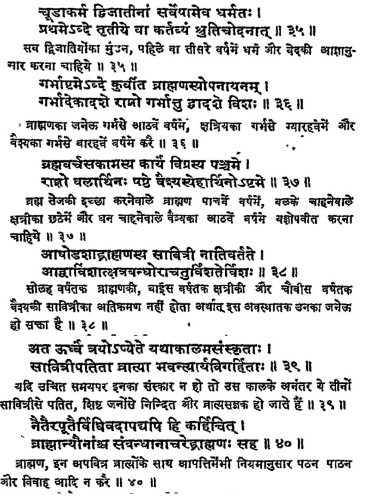
As is evident, Manu lays down instructions only for the initiation of Dvija students and makes no provision whatsoever for the initiation of Shudra students. Yajnavalkya adopts the same position, confining the Upanayana rite and access to Vedic education exclusively to the twice born castes.
Yajnavalkya Smriti verse 14 “In the eighth year of conception or in the eighth (year of) birth, the Upanayana ceremony of the Brahmanas, of the Ksatriyas in the eleventh; of the Vaisyas in eleven plus one. Some say according to family custom.” Tr. Rai Bahadur Srisa Chandra Vidyarnava (Source)
It is mentioned in Agni Purana,
Agni Purana 152.2-8 ”The rite of Chudakaranam (binding of the tuff of hair on the crown of a child) together with that of Upanayanam (investiture with the holy thread in the case of a Brahmana child) should be performed in its eighth year or in the eighth year counted from the period of jestation, while the same should be performed in the eleventh and the twelfth year (counterd from the period of gestation) in the case of a Kshatriya, and Vaishya child respectively.” Tr. M.N. Dutt (Source)
Acharya Medhatithi writes,
“…Of these four, three castes are ‘twice born’, the initiatory rite being prescribed for them. ‘One caste’ is the Shudra; there is no Initiatory Rite for him; since the injunction of this rite contains the distinct mention of the three castes, Brahmanas and the rest; e.g., the Brahmana shall be initiated in the eight year, the Ksattriya in the eleventh and the Vaishya in the twelfth; and nowhere is the name of the Shudra mentioned…” Medhatithi on Manu Smriti 10.4 (Source)
As is evident, Hindu texts lay down detailed instructions regarding the initiation of Brahmin, Kshatriya, and Vaishya children for Vedic study, but make no provision for Shudra children. This omission indicates that a Shudra, by birth, had no right to study the Vedas and was entirely excluded from Vedic learning.
Duty of a Shudra
Manu Smriti 8.413 “But a Sudra, whether bought or unbought, he may compel to do servile work; for he was created by the Self-existent (Svayambhu) to be the slave of a Brahmana.” Tr. Georg Buhler (Source)
Garuda Purana chapter 96 “the sole duty of a Shudra is to render personal service to the foremost of the twice born castes.” Tr. M.N. Dutt (Source)
Yajur Veda 30.5 “For Brahman (Priesthood) he binds a Brahman to the stake; for Kshatra (Royalty) a Râjanya; for the Maruts a Vaisya; for Penance a Sudra…” Tr. Ralph Griffith (Source)
In this verse, the association of the Shudra with penance does not imply ascetic practice but denotes service.
Vamana Purana, Saromahatmya 22.38-39 “In its middle is a mighty Banyan tree, the embodiment of Sthanu. From Him have issued the castes, Brahmans, Ksatriyas, Vaisyas, and Shudras were born from Him to render service to the twice born…” Tr. Anand Swarup Gupta (Source)
Vishnu Purana 3.8.33-34 “Attendance upon the three regenerate castes is the province of the Śúdra, and by that he is to subsist, or by the profits of trade, or the earnings of mechanical labour. He is also to make gifts; and he may offer the sacrifices in which food is presented, as well as obsequial offerings.” Tr. H.H. Wilson (Source)
Narasima Purana 58.10-13 “The Sudra should serve all these three varnas and serve the Brahmanas like a slave. He should donate from his earning without asking for anything form others. He should do agriculture for survival. He should worship the stars every month as per the religion and justice and always wear old apparel. He should clean the pots used by the Brahmanas keep attachment with his own wife.” Tr. Joshi K.L. Shastri and Bindiya Trivedi
Sankha Samhita 1.5 “Serving the Brahmanas, and performance of different handicrafts should be the specific duties of a Sudra. Practice of forbearance, truthfulness, and self-control, and cleanliness of body and spirit are equally obligatory on all, without any distinction of caste.” Tr. M.N. Dutt (Source)
Katyayana Smriti verse 722 “One may make the sudra work as a slave, whether he be purchased or not purchased; the creator himself created him for slavery.” Tr. P.V. Kane (Source)
Mahabharata 13.141 “The service of the three regenerate classes constitutes the high duty of the Sudra. That Sudra who is truthful in speech and who has subdued his senses is regarded as having acquired meritorious penances. Verily, the Sudra, who having got a guest, discharges the duties of hospitality towards him, is regarded as acquiring the merit of high penances. That intelligent Sudra whose conduct is righteous and who worships the deities and Brahmanas, becomes endued with the desirable rewards of righteousness.” Tr. K.M. Ganguli (Source)
Manu Smriti 10.123 “The service of Brahmanas alone is declared (to be) an excellent occupation for a Sudra; for whatever else besides this he may perform will bear him no fruit.” Tr. Georg Buhler (Source)
The same principle is reiterated in Apastamba Dharma Shastra 1.1.1.7, Vishnu Smriti 2.8, Manu Smriti 10.334, and Yajnavalkya Smriti 1.120. These texts define the Shudra’s duty as service to the twice born, while simultaneously prohibiting the twice born from serving those of lower caste.
Padma Purana V.9.40-47 “…A brahmana should always avoid serving low people….” Tr. N.A. Deshpande (Source)
Parasara Smriti 1.64 “The highest virtue for a Shoodra is to serve the members of the regenerate castes. Fruitless for him is everything else that he may do.” (Source)
Punishment for not Carrying out his Duties
Parasara Smriti 2.16 “By not in any way serving the Brahmanas, and by doing heinous acts, a Sudra becomes short lived, and goes to hell, after death. These duties are imperatively obligatory on the men of four castes.” Tr. M.N. Dutt (Source)
Skanda Purana III.ii.40.56 “If a Sudra created for service does not serve Brahmanas, nor does he give the means of sustenance (to them), Hanuman becomes angry with him.” Tr. G.V. Tagare (Source)
Prohibition to Intermingle
The following verses present a rigid code of social segregation in which even basic human interactions are prohibited across caste lines. Speaking directly to lower castes, sharing a seat, room, bed, vessel, or meal, residing in the same locality, or engaging in joint study or worship are all condemned as sinful and polluting. Intermixture is portrayed not merely as social misconduct but as a grave religious offence, and the ideal social order, including the so called Ram Rajya, is depicted as one where such contact does not exist at all.
Kurma Purana II.16.26-27 “An excellent Brahmana shall not stay anywhere else except within half a Krosa of the holy river (1 Krosa=3 Km). He shall not stay near the village of the Sudras. He should not live in the same place with that of fallen castes, Candalas, Pukkasas, foolish fellows, arrogant persons, Sudras and the people of the lowliest castes called Antavasayins.” Tr. G.V. Tagare (Source)
Parasara Smriti 6.43 “One should immediately come out of the room in which a Chandala has entered, and throw away all the earthen pots kept therein.” Tr. Manmatha Nath Dutt (Source)
Satapatha Brahmana 3:1:1:10 “Let him not commune with every one; for he who is consecrated draws nigh to the gods, and becomes one of the deities. Now the gods do not commune with every one, but only with a Brahman, or a Râganya, or a Vaisya; for these are able to sacrifice. Should there be occasion for him to converse with a Sûdra, let him say to one of those, ‘Tell this one so and so! tell this one so and so!’ This is the rule of conduct for the consecrated in such a case.” Tr. Julius Eggeling (Source)
Samvarta Samhita verse 197 “By associating with an outcast for a month or a half, one would become purified, in half-a-month, by living upon barley and the urine of cow.” Tr. Manmatha Nath Dutt (Source)
Angiras Samhita 1.49-50 “[Partaking of] a Sudra’s food, associating with a Sudra, sitting with a Sudra, acquiring knowledge from a Sudra, degrade even one burning with Brahma-energy. The twice-born person, who utters benediction before a Sudra and salutes him, that Brahmana as well as the Sudra go to hell.” Tr. Manmatha Nath Dutt (Source)
Kurma Purana II.16 28-29 “The following eleven defects caused by mingling of the castes are called sins of intermixture (Samkarya Dosas) viz. sharing the same bed, sharing a common seat, sitting in the same row, sharing of the same vessel, partaking of the cooked food together, presiding over the sacrifices, teaching, marriage alliance, taking of food together, studying together, and jointly presiding over the sacrifices.” Tr. G.V. Tagare (Source)
Inter dining, sharing the same seat, and engaging in common activities are widely regarded as marks of civilisation and humane conduct, yet Hindu scriptures portray such practices as undesirable or even sinful.
Vishnu Smriti 35.2-4 “He, who associates with an outcaste, for a year, becomes himself an outcast. Likewise, by riding in the same carriage, by sharing the same bed, and by eating (in the same row) with him.” Tr. Manmatha Nath Dutt (Source)
Skanda Purana III.ii.6.76-77 “Close association with fallen people is but conducive to one’s own fall. One should never offer a higher seat or rostrum to a Sudraa. (Thereby) a Brahmana becomes deficient in his Brahmanical powers and a Sudraa in his merits. Instruction in Dharma to Sudras shall obstruct one’s own progress and glory.” Tr. G.V. Tagare (Source)
Varaha Purana 112.25-27 “Once a Brahmin receives a gift from a Sudra, his ancestral manes fall into filth. No other Brahmin shall speak with him or share a seat with him. He is to kept afar. The Brahmin who, however, chances to speak with him or share a seat, shall perform Prajapatyakrcchra ceremony for purification.” Tr. Venkitasubramonia Iyer, edited by J.L. Shastri (Source)
Vamana Purana, Saromahatmya 28.43-44 “At the time of creation Sankara was worshipped by the Lord on the northern bank of the Sarasvati known by the name Caturmukha. Having saluted Him with faith, a man is absolved of all sins, arising out of lustful intermixture of castes and interdining.” Tr. Anand Swarup Gupta (Source)
Narada Purana I.41.33-38 “The Brahmanas and other castes get mixed with other castes mutually; all castes will be more or less like the Sudras, overwhelmed by lust and fury, confounded and afflicted by unncessary distress. In the Kali Yuga the excellent men become mean and the base men rise to excellence…Brahmanas become the pall-bearers of the Sudras…” Tr. G.V. Tagare (Source)
Narada Purana I.14.60b-62a “If one is touched by persons belonging to Candala and Svapaca castes, ablution (for purification) is enjoined even at night, but he shall not stay there with those low castes, at night, he will regain purity immediately after taking bath. If unknowingly a person had been careless enough to stay there (with low castes) at night, his sin is increased a hundred-fold.” Tr. G.V. Tagare (Source)
The following verse illustrates the prevalence of the caste system during the reign of Rama.
Skanda Purana III.ii.30.93-94 “Ther was neither mental anguish nor illnes, O king, in the kingdom of Rama. All the women were chaste; all the men were devoted to their parents. Brahmanas were devoted to the (study of) Vedas always; Ksatriyas served Brahmanas. Men of Vaisya caste continued to be devoted to Brahmanas and cows. There was no mixture of castes and no transgression of duties. There was no barren or wretched woman; no woman had only a single child or had her child dead.” Tr. G.V. Tagare (Source)
This was the so called ideal state, Ram Rajya, under the rule of Rama.
Skanda Purana VII.I.206.6-7 “[Isvara said] If a Brahmana cooks food on behalf of a Sudra in the manner of Upaniksepa that food shall also be Abhojya (unfit for consumption) and the Brahmana falls down. The food of a Sudra, the association of a Sudra, occupying the same seat as the Sudra, and learning a lore from a Sudra – these will cause the fall of even the resplendent one.” Tr. G.V. Tagare (Source)
Segregation of Humans into Castes
The following verse from the Manu Smriti illustrates the extreme social segregation of outcast groups such as Chandalas and Svapakas. It prescribes that they live on the outskirts, follow strict restrictions in dress, food, and movement, and confine their interactions and marriages to their own community.
Manu Smriti 10.51-54 “But the dwellings of Kandalas and Svapakas shall be outside the village, they must be made Apapatras, and their wealth (shall be) dogs and donkeys. Their dress (shall be) the garments of the dead, (they shall eat) their food from broken dishes, black iron (shall be) their ornaments, and they must always wander from place to place. A man who fulfils a religious duty, shall not seek intercourse with them; their transactions (shall be) among themselves, and their marriages with their equals. Their food shall be given to them by others (than an Aryan giver) in a broken dish; at night they shall not walk about in villages and in towns.” Tr. Georg Buhler (Source)
Hinduism also prescribes distinct lifestyles for people of different castes, mandating that each caste adopt specific dress codes, use different names, construct houses in particular ways, and follow separate customs, thereby completely segregating their modes of living.
Manu Smriti 2.30-32 “But let (the father perform or) cause to be performed the Namadheya (the rite of naming the child), on the tenth or twelfth (day after birth), or on a lucky lunar day, in a lucky muhurta, under an auspicious constellation. Let (the first part of) a Brahmana’s name (denote something) auspicious, a Kshatriya’s be connected with power, and a Vaisya’s with wealth, but a Sudra’s (express something) contemptible. (The second part of) a Brahmana’s (name) shall be (a word) implying happiness, of a Kshatriya’s (a word) implying protection, of a Vaisya’s (a term) expressive of thriving, and of a Sudra’s (an expression) denoting service.” Tr. Georg Buhler (Source)
Agni Purana 152.2-8 “Vishnu Purana 3.10.8-12 “The name of a Brahmin child should end with the term “Sharma” (the happy one), the name of a child of the Kshatrya caste should end with the term “Varma” (the defender or protector) while those of a Vaishya or a Shudra child should respectively end with the terms “Gupta” and “Dasa” (slave).” Tr. M.N. Dutt (Source)
Manu Smriti 3.8-9 “Let him not marry a maiden (with) reddish (hair), nor one who has a redundant member, nor one who is sickly, nor one either with no hair (on the body) or too much, nor one who is garrulous or has red (eyes), Nor one named after a constellation, a tree, or a river, nor one bearing the name of a low caste, or of a mountain, nor one named after a bird, a snake, or a slave, nor one whose name inspires terror.” Tr. Georg Buhler (Source)
Hindu texts prescribe caste specific distinctions in marriage rituals.
Agni Purana 153.1-4 “…A Kshatriya woman having been duly wedded, should hold an arrow in her hand, a Vaishya bride should hold a paddy measure while a Shudra girl should hold a cotton string in her hand just after the wedding ceremony had been gone through…” Tr. M.N. Dutt (Source)
The following verse prescribes that the method of building houses should differ according to caste.
Matsya Purana 253.13-14 “In laying the foundations of a building or digging a tank or well first it is necessary to test the nature of the soil before commencing the operations and lying Vastua. White earth is lucky for the Brahamanas, red is good for the Ksatriyas, yellow earth for the Vaisyas, and black earth is auspicious for the Sudras. This can be ascertained by digging. The earth tasting sweet is good for the Brahmanas…and astringent earth is good for the Sudras.” Tr. Taluqdar of Oudh, edited by B.D. Basu (Source)
Natya Shastra II.46-57 states that direction of pillars (first to be raised) should be different as per castes. (Source)
These verses from the Garuda Purana prescribe distinct rules for personal hygiene based on caste. While Brahmins, Kshatriyas, and Vaishyas are instructed to recite mantras during bathing and perform thorough purification, Shudras and women are required to observe silence, perform gestures like Namaskara discreetly, and cleanse only limited parts of the body.
Garuda Purana 1.213.143 “The procedure of bath has been laid down thus by great men. While taking bath Brahmins, Ksatriyas and Vaisyas have to repeat Mantras. A Sudra has to observe silence during bath and perform Namaskara also silently.” Tr. J.L. Shastri (Source)
Garuda Purana chapter 94 “A member of any of the twice born castes, shall first take two draughts of water to rinse his lips with, and then cleanse his face with undisturbed and frothless water. The twice born shall purify their breasts, throats, palates and umbilical regions with water. It will be enough for women and Shudras to purify their regions of back and umbilicus.” Tr. M.N. Dutt (Source)
These verses illustrate that caste-based discrimination extended even to funeral rites. Shudras were prohibited from participating in the cremation or transport of twice-born corpses, and their own dead had to be carried through designated gates or handled with strict restrictions. Contact with Shudras during mourning or childbirth in a Brahmin household was considered ritually polluting, requiring purification of people, objects, and the household itself.
Manu Smriti 5.92 “Let him carry out a dead Sudra by the southern gate of the town, but (the corpses of) twice-born men, as is proper, by the western, northern, or eastern (gates).” Tr. Georg Buhler (Source)
Manu Smriti 5.104 “Let him not allow a dead Brahmana to be carried out by a Sudra, while men of the same caste are at hand; for that burnt-offering which is defiled by a Sudra’s touch is detrimental to (the deceased’s passage to) heaven.” Tr. Georg Buhler (Source)
Agni Purana 158.38-51 “A Brahmana who has followed the dead body of a Shudra to the burning ground or has joined with friends of such a deceased in mourning his death, becomes pure at the expiry of three days. On a Shudra woman having been delivered of a child in the house of a Brahmana, or a Shudra having, departed his life therein, the master of the house should abstain from making any gift or from undertaking any religious ceremony for the attainment of any object, for that entire day. Cooking pots and other articles of pottery should be thrown away and the flows an walls should be plastered over with a fresh coating of clay, whereby the house would be again clean and pure…” Tr. M.N. Dutt (Source)
Vishnu Smriti 29.1-4 “One shall not allow the dead body of a twice-born person to be carried by a Sudra. Nor [that of a] Sudra by a twice-born person…The Sudras [shall never carry the dead body of a] twice-born one even if he be their father.” Tr. Manmatha Nath Dutt (Source)
Brahmins, Kshatriyas, Vaishyas, and Shudras are prescribed to use umbrellas of different colors.
Varaha Purana 128.38 “The white umbrella is for the Brahmin, red for Ksatriya, yellow for Vaisya, and blue for Sudra.” Tr. Venkitasubramonia Iyer, edited by J.L. Shastri (Source)
Punishment for Sitting on the Same Seat as Upper Castes
A Shudra is subjected to punishment for sitting on the same seat as a Brahmin.
Manu Smriti 8.281 “A low-caste man who tries to place himself on the same seat with a man of a high caste, shall be branded on his hip and be banished, or (the king) shall cause his buttock to be gashed.” Tr. Georg Buhler (Source)
Agni Purana 227.30-31 “If a member of a low caste had occupied the seat of a member of a higher caste, his lower organ (buttocks) should be cut…” Tr. N. Gangadharan (Source)
Vishnu Smriti 5.20 “If one (i.e., a low-caste man) sits on the same seat [with a superior caste] he, having his hip branded, shall be banished.” Tr. Manmatha Nath Dutt (Source)
Gautama Dharma Shastra 12.7 “If he assumes a position equal (to that of twice-born men) in sitting, in lying down, in conversation or on the road, he shall undergo (corporal) punishment.” Tr. Georg Buhler (Source)
Apastamba Dharma Shastra 2.10.27.15 “A Sûdra who assumes a position equal (to that of a member of one of the first three castes), in conversation, on the road, on a couch, in sitting (and on similar occasions), shall be flogged.” Tr. Georg Buhler (Source)
Narada Smriti 15.26 “If an inferior desires to sit on the same seat with his superior, he shall be banished, after having his hinder parts stamped, or he shall be deprived of his buttock.” Tr. Julius Jolly (Source)
Intermingling of Castes is Evils of Kali Yuga
Linga Purana Section I.40.6-8 “Men perish. Ksatriyas and Vaisyas decline gradually. In Kali Sudras claim kinship with brahmins through their learning through interdining and sharing seats and beds. Kings become mostly Sudras and they harass brahmins. Killing of foetus and murder of heroes become prevalent. Sudras adopt the conduct of life prescribed for the Brahmins and the brahmins adopt the ways of Sudras.” Tr. Board of Scholars, edited by J.L. Shastri (Source)
Brahmanda Purana 1.2.31.42 “Span of life, intellect, strength, beauty and prestige of the family dwindle down and become extinct. The Sudraas take to the conduct of life of the Brahmanas and the Brahmanas behave and act like Sudras.” Tr. G.V. Tagare (Source)
Kurma Purana I.30.18 “O tormentor of enemies, Sudras will be occupying lofty seats in the middle of Brahmanas. In Kali age, as a result of the influence of times, the king will dishonour the Brahmins.” Tr. G.V. Tagare (Source)
Narasima Purana 54.44-46 “The Brahmanas, Ksatriyas, Vaisya and Sudra all will have over excitement and sensuality and reproduce a hybrid generation by mixing with one another. In the state of such a hybrid generation, relations like teacher and student, father and son, husband and wife will be kicked off…” Tr. Joshi K.L. Shastri and Bindiya Trivedi
Inter-Caste marriage is Prohibited
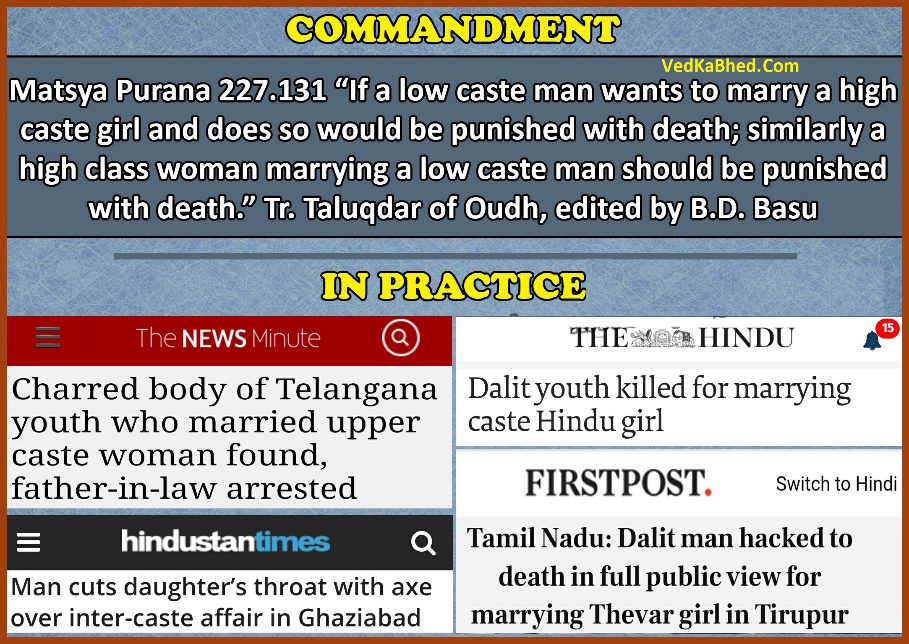
Hinduism restricts inter caste marriage to a significant degree. It permits marriage in which a man of a higher caste marries a woman from a lower caste, while strictly prohibiting a man of a lower caste from marrying a woman of a higher caste. Some texts appear to allow a Brahmin to take wives from all four castes, while other texts explicitly prohibit a Brahmin from marrying a Shudra, a restrictive position that is also upheld by Yajnavalkya and Vasishta. Certain scholars have interpreted this contradiction to mean that although a Brahmin may formally take a Shudra woman as a wife, he is forbidden from engaging in sexual relations with her during her fertile periods, effectively barring him from begetting children through her. In this reading, a Shudra wife is reduced to a source of sexual gratification rather than a legitimate partner in lineage. Hindu scriptures further prescribe a rigid hierarchy in marriage, stating that a Dvija must take his first wife from his own caste and only thereafter from lower castes. Accordingly, a Kshatriya may marry women from his own caste as well as Vaishya and Shudra castes, a Vaishya may marry Vaishya and Shudra women, while a Shudra is restricted to marrying only within his own caste.
Gita 1.41-43 “By the prevalence of impiety, O Krishna, the women of the family becomes corrupt. Women corrupted, there will be intermingling of castes (Varna-Samkara), O descendant of Vrishnis. Confusion of castes leads the family of these destroyers of families also to hell; for, their forefathers fall (down to hell), deprived of the offerings of pinda (rice-ball) and water. By these evil deeds of the destroyer of families which cause the intermingling of castes, the eternal dharmas of castes and families are subverted.” Tr. A. Mahadeva Sastri (Source)
Madhavacharya writes on Gita 1.41 “When there is a resultant intermixture of castes due to the destruction of the family structure; those who are responsible are damned to hell; but not only these ruinous family members. Their forefathers are also sent to hell as well due to the cessation of the ritual offerings of food and water that are no longer given due to the fact that there no longer exist any male descendants to perform such rites” (Source)
Sridhar Swami writes on Gita 1.41 “When this happens there is an intermingling of castes and the ancestors of these destroyers of the family fall from heaven as they are deprived of their periodic ritual offerings of food and water.” (Source)
Kesava Kasmiri writes on Gita 1.41-42 “In regard to the result of undesirable progeny. The intermixture of castes that follow the family customs and honor the age-old Vedic traditions with those that do not causes a degradation in society and leads the family to a hellish existence. Not only this but the ancestors of such a family also suffer as well because there is no descendant qualified to perform the propitiatory rites prescribed in Vedic scriptures such as sraddha and tarpana. Being deprived of these oblations due to the absence of qualified progeny as a result of destruction of the family structure the ancestors fall down from heaven and go directly to the hellish planets. In the previous verse the effects of the intermixture of castes as described in the Vedic scriptures regarding the ancestors has been determined. Now Arjuna describes the misery experienced for those who are responsible for causing this intermixture of castes beginning with dosair etaih. Due to these evils the essential duties prescribed in the Vedic scriptures for the four castes which are the authorised and proven means leading humanity to the highest good and which are faithfully instructed by holy sages and spiritual masters are all forsaken.” (Source)
Swami Nikhilananda writes on Gita 1.41-42 “…Mixing of castes – One of the evil consequences of the depletion of the number of men in society is that the women break the caste rules and traditions as regards marriage. Marriage outside one’s caste is considered irregular by the Hindu law-givers. Rice-balls and water- The reference is to the Hindu religious rites for the dead, known as the Sraddha ceremony, in which rice-balls and water are offered by the eldest son for the satisfaction of the soul of the deceased. This ceremony cannot be performed by children born of irregular marriages, that is to say, marriage in which husband and wife belong to different caste, Deprived of the rice balls and water, the soul of the deceased, according to Hindu tradition, goes to hell…” (Source)
Usana Samita 9.51 “By marrying in another caste (i.e., a Sudra maiden), one (i.e., a Brahmana) becomes a Mahapatakin (great sinner). By associating with such a sinner, one also becomes a sinner.” Tr. Manmatha Nath Dutt (Source)
Agni Purana 150.14-15 “A marriage should take place only between the members of the same class, the union of a person belonging to a higher class with one of the lower being always forbidden…” Tr. M.N. Dutt (Source)
Devi Bhagavatam 9.34.32-91 “…This is a general remark; now hear everything in particular. O Chaste One! The Brâhmin wives of S’ûdras or the S’ûdra wives of Brâhmanas are Atyâgamyâs (very unfit to be approached) and blameable both in the Vedas and in the society. A S’ûdra going to a Brâhmanî woman commits one hundred Brahmahattyâs; so a Brâhmana woman going to a S’ûdra goes to the Kumbhîpâka hell. As a S’ûdra should avoid a Brahmâni, so a Brâhmana should avoid a S’ûdra woman…” Tr. Swami Vijnananda (Source)
Vamana Purana 35.21-27 “…intermixing in all the varnas (castes), abandonment of Omkara…marrying a low-caste woman like a Candala…all these entail suffering in hell.” Tr. Anand Swarup Gupta (Source)
Skanda Purana V.i.29.27-33 “…An uncivilized Brahmana who carnally serves a Sudra woman and one who marries a Sudra woman, both of them fall into the hell…” Tr. G.V. Tagare (Source)
Narada Purana I.23.26 “The observer of the holy rite should never talk to one who nourishes his progeny through a Sudra woman, to the husband of a Sudra woman and to one who performs sacrifices on behalf of those who are not eligible for the same.” Tr. G.V. Tagare
Mahabharata 13.48 “It is only from sexual union of women with persons who should not have such union with them that mixed classes spring up.” Tr. K.M. Ganguli (Source)
Garuda Purana ch 95 “A Brahmana is at liberty to take a wife from any of the first three social orders, or to put it more explicitly, a Brahmana shall marry a girl either of his own caste, or one belonging to the warrior (Kshatriya), or to the trading (Vaishya) community. Similarly a Kshatriya shall marry a Kshatriya or a Vaishya girl, while a Vaishya shall take a wife from his own community, the marriage of a Shudra girl with a member of any of the twice born castes being hereby absolutely forbid.” Tr. M.N. Dutt (Source)
Manu Smriti 3.14 “A Sudra woman is not mentioned even in any (ancient) story as the (first) wife of a Brahmana or of a Kshatriya, though they lived in the (greatest) distress.” Tr. Georg Buhler (Source)
Mahabharata state that a son born to a Dvija father does not attain Dvija status if his mother belongs to a lower caste.
Mahabharata 13.47.17 “The son born of the Sudra wife should not be regarded as invested with the status of a Brahmana in consequence of his being unskilled (in the scriptures and the duties ordained for the Brahmana). Only those children that are born of wives belonging to the three higher orders should be regarded as invested with the status of Brahmanas.” Tr. K.M. Ganguli (Source)
A son born to a Brahmin father and a Shudra mother is denied any right to inheritance under the texts.
Manu Smriti 9.155-6 “The son of a Brahmana, a Kshatriya, and a Vaisya by a Sudra (wife) receives no share of the inheritance; whatever his father may give to him, that shall be his property. All the sons of twice-born men, born of wives of the same caste, shall equally divide the estate, after the others have given to the eldest an additional share.” Tr. Georg Buhler (Source)
Shudra Wife is only for Sexual Gratification
Hindu texts further depict Shudra wives as objects of sexual use by stating that a Brahmin may take a Shudra woman in marriage solely for sexual pleasure, rather than as a legitimate partner in lineage or ritual life.
Vasistha Dharma Shastra 18.17-18 “Let him not approach a wife of the Sudra caste after he has built the fire altar for a Srauta sacrifice. For a Sudra wife who belongs to the black race, (is espoused) for pleasure, not in order to fulfil the law.” Tr. Georg Buhler (Source)
Vishnu Smriti 26.5 “The Sudra wife of a Brahmana can never be for virtue. She is only the object of enjoyment of a passionate Brahmana.” Tr. M.N. Dutt (Source)
Death Penalty for Inter-Caste Marriage/Relationship
If a Shudra marries a Brahmin woman, the prescribed punishment in the scriptures is the death penalty.
Matsya Purana 227.131 “If a low caste man wants to marry a high caste girl and does so would be punished with death; similarly a high class woman marrying a low caste man should be punished with death.” Tr. Taluqdar of Oudh, edited by B.D. Basu (Source)
Hindu texts prescribe comparatively mild punishment for a Brahmin man committing adultery, while imposing severe punishment, including the death penalty, on a Shudra who commits adultery with a high caste woman. In such cases, the texts explicitly state that the Shudra is to be burnt alive.
Vasistha Dharma Shastra 21.1-3 “If a Sûdra approaches a female of the Brâhmana caste, (the king) shall cause the Sûdra to be tied up in Vîrana grass and shall throw him into a fire. He shall cause the head of the Brâhmanî to be shaved, and her body to be anointed with butter; placing her naked on a black donkey, he shall cause her to be conducted along the highroad. It is declared that she becomes pure (thereby). If a Vaisya approaches a female of the Brâhmana caste, (the king) shall cause the Vaisya to be tied up in Lohita grass and shall throw him into a fire. He shall cause the head of the Brâhmanî to be shaved, and her body to be anointed with butter; placing her naked on a yellowish donkey, he shall cause her to be conducted along the highroad. It is declared in the Veda that she becomes pure (thereby). If a Kshatriya approaches a female of the Brâhmana caste, (the king) shall cause the Kshatriya to be tied up in leaves of Sara grass and shall throw him into a fire. He shall cause the head of the Brâhmanî to be shaved, and her body to be anointed with butter; placing her naked on a white donkey, he shall cause her to be conducted along the highroad. It is declared in the Veda that she becomes pure (thereby).” Tr. Georg Buhler (Source)
Arthashastra of Chanayka Book 4 Chapter 13 “A Kshatriya who commits adultery with an unguarded Bráhman woman shall be punished with the highest amercement; a Vaisya doing the same shall be deprived of the whole of his property; and a Súdra shall be burnt alive wound round in mats.” Tr. R. Shamasastry (Source)
Gautama Dharma Shastra Chapter 23 Verse 14-15 “A woman who commits adultery with a man of lower caste the king shall cause to be devoured by dogs in a public place. He shall cause the adulterer to be killed (also).” Tr. Georg Buhler (Source)
Gautama Dharma Shastra 12.2 “If he [Shudra] has criminal intercourse with an Aryan woman, his organ shall be cut off, and all his property be confiscated.” Tr. Georg Buhler (Source)
Manu Smriti 8.374 “For having sexually visited a woman of any twice-born caste, whether protected or unprotected by her husband, a S’udra shall be punished with the mutilation of his reproductive organ and a confiscation of all his goods and estates in the first named instance (i.e., for knowing an unprotected twice-born woman), and in the last named case he shall pay the penalty with his life and all his goods and estates will be escheated to the sovereign.” Manmatha Natha Dutt (Source)
Apastamba Dharma Shastra Prasna II, Patala 10, Khanda 27 Verse 9 “A Sûdra (who commits adultery) with a woman of one of the first three castes shall suffer capital punishment.” Tr. Georg Buhler (Source)
Mahabharata 13.91.88.90 “That Sudra who has sexual intercourse with a Brahmana woman, has, after death, to take birth as a hog. As soon as he takes birth in the porcine order he dies of disease, O king. The wretch has next to take birth as a dog. O king, in consequence of his dire act of sin. Casting off his canine form he regains upon the exhaustion of his demerit, the status of humanity. The Sudra who begets offspring upon a Brahmana woman, leaving off his human form, becomes reborn as a mouse.” Tr. K.M. Ganguli (Source)
Brahmins are exempt from capital punishment, while lower castes face severe or lethal penalties.
Baudhayana Dharma Shastra 2.4.1 “Everybody except a Brahmin is subject to corporal punishment for Adultery.” Tr. Georg Buhler (Source)
Low Castes are Equal to Dogs, Pigs and Other Animals
This collection of verses illustrates how numerous Hindu texts repeatedly equate Shudras, Chandalas, and other so called lower castes with animals such as dogs, pigs, and donkeys in matters of purity and pollution. Through rules on food, touch, sight, ritual participation, and expiation, these texts portray lower castes as inherently defiling, thereby institutionalising social exclusion and dehumanisation within religious practice.
Linga Purana Section I.85.216 “He shall not partake of the cooked rice touched and defiled by pigs, Candalas, wicked people and cock. If he eats it he shall repeat the japa hundred and eight times.” Tr. Board of Scholars, edited by J.L. Shastri (Source)
Manu Smriti 12.55 “The slayer of a Brahmana enters the womb of a dog, a pig, an ass, a camel, a cow, a goat, a sheep, a deer, a bird, a Kandala, and a Pukkasa.” Tr. Georg Buhler (Source)
Manu Smriti 3.239 “A Kandala, a village pig, a cock, a dog, a menstruating woman, and a eunuch must not look at the Brahmanas while they eat.” Tr. Georg Buhler (Source)
Apastamba Dharma Shastra 2.7.17.20 “They blame it, if dogs and Apapâtras are allowed to see the performance of a funeral-sacrifice.” Tr. Georg Buhler (Source)
Gautama Dharma Shastra 15.24 “If (a funeral offering) is looked at by dogs, Kandâlas, or outcasts, it is blemished.” Tr. Georg Buhler (Source)
Mahabharata 13.23.5 “Gifts of articles that have been proclaimed before many people or from which a portion has been eaten by a Sudra, or that have been seen or licked by a dog, form portions of Rakshasas.” Tr. K.M. Ganguli (Source)
Agni Purana 168.1-12 “…The boiled rice smelled by a cow, or dedicated to one’s ancestors, as well as that partaken of by a Shudra or a dog, or that prepared by a fallen man, if eaten by a person, would entail the performance of the pencance known as the Taptakrichchha…” Tr. M.N. Dutt (Source)
Narada Purana I.26.30-31 “If he touches a wet bone, leavings of food, a Sudra, a fallen man, a serpent or a dog, he should bath along with the clothes he is wearing. After touching the funeral pyre, a piece of wood thereon, the sacrificial pole, a Candala and a professional worshipper of idols, he should plunge into water along with the clothes he is wearing.” Tr. G.V. Tagare (Source)
Narada Purana II.51.42 “O Narada, it is laid down (in Smritis) that the sprinkling of the vessels is for the destruction of defects (defilement) due to the glances of Sudras, the fallen ones and donkeys and other beings (at them).” Tr. G.V. Tagare (Source)
Vamana Purana 15.19 “By touching a woman in menses, a dog, a naked man, a woman recently delivered, and untouchables, one should take a bath for purification, as also those that carry dead bodies.” Tr. Anand Swarup Gupta (Source)
Yajnavalkya Smriti 1.197 “Mud and water lying on a roadside and buildings made of burnt bricks, when touched by Chandalas or by other degraded castes, and by dogs and crows, are purified by air.” Tr. Manmatha Nath Dutt (Source)
Skanda Purana III.ii.5.129 “Food is to be scattered outside for the sake of dogs, fallen persons, Candalas, persons sick with sinful ailments (leprosy etc), crows, worms etc.” Tr. G.V. Tagare (Source)
Baudhayana Srauta Sutra 28.8 “Now we shall explain the expiation in connection with the defilement of kindling woods. The kindling woods become defiled on account of eight contingencies. The defilement of kindling woods occurs as a result of the contact with an impure object, a dog, a Candala, a Sudra, a crow, a sinner, a donkey, or a woman in her menses. One should discard such kindling woods, and get prepared similar new ones…” Tr. C.G. Kashikar
Sinners Are Reborn into Lower Castes
These passages together assert that thieves, liars, violators of ritual duties, prostitutes, and other sinners are reborn as low castes, outcast communities, untouchables, or even animal forms after suffering in hell. Through the doctrine of karma and rebirth, acts such as theft and sexual transgression are explicitly linked to social degradation in a future life, presenting birth as a Candala or untouchable as a divinely sanctioned punishment for moral failure. In this way, caste hierarchy is not treated as a mere social arrangement but is sacralised as a moral and cosmic consequence of sin.
Chandogya Upanishad 5.10.7. ‘Those whose conduct has been good, will quickly attain some good birth, the birth of a Brahmana, or a Kshatriya, or a Vaisya. But those whose conduct has been evil, will quickly attain an evil birth, the birth of a dog, or a hog, or a Kandala.” Tr. Swami Nikhilanda (Source)
Garuda Purana 4.58-63 “Thus, it is declared, O Tarksya, that there are many torments for the sinful. Why should I explain them fully, when they are spoken of in all the S’astras? Being tortured thus, men and women by thousands are baked in dreadful hells until the coming of the deluge. Having eaten there their undecaying fruits they are born again. By order of Yama they return to the earth and become unmoving and other creatures: Trees, bushes, plants, creepers, rocks and grasses, these are spoken of as unmoving; enveloped in great delusion, Insects, birds, animals and fish;–it is said that there are eighty-four hundred thousands of fates of birth-fates. All these evolve thence into the human condition; having come back from hell they are born in the human kingdom amongst low outcastes, and even there, by the stains of sin, become very miserable.” Tr. Ernest Wood and S.V. Subrahmanyam (Source)
Yajnavalkya Smriti 3.213 “One, who robs another’s jewel, is born in a degraded caste…” Tr. Manmatha Nath Dutt (Source)
Garuda Purana 5.11 “Who steals jewels is born in a low caste…” Tr. Ernest Wood and S.V. Subrahmanyam (Source)
Apastamba Dharma Sutra, Prasna 2, Patala 1, Kanda 2, verse 6 “Thus after having undergone a long punishment in the next world, a person who has stolen (the gold of a Brahmana) or killed a (Brahmana) is born again, in case he was a Brahmana as a Kandala, in case he was a Kshatriya as a Paulkasa, in case he was a Vaisya as a Vaina.” Tr Georg Buhler (Source)
Skanda Purana V.iii.171.14-22 “…O excellent Brahmanas, these people fall into terrible hell and are reborn as Candalas: those who do not take holy bath regularly; those who do not practise Japa, Homa, worship of Suras, hospitality to other people, performance of Pitr Sraddha during Parvas and also regular Dana…” Tr. G.V. Tagare (Source)
Skanda Purana V.iii.155.79b-89a “…Those who utter falsehood jeopardising cows and Brahmanas fall into the Kalsutraka hell. The torture therein as per the authors of the scriptural texts is indeed terrible. After experiencing those sufferings those who come back in the human world are born as men of low caste…” Tr. G.V. Tagare (Source)
Vishnu Smriti 44.9 “Those, who are guilty of committing crimes leading to defilement, are re-born in the wombs of outcast women.” Tr. Manmatha Nath Dutt (Source)
Hindu texts state that prostitutes are reborn as untouchable women in their next life.
Brahma Vaivarta Purana, Krishna Janma Khanda 85.105-116 “…A whore after having suffered the torments of hell called Raurava for a long time attains the form of a useless worm for a century and by turns for seven birth she attain the condition of a widow, a barren woman, an untouchable woman of low class and a woman with her nose cut…” Tr. Rajendra Nath Sen (Source)
A Brahmins Owns Everything
Brahma Purana 45.77-78 “Whatever the Brahmins desire in their mind may be given to them, even if the objects be women, jewels, villages and cities. Let the fertile lands or fields be given to the suppliants.” Tr. G.P. Bhatt (Source)
Mahabharata, Santi Parva 12 Section 72 “…Matariswan answered, ‘The Brahmana, O best of kings, has sprung from the mouth of Brahman. The Kshatriya has sprung from his two arms, and the Vaisya from his two thighs. For waiting upon these three orders, O ruler of men, a fourth order, viz., the Sudra, sprung into life, being created from the feet (of Brahman). Originally created thus, the Brahmana takes birth on earth as the lord of all creatures, his duty being the keep of the Vedas and the other scriptures. Then, for ruling the earth and wielding the rod of chastisement and protecting all creatures, the second order, viz., the Kshatriya was created. The Vaisya was created for supporting the two other orders and himself by cultivation and trade, and finally, it was ordained by Brahman that the Sudra should serve the three orders as a menial.’ “Pururavas said, ‘Tell me truly, O god of Winds, to whom, this earth righteously belong. Does it belong to the Brahmana or to the Kshatriya?’ “The god of Winds said, ‘Everything that exists in the universe belongs to the Brahmana in consequence of his birth and precedence. Persons conversant with morality say this. What the Brahmana eats is his own. The place he inhabits is his own. What he gives away is his own. He deserves the veneration of all the (other) orders. He is the first-born and the foremost. As a woman, in the absence of her husband, accepts his younger brother for him, even so the earth, in consequence of the refusal of the Brahmana, has accepted his next-born, viz., the Kshatriya, for her lord…” Tr. K.M. Ganguli (Source)
A Brahmin, whether Learned or Illiterate, retains his Brahmin status solely by virtue of Birth.
One of the most common arguments advanced by Hindu apologists is that a person who does not study the Vedas becomes a Shudra. However, Hindu texts themselves state that a Brahmin, whether learned or illiterate, retains his Brahmin status solely by virtue of birth.
The claim that a Brahmin “loses his rank” by neglecting Vedic study is frequently presented in a misleading manner that obscures the permanence of the caste hierarchy. In orthodox Hindu theology, this loss of rank does not signify a literal descent into a lower varna by birth. Rather, it denotes a temporary state of ritual degradation, specifically the suspension of eligibility to perform Vedic rites and sacrifices. This condition is explicitly reversible through prescribed expiatory rites (prayaschitta), after which the Brahmin’s ritual authority may be restored. The varna itself, however, remains unchanged. By contrast, no Hindu scripture states that a Shudra who studies the Vedas can attain Brahminhood in the same lifetime. To date, apologists have failed to produce even a single verse that supports such a claim, and neither the Smritis nor the Upanishads affirm that Vedic study by a Shudra results in a change of varna.
Chandogya Upanishad 6.1.1 “Harih, Om. There lived once Svetaketu Aruneya (the grandson of Aruna). To him his father (Uddilaka, the son of Aruna) said: ‘Svetaketu, go to school; for there is none belonging to our race, darling, who, not having studied (the Veda), is, as it were, a Brahmana by birth only.” Tr. Max Muller (Source)
Parasara Smriti 8.11 “Brahmanas, who are ignorant of the Vedas, and Gayatri and Sandhya, and those who do not cast any oblation in the sacrificial fire and live by agriculture, are only Brahmanas in name.” Tr. Manmatha Nath Dutt (Source)
It is mentioned in Mahabharata.
Mahabharata 3.199.88 “Whether the Brahmana be cognisant of the Vedas or ignorant of them, whether they be pure or impure, they should never be insulted, for Brahmanas are like fires.” Tr. K.M. Ganguli (Source)
The verse itself answers the question. Mahabharata 3.199.88 explicitly affirms that Brahminhood does not depend on knowledge of the Vedas. A Brahmin is to be regarded as a Brahmin whether he is learned or ignorant, pure or impure. The text grounds Brahmin identity in birth, not in education or conduct, and commands reverence on that basis alone by comparing Brahmins to fire, which remains fire regardless of its state.
Mahabharata and Maharshi Manu lists learned Brahmin and unlearned Brahmin separately,
Mahabharata 12.180 “Thou, O Kasyapa, art a human being! Amongst human beings, thou art again a Brahmana. Among Brahmanas, thou art again one that is conversant with the Vedas.” Tr. K.M. Ganguli (Source)
Manu Smriti 1.96-97 “Of created beings the most excellent are said to be those which are animated; of the animated, those which subsist by intelligence; of the intelligent, mankind; and of men, the Brahmanas; Of Brahmanas, those learned (in the Veda); of the learned, those who recognise (the necessity and the manner of performing the prescribed duties); of those who possess this knowledge, those who perform them; of the performers, those who know the Brahman.” Tr. Georg Buhler (Source)
Manu Smriti 9.317 “A Brahmana, be he ignorant or learned, is a great divinity, just as the fire, whether carried forth (for the performance of a burnt-oblation) or not carried forth, is a great divinity.” Tr. Georg Buhler (Source)
Manu Smriti 2.118 “A Brahmana who completely governs himself, though he know the Savitri only, is better than he who knows the three Vedas, (but) does not control himself, eats all (sorts of) food, and sells all (sorts of goods).” Tr. Georg Buhler (Source)
Apastamba Dharma Shastra 2.2.4.16 “To a Brâhmana who has not studied the Veda, a seat, water, and food must be given. But (the giver) shall not rise (to do him honour).” Tr. Georg Buhler (Source)
Hindu apologists should recognise that the scriptures themselves distinguish a learned Brahmin as a Vipra, while also acknowledging other graded designations. The Puranas offer clear examples in which a man born into a Brahmin family continues to be identified as a Brahmin despite lacking Vedic learning and even engaging in sinful conduct, indicating that Brahmin status is grounded in birth rather than knowledge or behaviour.
Vyasa Samhita 4.41-43 “One, born of the seeds of a Brahmana but not purified with any of the purificatory rites or Mantras, and making use of his caste as a means of livelihood, is called a Sama Brahmana. A Brahmana, unto whom all the purificatory rites of Garbhdanam, etc., have been performed, but who has neither read nor taught any part of the Vedas, is called a Vruva Brahmana. A Brahmana, who practises penitential austerities and performs the rite of Homa, every day, and teaches the Vedas with their Kalpas and Rahasyas, is called an Acharyaya.” Tr. Manmatha Nath Dutt (Source)
Varaha Purana 167.3-4 “Varaha said:- In Ujjayini there was a Brahmin who never cared for the rules of virtuous life. He never worshipped gods and never bowed to the saints. He never bathed in any holy tirtha. He knew neither the Vedas nor the Vedangas. He was lustful and longed for the wives of others.” Tr. Vekitasubramonia Iyer, edited by J.L. Shastri (Source)
Vyasa Samhita 4.33 “A gift should be made to an erudiate person living at a distance in preference to an illiterate on living close by one’s house. Nothing can be humiliating (insulting) to an illiterate Brahmana.” Tr. Manmatha Nath Dutt (Source)
Usana Samhita 3.118 “An illiterate Brahmana, accepting funeral cakes, gold, kine, horses, lands and sesame seeds, gets consumed like a wood” Tr. Manmatha Nath Dutt (Source)
Manu Smriti 2.157-8 “Like unto a wooden elephant or a leathern deer, a Brahmana, who has not studied, bears only the name of a Brahmana. As a eunuch is (sexually) fruitless (unsuccessful) in respect of a woman, as (sexually) fruitless is the meeting of two cows, as fruitless is the gift to an ignorant, so fruitless (is the life of a) Brahmana who has not studied the Riks (i.e., the Vedas).” Tr. Manmatha Nath Dutt (Source)
Vyasa Samhita 4.37-38 “A Brahmana, who has not studied the Vedas, does, like a wooden elephant, or a leather-deer, but bear the name of the genus he belongs to. Like a deserted hamlet, like a waterless well, a Brahmana, who has not read the Vedas, is a Brahmana only in name.” Tr. Manmatha Nath Dutt (Source)
The above verses praise a learned Brahmin over an unlearned Brahmin, in the same manner as stated in Manu, while still maintaining that both are recognised as Brahmins by birth.
Manu Smriti 1.95-99 “Of the created things the animate creatures are the highest; of the animate creatures the intelligent ones are the highest, of the intelligent creatures men are the highest, and among men the Brahmanas are the highest. Among Brahmanas the erudite ones are the highest, among the erudite Brahmanas those, who think it their duty to perform the Sastric rites, are the highest, among the latter those, who perform such rites, are the highest, and among the performers of rites the knowers of Brahma are the highest. The Brahmana has originated as the eternal embodiment of virtue. His origin is for the furtherance of virtue; he becomes of the essence of Brahma. Born as a Brahmana, he wields the supremacy of the world, the ruler of all creatures, the custodian of the treasure of virtue.” Tr. Manmatha Nath Dutt (Source)
The Myth of Profession Based Caste in Hindu Texts
The following verses collectively demonstrate that Hindu scriptures do not treat caste as a flexible system based on profession, but as a hereditary and rigid social order. They repeatedly prohibit lower castes from adopting higher occupations, while allowing the twice born to cross occupational boundaries without loss of caste, thereby reinforcing birth, not work, as the determinant of varna.
Manu Smriti 10.96 “A man of low caste who through covetousness lives by the occupations of a higher one, the king shall deprive of his property and banish.” Tr. Georg Buhler (Source)
If caste were truly based on profession, there would be no justification for punishing a lower caste person for adopting the occupation of a higher caste. Hindu texts permit temporary deviation from one’s hereditary occupation in times of distress. However, they never state that a Shudra becomes a Brahmin by adopting Brahminical duties, nor do they grant a Shudra eligibility to perform Brahminical functions. This distinction makes it clear that occupational flexibility does not translate into a change of caste, which remains fixed by birth. A Dvija may live by other professions as well, and this does not change his caste.
Parasara Smriti 2.15 “Even an agriculturist Kshatriya should propitiate the gods and Brahmanas with the produce of his fields. A Vaisya, or a Sudra should always live by trade, agriculture, or handicraft.” Tr. Manmatha Nath Dutt (Source)
Gautama Dharma Shastra 7.6-7 “On failure of the (occupation lawful for a Brahmana) he may live by the occupations of a Kshatriya. On failure of those, he may live by the occupations of a Vaisya.” Tr. Georg Buhler (Source)
Manu Smriti 10.81-82 “But a Brahmana, unable to subsist by his peculiar occupations just mentioned, may live according to the law applicable to Kshatriyas; for the latter is next to him in rank. If it be asked, ‘How shall it be, if he cannot maintain himself by either (of these occupations?’ the answer is), he may adopt a Vaisya’s mode of life, employing himself in agriculture and rearing cattle.” Tr. Georg Buhler (Source)
Yajnavalkya Smriti 3.35 “Under distressed circumstances, a Brahmana may maintain himself by following the military or the mercantile callings. Having surmounted [the distress], he should get purified and resume his proper occupation.” Tr. Vishvanath Mandlik (Source)
Apastamba Dharma Shastra 1.7.20.10-11 “Trade is not lawful for a Brâhmana. In times of distress he may trade in lawful merchandise…” Tr. Georg Buhler (Source)
Srimad Bhagavatam 7.11.16-17 “As an alternative, a brāhmaṇa may also take to the vaiśya’s occupational duty of agriculture, cow protection, or trade. He may depend on that which he has received without begging, he may beg in the paddy field every day, he may collect paddy left in a field by its proprietor, or he may collect food grains left here and there in the shops of grain dealers. These are four means of livelihood that may also be adopted by brāhmaṇas. Among these four, each of them in succession is better than the one preceding it. Except in a time of emergency, lower persons should not accept the occupational duties of those who are higher. When there is such an emergency, of course, everyone but the kṣatriya may accept the means of livelihood of others.” Tr. Swami Prabhupada (Source)
Srimad Bhagavatam permits a Brahmin to adopt the occupation of a Vaishya, yet it nowhere states that doing so transforms the Brahmin into a Vaishya. The verse itself makes this distinction clear and requires no further explanation.
Krishna states in the Gita that one should adhere to their assigned occupation even if they perform it imperfectly. If caste were genuinely based on profession, this insistence on remaining within a fixed occupation would be difficult to justify, as it effectively prohibits any meaningful change of profession.
Gita 18.41-48 “Of Brâhmanas and Kshatriyas and Vaishyas, as also of Sudras, O scorcher of foes, the duties are distributed according to the Gunas born of their own nature. The control of the mind and the senses, austerity, purity, forbearance, and also uprightness, knowledge, realisation, belief in a hereafter,—these are the duties of the Brâhmanas, born of (their own) nature. Prowess, boldness, fortitude, dexterity, and also not flying from battle, generosity and sovereignty are the duties of the Kshatriyas, born of (their own) nature. Agriculture, cattle-rearing and trade are the duties of the Vaishyas, born of (their own) nature; and action consisting of service is the duty of the Sudras, born of (their own) nature. Devoted each to his own duty, man attains the highest perfection. How engaged in his own duty, he attains perfection, that hear…Better is one’s own Dharma, (though) imperfect, than the Dharma of another well-performed. He who does the duty ordained by his own nature incurs no evil. One should not relinquish, O son of Kunti, the duty to which one is born, though it is attended with evil; for, all undertakings are enveloped by evil, as fire by smoke.” Tr. Swami Swarupananda
Swami Prabhupada discourages ‘changing of castes’ and advises that a Shudra should remain a Shudra,
“Not that a śūdra man is by force become a brāhmaṇa. You cannot improve. That is not possible. But even if he remains a śūdra and does accordingly, he will get the same position as devotee. Sva-karmaṇā tam abhyarcya sam… [Bg. 18.46]. He’ll get the perfection. At the present moment the idea is: if one remains a śūdra, then he cannot get perfection. No. Even a śūdra can get perfection provided he does the work of a śūdra perfectly. Therefore why a śūdra artificially should be a brāhmaṇa? Let them, let him remain a śūdra, and if he follows strictly the rules and regulation of śūdra, he’ll also be as good as a brāhmaṇa. The same example: Just like head is as important as my leg. It is not that because it is leg, it is less important than my head. And if you ask the head, “Do the work of a leg,” it is impossible. And if you ask the leg to work as a brain, that is impossible. Let him remain brain, let him remain leg, and do your duty and you become perfect.” Room Conversation
Varṇāśrama System Must Be Introduced — February 14, 1977, Māyāpura (Source)
Changing one’s profession is prohibited.
Vasistha Dharma Shastra 19.7-8 “Let the king, paying attention to all the laws of countries, (subdivisions of) castes (gati) and families, make the four castes (varna) fulfil their (respective) particular duties. Let him punish those who stray from (the path of duty).” Tr. Georg Buhler (Source)
Agni Purana 258.80-83 “… A Shudra living like a Brahmana and performing religious rites exclusively belonging to the creed of the latter, should be liable to pay a fine of eighteen hundred Panas…” Tr. M.N. Dutt (Source)
Padma Purana VII.23.29 states that King Nityodaya, though a ruler, remained a Shudra by caste, indicating that the attainment of kingship or royal authority did not alter one’s varna by birth.
Response to Apologists
Dalits suffered Brahminical oppression for centuries, so the sudden attempt by some to project equality within Hindu scriptures raises a serious question. Instead of openly rejecting texts that are clearly anti human in nature, these efforts try to reinterpret or selectively highlight verses to claim that Hinduism always upheld equality. If the scriptures genuinely advocated equal status for all, then why were such verses historically concealed, ignored, or never allowed to shape social practice? This selective memory suggests not compassion for lower castes, but an attempt to protect religious authority.
In the present age, the rigid Brahminical laws prescribed in these texts can no longer be enforced. One of the main reasons is the Constitution of India, which guarantees equal rights and dignity to all citizens, including Dalits. Faced with constitutional equality, democratic politics, and social reform, some now attempt to present Hinduism in a more humane and egalitarian light. This shift appears driven less by moral awakening and more by the need to retain votes, legitimacy, and followers in a society where overt caste oppression is no longer acceptable.
Akhil Bhartiya Kshetriya Brahmin Mahasangh criticized Baba Ramdev’s statement that “I have studied Vedas hence I am a Brahmin”
Nakul Pandey said that one becomes a Veda master by learning the Vedas but not a Brahmin. Birth, education and Karma is the neccisity to be a Brahmin, Pandey said. (Source)
Converts to get caste, gotra of Hindu ancestors: Yogi Adityanath (Source)
So Hindu scholars themselves continue to acknowledge that caste is fundamentally based on birth.
Claim: Hindu apologists argue that a Brahmin who engages in immoral conduct or behaves like a Shudra loses his Brahmin status and effectively becomes a Shudra.
Response: This claim is incorrect, as Manu Smriti explicitly rejects the idea that conduct alone can alter one’s varna.
Manu Smriti 10.73 “Having considered (the case of) a non-Aryan who acts like an Aryan, and (that of) an Aryan who acts like a non-Aryan, the creator declared, ‘Those two are neither equal nor unequal.’” Tr. Georg Buhler (Source)
Following is the Hindi translation by Pandit Rameshvar Bhatt.
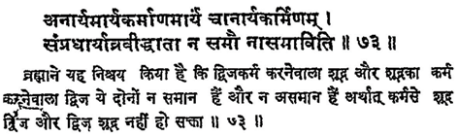
The meaning of this verse is straightforward. A Shudra does not become a Brahmin merely by adopting Brahminical conduct, nor does a Brahmin become a Shudra by behaving like a Shudra, even while the text encourages the twice-born to possess virtuous qualities. This interpretation follows Pandit Tulsiram and is shared by several other scholars. Below, I cite Pandit Tulsiram’s translation of Manu Smriti 10.73 together with his commentary.
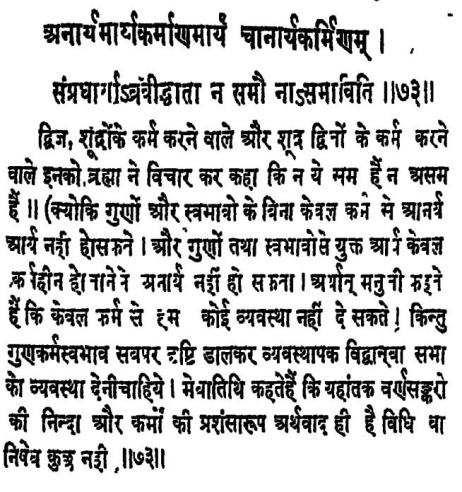
“This is because, in the absence of requisite qualities and innate nature, a non-Aryan cannot become an Aryan merely through action. Conversely, an Aryan endowed with noble qualities and nature cannot become a non-Aryan simply by being devoid of proper action. In other words, Manu asserts that we cannot establish any social order based solely on action; rather, the learned administrator or the assembly must establish the order by surveying all aspects: qualities, actions, and innate disposition…”
Mahabharata states,
Mahabharata 13.151.20-23 “Even the Brahmana that is destitute of knowledge is a god and is a high instrument for cleansing others. He amongst them, then, that is possessed of knowledge is a much higher god and like unto the ocean when full (to the brim). Learned or unlearned, Brahmana is always a high deity. Sanctified or unsanctified (with the aid of Mantras), Fire is ever a great deity. A blazing fire even when it burns on a crematorium, is not regarded as tainted in consequence of the character of the spot whereon it burns. Clarified butter looks beautiful whether kept on the sacrificial altar or in a chamber. So, if a Brahmana be always engaged in evil acts, he is still to be regarded as deserving of honour. Indeed, know that the Brahmana is always a high deity.” Tr. K.M. Ganguli (Source)
Claim: This is called Varna System. Now the very word Varna derived from root word “Vrinja” means “Choice”. A similar usage happens in common used word “Varan” meaning “choosing” or “Var” meaning a husband chosen by the girl.
Response: The term Varna is derived from the root vrta, meaning to cover or envelop. In the Vedas, Varna is used to denote colour or complexion, as seen in Rig Veda 3.34.9. In the Dharma Shastras, expressions such as Krishna Varna are understood to signify a black race, with krishna meaning black and varna meaning race, while the Gopatha Brahmana 1.1.23 assigns the colour white or shukla to Brahmins. Despite these varied usages, Hindu scholars as well as Indologists routinely translate Varna as caste. In the Ashtadhyayi 1.1.34 and 5.2.134, Maharshi Panini explicitly interprets Varna as caste. Although the term Varna can signify caste, race, colour, or tribe, it is most commonly employed to denote caste. Acharya Medhatithi, in his commentary on Manu Smriti 1.2, further reinforces this interpretation.
“…The term ‘Caste’ is implied to the three castes, ‘Brahmana, Ksattriya and Vaishya; and the term ‘all’ has been added for the purpose of including the Sudra…” (Source)
V.S Apte also translate Varna as caste,
[The Student’s English-Sanskrit Dictionary, by Vaman Shivram Apte, 1893 edition, Published by Mrs. Radhabai Atmaram Sagoon, Bombay]
Claim: In fact, Manu Smriti 3.109 clearly states that one who eats by glorifying his Gotra or Family is considered an eater of his own vomit. Thus, as per the Manu Smriti that the self-proclaimed birth-based Brahmins or upper-castes believe in, the very act of glorifying their lineage or gotra to demand special privileges makes them deserving of condemnation
Response: Manu Smriti 3.109 prohibits a Brahmin from obtaining a meal by advertising his family lineage, meaning that he should not invoke his family name to secure hospitality, and it even forbids him from obtaining food by mentioning his own name.
Manu Smriti 3.109 “A Brahmana shall not name his family and (Vedic) gotra in order to obtain a meal; for he who boasts of them for the sake of a meal, is called by the wise a foul feeder (vantasin).” Tr. Goerg Buhler (Source)
The context becomes clearer when one reads the preceding and succeeding verses alongside it.
Manu Smriti 3.108-112 “But if another guest comes after the Vaisvadeva offering has been finished, (the householder) must give him food according to his ability, (but) not repeat the Bali offering. A Brahmana shall not name his family and (Vedic) gotra in order to obtain a meal; for he who boasts of them for the sake of a meal, is called by the wise a foul feeder (vantasin). But a Kshatriya (who comes) to the house of a Brahmana is not called a guest (atithi), nor a Vaisya, nor a Sudra, nor a personal friend, nor a relative, nor the teacher. But if a Kshatriya comes to the house of a Brahmana in the manner of a guest, (the house-holder) may feed him according to his desire, after the above-mentioned Brahmanas have eaten. Even a Vaisya and a Sudra who have approached his house in the manner of guests, he may allow to eat with his servants, showing (thereby) his compassionate disposition.” Tr. Georg Buhler (Source)
Claim: Manu Smriti 2.136 states that one earns respect due to wealth, company, age, actions and knowledge in increasing order. There is no mention of family, gotra, caste, lineage and other non-factors to demand or earn respect.
Response:
Manu Smriti 2.136 “Wealth, relation, action and learning, as the fifth, These are the grounds of respect; (among them) that which follows is weightier (than that which goes before it).” Tr. Ganganath Jha (Source)
This is talking about upper three castes only, that whoever possess these five qualities within the same caste should be respected. Acharya Medhatithi explains Manu Smriti 2.136 as,
“Caste has been described as a ground of superiority; so that one belonging to a higher caste should be respected by one of a lower caste. The text now proceeds to describe the relative strength of those factors that entitle persons of a caste to salutation and honour among themselves.” (Source)
The apologist should have honestly cited the preceding verse as well, as it is essential for understanding the full context.
Manu Smriti 2.135 “A Brahmana, ten years old, and a Kshatriya of a hundred years of age, shall considered as a father and a son; the Brahmana shall be treated as the father of the Kshatriya.” Tr. M.N. Dutt
Acharya Medhatithi writes,
“…All that this means is that even when the Ksatriya is very old and the Brahmana very young in years, the former should rise to meet and salute the latter.” (Source)
Moreover, several verses from Hindu scriptures cited above, such as Manu Smriti 8.20-21 and Tulsidas Ramayana, Aranya Kanda, Doha 33.1, explicitly state that regardless of how knowledgeable or capable a Shudra may be, and irrespective of how incapable a Brahmin may be, the Brahmin must still be respected and placed above others.

Claim: Manu Smriti 10.65 asserts that Brahmin can become Shudra and Shudra can become Brahmin. Similarly, Kshtariyas and Vaishyas can also change their Varnas.
Response: Manu Smriti 10.65 actually implies that when a Shudra woman marries a Brahmin man, and their daughter in turn marries a Brahmin, and this pattern continues for seven generations, the seventh generation is regarded as Brahmin. This is because a Brahmin marrying a Shudra woman produces offspring of a different caste. This meaning becomes clear when the preceding verse is read carefully.
Manu Smriti 10.64 “If the daughter of a Brahmana by his Sudra wife is married to a Brahmana, and the daughter of that union is again married to a Brahman, and so on uninterruptedly up to the seventh generation in the female line, then at the seventh generation the issue of such union is divested of its Parasara caste and becomes a Brahmana.” Tr. M.N. Dutt (Source)
Renowned Hindu scholar Vijnanesvara explains this interpretation in his Mitakshara commentary on Yajnavalkya Smriti verse 96.
”…This is the adjustment: the daughter begot by a Brahmana on a Sudra woman is Nisadi; she (Nisadi) is married by a Brahmana and gives birth to a certain daughter. The latter is also married by a Brahmana and gives birth to a daughter, and so on, till the sixth daughter, who will give birth to a Brahman as seventh…” (Source)
This interpretation instead reinforces a rigid, birth based caste system.
Claim: Even Shudras can teach
Though Shudra means an uneducated person, a Shudra can also become a teacher for specific knowledge that he has. For example,
Manu 2.238: One should acquire knowledge even from a person born in a low family otherwise. Similarly, one should accept a noble woman as wife even if her family is otherwise not up to mark.
Manu 2.241. If needed, one may acquire knowledge from one who is not a Brahmin; and that he shall follow and serve such a teacher, as long as the instruction lasts.
Response: The apologist now contradicts himself. If an uneducated person is capable of imparting meaningful knowledge, it becomes unclear why such knowledge does not qualify a Shudra for elevation to Brahmin status. Conversely, if Brahmins are defined as educated, as the apologist claims, then the assertion that a Shudra can surpass them in knowledge renders the caste distinction logically incoherent.
Manu 2.238 “One imbued with faith may acquire excellent learning even from a lowly person, special law even from the lowest, and the gem of a wife even from a base family.” Tr. Ganganath Jha (Source)
The knowledge referred to here is limited to worldly matters rather than religious or Vedic learning. The verse is addressed to Brahmins, and the term lowly in this context refers to Kshatriyas and Vaishyas. A Brahmin may seek advice on worldly affairs from Kshatriyas and Vaishyas, even though formal instruction for a Brahmin student from them is generally prohibited, except in times of distress.
The term lowest refers to Chandalas, from whom only minimal and practical information may be taken, such as directions in an unfamiliar city. This restricted scope of interaction further underscores that the verse does not permit religious or moral instruction across caste boundaries. Acharya Medhatithi explains this distinction as follows.
“…Such learning one might ‘acquire’ learn- even from the lowly person, i.e., from a person born of a lower caste. ‘excellent learning’ here should not be taken as the ‘Vedic Science’; for even though in abnormal times of distress the learning of the Veda from lower castes may be permitted as we shall find later on, yet it cannot be permitted in normal times. That learning which is ‘not excellent’, such as the science of magic, etc. one should not learn at all. Lowest is the Chandala; from him even, one may learn the ‘special law’, i.e., law other than that expounded in Shrutis and Smritis; i.e., law relating to ordinary worldy matters. The term ‘Dharma’, law, is also used in the sense of rule. The sense thus is that if even a Chandala should say such is the rule here, ‘do not stay here for long,’ do not bathe in this water,- such is the custom among the people of the village, such is the restriction imposed by the king, then one should not think that he should obey only the words of his Preceptor and he need not pay any heed to those of a Chandala who has dared to advise him. We should not take the term ‘special law’ to mean ‘the knowledge of truth regarding Brahman’, because it is not possible to acquire this knowledge from the Chandala and such people, for the simple reason that they are ignorant of the Veda…” Medhatithi on Manu Smriti 2.238, Tr. Ganganath Jha (Source)
I am presenting the correct translation of the subsequent verse cited by the author.
Manu Smriti 2.241 “It is prescribed that in times of distress (a student) may learn (the Veda) from one who is not a Brahmana; and that he shall walk behind and serve (such a) teacher, as long as the instruction lasts.” Tr. Georg Buhler (Source)
Acharya Kulluka explains it as,
‘In the absence of a Brahmana, he may study under a Kshatriya; and in the absence of a Kshatriya, under a Vaisya preceptor.”
The verse clearly states that a student may acquire knowledge from a Kshatriya or a Vaishya only in times of distress and not otherwise. Acharya Medhatithi shares this interpretation, explicitly stating that such instruction is permitted solely under exceptional circumstances and never in normal conditions.
“‘Āpatkalpe’ is another reading. The meaning in this case would be tbat the ‘kalpa,’ ‘kalpana,’ assumption, of these is permitted during difficulties.
If the preceptor, after having begun the course of teaching, should happen, either on account of an expiatory rite or of some other reason, to abandon the pupil and go to another place,—and no other Brāhmaṇa-teacher is available,—and the pupil himself being too young, is unable to go to another place,—then he may receive teaching even from a non-Brāhmaṇa; i.e., from the Kṣatriya, and in his absence, from the Vaiśya. In view of the context, which began with the mention of the ‘learning of the entire Veda’ (165), the ‘learning’ here enjoined is the getting up of the Veda.
Though the term ‘non-Brāhmaṇa’ denoting all the three castes, except the Brāhmaṇa, stands for all men, yet the Śūdra could not be meant here; for the Śūdra is not entitled to learn the Veda; and it is only when one has learnt something that he can teach it.
“But by transgressing the scriptural ordinance, the Śūdra also might learn the Veda, just as the Kṣatriya and the Vaiśya do the work of teaching (which is not permitted).”
This also cannot be; because it has been laid down that if the Śūdra happens to learn the Veda, his body should be cut up. And since the penalty is so severe, it follows that the act is a grievous sin; and one who commits a grevious sin is regarded as ‘fallen’; so that if the Religious Student associated with a ‘fallen’ person, he would render himself extremely defiled.” Medhatithi on Manu Smriti 2.241, Tr. Ganganath Jha (Source)
According to Hindu texts, while Dvijas are entitled to study the Vedas, the authority to teach them is reserved exclusively for those born into the Brahmin caste.
Manu Smriti 10.1 ” Let the three twice-born castes (varna), discharging their (prescribed) duties, study (the Veda); but among them the Brahmana (alone) shall teach it, not the other two; that is an established rule.” Tr. Georg Buhler (Source)
These verses reinforce the notion of a rigid caste system, since even when Kshatriyas and Vaishyas are sufficiently conversant with the Vedas to be capable of teaching them, they are still not recognized as Brahmins, exposing the primacy of birth over knowledge or competence.
Claim: Education is true birth. As per Manu, actual birth happens after completion of education. All human beings are Shudras or uneducated when born. Those who complete their education are supposed to have a new birth. Thus they are called Dwija or Twice Born. Those who were unable to complete the education remain Shudra. This has nothing to do with birth or heredity. This is pure meritocracy.
2.148: When a teacher who is well-versed in Vedas teaches a student the science of Gayatri (that summarizes all principles of Vedas and rational living), then the actual birth of the student takes place. This birth is free from risks of death or destruction and leads the student to immortality.
Response: The writer claims that everyone is born a Shudra and that only after the completion of Vedic study are they regarded as Dvija, or twice born. To evaluate this assertion, it is necessary to examine what other verses state on the matter.
Manu Smriti 2.169 ” According to the injunction of the revealed texts the first birth of an Aryan is from (his natural) mother, the second (happens) on the tying of the girdle of Munga grass, and the third on the initiation to (the performance of) a (Srauta) sacrifice.” Tr. Georg Buhler (Source)
Sankha Samhita 1.6 “Brahmanas, Kshatriyas, and Vaisyas are the three twice born; their second birth takes place on the occasion of putting on the girdle of sacred rush.” Tr. M.N. Dutt (Source)
The cited verses clearly state that a Brahmin is born through physical birth and that his second birth occurs at initiation, that is, at the time of Upanayana when he formally begins the study of the Vedas.
If everyone were truly born a Shudra, as the writer claims, it becomes impossible to explain why the Shrutis permit the Upanayana ceremony exclusively for Aryans, as stated in Manu Smriti 2.35 to 40 and Yajnavalkya Smriti verse 14. Under this logic, there is no justification for barring those born in Shudra families from Vedic study while granting this privilege solely to those born into Brahmin, Kshatriya, and Vaishya families. This restriction exposes the fundamentally hereditary nature of Dvija status rather than any genuine merit based system.
Claim: Rama consumed berries that had been previously tasted by Shabari.
Refutation: There is no reference in Valmiki Ramayana or any earlier text about Rama eating tasted berries of Shabari. This story written by Balaram Das is understandable as he was part of the Pancha-sakha group in 15th century Puri, Odisha, who challenged Brahmanical customs and identified themselves as Shudra-munis (low caste sages). There are suggestions that he was probably inspired by a south Indian Sanskrit hagiography of saints known as Divya-Suri-Charitham, but the story did not gain popularity as the Brahmin orthodoxy found the story too radical. There is reference of Rama eating berries offered by Shabari but there’s no mention of her offering them tasted berries,
Padma Purana Book VI, Chapter 242, Verses 267-270 “He went to the pious, glorious Sabari. That best among Visnu’s devotees, seeing Rama and Lakshmana, went forth to greet them. Having saluted and seated them on a seat of darbhas, she washed their feet. With her mind full of joy she devoutly worshipped them with fragrant wild flowers. She, of a firm vow, then offered the two descendants of Raghu (viz. Rama and Lakshmana) fragrant fruits and sweet roots. (Rama,) the descendent of Kakutstha, gave her the highest liberation.” Tr. N.A. Deshpande (Source)
Some texts permit Dvijas, or twice-born men, to eat food prepared by a Shudra servant, so there is no breaking of caste barriers in such instances. While Shabari did offer berries to Rama, the claim that he consumed berries already tasted by her appears to be a later interpolation or a later version and does not occur in the earlier textual traditions.
Valmiki & Vyasa were Shudras?
Claim: Sage Valmiki, a Shudra, authored the Valmiki Ramayana.
Refutation: According to traditional accounts, Valmiki’s original name was Agni Sharma, and he was born to a Brahmin named Sumali of the Bhargava lineage, while his mother Kaushiki also belonged to the Brahmin caste of the Kaushik Gotra. Agni Sharma undertook severe penance, during which he repeatedly uttered the word mara, meaning kill, which over time transformed into Rama, the name of Vishnu. As his austerities continued for years, large anthills formed around him, leading to the name Valmiki. The Skanda Purana explicitly states that Agni Sharma, later known as Valmiki, was born into a Brahmin family, undermining claims that his status resulted from varna migration.
Skanda Purana V.i.24.3-4 “O Vyasa, formerly there was a Brahmana named Sumati, born in the family of Bhrigu. His wife Kausiki was richly endowed with beauty and youth. A son was born to him named Agnisarman…” Tr. G.V. Tagare (Source)
Vishnu Purana 3.3.18 identifies Riksha, also known as Valmiki, as a descendant of Bhrigu, while Padma Purana 1.8.156 describes Valmiki as the foremost among the Bhargavas. Padma Purana 5.66.143 explicitly refers to Valmiki as a Brahmin. In Valmiki Ramayana, Uttara Kanda 7.96.14, Valmiki describes himself as the tenth Pracheta, a name associated with Varuna. Srimad Bhagavatam 6.18.5 further states that Valmiki was born from Varuna. Since Valmiki is repeatedly linked to Bhrigu’s lineage, and Bhrigu himself is regarded as the son of Varuna, these multiple scriptural attestations collectively establish Valmiki’s identity as a Brahmin.
Claim: Vyasa was a Shudra.
Vyasa’s father was the sage Parashara, a Brahmin, while his mother Satyavati was the daughter of a Kshatriya father and an Apsara mother. Given this lineage, there is no textual basis for classifying Vyasa as a Shudra.
Mahabharata 1.63 “…the king, acquainted with the subtle truths of Dharma and Artha, went unto him and said, ‘Amiable one, carry thou this seed (semen) for my wife Girika and give it unto her. Her season hath arrived.’ “The hawk, swift of speed, took it from the king and rapidly coursed through the air. While thus passing, the hawk was seen by another of his species. Thinking that the first one was carrying meat, the second one flew at him. The two fought with each other in the sky with their beaks. While they were fighting, the seed fell into the waters of the Yamuna. And in those waters dwelt an Apsara of the higher rank, known by the name of Adrika, transformed by a Brahmana’s curse into a fish. As soon as Vasu’s seed fell into the water from the claws of the hawk, Adrika rapidly approached and swallowed it at once. That fish was, some time after, caught by the fishermen. And it was the tenth month of the fish’s having swallowed the seed. From the stomach of that fish came out a male and a female child of human form. The fishermen wondered much, and wending unto king Uparichara (for they were his subjects) told him all. They said, ‘O king, these two beings of human shape have been found in the body of a fish!’ The male child amongst the two was taken by Uparichara. That child afterwards became the virtuous and truthful monarch Matsya…”The fish-smelling daughter of the Apsara in her piscatorial form was then given by the king unto the fishermen, saying, ‘Let this one be thy daughter.’ That girl was known by the name of Satyavati.” Tr. K.M. Ganguli (Source)
According to the Mahabaharata 1.63, Rishi Parashara became sexually aroused upon seeing Satyavati and threatened her with a curse if she refused him. He ultimately persuaded her by granting a boon, after which intercourse took place and Satyavati conceived, resulting in the birth of Ved Vyasa.
Narada Purana, Uttarabhaga 28.32 “O Brahmana, the activities of the Lord are beyond human scrutiny though he abides by the favourably Dharma. Vyasa the son of Parasara, is himself the classifier of the Vedas. He was a man of truthful vision. His very form is worthy of being worshipped. (But) he was born of the semen virile of one who destroyed the virginity (of a woman). Hence he is called a Kanina (son of an unmarried girl). Moreover, he had sexual intercourse with the wives of his younger brothers.” Tr. G.V. Tagare (Source)
Refuting Claims of Varna Mobility in Ancient History
Claim: Aitareya Rishi was son of a Daasa or criminal but became a Brahmin of highest order and wrote Aitareya Brahman and Aitareyopanishad. Aitareya Brahman is considered critical to understand Rigveda.
Refutation: Aitareya Mahidasa would have had grounds to file a defamation case against the Hindu apologist for labeling his father a criminal. According to textual accounts, Aitareya Mahidasa was born to the sage Mundaka, while another version identifies his father as a Brahmin named Visala.
Claim: Vatsa became a Rishi though born to a Shudra (Aitareya Brahman 2.19).
Refutation: The Aitareya Brahmana does not mention the name or caste of Vatsa’s father. However, Rig Veda 8.8.8 and Pancavimsa Brahmana 14.6.6 state that Vatsa was born to a Brahmin named Kanva. Furthermore, Rig Veda 8.8.11 identifies Vatsa as the son of a sage, indicating that Kanva himself was also a sage.
Claim: Ailush Rishi was son of a Daasi, gambler and of low character. However he researched on Rigveda and made several discoveries. Not only was he invited by Rishis but also made an Acharya. (Aitareya Brahman 2.19).
Refutation: The story of Kavasa Ailusa appears in Aitareya Brahmana 2.19 and Kausitaki Brahmana 12.3. He was born to a Brahmin father named Ilusha and a slave woman. When Kavasa joined the sacrifice by the Saraswati, the rishis expelled him, questioning how the son of a slave woman could remain among them or be initiated. Only after the Saraswati miraculously favored him did the rishis accept him. His initial expulsion from ritual participation is a clear illustration of social exclusion based on birth and shows that access to religious rites was ordinarily restricted to Brahmins or Dvijas.
It is therefore essential to distinguish rare narrative exceptions from the normative social rule. The Dharma Shastras and other major Hindu texts consistently permit only Dvijas to undergo initiation and to perform Vedic sacrifices, making ritual eligibility explicitly dependent on birth. Texts such as Manu Smriti codify varna in rigid hereditary terms, detailing mixed unions, the transmission of status through lineage, and regulations that severely restrict social mobility, thereby leaving no scope for a genuinely merit based caste order.
Claim: Satyakaam Jaabaal was son of a prostitute but became a Brahmin.
Response: Satyakam Jabal was initiated by Gautama Rishi only after the sage confirmed that he was a Brahmin by birth, as noted by Adi Shankara in his commentary on Brahma Sutra 1.3.37, cited earlier in this article. The relevant passage from the Chandogya Upanishad is as follows.
Chandogya Upanishad 4.4.4-5 “He said to him: ‘Of what family are you, my friend?’ He replied: ‘I do not know, Sir, of what family I am. I asked my mother, and she answered: “In my youth when I had to move about much as a servant, I conceived thee. I do not know of what family thou art. I am Gabâlâ by name, thou art Satyakâma,” I am therefore Satyakâma Gâbâlâ, Sir.’ He said to him: ‘No one but a true Brâhmana would thus speak out. Go and fetch fuel, friend, I shall initiate you. You have not swerved from the truth.’” Tr. Max Muller (Source)
Claim: Matanga was son of Chandal but became a Brahmin. (Mahabharat Anushasan Parva Chapter 3)
Refutation: The Mahabharata does not state that Matanga transitioned from a Chandala to a Brahmin.
Mahabharata 13.3 ‘Matanga was born as a Chandala, and could not attain to Brahmanahood’ Tr. Kisari Mohan Ganguli (Source)
Matanga performed rigorous penance. Pleased by his asceticism, Indra appeared before him several times, offering boons. Matanga repeatedly requested to be elevated to the status of a Brahmin. Indra, however, consistently refused.
Mahabharata 13.29. ‘Sakra said, ‘One born on a Chandala cannot, by any means acquire the status of a Brahmana. Do thou, therefore name some boon so that all this labour of thine may not prove fruitless–Thus addressed by the chief of the celestials, Matanga became filled with grief… Matanga also, casting off his life-breaths, attained to a high place. Thou mayst thus see, O Bharata, that the status of a Brahmana is very high. That status is incapable of being acquired here (except in the natural way of birth) as said by the great Indra himself.” Tr. K.M. Ganguli (Source)
This has been refuted in detail in the article मातंग चांडालपुत्र से ब्राह्मण बने? Let’s
Claim: Raavan was born from Pulatsya Rishi but became a Rakshas.
Response: He was of mixed lineage, with a Brahmin sage, Vishvasrawa, as his father and a Rakshasi as his mother, rather than a Brahmin who later transformed into a Rakshasa.
Caim: Sons of Vishwamitra became Shudra. Vishwamitra himself was a Kshatriya who later became a Brahmin.
Response: No reference is provided to substantiate this claim. According to Mahabharata 13.4, Vishwamitra was born as a Brahmin due to the exchange of charu administered by Rishi Richika. The text recounts that Vishwamitra’s maternal grandmother sought a boon from the rishi, who instructed her to embrace a tree to give birth to a Kshatriya, while Satyavati was told to embrace another tree to bear a Brahmin son.
However, the two women deliberately exchanged the trees they were meant to embrace. As a result of this act, they conceived accordingly, and Vishwamitra was born as a Brahmin, contrary to the apologetic claim that he was Kshatriya by birth.
Mahabharata 13.4 “I had so ordered that thou wouldst give birth to a Brahmana whose virtues would be famous throughout the three worlds, and that she (thy mother) would give birth to an excellent Kshatriya. But now, O excellent lady, that thou hast reversed the order (of the charu) so, thy mother will give birth to an excellent Brahmana and thou too, O excellent lady, will give birth to a Kshatriya terrible in action.” Tr. K.M. Ganguli (Source)
Medieval scholar Vedanta Desika writes,
“Those who abide by the shastras should not believe in the elevation from lower castes stated in the deceptive shastras of heretics. The case of such as Vishvamitra, who became a Brahmin after being a Kshatriya, was due to certain special causes as the charu eaten by his mother without knowing that it was intended for producing a Brahmin child – it should not be considered that it is applicable to others as well, for it is against the texts in the shastras. The incidents and conduct of the Alvars who were possessed of powers even superior to those of Vidura and others should not be taken as precedents for our conduct. If we examine even their conduct carefully, we shall find that they did not transgress the rules of their respective castes.” Rahasyatraya Sara page 303, Tr. M R Raja Gopala Ayyangar (Source)
Claim: Vidur was son of a servant but became a Brahmin and minister of Hastinapur empire.
Response: Vidura was not a Shudra who became a Brahmin. According to the tradition preserved in the Mahabharata, he was originally a Dvija named Dharma, who was cursed by a sage to be born as a Shudra due to an unintended offence. Although he was born in a Shudra womb in that birth, he retained the memory and moral insight of his previous existence, which explains his wisdom and stature.
This account aligns with Hindu scriptural doctrine, which holds that elevation or degradation of caste occurs only across births and not within a single lifetime. Vidura’s case therefore does not demonstrate caste mobility through merit or conduct. Ramanuja Acharya explicitly refutes the apologetic claim that Vidura became a Brahmin,
“The case of Vidura and other Sudras having been ‘founded on Brahman,’ explains itself as follows:- Owing to the effect of former actions, which had not yet worked themselves out, they were born in a low caste, while at the same time they possessed wisdom owing to the fact that the knowledge acquired by them in former births had not yet quite vanished. (On these general grounds we object to Sudras being viewed as qualified for meditation on Brahman.) The Sutra now refutes that argument, which the Purvapakshin derives from the use of the word ‘Sudra’ in the Samvarga vidya.” Ramanuja Acharya on Brahma Sutra 1.3.32 (Source)
It is also mentioned in Mahabharata,
Mahabharata 1.63 “And because the killing of a Brahmana is more heinous than that of any other living thing, therefore, hast thou, O Dharma, been sinful. Thou shalt, therefore, be born on earth in the Sudra order.’ And for that curse Dharma was born a Sudra in the form of the learned Vidura of pure body who was perfectly sinless…And from Dwaipayana also born, in the Sudra caste, the wise and intelligent Vidura, conversant with both religion and profit, and free from all sins…” Tr. K.M. Ganguli (Source)
Nowhere do the texts state that Vidura became a Brahmin. On the contrary, they explicitly describe him as being born a Shudra who was well versed in dharma and artha due to the memory of his previous life, yet this exceptional knowledge did not elevate him to Brahmin status, thereby reaffirming that caste was not altered by merit or wisdom within a single lifetime.
Claim: Prishadh was son of King Daksha but became a Shudra. Further he did Tapasya to achieve salvation after repenting. (Vishnu Puran 4.1.14) Had Tapasya been banned for Shudra as per the fake story from Uttar Ramayan, how could Prishadh do so?
Nabhag, son of King Nedishtha became Vaishya. Many of his sons again became Kshatriya. (Vishnu Puran 4.1.13)
Dhrist was son of Nabhag (Vaishya) but became Brahmin and his son became Kshatriya (VP 4.2.2)
Further in his generation, some became Brahmin again (VP 9.2.23)
Response: The chapter heavily quoted by apologists concerns the initial stage of human propagation. In the beginning, some sons and daughters of Manu are described as marrying one another. Would apologists seriously use this origin narrative to argue that incest is permissible?
Mahabharata 1.75.14-16 And in Manu’s race have been born all human beings, who have, therefore, been called Manavas. And it is of Manu that all men including Brahmanas, Kshatriyas, and others have been descended, and are, therefore, all called Manavas. Subsequently, O monarch, the Brahmanas became united with the Kshatriyas. And those sons of Manu that were Brahmanas devoted themselves to the study of the Vedas. And Manu begat ten other children named Vena, Dhrishnu, Narishyan, Nabhaga, Ikshvaku, Karusha, Saryati, the eighth, a daughter named Ila, Prishadhru the ninth, and Nabhagarishta, the tenth. And Manu begat ten other children named Vena, Dhrishnu, Narishyan, Nabhaga, Ikshvaku, Karusha, Saryati, the eighth, a daughter named Ila, Prishadhru the ninth, and Nabhagarishta, the tenth. They all betook themselves to the practices of Kshatriyas.” Tr. K.M. Ganguli (Source)
Prishadhra is said to have committed the offence of killing his teacher’s cow, for which he was cursed and described as being degraded to the status of a Shudra. However, degradation to a lower caste does not imply an actual loss of birth caste. As noted earlier, it signifies ritual disqualification and a temporary prohibition from performing Vedic rites or studying the Vedas. Moreover, the Bhagavata Purana states that Prishadhra was cursed to be born as a Shudra, which clearly indicates that this degradation was to take effect in a subsequent birth, not within the same lifetime.
Srimad Bhagavatam 9.2.9 “Although Pṛṣadhra had committed the sin unknowingly, his family priest, Vasiṣṭha, cursed him, saying, “In your next life you shall not be able to become a kṣatriya. Instead, you shall take birth as a śūdra because of killing the cow.” Tr. Swami Prabhupada (Source)
He then undertook penance, since Hindu scriptures permit Dvijas to perform expiatory rites even after committing serious sins. Accordingly, Srimad Bhagavatam 9.2.10-14 states that Prishadhra performed penance and that his sin was duly expiated.
Nabhaga is said to have become a Vaishya because he married a Vaishya woman. However, Hindu scriptures permit a Kshatriya to marry a woman of his own caste, as well as a Vaishya or a Shudra. While there is a preference and minor restriction against taking a woman of another caste as the first wife, the texts also prescribe expiatory rites to address such violations. This case therefore represents ritual or social degradation, not an actual loss or transformation of caste by birth.
The reference cited by the apologist does not state that Dhrista became a Vaishya. On the contrary, it says that the Kshatriya lineage arose from him. According to Srimad Bhagavatam 8.13.2 to 3, both Nabhaga and Dhrista were sons of Manu. Rather than supporting caste mobility, this narrative reinforces caste hierarchy. The idea that a person should lose caste merely by marrying a woman of another caste itself reflects a deeply casteist assumption.
Further, Markandeya Purana 114.114 to 116 states that Nabhaga’s wife was originally a Kshatriya who was degraded to Vaishya status due to a curse. After the curse was lifted, their son was born as a Kshatriya. This directly contradicts the claim that Nabhaga permanently became a Vaishya by marriage. It is also important to note that Manu had two sons named Nabhaga, and the apologist must clarify which Nabhaga is being referenced before making such assertions.
Claim: Shaunak became Brahmin though born in Kshatriya family. (VP 4.8.1).
Response: Shaunaka himself was born into a Brahmin family. The figure often cited here is his ancestor King Vitahavya, who was originally a Kshatriya and was reclassified as a Brahmin through the intervention of sage Bhrigu. This episode should be treated as an exceptional and isolated case, not as evidence of a general principle. As Vedanta Desika observes in the case of Vishvamitra, “it should not be considered that it is applicable to others as well, for it is against the texts in the shastras.”
If caste mobility were genuinely possible in the manner claimed by apologists, they must produce clear textual evidence showing that a Shudra could attain Brahmin status through Vedic study or ritual practice. In the absence of such evidence, these rare narratives cannot override the consistent scriptural position that restricts Vedic learning and initiation to the Dvijas.
Claim: Vasistha was born to a prostitute but became a sage.
Response: It is true that Urvashi is associated with his birth, but the texts do not state that he was born from her womb. According to Rig Veda 7.33.11 and Nirukta 5.13, he is described as the joint son of Mitra and Varuna, brought forth in a pot, which clearly contradicts the claim of a normal biological birth through Urvashi.
Claim: Many verses of adulterated Manu Smriti (10.43-44) state that certain castes were earlier Kshtariya but became Shudra later. These verses are adulterated but prove that concept of Varna migration did exist. The castes mentioned are: Paundrak, Audru, Dravid, Kamboj, Yavan, Shak, Parad, Palhava, Cheen, Kirat, Darad, Khash.
Response: Acharya Medhatithi has explained it as,
”…This is what is meant by ‘gradually’; which means that the continued neglect of the rites reduces successive generations to the position of the Shudra; and this does not refer to the new born child, who loses his title only by the omission of his initiation. It is not that the man’s caste becomes lost; all that happens is that he becomes liable to be called by such caste names as the Bhrijjakantaka’ and the rest…The assertion that these people have become ‘low born’ is based upon the fact that in these countries we do not meet with any clear division of the four castes…Some people might be led to think that all these races here named are found to be described as Ksattriyas, so that must be Ksattriyas still. And it is with a view to preclude this idea that it ias asserted that these are low born. All the people spoken of form the races inhabiting the borders of Aryavarta, such races for instance, as the Kirata, the Vena, the Darada and so forth; and it is with reference to this that we have declaration that one should not go to the borders.” Medhatithi on Manu Smriti 10.43 and 44, Tr. Ganganath Jha
So Called Loss of Caste in Manu Smriti
Claim: There are several shlokas in Manusmriti that state that a person belonging to high Varna falls down to level of a Shudra if he does not conduct noble deeds. For example,
Manu 2.104: A person who does not worship the Supreme Lord twice daily should be considered a Shudra.
Manu 2.172. He who has not been initiated with teaching of the Vedas is a Sudra.
Manu 4.245 A Brahmin acquires brilliance through company of noble persons and avoiding bad company. On contrary, if he indulges in bad company, he becomes a Shudra
Response: The meaning of the term Dvija, or twice born, clarifies this issue. Dvija refers to those who are said to have two lives, the first at physical birth from the mother’s womb and the second at the ritual initiation marked by the tying of the girdle. This understanding, explicitly stated in Manu Smriti, directly refutes the apologist’s interpretation of Manu Smriti 2.172.
Manu Smriti 2.39 “Henceforth (beyond these age limits) these three twice born ones, not duly initiated with the thread, become Vratyas (of broken vows), and are degraded from the society of the Aryans.” Tr. M.N Dutt (Source)
The following verse prescribes expiation for the failure to study the Vedas.
Manu Smriti 2.40 “A Brahmana, even in the time of distress, must not hold any connection with these Vratyas, not duly expiated according to the regulation, either by marriage, or by (Vedic) study.” Tr. M.N Dutt (Source)
Manu Smriti 11.192-3 “Twice born ones, who have not been initiated with the Gayatri at their respectively proper ages (of initiation), shall first practice three Krichchhra penances; thereafter they should be initiated with the holy thread.” Tr. M.N. Dutt (Source)
Vijnaneshwara writes,
“Vratyas or outcastes are devoid of all sacraments; so long as they do not perform the Vratyastoma; performing which they again become entitled to Upanayana.” Vijnanesvara in Mitaksara on Yajnavalkya Smriti verse 38
By performing this rite, they again become entitled to Upanayana, demonstrating that a Brahmin continues to remain a Brahmin despite such lapses, since expiatory rites are prescribed for him and he is allowed to resume Vedic study after completing the required penance, an understanding also reflected in the Upanishadic tradition and one that further weakens the apologetic claim of caste change through conduct alone.
Chandogya Upanishad 6.1.1 “Harih, Om. There lived once Svetaketu Aruneya (the grandson of Aruna). To him his father (Uddilaka, the son of Aruna) said: ‘Svetaketu, go to school; for there is none belonging to our race, darling, who, not having studied (the Veda), is, as it were, a Brahmana by birth only.” Tr. Max Muller (Source)
It is true that Hindu scriptures state that a Brahmin falls from his rank upon committing certain sins, but this does not imply that he becomes a Shudra, as it merely denotes a form of degradation. Acharya Medhatithi explains this point as follows.
“The mention of ‘outcaste’ here is only meant to indicate degradation; it does not mean that the man is to be actually treated as an ‘Outcaste’, as described under 11.182.” Medhatithi on Manu Smriti 3.16, Tr. Ganganath Jha (Source)
“…‘Becomes an outcast.’—All that this means is that the expiation shall be heavier than the ‘performance of the Kṛcchra for one year,’—and not that the man actually becomes an outcast…” Medhatithi on Manu Smriti 11.175, Tr. Ganganath Jha (Source)
“…‘By selling meat he at once becomes an outcaste‘; where becoming an outcaste could not apply to any one else except the seller himself. From all this it is clear that all that is meant to be really related to the prohibition is that something undesirable happens; and the words of the text cannot be taken as literally true. Hence what is meant is that ‘the man who does anything else- in the shape of selling and the like- with sesamum than eating and the rest, becomes a worm,- i.e., becomes tainted with the evil effects described.” Medhatithi on Manu Smriti 10.92, Tr. Ganganath Jha (Source)
“The term ‘outcast’ connotes disqualification in regard to the rites of twice born men; the meaning is that he ‘falls’, recedes, becomes deprived of, his rights.” Medhatithi on Manu Smriti 11.180, Tr. Ganganath Jha (Source)
Likewise, Gautama reiterates this principle by defining outcast status as the deprivation of lawful occupations reserved for the twice born
Gautama Dharma Shastra 21.4 “To be an outcast means to be deprived of the right to follow the lawful occupations of twice-born men.” Tr. Georg Buhler (Source)
When Hindu texts state that a Brahmin falls from his rank, this language signifies degradation of status rather than a literal transformation into a Shudra. As demonstrated above, wherever such a fall is mentioned in the scriptures, it is consistently followed by prescriptions of expiatory rites for the specified offences, indicating the possibility of ritual restoration rather than a change of caste.
Manu Smriti 4.245 is frequently mistranslated and misinterpreted by Hindu apologists,
Manu Smriti 4.245 “A Brahmana who always connects himself with the most excellent (ones), and shuns all inferior ones, (himself) becomes most distinguished; by an opposite conduct he becomes a Sudra.” Tr. Georg Buhler (Source)
Acharya Medhatithi explains this as,
“…By the contrary procedure,’ by adopting the opposite process i.e., by forming connections with inferior people the man becomes a Shudra. Since it is not possible for the caste of a man to disappear, what is meant is that he becomes equal to the Shudra.” Medhatithi on Manu Smriti 4.245, Tr. Ganganath Jha (Source)
He further reiterates the same interpretation in his commentary on Manu Smriti 10.43.
”It is not that the man’s caste becomes lost; all that happens is that he becomes liable to be called by such caste names as the Bhrijjakantaka’ and the rest.” Medhatithi on Manu Smriti 10.43, Tr. Ganganath Jha (Source)
An expiation is prescribed for this offence as well.
Manu Smriti 11.181-2 “By sharing the same car, with, or by eating in the company of a degraded person for a year, a man becomes degraded; by teaching the Vedas to such a person, or by officiating as a priest at a sacrifice instituted by him, or by contracting any; marital relation with him, one becomes degraded on the same day. He, who associates with a degraded person, must practice the same penance for his purification, as is laid down for the expiation for the sin through which that person has become degraded.” Tr. M.N Dutt (Source)
Claim: 2.168: A Brahmin, Kshatriya or Vaishya who puts efforts in other areas except understanding and following the Vedic precepts becomes a Shudra and his future generations also suffer from ignorance of Vedas.
Response: The correct translation is,
Manu Smriti 2.168 ” A twice-born man who, not having studied the Veda, applies himself to other (and worldly study), soon falls, even while living, to the condition of a Sudra and his descendants (after him).” Tr. Georg Buhler (Source)
The next verse is,
Manu Smriti 2.169 “According to the injunction of the revealed texts the first birth of an Aryan is from (his natural) mother, the second (happens) on the tying of the girdle of Munga grass, and the third on the initiation to (the performance of) a (Srauta) sacrifice.” Tr. Georg Buhler (Source)
The question then arises as to how one can still be regarded as a Dvija, that is a Brahmin, Kshatriya, or Vaishya, if the Vedas have not been studied. Acharya Medhatithi explains the verse as follows.
“…The mention of ‘falling to the state of the Shudra’ is meant to express excessive deprecation…” Medhatithi on Manu Smriti 1.168, Tr. Ganganath Jha (Source)
An expiation is prescribed for this offence as well.
Manu Smriti 11.192-3 “T Those twice-born men who may not have been taught the Savitri (at the time) prescribed by the rule, he shall cause to perform three Krikkhra (penances) and afterwards initiate them in accordance with the law. Let him prescribe the same (expiation) when twice-born men, who follow forbidden occupations or have neglected (to learn) the Veda, desire to perform a penance.” Tr. Georg Buhler (Source)