Written by Sulaiman Razvi
Hinduism is often presented by its adherents as an exceptionally peaceful and tolerant religion, sometimes described as a “way of life” rather than a religion. It is frequently claimed that, unlike some other faiths, Hinduism does not prescribe punishment or eternal damnation for disbelief or blasphemy. However, when verses from Hindu scriptures that appear to endorse violence are brought to attention, such claims of absolute tolerance are often reconsidered or dismissed without substantive engagement.
Public discourse also reveals a tendency to emphasise violence associated with other religious communities while minimising or denying instances of violence carried out by individuals or groups identifying as Hindu. In some cases, Hindu organisations accused of religiously motivated violence are portrayed not as extremists but as patriots or saviours of Dharma, while the broader phenomenon of Hindu extremism is denied altogether.
Official data complicates the narrative of inherent religious harmony. According to the Government of India, as stated by the Minister of State for Home Affairs, Nityanand Rai, the country recorded 3,399 cases of communal or religious riots between 2016 and 2020. India experiences an unusually high number of communal clashes, a phenomenon that may be linked to the fact that Hindus constitute the overwhelming religious majority in the country.
By contrast, Muslim majority countries such as Malaysia and Indonesia, which have significant religious diversity but Hindu minorities, experience comparatively fewer or no communal clashes of this nature. These comparisons invite a broader discussion on how majority religious dominance, political mobilisation, and identity politics may contribute to communal unrest. While India is constitutionally secular and home to the vast majority of the world’s Hindu population, the continued prevalence of religious violence challenges idealised portrayals of universal tolerance.
Hindu leaders who deliver hate speeches against religious minorities often receive widespread support from within the Hindu community, and legal action is rarely initiated against them. Some Hindu leaders openly call for the killing of Muslims and Christians, while others vandalise mosques and churches or make public statements advocating sexual violence against Muslim women. In several instances, individuals accused of killing Muslims during communal riots have been granted Z plus security. People have been lynched merely on allegations of eating beef, while others have been shot dead for expressing critical views on Hinduism. Certain Hindu leaders openly speak of demolishing mosques, while others have declared their intention to eradicate Islam and Christianity from India.
All of this is occurring in a country that officially identifies itself as secular. One can only imagine the consequences for religious minorities if India were formally declared a Hindu state. In this context, the observation made by Dr B R Ambedkar appears particularly relevant. He stated,
“The Hindus claim to be a very tolerant people. In my opinion this is a mistake. On many occasions they can be intolerant, and if on some occasions they are tolerant, that is because they are too weak or too indifferent to oppose.” Source
You will find numerous Hindu scholars openly expressing hostility towards non-Hindus, yet very few who genuinely attempt to promote harmony or constructive engagement between Hindus and non-Hindus. The rhetoric frequently delivered at Dharm Sansads, where scholars and religious leaders publicly denounce other communities, reinforces this pattern. Such discourse suggests that these scholars are not speaking in ignorance but are drawing upon their familiarity with Hindu texts. Consequently, their statements strengthen the argument that violence and intolerance are not merely social deviations but are rooted in religious interpretations that these scholars themselves consider authoritative.
A profound double standard characterizes the Hindu majority’s response to religious violence and social misconduct. When acts of aggression are perpetrated by non-Hindus even in other nations, they are swiftly denounced as manifestations of ‘religious bigotry’ or ‘barbarism,’ with the blame being attributed directly to the culprit’s faith. Conversely, equivalent atrocities committed by Hindus are often glorified as acts of valor or met with diversionary rhetoric intended to obscure the gravity of the crime. This contradiction is further highlighted by a selective indignation, they take pleasure in hearing that Muslims have been killed in other countries, yet find nothing contradictory in seeking work and sustenance in Christian and Muslim countries.
Furthermore, this communal bias extends to secular crimes, instances of theft or murder involving non-Hindus are frequently framed through a theological lens, yet systemic issues within the Hindu fold ranging from the sexual misconduct of priests and the targeted killing of Dalits to ‘honor’ killings and communal lynchings are met with a conspicuous and defensive silence. By refusing to apply the same moral scrutiny to their own community, they perpetuate a culture of impunity that shielding internal regression while weaponizing the failures of others.
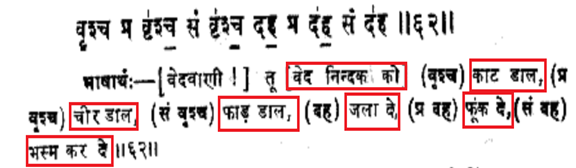
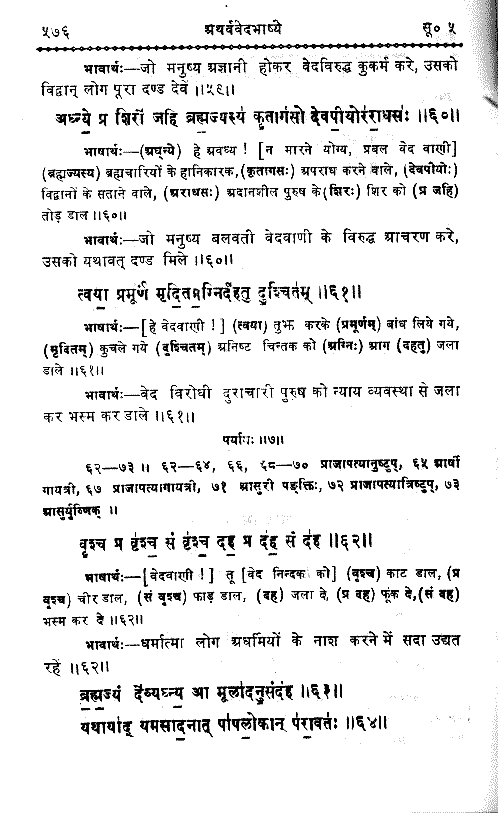
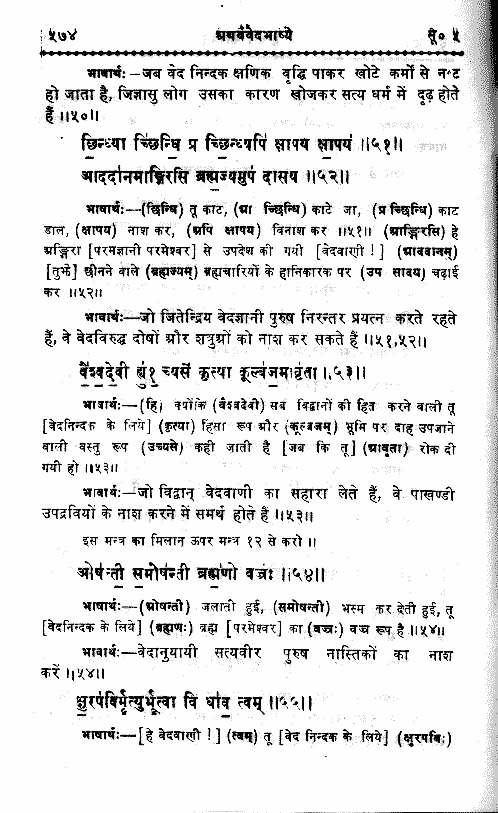
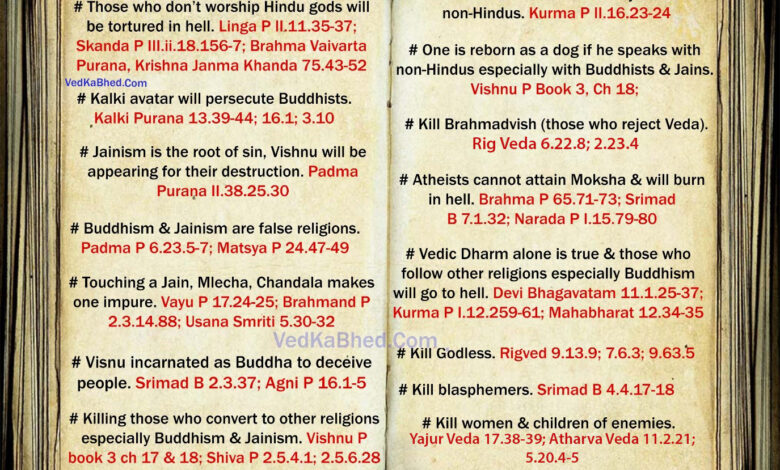
According to the Vedas, severe punishments, including death, are prescribed for individuals who reject or oppose Vedic authority. These include those who deny the Vedas, harbour hatred towards the Vedas or Ishwar, refuse to worship or offer sacrifices, commit blasphemy by insulting the gods, or oppress Brahmins. Numerous passages within the Vedic corpus explicitly call for the destruction or killing of such individuals, indicating that disbelief and religious nonconformity were treated as grave offences.
The Vedas employ a wide range of terms to denote non-believers or those considered outside the Vedic religious order. These include Adeva and Adevayu, meaning godless, Anindra, referring to those opposed to Indra, Ayajyu and Ayajvan, meaning those who do not perform sacrifices, Abrahman, denoting those hostile to sacred knowledge, and Anyavrata, referring to followers of other gods. Additional terms such as Apavrata and Avrata describe individuals who reject ritual observance, while Devanid refers to haters of the gods, and Brahmadvish denotes those who despise devotion and denounce the Vedas. Collectively, these classifications reflect a theological framework in which dissent from Vedic religion was not merely discouraged but actively criminalised.
Some members of minority communities in India attribute communal violence primarily to politicians, arguing that such conflicts are manufactured for electoral gain. This explanation is partially valid, yet it fails to capture the deeper reality. Among Hindus, communal violence is rarely blamed on politicians. Instead, the blame is often directed at the religion of the other community as a whole.
When minorities object to saffronised textbooks, they argue that the British deliberately distorted Indian history under the policy of divide and rule. However, Hindus themselves do not apply this logic consistently. It was neither politicians nor Britishers who instructed Hindu kings such as Pushyamitra Sunga, Kinnara, Shashanka, or the Chola rulers to persecute and kill Buddhists and Jains. It was neither politicians nor colonial authorities who compelled Hindu scholars like Adi Shankaracharya and Kumarila Bhatta to vilify Buddhism and Jainism and justify the persecution of their followers.
From the historical persecution of Buddhists and Jains, to the killing of nearly a million Muslims in post-independence communal violence, the 1984 anti-Sikh pogroms, the demolition of a mosque, repeated riots targeting Muslims, the anti-Christian Kandhamal violence, the vandalisation of churches and mosques, and the constant stream of hate speeches delivered by Hindu leaders against minorities, a common pattern emerges. These acts are not isolated political events but are rooted in a long-standing ideological hostility.
The unifying thread across these episodes is the influence of religiously sanctioned hatred. This hostility draws legitimacy from scriptures, traditions, and historical narratives that demonise dissenters, heretics, and non-Hindus.
If this argument sounds like the rhetoric of Hindutva, it is only because it responds to Hindutva using its own language. Sometimes, confronting an ideology requires speaking in the terms its adherents understand best.
Intolerance within Hindu Caste and Sect
Hinduism is perhaps the only religion that institutionalises birth based discrimination by dividing its followers into castes and sects. Its scriptures threaten hell for those who cause caste intermixture, condemn Shudra kings to destruction in the Kali Yuga, and prescribe punishment for Shudras who perform Brahminical duties. Such doctrines reinforce social inequality as a religious mandate.
Brahma Purana 106.121 “There is a hell named Gudapaka. It is full of boiling eddies of treacle and molasses. A man responsible for the mixture in castes is thrown into it. He is burnt therein.” Tr. Board of Scholars, edited by J.L. Shastri (Source)
Several Hindu scriptures describe Kalki as a figure who will destroy Shudra rulers and those of mixed caste origin, reflecting a theological endorsement of caste purity and exclusion.
Brahmanda Purana 1.2.31.77-84 “In the previous Svayambhuva Manvantara, he had been born of a part of Madhava (Visnu). For a full period of twenty years, he wandered over the Earth taking with him an army along with horses, chariots and elephants. Surrounded by hundreds and thousands of Brahmanas wielding weapons, he killed all the Mlecchas all round along with those kings, the heretics born of Sudra women. The lord exterminates those heretics. Everywhere he kills all those who are not scrupulously religious. The lord who was strong and who annihilated all the Mlecchas slew these also People who were born of parents of different castes, those who depended on them, the Udicyas (Notherners), Madhya Desyas (Persons of middle lands), Parvatiyas (Mountain-dweller), Pracyas (Easterners), Praticyas (Westerners), those who talk about on the ridges of the Vindya mountains, Daksinatyas (Southerners), Dravidas along with Simhalas (Ceylonese), Gandhara, Paradas, Pahlavas, Yavanas, Sakas, Tusaras. Barbaras, Cinas (Chinese), Sulikas, Daradas, Khasas, Lampa-karas, Katakas and different tribes of Kiratas. The powerful lord wielding the discuss slew all these barbarous people.” Tr. G.V. Tagare (Source)
Srimad Bhagavatam 11.4.22 “In his incarnation as Buddha, He shall bewilder by his arguments of ahimsa (non-injury) the Daityas performing sacrifices, though not entitled to the performance thereof. Then in the Kali Yuga, incarnating himself as Kalki He shall slay the Sudra kings.” Tr. J.M. Sanyal
Shudras are not even allowed to drink the milk of tawny cow.
Varaha Purana 112.19-21 “Those (Sudras) who drink (the milk of) Kapila make their forefathers eat the filth in the earth for long. Note what happens to the Sudras who feed on the milk, ghee and butter of the Kapila cows. They go to the terrible hell called Raurava.” Tr. Venkitasubramonia Iyer (Source)
Inter-mingling of Shudras and Brahmanas is evil of Kali Yuga.
Brahmanda Purana 1.2.31.41 “Alliances and associations of the Sudras and Antyayonis (lowest born) with Brahmanas take place in the Kali Yuga, in regard to bed, seats and food stuffs.” Tr. G.V. Tagare (Source)
Kurma Purana I.30.6 “In Kaliyuga, the Sudras will have close association with the Brahmanas by the use of spells and incantations as well as through the sharing of beds, seats and food.” Tr. G.V. Tagare (Source)
Intolerance towards Shudras is extensively explained in articles Caste system in Hinduism and Manu Smriti and Untouchables.
Intolerance towards sects
Hinduism is also divided into sects, in addition to its rigid caste structure. Over time, numerous sects have emerged, such as the Arya Samaj, Lingayat and ISKCON (Gaudiya Vaishnavism). Broadly, Hinduism is dominated by two major sectarian traditions, Shaivism and Vaishnavism. Shaivites worship Shiva as the supreme deity, while Vaishnavites regard Vishnu and his avatars as supreme. Although Shaivite texts acknowledge Vishnu and his incarnations as gods, and Vaishnavite texts similarly recognise Shiva as a god, each tradition elevates its chosen deity above all others. Shaivite scriptures frequently portray Shiva as the ultimate reality while depicting Vishnu as subordinate, whereas Vaishnavite scriptures exalt Vishnu as supreme and often diminish Shiva. This theological rivalry has not remained purely doctrinal, as historical records also point to tensions and clashes between followers of these two sects.
– On the eve of Kumbh, a conflict between priests and Sadhus Source
– A similar clash happened in the 19th century also.
– “At the Kumbh Mela at Ujjain in 1826, a combined army of Vaishnavite warrior-sadhus and Maratha soldiers inflicted a harsh military defeat on the Shaivite sadhus, and ended up plundering their temples and monasteries. Later, while the British put an end to the regular bouts of violence between the warrior-sadhus Shaivites and Vaishnavites, they made separate arrangements for both orders at the Kumbh Melas at Allahabad and Hardwar to prevent bloodshed over which sadhu order should have precedence in bathing in the Ganga.” The Radical Humanist, Volume 67, by Manabendra Nath Roy, p.13 also mentioned by Yoginder Sikand Source
– Visit by naga sadhus at Tirumala Tirupati Devasthanams leads to ‘suddhi’ Source
– In Tamil Nadu two groups of Vaishnavite Hindus namely Vadakalai and Thenkalai fought each after a dispute over whether to hold prayer in Sanskrit or Tamil Source
Although these two sects coexist today, their scriptures reveal persistent tensions between them. Both Shaivite and Vaishnavite texts engage in a clear contest for theological supremacy. Shaivite scriptures, in particular, portray Vishnu and his avatars as worshippers of Shiva, thereby asserting Shiva’s superiority over Vishnu.
Linga Purana Section I, 98.159-162 “Suta said: Thus he eulogised the bull-bannered lord with his thousand names. The lord (i.e. Visnu) bathed Siva and worshipped him with lotus flowers. In order to test Visnu, Mahesvara the lord of the worlds hid one of the lotus flowers intended for the worship. Visnu from whom the flowers was taken away thought thus, ‘What is this?’ After realising thee loss of the flower Visnu plucked out his eye and devoutly worshipped the preceptor of the universe, the support of all beings. He worshipped him repeating the last name of the lord.” Tr. Board of Scholars, edited by J.L. Shastri (Source)
This narrative from the Linga Purana is explicitly intended to establish Shiva’s supremacy over Vishnu. Another account reinforces this hierarchy by asserting that the Sudarshana Chakra, the discus wielded by Vishnu, was granted to him by Shiva as a boon, following Vishnu’s prolonged and rigorous worship of Shiva.
Linga Purana Section I.98.1-3 “The sages said: O Suta, how was the discus Sudarsana acquired from Mahesvara, the lord of Devas, by lord Visnu? It behoves you to recount it. Suta said: A terrible fight ensued between Devas and the leading Asuras causing destruction to all living beings. On being pierced and hit by lances, iron clubs, javelins and arrows of bent knots Devas became extremely terrified and fled. [18-26] Lord Visnu said: O Devas, I shall approach lord Siva now along with all the eternal Devas and shall carry out your task in full. O Devas, after acquiring the discus, formerly made by the slayer of the Tripuras in order to kill Jalandhara, I shall kill all the six thousand eight hundred great Asuras and Daityas beginning with Dhundhu…Suta said: After saying this to the excellent Devas, Visnu, the excellent one among Devas, remembered lord Siva worshipped him. On the splendid summit of the Himavan he duly installed the Linga that resembled the mountain Meru. It had been made by Visvakarman. Repeating the hymn called Tvarita-Rudra and the Rudrasukta he bathed the Linga and worshipped it with scents. It was charming in its flame-like form. He eulogised Rudra; worshipped him in the fire and bowed down to him. Repeating the thousand names in order he worshipped lord Siva… [169-170] Glancing lovingly at Visnu who stood aside with palms joined in reverence, Sankara, Mahadeva said smilingly. O Visnu, the task of Devas has been well understood by me. I shall give you the splendid discuss Sudarsana.” Tr. Board of Scholars, edited by J.L. Shastri (Source)
This illustrates how Shaivite Puranas consistently portray Shiva as the supreme deity. Another Shaivite text further reinforces this claim by stating that,
Shiva Purana, Kotirudrasamhita 4, chapter 27, verse 35-42 “Gautama said:- You are evil-minded desiring to put me in distress as I am a devotee of Siva. Hence you shall be averse to the Vedas always. Henceforth your faith in the rites of the Vedas, particularly with reference to the path of Siva yielding salvation shall cease to exist…fall, ye all, deep into the hell…You will not have Siva as your sole deity. You will be considering the matchless Siva on a par with other gods…All your descendants-sons, grandsons and other, O brahmins, shall be non-Saivites. You shall stay certainly in hell along with your sons.” Tr. J.L. Shastri (Source)
These verses imply that adherence to Shaivism alone leads to salvation, while non Shaivites are destined for hell. Additionally, certain narratives depict Vaishnavites as hostile or antagonistic towards Shiva, further reinforcing sectarian exclusivity within these texts.
Shiva Purana, Rudrasamhita 2, Parvatikhanda III, chapter 33, verses 5-6 “Now, a certain brahmin professing Vaisnava cult came here and spoke very critically about Siva. Ever since, the mother of Parvati has gone out of sense. Hence she does not wish her daughter’s marriage with Siva.” Tr. J.L. Shastri (Source)
Another verse from the Shiva Purana asserts that only sons who adhere to Shaivism are entitled to inherit property.
Shiva Purana Vayaviyasamhita 7, section II, chapter 39, verses 58-60 “…The descendant shall propitiate devotees. Only a devotee of Siva shall inherit his wealth. If his children are not initiated in Saivite cult the wealth shall be handed over the Siva. No child shall take it.” Tr. J.L. Shastri (Source)
Contrary to those Shaivite verses other Puranas (mostly Vaishnavite) praise Vaishnavism and exalt Vaishnavism and proclaim Vishnu as the supreme deity. In this context, Sage Narada declares that,
Garuda Purana I.99.6-7 “The following should not be entertained. A sickly person, a person deficient in limbs or having additional appendages, a one-eyed man, son of a widow after remarriage, a fallen sinner like Avakirna and those who do not conform to conventions, and a a-Vaisnava (non-believer in Visnu). These are not worthy of being invited for Sraddha. They (the deserving brahmins) shall be invited the day before when they shall observe celibacy.” Tr. J.L. Shastri (Source)
Skanda Purana II.ii.10.120-1 “(As opposed to these) Avaisnavas (‘non-devotees of Visnu’) hate auspicious conduct of (other) men. They themselves indulge in evil conduct and evil thoughts in the minds. They are undisturbed even if great misfortune befalls them. They take delight in sexual enjoyment. Those Avaisnavas are inebriated. They do not resort to the Lord even for a moment, although he is the cause of supreme happiness and is present in the lotus of the heart. They always cover up the names of Hari by means of aimless, worthless and futile network of words…Indeed those devoid of devotion to Visnu are human brutes.” Tr. G.V. Tagare (Source)
“One who blasphemes a Vaisnava cannot be protected by anyone. Even if a person is as strong as Lord Siva, if he blasphemes a Vaisnava, he is sure to be destroyed. This is the verdict of all sastras. If one does not care for the verdict of the sastras and dares blaspheme a Vaisnava, he suffers life after life because of this.” Chaitanya Bhagavata Madhya 22 by Vrindavana Dasa Thakura, Tr. Swami Prabhupada
One Purana even asserts that one should not reside in a kingdom ruled by a king who is not a Vaishnavite
Skanda Purana II.v.11.23-24 “Bharadvaja said: Well asked, O highly fortunate one, since you are a devotee of Visnu. The earth that you protect, O king, is blessed. The subjects (governed by you) are good (blessed). One shall not stay in that kingdom where the king is not a Vaisnava. Better to stay in a forest or in a Tirtha but not in a realm where there are no Vaisnavas.” Tr. G.V. Tagare (Source)
Vaishnavite scriptures portray Sage Bhrigu as a devotee of Vishnu and recount an incident in which he curses the followers of Shiva, thereby reflecting sectarian hostility within the textual tradition.
Srimad Bhagavatam 4.2.28-29 “One who takes a vow to satisfy Lord Śiva or who follows such principles will certainly become an atheist and be diverted from transcendental scriptural injunctions. Those who vow to worship Lord Śiva are so foolish that they imitate him by keeping long hair on their heads. When initiated into worship of Lord Śiva, they prefer to live on wine, flesh and other such things. Bhṛgu Muni continued: Since you blaspheme the Vedas and the brāhmaṇas, who are followers of the Vedic principles, it is understood that you have already taken shelter of the doctrine of atheism.” Tr. Swami Prabhupada (Source)
Swami Prabhupada commented on the above verses: “It is sometimes seen that devotees of Lord Śiva imitate the characteristics of Lord Śiva. For example, Lord Śiva drank an ocean of poison, so some of the followers of Lord Śiva imitate him and try to take intoxicants like gāñjā (marijuana). Here the curse is that if someone follows such principles he must become an infidel and turn against the principles of Vedic regulation. It is said that such devotees of Lord Śiva will be sac-chāstra-paripanthinaḥ, which means “opposed to the conclusion of śāstra, or scripture.’…” Swami Prabhupada on Srimad Bhagavatam 4.2.28 Source
Swami Prabhupada also writes.
“Lord Śiva’s symptoms of austerity are not exactly those of a Vaiṣṇava. Lord Śiva is certainly the number one Vaiṣṇava, but he exhibits a feature for a particular class of men who cannot follow the Vaiṣṇava principles. The Śaivites, the devotees of Lord Śiva, generally dress like Lord Śiva, and sometimes they indulge in smoking and taking intoxicants. Such practices are never accepted by the followers of Vaiṣṇava rituals.” Swami Prabhupada on Srimad Bhagavatam 4.6.36. Source
Many Hindus expressed outrage when an actor impersonated Shiva in the film P.K. Protesters vandalised theatres, demanded a boycott of the film, and extended their calls to future projects involving the lead actor. This reaction raises a pertinent question. Would the same individuals condemn or destroy their own scriptures in which Shiva is portrayed in a far more humiliating manner? One such narrative describes a confrontation between Shiva and Krishna, in which Krishna defeats Shiva. The text further states that Shiva, terrified by Krishna’s fiery power, fled in fear and hid within a mountain. Such depictions, originating from revered scriptures, appear far more severe than any cinematic portrayal, yet they rarely provoke comparable outrage.
Skanda Purana II.ii.12.14-18 “…Nila mountain is in the third Yojana (i.e. 3X12 Kms.). This is the holy spot of the Lord of Gauri named Ekamrakavana. Not far off, O king, is the place where, being afraid, he sought refuge. Indradyumna said: Why was the Lord of Gauri (Siva) frightened? With whom did he seek refuge?” Tr. G.V. Tagare (source)
Although the text belongs to a Shaivite Purana, the translator Ganesh Vasudeo Tagare notes that this episode appears to be a later interpolation introduced by Vaishnavites to assert the superiority of Krishna over Shiva.
“A Vaisnavite twist to show the inferiority of Siva to Visnu. The fight between Siva and Visnu for one king of Kasi (Kasiraja) and the subsequent defeat of Siva and his praise of Visnu and Siva’s departure from Varanis to Ekamra Vana (vv50-79)-all this is invented to show Visnu’s superiority.”
Although the Skanda Purana is traditionally classified as a Shaivite text, it appears to have also been shaped by Vaishnavite influences. This may explain the presence of numerous passages that praise Vishnu while simultaneously diminishing or ridiculing Shiva, a point rightly noted by G. V. Tagare. Episodes describing conflicts between Shiva and Krishna or Vishnu are often treated briefly under the broader theme of God fighting each other. In these narratives, Shiva intervenes on behalf of his devotee to confront Krishna or Vishnu, yet the outcome consistently portrays Shiva in a position of humiliation, thereby reinforcing Vaishnavite claims of divine supremacy.
Skanda Purana II.ii.12.81-85a “Mahadeva said: O lord of Devas…carrying out your behest will be the cause of my welfare, O lord of the worlds. On account of my stupidity, I Lord, I had been arrogant. There, O Lord, your own blessing is the cause of my fickleness. Since you command me, O Lord of Devas, to proceed to Purusottama, I shall carry out your behest reverently and proceed to the auspicious holy place that bestows salvation. Do a favour to me and promise that you alone will protect and sustain my sacred region Purusottama…” Tr. G.V. Tagare (Source)
This theme is further discussed in the category on gods fighting each other. Similar to this verse, Vishnu is openly ridiculed in certain Shaivite Puranas.
Shiva Purana, Satarudra Samhita 3, chapter 23, verses 13-16 “When his pride fell off, Visnu was dejected, and dispirited. He then realised that Siva was sporting about in the form of a bull. Then on realising that Siva himself had come in the form of a Bull, Visnu spoke in a shrill voice with drooping shoulders and palms joined in reverence. Visnu said: O lord of the gods, O ocean of mercy, O lord Siva, I had been deluded by your Maya and my mind had been confused. O lord, I fought with you, Siva. Taking pity on me, O lord, let this offence be excused.” Tr. J.L. Shastri (Source)
This verse is also explained in Gods fighting each other category.
Kapalika
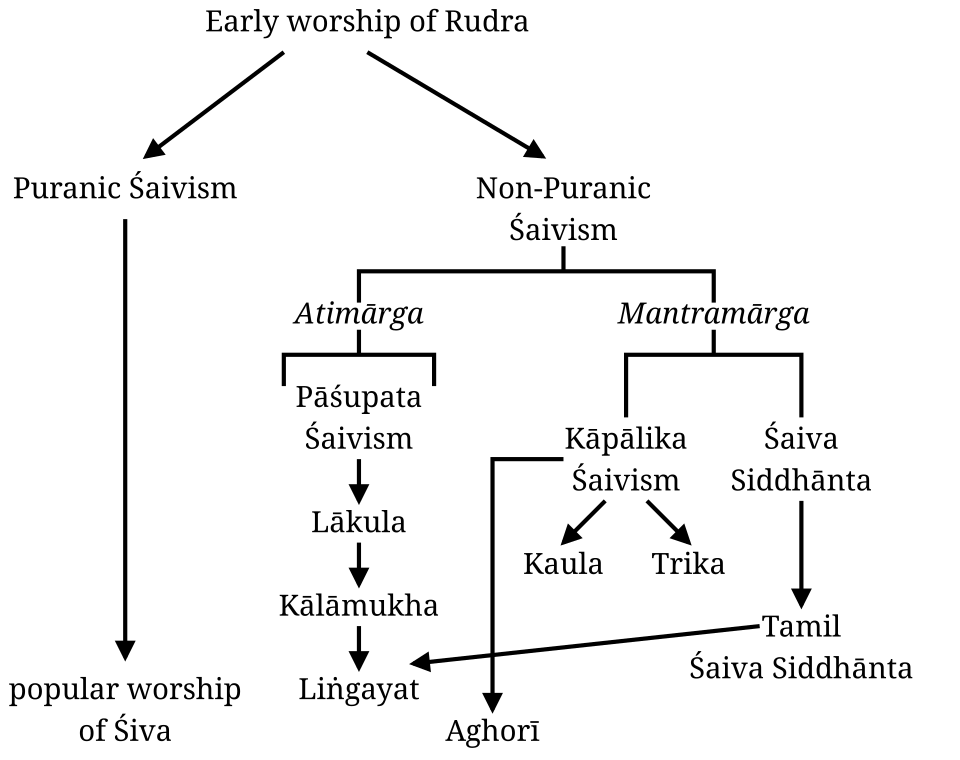
The Kapalika sect was a Shaivite sect characterised by extreme ascetic and ritual practices. The Aghori sadhus are generally regarded as an offshoot of this sect. Kapalika followers reportedly used human skulls as begging bowls, consumed food from them, smeared their bodies with ashes taken from cremation grounds, and engaged in several other unconventional practices. Although the Kapalika sect itself has become extinct, its beliefs and ritual outlook can still be partially understood through the practices of the Aghoris, who are considered its spiritual descendants. This relationship is more clearly illustrated in the following diagram sourced from Wikipedia.
Shiva himself is described in Hindu scriptures as a Kapalin.
Skanda Purana V.iii.214.2-3 “The lord wandered over the earth as a Kapalin (holder of a skull) wearing patched garments. He was surrounded by Pisacas, Raksasas, Dakinis, and Yoginis. He assumed the form of Bhairava and resorted to a cremation ground where he performed an elaborate penance causing freedom from fear to all the three worlds…” Tr. G.V. Tagare (Source)
Shiva Purana Ruda-Samhita 2, Satikhanda section II, chapter 27, verse 22 “Daksa, the evil-minded, did not invite Siva for that sacrifice, deciding that He was not worthy of taking part in the sacrifice because he was a Kapalin.” Tr. J.L. Shastri (Source)
In Varaha Purana 97.1, Shiva becomes enraged when Brahma addresses him as Kapalin. I have mentioned this verse in Gods fighting each other category. Kapalikas are praised in the following verse,
Skanda Purana I.iii.(P).8.76-80 “May the eminent sages staying in them protect the system of the worship of Siva. The devotees of Siva and the Pasupatas shall beg for alms (for their sustenance). Let these and the others of Yogic power and practice, as well as the Kapalikas always protect this holy spot. All the kings of past, present and future shall protect this spot without any disobedience to their commands…” Tr. G.V. Tagare (Source)
Rishi Upamanyu praises Kapalins,
Shiva Purana Vayaviyasamhita 7, Section II, chapter 31, verses 173-4 “[Upamanya said] The followers of Siva who adhere to the philosophical path, those who perform the Pasupata rites those who observe holy rites and the Saivite holy men such as Kapalikas-all these are adherents and executors of Siva’s behests. They shall be worshipped by me at the behest of Siva. May these bless me. Let them praise the successful holy rite.” Tr. J.L. Shastri (Source)
Kapalika Vrata prescribed by Shiva.
Skanda Purana V.i.6.84-94 “…[Shiva said] O sinless Devas, since I came over here it is called Mahakalavana. To you also who wished to perform austerities, it is Mahakalavana (forest of great opportunity). This secret holy shrine will become renowned in the world with this twin name. It is a secret forest. It is the cremation ground. It is the greatest and most majestic of all holy spots. This Kalavrtacarya (performace of Kapala Vrata) has been proclaimed by me. The devotee embellished with Kapala Vrata should take food in the Kapala (skull). The Kapala should always be held in the hand. He should be contented with the alms thus received in the course of his Vrata. He should (outwardly) adopt terrific features and reside in the cremation ground…He should adorn all limbs with holy ash… Formerly I too had adopted the Kapala Vrata and practised it. Kapala is the greatest of all secrets, holy and destructive of sins…[96] If out of delusion any man hates this Mahavrata, he will be overpowered by sins. Even after hundreds and crores of births, he is not rid of that sin. Hence no one should hate or violate it…” Tr. G.V. Tagare (Source)
The Kapalika sect and other Shaivite sects are condemned in Vaishnavite Puranas and Shakta traditions, which even state that Shiva created these sects to delude people.
Devi Bhagavatam 7.39.21-30 “…The S’âstras that are extant, as contrary to the S’rutis and Smritis, are all Tâmasa S’âstras, Mahâdeva has framed these Vâma, Kâpâlak, Kaulaks, Bhairava and such like S’astras for fascinating the people; else he has no object in framing them…” Tr. Swami Vijnananda (Source)
Varaha Purana 174.42-44 “The Brahmana said: He who dies with the food given by a Sudra within him, becomes ghost. By mere contact of, not to say sitting together or eating with, Nagas (a naked sect), Kapalikas or Pasandas, one becomes a ghost.” Tr. Venkitasubramonia Iyer, edited by J.L. Shastri (Source)
The following verses reflect Vaishnavite Puranic hostility toward Shaivite sub-sects like the Pasupatas, first acknowledging their Shaivite practices and then dismissing them as anti-Vedic and heretical.
Kurma Purana II.39.56-62 “Indeed the holy Pasupata vow has been formerly designed by me for the achievement of liberation. It is the greatest of all secrets. It is the subtlest essence of the Vedas. One who performs Pasupataa vow, shall be quiescent; he must have perfect self-control; he should dust his body with sacred ashes; he should observe celibacy and remain naked. Or he should wear a loin-cloth or a single garment; he should be silent and engaged in the study of Vedas. The scholar shall meditate on Siva as Pasupati. Sruti states that this Pasupata Yoga should be resorted by the seekers of liberation; that those who maintain Pasupata rite should be free from desire…There are other scriptures opposed to the Vedic view. They have been propounded by me alone and they are very fascinating in this world. Those cults are Vama, Pasupata, the Soma cult, the Lakura (Lakula) and the Bhairava and such other cults which are opposed to Veda should not be resorted to.” Tr. G.V. Tagare (Source)
Kurma Purana II.16.15 “One should not even verbally revere and honour the heretics, those who indulge in wrong actions, those who perform black magic, the Pancaratras and the Pasupatas.” Tr. G.V. Tagare (Source)
There is another Shaivite sect known as the Nakula sect, which is also condemned in Vaishnavite Puranas. A narrative in the Kurma Purana states that Shiva urged Vishnu to compose scriptures intended to delude sinners. Acting on Shiva’s request, Vishnu created such texts and subsequently encouraged Shiva to establish similar deluding traditions. In response, Shiva is said to have created several sects, including the Kapalika, Pasupata, and Nakula sects. This account, preserved in a Vaishnavite Purana, appears to deliberately portray these Shaivite traditions as deceptive and heretical, thereby reinforcing sectarian polemics within Hindu literature.
Kurma Purana I.16.117-9 “Hence, O bull-bannered lord, we shall compose scriptures for deluding the sinners and for saving those who are out of the pale of the Vedas.’ Thus addressed by Visnu, the slayer of Mura, Rudra composed deluding Scriptures and Kesava too did the same, on being urged by Siva. They were the treatises of the cults of Kapala, Nakula, Vama, Bhairava, both of Western and Eastern variety. Pancaratra, Pasupata and thousands of other cults as well.” Tr. G.V. Tagare (Source)
Ganesh Vasudeo Tagare writes, “The list shows what sects were regarded as being out of the pale of Vedic religion in KP. Out of these, Kapalas, or Kapalikas whether Brahminic or non-Brahminic, ate and drank in human skulls, wore garlands of skulls and indulged in horrid practices of wine-drinking, in sexual orgies and living in unclean manner (S.N. Dasgupta Ind. Phil. V.P.2, 3). Nakulas are the followers of Nakula or Lakulisa, a semi-historical founder of a sect of Saivism. In the Vayu P.23.2.17-23 and the LO.I.24, he is said to be an incarnation of Siva in a cemetry and Kayavarohana in Bhrgu ksetra, in Dabhoi Tehsil in Gujarat. Vama is a general term for the (Sakta?) observers of socially disapproved practices, the group being designated as Five Ma-karas. Bhairavas are also Saivites who worshipped Bhairava form of Siva. Bhairava-worship has been very popular among the masses in Maharashtra. Pancaratras, the Vasudeva worshippers who were later accommodated by the followers of Veda, held the famous Catur-vyuha (the four manifestations of Vasudeva) doctrine and had their own way of worship, are quite famous. Pasupatas are the followers of system founded by Umapati Srikantha (or Siva) and they are mentioned in Mbh. Santi. 337.62….”
Kurma Purana II.39.56-62 “Indeed the holy Pasupata vow has been formerly designed by me for the achievement of liberation. It is the greatest of all secrets. It is the subtlest essence of the Vedas. One who performs Pasupataa vow, shall be quiescent; he must have perfect self-control; he should dust his body with sacred ashes; he should observe celibacy and remain naked. Or he should wear a loin-cloth or a single garment; he should be silent and engaged in the study of Vedas. The scholar shall meditate on Siva as Pasupati. Sruti states that this Pasupata Yoga should be resorted by the seekers of liberation; that those who maintain Pasupata rite should be free from desire…There are other scriptures opposed to the Vedic view. They have been propounded by me alone and they are very fascinating in this world. Those cults are Vama, Pasupata, the Soma cult, the Lakura (Lakula) and the Bhairava and such other cults which are opposed to Veda should not be resorted to.” Tr. G.V. Tagare (Source)
Just as Vaishnavite redactions appear to have distorted the Shaivite Skanda Purana II.ii.12.14–18, a verse in the Linga Purana also seems to have been altered by Vaishnavites, in which Indra is made to say the following.
Linga Purana Section I.40.38-39 “People overwhelmed by misery will never see the maximum span of life of hundred years. In Kali all the Vedas will not be available. Yajnas perish afflicted by people of no virtue. Ochre-robed and naked anchorites will be wandering and many Kapalikas (ascetics holding skulls as their begging bowls) will infest the territories.” Tr. Board of Scholars, edited by J.L. Shastri (Source)
Vayu Purana a Vaishnavite Purana condemns Kapalikas and other religions also.
Vayu Purana I.58.64-66 “Yajnas are forsaken when Dharma receives a setback. There will be many types of heretics like wearers of ochre-coloured robes (Buddhists), Jainas and Kapalikas (skull bearing mendicants). There will be sellers of the Vedas and the sacred places. Heretics antagonistic to the discipline and arrangement of different castes and stages of life will be born. When Kali Yuga sets in, the Vedas will not be studied. Sudras will be experts and authorities in the affairs of Dharma.” Tr. G.V. Tagare (Source)
Shaivite Puranas portray Shiva as a Kapalika and explicitly endorse the Kapalika Vrata. Within these texts, Kapalikas are often praised and presented as legitimate followers of Shiva. In contrast, Vaishnavite Puranas claim that Shiva deliberately created the Kapalika and other Shaivite sects to delude sinners. This contrast provides clear evidence of a polemical agenda within Vaishnavite literature aimed at demonising rival Shaivite traditions. In several Vaishnavite texts, Shaivite sects are even labelled as heretical. Further examples of this hostility can be found in passages that condemn the Kapalika sect alongside Buddhism and Jainism. Additionally, Vedic texts themselves criticise the worship of the Shivlingam, suggesting theological tension between Vedic religion and later Shaivite practices. These factors support the view that Shiva was originally a local deity who was later assimilated into the Vedic framework by the Aryans. Read the article What is Shivling? for further information.
Others
There is a persistent conflict among Hindu sects, with each accusing the other of failing to adhere correctly to the Vedas.
Swami Prabhupada the founder of ISKCON and also a follower of Gaudiya Vaishnavism criticized Arya Samaj.
“Those who are Āryans strictly follow the Vedic principles, but in this age of Kali a community has sprung up known as the ārya-samāja, which is ignorant of the import of the Vedas in the paramparā system. Their leaders decry all bona fide ācāryas, and they pose themselves as the real followers of the Vedic principles. These ācāryas who do not follow the Vedic principles are presently known as the ārya-samājas…” Swami Prabhupada on Srimad Bhagavatam 5.15.1 Source
Swami Prabhupada on Ramakrishna mission.
“So you take any means, the Ramakrishna Mission also says like that. Yata mata tata patha. “You can worship brahma-varcasa, you can worship Devī-māyā; you can worship Vasūn; you can worship Rudra; you can worship anyone; ultimately, you become one with the Supreme.” Most misguiding. Here it is… But if you want this particular thing, then you worship this. In the Bhagavad-gītā also, it is confirmed, yānti deva-vratā devān pitṟn yānti pitṛ-vratāḥ (BG 9.25).
You will find, rascal gurus, they are preaching like that, that “Whatever you do, it is all right.” There is a big mission, they say also that yata mat tata patha. “Whatever you have manufactured, the way of salvation, that’s all right.” Source
Founder of Arya Samaj Swami Dayanand Saraswati criticized Puranik (orthodox) Hindus who worship idols. Puranik Hindus constitute the majority of the Hindu population.
“Fie on you! O you senseless, idiotic author of the Bhagvat Puranana. What a shameless creature you were! You did not feel a bit of shame or hesitation in writing such falsehood! You became so utterly blind.” by Swami Dayanand Saraswati, Satyarth Prakash, Ch 11, page 407, Tr. Chiranjiva Bhardwaja Source
He also writes.
“A Shaiva is really one who worships Shiva – the All merciful Being; a Vaishnava is one who worships Vishnu – the All-pervading God. A Ganpata is one who worships Ganpati – The Lord of Hosts i.e., (of the Universe); Bhagvata is one who sits at the feet of the muses. A Saurka is one who is the devotee of the All-pervading God, the Soul of the Universe – animate and inanimate. Thus Rudra, shiva, Vishnu, Ganapati, Surya, connote God, and Bhagvati connotes truthful speech. These various Puranic texts were invented owing to the wrong interpretation of the Vedic texts (quoted above)… likewise the Shivites, Shaktas, Vaishnavites and the like revile one another, because they are ignorant of the true meanings of the words Shiva, Rudra, Vishnu, etc., which, as is set forth in the first chapter of this book, are the different names of the Immutable God Who is Self-existent, All-wise and Blissful. These men of little understanding do not use their brains and never give the least thought to the matter, otherwise they will soon find out that all such terms as Shiva, Rudra, and Vishnu connote One Supreme, Incomparable< Omniscient God, the Controller of the universe, on account of His possessing multitudinous attributes. Would not the wrath of God descend on such people?” By Swami Dayanand Saraswati, Satyarth Prakash, Ch 11, page 366-7, Tr. Chiranjiva Bhardwaja
Clashes between Hindu sects continue to occur even in modern times. One such conflict arose between members of the Arya Samaj and followers of Sant Rampal. Arya Samaj adherents, who are often vocal in criticising other religions, took offence at remarks made by Sant Rampal that they considered derogatory towards Dayanand Saraswati. Tensions between these two groups also escalated on another occasion over disputes related to the control and administration of an ashram. Source
In Karnataka, clashes between two Shaivite sub sects Lingayat and Veerashaiva was reported. Source
Intolerance towards other religions
Hindu Scholars’ Hate Speeches against Islam/Muslims and other religions
Assertions of Hinduism’s exceptional tolerance become questionable when examined against its own historical narratives. It is frequently claimed that Buddhism and Jainism are merely offshoots of Hinduism and that all three traditions share the same values and teachings. However, this assertion appears contradictory when examined in light of Hinduism’s treatment of Shudras. It is difficult to accept claims of religious tolerance when Shudras themselves are historically marginalised within Hindu society. Hindu scriptures frequently exclude Shudras from the category of Aryas and instead label them as Anaryas (ill mannered). Non Hindus and dissenting groups are further denigrated through pejorative terms such as Maleccha, meaning barbarian or foreigner, and Yavana, who are sometimes portrayed as inferior even to Chandalas. In this context, the claim that Hinduism promotes tolerance towards other religions appears deeply problematic.
There are numerous Hindu scholars who have given hate speeches against Muslims, I am mentioning some of those here, Sakshi Maharaj vowed death sentence to those converting to Islam & Christianity and called for death to those who slaughter cows; Yogi Adityanath said he will kill 100 Muslims for 1 Hindu, he said he will install idols of Hindu deities in mosques and gave various other hate speeches; Mahant Kanhaiyya Das said Muslims will have to go to Pakistan or Kabristan; Behead those who slaughter cows, says Shankaracharya Jagadguru Narendrananda Saraswati of Varanasi’s Sumeru Peeth; Honour people who murdered cow killer, says Chhattisgarh Sanskrit Board chairman Swami Parmatamanand; Nothing bigger deed than cow protection said VHP leader Acharya Dharmendra who is known for giving hate speeches against Muslims, also said Muslims Are our disease, our headache that the Hindus need to deal with; Sadhvi Prachi justified Dadri murder, says beef-eaters deserve such treatment and also said it is time to make India free of Muslims; Sadhvi Kamal equates cow vigilantes to Bhagat Singh, calls them future heroes; Hang those who eat beef as status symbol, says Sadhvi Saraswati also said, If we do not stock arms, we will be destroyed in future; Justifying cow vigilantism Ramdev said Gau rakshaks forced to come on streets as police fail to deal with cow smuggling; Swami Narendranath told Hindus to drop mobile phones, pick up arms, Sadhvi Deva Thakur vowed to attack Muslim pilgrims going to Hajj and also called for forcible sterlization of Muslims and Christians, Swami Pranavanandram tells Hindu youths to lure Muslim girls, Hindu Mahasabha leader Swami Om says he will kidnap Shahrukh, Aamir and Saif Ali khan and forcefully convert them to Hinduism, Ram Vilas Vedanti said he asked kar sewaks to demolish shrine [Babri Mosque], he said ‘will go to jail but won’t lie’, Swami Yati Narsinghananda gave several hate speeches against Islam and Muslims, says Muslims are carrying the corpse of a dead religion that has started to stink and also gives arms training openly to Hindu terrorists, in another incident he called for massacre of Muslims, he has given several hate speeches against Muslims openly calling for massacre of Muslims yet he is roaming free, “Those we call Muslims in our current era were called demons in earlier eras” also said “…I am telling each and every Muslim, we will eradicate Islam from the country one day.” also said, “I appeal to all you young people, these Muslims who keep coming out [on the streets], they should find out what will happen to them the day we come out. And I would like to tell Narendra Modi and Amit Shah, please don’t worry, we are all with you. You have brought the CAA, now bring the National Register of Citizens and after that put a stop to the population of the ‘katuon’. If these swine increase their numbers, they will spread filth, so to save this country from filth and dirt, please bring a law to stop their population, we will support you.”; Mahant Gyan Das said If not in Ayodhya, will the temple be built in Mecca? Shankaracharya Swami Swaroopananda makes anti Muslim speech, makes remarks against Burkha, Polygamy, Triple Talaq; Hindu seer Swami Paripoornanda was banished from Hyderabad over ‘anti-Muslim comments’; Swami Aseemanand, Acquitted in Samjhauta Blast case says Muslims are ‘big problem’ for India; Swami Agnivesh appeals for ban on burqa. Then calls it ‘odd and scary’; Swami Mahamandleshwar Prabhodanand Giri Maharaj of Hindu Raksha Senasaid Muslims must convert to Hinduism if they want to stay in India otherwise they will be kicked out to Pakistan. Acharya Shekhar threatens to persecute Muslims, says “Will create so many graveyards you will struggle for space to bury your dead” He cannot even tolerate a language like Urdu just because of its association with Muslims of the subcontinent, he forced railway authority to remove Urdu from signboard from newly-built Chintaman Ganesh railway station in Madhya Pradesh’s Ujjain. Swami Anand Swaroop of Shankaracharya Parishad calls for econimic and social boycott of Muslims, “One who reads the Quran becomes a beast, they are no longer human. For those who wish to remain connected to India, they must give up the Quran and namaz. If we start boycotting Muslims socially and economically, they will embrace Hinduism.”
Dharma Sansad a religious congregation of Hindu seers organised by Yati Narsinghanand’s Dasna Hindu Peeth Ghaziabad witnessed numerous calls for genocide of Muslims by Hindu religious leaders. Annapurna Maa of the Niranjani Akhara said “It’s an alarming situation. If we rise to the occasion and realise their intention even today, India will not become Islamic but a Sanatan Vedic Hindu nation,” she added. “I am willing to sacrifice myself to ensure a Muslim prime minister does not take over in 2029. We need to increase our population over them. If needed, we can kill them. We will be considered winners even if 20 lakh of their population is killed.” Anand Swaroop, head of a body named the Shankaracharya Parishad sought to threaten hotels in Haridwar against holding Christmas celebrations on 25 December, he also vowed not to allow Eid celebrations, “It’s a norm since 1915 that non-Hindu religious functions cannot be held in Haridwar, acknowledged as a pilgrimage city of Hindus. We have written to nearly 300 hotels that they should not entertain Christmas celebrations at their places on 25 December. If they do, they will have to face the consequences.” Seer Sindhu Sagar called on “rich Hindu villagers” to “buy all Muslim properties and keep the village free of the minority population”. “Harass them to the extent that they are forced to sell off their houses. I have arrested more than 10 Muslims on false charges under the SC/ST Act.” Swami Prabodhanand said, “Just like Myanmar, the police, the army and every Hindu must pick up arms and organise a cleansing [of Muslims…We have no other choice.” Another speaker, Sadhvi Annapurna or Pooja Shakun Pandey repeated the call for genocide: “If you want to finish off their population then we are ready to kill them. Even if 100 of us are ready to kill 20 lakh of them, then we will be victorious” Yati Narsinghanand Saraswati argued that an “economic boycott” of Muslims was not enough: “No community can survive without picking up weapons…And swords won’t work, they look good only on stages.” Sagar Sindhuraj Maharaj said at the event“After you go out from here, the message should go that if they accept Hindu religion then lives would be spared, otherwise these people can kill and chase us from here just like in Myanmar.”
I have cited only those Hindu scholars whose statements have appeared in the media. However, many more Hindu religious figures routinely make hostile remarks about Islam and Muslims on social media and at religious gatherings, often using overtly Islamophobic language. The intensity of this hostility suggests that such attitudes are not isolated but are reinforced by religious teachings and long standing ideological narratives. This pattern is not new. Historical records indicate that Hindu scholars have engaged in polemics and persecution of non Hindu communities for centuries. In ancient India, similar hostility was directed towards Buddhists and Jains during periods when those traditions flourished. Prominent Hindu figures such as Adi Shankaracharya, Kumarila Bhatta, and Basava played notable roles in articulating opposition to these religions. In the contemporary context, this antagonism has shifted towards Muslims, now the second largest religious community in India, reflecting a continuation of exclusionary attitudes rather than an isolated modern phenomenon.
Intolerance towards Buddhism & Jainism
In the 2nd century BC, Hindu scholar Patanjali said that the relationship between Brahmins and Buddhists is like that between the snake and the mongoose. Swami Dayanand Saraswati criticized Buddhism in his book Satyarth Prakash, Adi Shankaracharya criticized Buddhist scriptures and used abhorrent words for Buddha.
“To be brief, from every point of view that this Buddhist doctrine may be examined for finding out some justification, it breaks down like a well sunk in sand; and we do not find any least logic here. Hence also all behaviour based on the Buddhist scripture is unjustifiable. Moreover, Buddha exposed his own incoherence in talk when he instructed the three mutually contradictory theories of the existence of eternal objects, existence of consciousness, and absolute nihilism; or he showed his malevolence towards all creatures, acting under the delusion that these creatures would get confused by imbibing contradictory views. The idea is that the Buddhist view should be abjured in every way by all those who desire the highest good.” Adi Shankaracharya in his commentary on Brahma Sutra 2.2.32, Tr. Swami Gambhirananda (Source)
Jaimini’s views on Buddhist scriptures are as follows.
Purva Mimansa Sutra of Jaimini, Pada 3, verse 14, Adhikarana VII (b) “With regard to the non-Vedic scriptures of the Bauddha, &c., the Purvapaksa is that, ‘inasmuch as these are as much scriptures of actions as the Veda, their authoritative character cannot be denied. The eternal and authoritative character of these scriptures can be proved by the same arguments that have been put forward in support of the eternality of the Veda.’
The Siddhanta is that, inasmuch as these other scriptures are acknowledged to have been the work of human authors, they cannot be accepted to be possessed of infallible authority. They they are not eternal is proved by their having been compiled by human authors; and also by the absence in those so called ‘scriptures’ of all regularity; that is to say, they are found to be full of incorrect words and phrases…” Tr. Pandit Ganganath Jha (Source)
Kumarila Bhatta on Buddhist scriptures,
Tantra Vartika, Adhyaya 1, Pada III, Adhi (7d) “…Thus, then, we conclude that on account of their being composed of incorrect words and expressions, the scriptures of the Bauddha, &c., can never be held to be either a Veda, or an eternal scripture…Nor can these scriptures be held to be eternal, because there is a clean remembrance of their authors (Buddha, and others) And hence in matters relating to Dharma, which is amenable only to an eternal scriptures (as proved under Sutra I-1-2), we cannot admit of the independent authority of the Bauddha scriptures.” Tr. Pandit Ganganath Jha (Source)
Swami Dayanand Saraswati the founder of Arya Samaj writes.
“The Charvakas, the Buddhists and the Jainees began to revile the Vedas when they saw that the professed believers in these scriptures followed such wicked modes of conduct. The founded a new religion which is atheistic and anti-Vedic…” Satyarth Prakash, by Swami Dayanand Saraswati, Ch 12, page 510, Tr. Chiranjiva Bhardwaja (Source)
Swami Prabhupada, the founder of ISKCON, writes that Adi Shankaracharya formulated Advaita Vedanta primarily as a strategy to counter and defeat Buddhism.
“According to Lord Śrī Caitanya Mahāprabhu, Śrīpāda Śaṅkarācārya preached the Māyāvāda philosophy for a particular purpose. Such a philosophy was necessary to defeat the Buddhist philosophy of the nonexistence of the spirit soul, but it was never meant for perpetual acceptance. It was an emergency. Thus Lord Kṛṣṇa was accepted by Śaṅkarācārya as the Supreme Personality of Godhead in his commentation on Bhagavad-gītā.” Swami Prabhupada on Srimad Bhagavatam 3.4.20 (Source)
Hindus often claim that Buddhism is a part of Hinduism and that the Buddha was an avatar of Vishnu. However, an Indologist has argued that the portrayal of the Buddha as a Vishnu avatar was a strategic move intended to absorb Buddhists back into Hinduism. A Dalit scholar similarly writes that this narrative functioned less as theological recognition and more as a means of religious appropriation and control.
“Declaring the Buddha as ninth avatara of Vishnu, by the Brahmanic Puranas, was meant to cause confusion in the minds of people with the result that Buddhism came to be treated as a “heretical” and “aesthetic” branch of Brahmanism” Source
According to Hindu texts and several Hindu scholars, the Buddha rejected the Vedas and established an explicitly anti Vedic philosophy, primarily to oppose animal sacrifice. At the same time, many Hindu scholars argue that animal sacrifice during the Buddha’s era resulted from a misinterpretation of the Vedas, claiming that the Vedas themselves do not sanction violence. This position raises a fundamental contradiction. If the problem was merely a misreading of Vedic teachings, why would an avatar of Vishnu respond by founding an anti Vedic and even atheistic system rather than correcting those interpretations? Why did the Buddha not revive or reform the Vedic tradition instead of rejecting it altogether? If he was truly a divine incarnation within Hinduism, one would expect him to restore the authority of the Vedas rather than undermine them. This inconsistency calls into question the claim that Buddhism was intended as a corrective movement within Hinduism rather than a deliberate departure from it.
Hindus often assert that the Buddha was an avatar of Vishnu, yet they rarely acknowledge the purpose attributed to this incarnation within Hindu scriptures themselves. According to these texts, Vishnu did not incarnate as the Buddha to guide humanity towards the Vedas or to restore religious righteousness. Instead, he is said to have assumed the form of the Buddha in order to delude sinners and demons by propagating a false doctrine. Hindu scriptures explicitly state that Vishnu established Buddhism as a deceptive religion so that demons would abandon the Vedas, adopt Buddhism, and thereby be weakened and ultimately defeated. In this narrative, Buddhism is not portrayed as a legitimate spiritual path but as a deliberate instrument of divine deception. This portrayal stands in stark contrast to modern claims that Buddhism is an integral or harmonious part of Hinduism.
Srimad Bhagavatam 2.7.37 “Asuras, the enemies of the celestials, became proficient in the knowledge of the Vedas, and having got made by Mayadanaba (an Asura of that name) and invisible city of velocity, engaged themselves in the destruction of the people. Thereupon the glorious God incarnated Himself as Buddha, and with a view to bring about a confusion of their understanding and to create avarice in them taught them many false religions in the guise of a Pashanda (one setting the true religious texts at naught).” Tr. J.M. Sanyal (Source)
Padma Purana VI.252.108-115 “…The glorious one, taking up the form of Buddha, deluded his enemies. Those who were deluded by that teaching gave up all religious practices….” Tr. N.A. Deshpande (Source)
Garuda Purana 3.15.26 “Then in Kali age, the Lord was born in the Kikata [modern Bihar] as Buddha. He deluded the asuras and flouted the Vedas.” Tr. Board of Scholars, edited by J.L. Shastri (Source)
Agni Purana 16.1-5 “Agni said:- I will now describe the Buddha incarnation…Formerly in the war between gods and demons the former were defeated by the latter. Saying ‘Save us, Save us!’ they sought refuge with Iswara. Being incarnation of illusion and infatuation he was born as the son of Suddhodana. He infatuated the Daityas and made them relinquish the religion of the Veda. They then became followers of Buddha and induced others to forsake Vedic religion. He became Arhata and afterwards made others Arhatas. Divorced from Vedic religion they became all Pashandinas [Irreligious people]. They committed (sinful) deeds capable of taking one to hell and received (gifts) from degraded persons…” Tr. M.N. Dutt (Source)
It’s mentioned in Bhagavad Purana,
Srimad Bhagavatam 1.3.24 “Then, in the beginning of Kali-yuga, the Lord will appear as Lord Buddha, the son of Añjanā, in the province of Gayā, just for the purpose of deluding those who are envious of the faithful theist.” Tr. Swami Prabhupada (Source)
Srimad Bhagavatam 4.19.24-25 “In this way while carrying away the hose with the intention of interrupting Prthu’s sacrificce, Indra assumed and abandoned deceitful disguise of nude ascetics (Digamabara Jainas), red-robed ascetics (Buddhists) and others (such as Kapalakas). Minds of men, through their misapprehension (of the true teachings of the Vedas), are generally attracted to these pseudo-religious sects as the true religion, as they are charmingly presented with excellent eloquence.” Tr. G.V. Tagare (Source)
Srimad Bhagavatam 4.19.23-25 “All the forms that Indra assumed for the purpose of stealing the sacrificial horse in disguised form are therefore considered to be vile and generally adopted by persons known as Pashandas. The guises so assumed and cast off by Indra for the purpose of stealing the horse with a view to thwarting the performance of Prithu’s sacrifice have been the cause of unreligious creeds as professed by Jainas, Buddhas, and Kapalikas. Although such forms faith differ widely from the true religion or truth, they attracted the attention of the people. Such creeds in view of their intelligent arguments prove apparently charming to weak minds.” Tr. J.N. Sanyal
Ironically, verse 14 of the same chapter states that Indra assumed the form of a Hindu ascetic, yet this form is not included among the heretics. In contrast, the same set of verses explicitly categorises Jainism, Buddhism, and the Kapalika sect as false religions. The Sanskrit term used for Buddhists in this passage is rakta pata, meaning red robed, a clear reference to Buddhist monks who traditionally wear red or ochre coloured robes. Similarly, the term used for Jains is nagna, meaning naked, which alludes to the Digambara Jain tradition. The expression upadharmesu is translated as inclined towards false religions. Taken together, these verses assert that Buddhism and Jainism are false paths, while simultaneously acknowledging that people are drawn to them as though they were true religions. Following this denunciation, the text narrates how Gautama Rishi curses the Brahmins who oppressed him in the following manner.
Devi Bhagavatam 12.9.63-81 “O vile Brâhmanas! You will be always averse to see the festivals of S’iva, to worship S’iva, to Rudrâksa, to the Bel leaves, and to the holy Bhasma (ashes). You will be wholly indifferent to practise the right ways of living as presented in the Vedas and Smritis, to preserve your conduct good and to observe the path of knowledge to Advaita Jñânam, to practise restraint of senses and continence, to the daily practices of Sandhyâ Bandanam, to performing the Agnihotra ceremonies, to the study of the Vedas according to one’s own S’âkhâ or to the daily studies thereof as to teach those things or to give, as gifts, cows, etc., or to perform the S’râddhas of the fathers, etc., or to perform Krichchra Chândrâyana and other penances. O Vile Brâhmanas! As you are ready to do these mean things, you will have to suffer for this that you will desist from worshipping the Most Adorable S’rî Bhagavatî Devî and that you will worship the other Devas with faith and devotion and hold on your bodies S’amkha, Chakra and other signs. You will follow the Kâpâlikas, Bauddha S’âstras and other heretics. You will sell your father, mother, brothers, sisters, sons and daughters and even your wives too! You will sell the Vedas, Tîrthas, and your Dharma. You will not feel ashamed in any way to sell all these. You will certainly have faith in Kâpâlika and Bauddha opinions, Pâñcharâtras and Kâma S’âstras…” Tr. Swami Vijnananda (Source)
The reason Gautama Rishi curses the Brahmins is not the focus of this discussion. What is significant, however, is the nature of the curse itself. He condemns them to follow Bauddha, or Buddhist, scriptures and further curses them to sell their father, mother, sister, brother, daughters, and even their wives. This comparison reveals the extent of contempt with which Gautama Rishi regarded Buddhist, Jain, and Kapalika traditions. Adopting these religious paths is portrayed as morally equivalent to selling one’s own family members. The verses that follow reinforce this denunciation by declaring that those who embrace what are described as heretical philosophies, such as Buddhism, Jainism, and the Kapalika tradition, are destined for hell.
Devi Bhagavatam 12.9.91-100 “…Some of them began to mark on their bodies various heretical signs, e.g., Taptamûdrâ, etc.; some became Kâpâlikas; some became Kaulas; some Bauddhas and some Jainas. Many of them, though learned, became lewd and addicted to other’s wives and engaged themselves in vain and bad disputations. For these, they will have to go again surely to the Kumbhîpâka hell…” Tr. Swami Vijnananda (Source)
The Brahmanda Purana asserts that Buddhism and Jainism were created by the Asuras, or demons, thereby portraying these traditions as demonic in origin rather than legitimate religious paths.
Brahmanda Purana 2.3.14.38b “Formerly, in the battle between the Devas and the Asuras, the Asuras were defeated. They created the heretics like Vrddhasravakis, Nirgranthas, (nude Jainas), Sakyas (Buddhists), Jivaskas and Karpatas.” Tr. G.V. Tagare (Source)
Another verse describes these groups as heretics who are destined to flourish during the Kali Yuga,
Brahmanda Purana 1.2.31.65 “After the advent of the Kali age, many types of heretics crop up. They may be Buddhists wearing ochre-coloured robes, Jainas, Kapalikas and others who sell the Vedas. Still others are those who sell holy centres of pilgrimage.” Tr. G.V. Tagare (Source)
Vayu Purana I.58.64-66 “Yajnas are forsaken when Dharma receives a setback. There will be many types of heretics like wearers of ochre-coloured robes (Buddhists), Jainas and Kapalikas (skull bearing mendicants). There will be sellers of the Vedas and the sacred places. Heretics antagonistic to the discipline and arrangement of different castes and stages of life will be born. When Kali Yuga sets in, the Vedas will not be studied. Sudras will be experts and authorities in the affairs of Dharma.” Tr. G.V. Tagare (Source)
Skanda Purana describes a scene where Lakshmi takes on the form of a follower of Buddha, presenting herself beautifully and attracting attention. A character named Punyakirti, described as a devotee of Buddha, teaches his disciple about the nature of the world and spiritual truths in a way that reflects non Vedic philosophy. That form also speaks against the caste system. The narrative then claims that the people of Kashi adopted Buddhism, turning away from the Vedic path, and that as a consequence sin entered the city, which is portrayed as moral and religious degeneration from the Puranic point of view.
Skanda Purana, book 4, section 2, chapter 58, verses 72-73 “Thereafter the Lord of Lakṣmī himself assumed the form of (a follower of) Buddha, that was very beautiful, fascinating unto the three worlds. Śrī (Lakṣmī) became a Parivrājikā (female mendicant) exquisitely beautiful in form. On seeing her, the entire universe remained (motionless) as though painted in a picture. [112-3] The women of the city were attracted by that Parivrājikā named Vijñānakaumudī who was very proficient in all lores. Before them she elaborated on the tenets of Buddha…[126] This discrimination between caste and caste does not appear (to be correct) to the mind. Hence nobody should entertain discrimination between man and man at any time and at any place. [132-134] Many (women) were initiated (into Buddhism) with Mantras effective in bringing (others) under control. Some were muttering Mantras while others were drawing Maṇḍalas (magical designs). Some women sitting steady in front of fire-pit began to offer various material as oblations into the sacrificial fire. Best results such as the growth of vegetation without cultivation (and others like provision of honey in cups of leaves from trees) became defunct because of the rise of sins. Slowly the power of the king also got blunted.” Tr. G.V. Tagare (Source)
Rama in Valmiki Ramayana says that Buddhists are thieves and should be punished like a thief,
यथा हि चोरः स तथा हि बुद्ध |
स्तथागतं नास्तिकमत्र विध्हि |
तस्माद्धि यः शङ्क्यतमःप्रजानाम् |
न नास्ति केनाभिमुखो बुधः स्यात्
Ramayana of Valmiki, Ayodhya Kanda II.109 “I blame this act of my father’s, viz.,-that he took (for his priest) one of perverse understanding, who rangeth by help of such an intellect-who is frightfully atheistic, and who hat swerved from the path of righteousness. As a thief is, so is a Buddha, and know that in this matter, an atheist is in a like predicament. Therefore, such an one, when capable of being punished like a thief for the good of the people, should be punished like a thief; and let no Brahmana ever speak with an atheist.” Tr. Manmath Nath Dutt (Source)
Yatha hi chor = As a theif
Sa tatha hi Buddhah = so is Buddha/Buddhist
Ralph T. H. Griffith also translates the term as referring to Buddhists. I have rendered the Sanskrit passage in a near literal manner because several Hindu scholars appear to deliberately manipulate the translation. For instance, Hari Prasad Shastri renders the term as the Charvaka school, while another translator interprets it vaguely as an atheistic doctrine, despite the explicit presence of the word Buddha, which in English is rendered as Buddha or Buddhist. Although the Sanskrit word buddha can mean intellectual, such an interpretation is implausible in this context, as the passage is clearly condemnatory and does not make sense as a criticism of intellectuals.
Moreover, Jabali is depicted as urging Rama to adopt an atheistic philosophy, and Buddhism is traditionally classified as atheistic within Hindu literature. When these contextual elements are considered together, the term Buddhah is most reasonably understood as referring to Buddha or Buddhists. It is true that the Ramayana predates Buddhism, which suggests that this passage may represent a later interpolation introduced by Brahmanical authors. This interpretation is further supported by other Hindu scriptures that explicitly instruct followers to avoid Buddhists, even portraying the sight of a Buddhist monk, including in dreams, as an inauspicious omen.
Dreaming of or seeing a Buddhist is inauspicious
These texts extend ritual hostility from places to people, with the Kurma Purana and Yajnavalkya Smriti portraying even the sight, or dream, of a Buddhist monk as ritually inauspicious and spiritually contaminating.
These verses also illustrate the Puranic portrayal of Buddhist places of worship as ritually defiling and spiritually dangerous. Buddhist shrines are explicitly grouped with cremation grounds, impure spaces, and morally corrupt environments, while entry into them is depicted as a grave and irreversible transgression for Brahmins.
Narada Purana I.15.49-53 “There is no expiation anywhere to those persons who intimately associate themselves with Sudra women, whose bodies are nourished with the food of the Sudras and who indulge themselves in denouncing the Vedas. There is no expiation here or hereafter to those who find fault with stories of saintly people. Even through hundreds of expiations, it is impossible to see the redemption of that Brahmana who enters a Buddhistic shrine, even in a great emergency. The Buddhistic are heretics, as they are the revilers of the Vedas. Hence, a Brahmana shall not even look at them, since they are excluded from righteous holy rites. A Brahmana may enter a Buddhist shrine knowingly or unknowingly. If he enters knowingly, there is no redemption at all. This is the decision of the scriptures.” Tr. G.V. Tagare (Source)
The Yajnavalkya Smriti says that the very sight of a monk with red robes and shaven head (referring to Buddhists), even in a dream, is a bad sign. [Yajnavalkya Smriti I/272-273] (Source)
Hindu scriptures go so far as to equate Buddhist places of worship with cremation grounds and locations inhabited by wicked or impure individuals.
Kurma Purana II.11.48-49 “The following places are also to be avoided for Yogic Practice: places where vermins abound, cremation ground, dilapidated cowpen, the quadrangle or place where four roads meet, a crowded noisy place or where there is an ant-hill or a Caitya (Buddhist place of worship), an unauspicious place full of wicked men, and places where mosquitoes are in plenty. Nor should one practice Yoga when the body is ailing or when the mind is dispirited.” Tr. G.V. Tagare (Source)
Touching a Jain or Buddhist makes one Impure
A similar account appears in the Basava Purana, which recounts the story of a Basava devotee who, in a dream, touched a Buddhist. To atone for the “sin” of this contact, he reportedly immolated himself in Srisailam.
Basava Purana Chapter VI, The Story of Vira Sankara “Listen to the story of Vira Sankara, a devotee of Kama Killer. Even in his dreams he never thought of, touched, or spoke about other gods. This was the guiding principle of his life. Then one night he dreamed that he had touched a Buddhist. He was enraged and woke up wondering what to do. ‘What do you do with a pot that has been touched by a dog? You have to burn it, that is what!’ he though. ‘And he went resolutely to Srisailam. In front of Hatakesvara raged a fire and on this fire he placed an iron griddle and sat in the middle of it. In order to double the fearsome heat of the griddle, he hit himself with thirty-two weapons…” Tr. Velcheru Narayana Rao
The Brahmanda Purana even asserts that one becomes defiled merely by touching a Digambara Jain or a dog.
Brahmanda Purana 2.3.14.88 “It is laid down that one gets defiled by touching a women in her menses, a woman in confinement, a dog, a Candala, nudes (like Digambara Jainas) Nagnas and others and those persons who had carried a dead body.” Tr. G.V. Tagare (Source)
Same is repeated in Vayu Purana.
Vayu Purana II.17.24-25 “A woman in menses in all the castes becomes pure in three nights. It is laid down that by touching a woman in her menses, a woman lying-in-chamber, a dog, a Candala, a nudist like a Digambara Jaina and similar people and those who have borne a dead body, one gets polluted. He must take bath along with his clothes and smear clay twelve times on himself. Then he becomes pure.” Tr. G.V. Tagare, edited by G.P. Bhatt (Source)
Narada Purana I.7.54 “O observer of good vows! There is no atonement for an atheist, an ungrateful fellow, a person indifferent to dharma and a treacherous fellow.” Tr. G.V. Tagare (Source)
Quoting Hindu texts, the translator Ganesh Vasudeo Tagare writes in the footnotes.
“(I.7.54) Nastika: This term includes not merely those who deny the existence of God, but those who do not accept the authority of the Vedas. It includes Jainas, Bauddhas, Pasupatas and such heretics. One should take bath along with the clothes if one is touched by them (Sat-trimsan-mata quoted in Pravascilla-Prakarana P.110 and Smrti-candrika I.P.118)…” (Source)
Kalki avatar & Tara are murderers of Buddhists
According to the Kalki Purana, the final avatar of Vishnu is born on earth, plunders nearby tribes to fund his father’s horse sacrifice, kills numerous people, exterminates almost entire communities, and persecutes Buddhists. What crime have the Buddhists committed that warrants such punishment? Simply because they are Buddhists, they are branded heretics for not adhering to the Vedic religion. I am referring to the version of the Kalki Purana translated and edited by ISKCON scholars Bhumipati Das and Purnaprajna Das, published as Sri Kalki Purana.
Kalki Purana 13.39-44 “Lord Kalki appeared to flourish, being surrounded by all these family members. Once, Lord Kalki’s father, Visnuyasa, who was on the level of Lord Brahma, decided to perform a horse sacrifice. Understanding the intention of His father, Lord Kalki said: My dear father, I will go out and defeat all other kings in battle and thus bring you sufficient wealth so that you can conduct the horse sacrifice properly. Lord Kalki, who was certainly capable of conquering all other kings, offered His obeisances to his father and then set out with his army to first conquer Kikatapura. Most of the inhabitants of this city were Buddhists, who never offered oblations to their forefathers, nor worshiped the demigods…They did not deignate themselves or their families in terms of caste, and thus there was no conception of high or low birth. As far as earning wealth, marriage, or eating were concerned, they had no sense of discrimination. The people of that city were interested only in eating, drinking, and making merry. When the ruler of that city, who was named Jina, head that Lord Kalki had come to fight, He quickly gathered an army consisting of one aksauhini.” Tr. Bhumipati Das edited by Purnaprajna Das (Source)
Kalki Purana 16.1 “Suta Gosvami said. After killing the Buddhists and mlecchas of Kikatapura, Lord Kalki took their wealth and returned to His capital, along with His vast army” Tr. Bhumipati Das edited by Purnaprajna Das (Source)
This demonstrates that Kalki’s sole motive for killing the Buddhists of Kitaka was plunder. The birth of Kalki to Vishnuyasa is also noted in Chapter 16 of the Agni Purana.
Kalki Purana 3.10 “Thereafter, You will set out to conquer the entire world and in the course of that conquest, You will defeat many sinful kings who are representatives of Kali. You will also annihilate many followers of Buddhism and finally, You will entrust the responsibility of ruling the world to Devapi and Maru.” Tr. Bhumipati Das, edited by Purnaprajna Das (Source)
Kalki Purana 10.30 “Recently, You appeared as Lord Kalki in order to eliminate the dynasty of Kali by destroying the Buddhists, atheists, and mlecchas, thereby protecting the true path of religion. What more can we say about your causeless mercy?” Tr. Bhumipati Das edited by Purnaprajna Das (Source)
Kalki Purana 20.25 “You will be happy to learn that I have already defeated the Buddhists residing at Kikata-desa. My mission is to destroy all the miscreants who are envious of you and other Vaisnavas. You can now wander fearlessly over the earth because I am just about to set out on a tour to conquer all the kings of the world.” Tr. Bhumipati Das, edited by Purnaprajna Das (Source)
Kalki Purana 14.11 “Although Lord Kalki’s wonderful horse had been injured by Jina’s trident, he soon regained his composure and began roaming over the battlefield, jumping fiercely while angrily attacking hundreds and thousands of Buddhist soldiers. In this way, Lord Kalki’s horse killed many sinful men. [13] Within a short period of time, Gargya and his associates killed six thousand Buddhist warriors. Bhargya killed ten million enemy soldiers with the help of his army, and Visala killed twenty five thousand.” Tr. Bhumipati Das edited by Purnaprajna Das (Source)
The translator, Bhumipati Das, provides an explanation for why certain verses in the Kalki Purana are written in the past tense, even when they foretell the advent of the Kalki avatar.
“Among the upa-puranas or sub Puranas, the Kalki Purana is most sacred and widely respected. At the end of Kali-yuga, the Supreme Lord, Hari, will incarnate as Lord Kalki and kill all the mlecchas, yavanas, atheists, and Buddhists of the world that defy the Vedic authority. The pastimes of Lord Kalki are subject matter of this literature, which is presented in story form. Exalted personalities can see everything, past, present, and future. For this reason, there is no fault in narrating these future events as if they had already occurred. The Kalki Purana consists of thirty-five chapters.” by Bhumipati Das in Introduction of book Kalki Purana, Published by Jai Nitai Press (Source)
Distressed by the spread of Buddhism and the abandonment of Vedic rituals, Hindu goddess Tara is invoked to restore order. The Goddess manifests in a terrifying form to annihilate the Buddhist teachers, thereby cleansing the land of “heretical” influence and reinstating Brahminical orthodoxy.
Skanda Purana Book 1 Māheśvara-khaṇḍa, Section 2 Kaumārikā-khaṇḍa, chapter 47, verses 12-15. Tārā was installed by me in the South, for the sake of the redemption of the Devas, as she has resorted to Kūrma (Viṣṇu, the Tortoise). Permeated by her, Kūrma, the sire of the universe, lifted up the Vedas. With his body possessed by her, Budha will kill the Bauddhas (Buddhists) in crores, the sinners who destroyed the Vedic path. She is the daughter of the Mountain. She has been brought by me after due propitiation.” Tr. G.V. Tagare (Source)
Jainism
Like Buddhism, Jainism is also condemned as a false and heretical religion in Hindu scriptures. Swami Dayanand Saraswati.
“When the people of Aryavarta gave up the study of the Vediclore which alone enables one to discriminate between right and wrong, ignorance spread over the land and many sects sprang up, the Jain religion, whose teachings are opposed to science, took root in the country…” By Swami Dayanand Saraswati, Satyarth Prakash, Ch 12, p.499, Tr. Chiranjiva Bhardwaja (Source)
‘‘What a nice trap have the Jainees set to attract fools who would like nothing better than to be placed in the way of attaining salvation without having to do (righteous) deeds. We do not think that there exists a religion more idiotic than this.” by Swami Dayanand Saraswati, Satyarth Prakash, Ch 12, page 559, Tr. Chiranjiva Bhardwaja (Source)
Both Jainism and Hinduism recognize Rishabhdeva, or Rishabhnatha, as a Tirthankara, the first teacher. However, Hinduism does not consider the Tirthankara to be a Jain or the founder of Jainism. According to Hindu scriptures, Rishabhdeva was a Hindu god and an avatar.
Linga Purana I.24.43-47 state that Shiva will incarnate as Rsabha. Srimad Bhagavatam 1.3.13 state that Rishabhdeva was the eighth incarnation of Vishnu.
Swami Prabhupada writes: “…Jains refer to Lord Ṛṣabhadeva as their original preceptor. If such people are serious followers of Ṛṣabhadeva, they must also take His instructions…” On Srimad Bhagvatam 5.6.12 (Source)
He implies that Jains do not follow the teachings of Rishabhdeva. Hindu scriptures offer varying accounts regarding the founder of Jainism: some claim a king named Arhat founded it, others attribute its origin to Jina, some assert that Brihaspati, disguised as Shukracharya, established it, while yet others contend that Vishnu created an illusory figure, Arhat, to mislead people. In these texts, Jains are referred to variously as Arhat, Jina, Jaina, or Jain. Even a single story from the Padma Purana suffices to illustrate how Hinduism portrays Jainism. I will present the relevant verses first.
Padma Purana II.37.4-11 [Suta said] I shall tell (you) all the sinful conduct of Vena. When he a noble king knowing righteousness was ruling, a man, having put on a guise, naked, of a huge body, with his head clean-shaved, of a great lustre, holding under his armpit a broom of peacock’s feathers, and a drinking-pot made of cocoa-nut in his hand reciting (texts containing) wrong doctrines, vilifying the Vedic religion, came (there). He quickly came to (the place) where Vena was (seated). The sinner entered the court of that Vena. Seeing him having arrived (there) Vena asked him a question: ‘Who are you, taking up such a form…What is your faith? Tell me (all this). What is your Veda (i.e. which Veda do you follow)? What are your practices…What are the real characteristics of your faith? Tell me all that and the truth before me.” Tr. N.A. Deshpande (Source)
Padma Purana II.37.12a-21 “Hearing those words of Vena the sinful man said these words. The sinful man said: In vain you are ruling. You are a great fool, there is no doubt about it. I am all-in-all of Dharma (i.e. religious practices). I am most adored by gods. I am knowledge…I am Dharma (i.e. religious practices)…Know me to be the chief Jaina saint, having body of true religion. The meditating sages, intent on (obtaining) knowledge, run to me only. Vena said: What kind of acts (do you do)? What is your doctrine? What are your practices? Tell (all this to me). The sinful man said: (That is my faith) where Arhats are the gods, and Nirgrantha is looked upon as the preceptor…The best worship is that of a Jaina mendicant, and the best meditation is that of an Arhat. This way of life is seen in the Jaina faith. I have told you all this i.e. the characteristics of my faith….” Tr. N.A. Deshpande (Source)
King Vena was astonished upon seeing this Jain saint and inquired about his faith and practices. The Jain saint also criticized the animal slaughter sanctioned by the Vedas. I have not included those verses here to keep the passage concise, they are discussed in detail in the article Meat Consumption in Hinduism. The saint thus explained his beliefs while critiquing the Vedic religion. Now, observe how Hindu sages regarded the Jain religion when addressing King Vena:
Padma Purana II.38.25-30 “When Kali (yuga) sets in, all men, deluded by sins, will act after having resorted to the Jaina faith. Men will abandon Vedic practices, and will commit sins. There is no doubt that the Jaina faith is the root of sin. O best king, the fall of those men, who are heaps of sins, brought about by this great delusion. Govinda (i.e. Visnu), destroyer of all sins, will be (appearing) for their destruction and for nothing else. Taking the form of his liking he will restrain (them) from sins. When sins will have thus accumulated, he, the god will be (appearing) as Kalki for the destruction of the Mlecchas; there is no doubt about it. Give up the behavior of (i.e. proper for) Kali (yuga) and resort to merit. Heave truthfully; become the guardian of your subjects.” Tr. N.A. Deshpande (Source)
Upon the advice of the Jain saint, King Vena embraced Jainism.
Padma Purana II.38.1-5a “Suta said: Vena, thus advised by that very sinful Jina, and deluded by him, attained to a sinful attitude. Abandoning the Vedic faith and rites of a truthful conduct, he saluted the feet of that very wicked one. There was cessation of good sacrifices, and also of that Vedas. Religious practices full of holy scriptures (i.e. as told in the holy scriptures) did not proceed at that time. As a result of (bad) rule, the world became full of all sins. When that king ruled, there were no sacrifices, no (recitation of) the Vedas, no excellent purport of the holy texts, no charity and no study, O brahmanas.” Tr. N.A. Deshpande (Source)
However, according to Hindu texts, King Vena, previously considered a righteous and noble ruler, began to govern poorly once he adopted Jainism. This illustrates a recurring tendency in Hindu scriptures to demonize anyone who opposes or departs from Hinduism. The verses further claim that people, deluded by sin, turn to Jainism. Notice how the Jain saint is referred to in these texts as “the wicked one” and “the sinful man.” Implicitly, this suggests that anyone who is not Arya cannot be righteous, and all non-Hindus are inherently wicked and sinful. While King Vena is mentioned in other scriptures, these sources do not note his conversion to Jainism. Yet even there, he is depicted as a bad ruler, likely because he abandoned the Vedic religion.
Also, read Srimad Bhagavatam 4.14.30-35 in the Blasphemy category where Brahmins killed King Vena for blaspheming Vishnu.
Other verses from the Padma Purana describe how Vishnu’s Mayamoha made the demons adopt Jainism and Buddhism, after which the Jains began criticising the Vedas, animal sacrifice endorsed in Hindu scriptures, and Hindu gods themselves.
Padma Purana I.13.342-358 “How can I make them sinners (and consequently) denizens of hell, outcast from the Vedic fold due to their ridiculing it and (therefore) being laughed at in the three worlds?’ Saying thus (to himself) Bṛhaspati meditated on Keśava (i.e. Viṣṇu). Knowing that meditation of his Janardana created Māyāmoha (i.e. a being who would delude the demons with his tricks) and presented him to Bṛhaspati and said to him: “This Māyāmoha associated with you will infatuate all demons, outcast from the Vedic path.” Having instructed thus the lord disappeared. That Māyāmoha went to the demons who were engaged in penance. Bṛhaspati approached them and said: “This naked, clean-shaven ascetic holding a peacock’s feather, being pleased with your devotion has come to favour you.” The demons replied: “In our opinion performance of penance is for the acquisition of religious merit in the other world… The entire door to release as advised by the Arhat is open. This Ārhata (way) is for release from the (Vedic) path; there is none greater than he… The demons were taken out of the Vedic path by Māyāmoha… When Māyāmoha told them the words of Arhat, viz. ‘Honour my way of life’, they resorted to him and therefore they became the followers of the Arhats. After they had given up (the path of the) three Vedas Māyāmoha made them wholly absorbed in the Arhat way…” Tr. N.A. Deshpande (Source)
The deluding form of Vishnu also made them adopt Buddhism (red-garment).
Padma Purana I.13.359-364 “Within a few days the demons almost gave up (the path of the three) Vedas. Māyāmoha with his senses conquered again became the wearer of red garments. He too, going to other demons, spoke sweet words: ‘If you have a desire for (going to) heaven or for release, then enough of the wicked practices like killing the beasts… He said manifold words intended for their release in such a manner that they abandoned their (former) practices. O king, some condemned the Vedas, while others condemned gods…” Tr. N.A. Deshpande (Source)
Padma Purana I.13.376-380 “The demons, when infatuated, said (these) words to Bhārgava: “O magnanimous one, give us initiation, that will free (us) from the entire worldly existence.” Uśanas said to the demons: “All right, let us go to (the river) Narmadā. O you, strip off your garments, I shall initiate you.” Thus, O Bhīṣma, the intelligent son of Aṅgiras in the form of Bhṛgu made the demons naked. And giving them peacock’s feathers, flags, berries of gunja plant, charming garlands, he got their hair plucked, (for) plucking out hair is a great means of (acquiring) religious merit. God Kubera became the lord of wealth due to having plucked out his hair. By always remaining dress-less (devotees) obtained great superhuman power…” Tr. N.A. Deshpande (Source)
Bhagavad Purana insults Jainism in the following way.
Srimad Bhagavatam 5.6.9 “Śukadeva Gosvāmī continued speaking to Mahārāja Parīkṣit: My dear King, the King of Koṅka, Veṅka and Kuṭaka whose name was Arhat, heard of the activities of Ṛṣabhadeva and, imitating Ṛṣabhadeva’s principles, introduced a new system of religion. Taking advantage of Kali-yuga, the age of sinful activity, King Arhat, being bewildered, gave up the Vedic principles, which are free from risk, and concocted a new system of religion opposed to the Vedas. That was the beginning of the Jain dharma. Many other so-called religions followed this atheistic system.” Tr. Swami Prabhupada (Source)
Swami Prabhupada writes “The followers of King Arhat went under the name Jains” Source
He also writes,
“…the King of Koṅka and Veṅka acted like a paramahaṁsa and imitated Lord Ṛṣabhadeva. He introduced a system of religion and took advantage of the fallen condition of the people in this age of Kali. It is said in Vedic literatures that people in this age will be more inclined to accept anyone as the Supreme Lord and accept any religious system opposed to Vedic principles. The people in this age are described as mandāḥ sumanda-matayaḥ. Generally they have no spiritual culture, and therefore they are very fallen. Due to this, they will accept any religious system. Due to their misfortune. they forget the Vedic principles. Following non-Vedic principles in this age, they think themselves the Supreme Lord and thus spread the cult of atheism all over the world.” Swami Prabhupada on Srimad Bhagavatam 5.6.9 Source
According to these narratives, the founder of Jainism was bewildered and, taking advantage of Kali Yuga, established a false religion called Jainism. The texts further claim that Jainism stands in opposition to the Vedas. The Kurma Purana even categorizes Jaina texts among ignorant scriptures.
Kurma Purana I.12.261 “Those various scriptures which are contrary to Srutis and Smrtis seen in this world, are based on Tamo-guna or ignorance. Belief in them or practising in accordance with them is a Tamasa activity. They i.e. those contrary to Vedas are the cults of Kapala, Bhairava, (v.1. Pancaratras), Yamala, Vama, and Arhata and others similar to these also. In another incarnation of mine, these scriptures having been promulgated by me to delude the people who themselves try to mislead other persons by propagating their false scriptures.” Tr. G.V. Tagare (Source)
Ganesh Vasudeo Tagare writes.
Pasupatism: KP. records two forms of Pasupatism, one approved by Vedic tradition and the other condemned so much that sect is not only classed with non-Vedic heretic sects like Vama (‘left hand’ type of Tantrism) and Arhata (Jainas) created for the delusion of non-believers (KP.I.12.261-62) but the believers are prohibited from even speaking with those heretics (KP.II.16.15)…” Ganesha Vasudeo Tagare, Introduction (V) Religious Sects in the KP, p.xxxiv
A verse in the Vishnu Purana states that demons embraced Buddhism and Jainism, branding them as false doctrines. It further declares that interaction with such people is forbidden, including conversing with them, eating in their homes, or even meeting them. The entire chapter is significant in this regard. Interested readers may consult the full chapter available on sacred-texts.com, although the passages are lengthy and only selected points have been presented here.
Vishnu Purana 3.18.1-3 “PARÁŚARA.–After this, the great delusion, having proceeded to earth, beheld the Daityas engaged in ascetic penances upon the banks of the Narmadá river ; and approaching them in the semblance of a naked mendicant, with his head shaven, and carrying a bunch of peacock’s feathers…[7-14] By such persuasions, and by many specious arguments, did this delusive being mislead the Daityas from the tenets of the Vedas…might be the duty of those who go naked, or who go clothed in much raiment: and so the Daityas were seduced from their proper duties by the repeated lessons of their illusory preceptor, maintaining the equal truth of contradictory tenets; and they were called Arhatas, from the phrase he had employed of “Ye are worthy (Arhatha) of this great doctrine;” that is, of the false doctrines which he persuaded them to embrace. The foes of the gods being thus induced to apostatize from the religion of the Vedas, by the delusive person sent by Vishńu, became in their turn teachers of the same heresies, and perverted others; and these, again, communicating their principles to others, by whom they were still further disseminated, the Vedas were in a short time deserted by most of the Daitya race…[18-26] In this manner, exclaiming to them, “Know!” (Budhyadwam), and they replying, “It is known” (Budhyate), these Daityas were induced by the arch deceiver to deviate from their religious duties (and become Bauddhas)…The delusions of the false teacher paused not with the conversion of the Daityas to the Jaina and Bauddha heresies, but with various erroneous tenets he prevailed upon others to apostatize, until the whole were led astray, and deserted the doctrines and observances inculcated by the three Vedas. Some then spake evil of the sacred books; some blasphemed the gods; some treated sacrifices and other devotional ceremonies with scorn; and others calumniated the Brahmans…”The precepts,” they cried, “that lead to the injury of animal life (as in sacrifices) are highly reprehensible…If an animal slaughtered in religious worship is thereby raised to heaven, would it not be expedient for a man who institutes a sacrifice to kill his own father for a victim?…[42-45] Let not a man associate, in residence, sitting, or society, with him whose person or whose house has been blasted by the sighs of the gods, progenitors, and spirits. Conversation, interchange of civilities, or association with a man who for a twelvemonth has not discharged his religious duties, is productive of equality of guilt; and the person who eats in the house of such a man, or sits down with him, or sleeps on the same couch with him, becomes like him instantaneously… [102-4] These, Maitreya, are the persons called naked, the meaning of which term you desired to have explained. Their very looks vitiate the performance of an ancestral oblation; speaking to then destroys religious merit for a whole day. These are the unrighteous heretics to whom a man must not give shelter, and speaking to whom effaces whatever merit he may that day have obtained.” Tr. H.H. Wilson (Source)
This chapter of Vishnu Purana is explained briefly in Punishment for Apostasy under the sub-category Examples. The Skanda Purana also states that demons embraced Buddhism & Jainism.
Skanda Purana VII.I.119.46-50 “…the Daitya warriors became furious. They rushed thereat roaring like rumbling clouds. When they were killed, they shouted ‘Ha! Ha!’ some of the Asuras entered the sea. A few Danavas went over the mountains. Some of them had tonsured their heads and they stayed within forests as rogues. Some of them adopted the Vrata of the Nirgranthas (nude sages or Digambara Jainas) and preached sermons on the pious activities of merciful nature. Some of them became afraid of (the goddess) for their lives. They resorted to the life of heretics. They were fools engaged in arguments and disputations about basic or original causes. They had no cleanliness and they did not crave for anything. They are indeed seen even today in the world of Ksapanakas (Buddhist monks). Others are Bhindakas excluded from the scriptures of Saiva cult.” Tr. G.V. Tagare (Source)
A narrative in the Devi Bhagavatam recounts that Brihaspati deceived the demons by assuming the form of Shukracharya and preaching the Jain religion to them. As a result, the demons rejected the real Shukracharya, who later cursed them for failing to recognize him. This fulfilled Brihaspati’s objective, as the cursed demons could then be easily defeated by Indra. Brihaspati subsequently informed Indra of his success. This story explicitly portrays demons as the first to embrace Jainism.
Devi Bhagavatam 4.13.44-58 “Vyâsa said:– Please hear what the disguised Brihaspatî in the shape of S’ukrâchârya did afterwards. The demons were made to understand clearly by Brihaspatî; and then they took him for S’ukrâchârya and placed implicit faith on him and began to think of him and him alone. The Daityas, enchanted and deceived by the magic of Brihaspatî, took now his refuge for acquiring the knowledge from him, since they mistook him for S’ukrâchârya. Who is there that is not enchanted by the idea of gaining something? On the other hand, when the term of ten years was over, S’ukrâchârya, the real Guru of the Daityas, ceased enjoying Jayantî and began to remember his disciples, the Daityas. He now began to think that “My disciples, the Daityas, are expecting every instant my return; and I would now go and see them, bewildered with fear. They are my devotees and I ought to do such that they might not be afraid of the Devas.” And then he exclaimed to Jayantî, “O beautiful one! Let my sons take the shelter of the Gods; your term of ten years is today over; I now go therefore, to see my disciples; soon I will again come to you.” “Be it so”, replied Jayantî, the best of those who know religion, “you can go where you like; I am not to destroy your Dharma.” Hearing these words, S’ukrâchârya went hurriedly to the Demons and saw the Devaguru Brihaspatî sitting before them in the guise of S’ukrâchârya. He was explaining to them the Jaina doctrines, compiled by himself and finding fault with the act of envy, taking revenge and killing and cursing the sacrifices, etc. He was telling them “O Enemies of Gods! Truly, I am telling you words that will, no doubt, prove good to you. Non-killing is the highest virtue; even the enemies ought never to be killed. It is the Brâhmanas, addicted to enjoyments and pleasures of the senses, who want to satisfy their tastes and pleasures that are found in the Veda’s injunctions to kill animals; but there is no virtue higher than non-killing animals.” O king! S’ukrâchârya was perfectly astonished to hear Brihaspatî, the Guru of the Devas, speaking against the Vedas and began to think that Brihaspatî is certainly my enemy. My disciples have been duped by this cheat; there is no doubt in this.” Tr. Swami Vijnananda (Source)
Devi Bhagavatam 4.13.59-62 “Fie to Avarice! It is the seed of sin; very strong and the veritable gate to hell; Brihaspatî, even, the Guru of the Devas, is speaking lies, bound under the influence of this heinous avarice! Oh! What wonder is this that the Guru of the Devas, who is the promulgator of all the religious S’âstras and whose word is accepted as the final decision, is now expounding the doctrines of atheists. When Brihaspatî can become the expounder of atheistic doctrines, impelled by covetousness what to speak of those whose minds are not pure and whose intelligence is not sharp? This Deva Guru, though a Brâhmin, is acting today like a rogue, wanting to take away all and is deceiving my disciples the Daityas, who have been confounded by his magic.” Tr. Swami Vijnananda (Source)
Devi Bhagavatam 4.14.16-19 “Vyâsa said:– Thus saying S’ukrâchârya hurriedly went away, infuriated with anger. Brihaspatî was glad and remained there with his mind calm. Brihaspatî then knowing the Daityas cursed by S’ukrâchârya, assumed his real appearance, left that place, and hurriedly returned to Indra. He began to say “I have undoubtedly succeeded in my undertaking; the Daityas have been cursed and left by me too. They are now helpless; so, O Good Suras! I have made them cursed, you would better now try to fight with them.” Tr. Swami Vijnananda (Source)
The founder of Virashaivism, Basava (initially a Shaiva Brahmin), was the chief minister of the Kalachuri king Bijjala, a staunch Jain with his capital at Kalyana in modern day Karnataka. The Basava Purana, a long hagiography dedicated to Basava narrates that not only did he successfully plot a regicide, but also sanctified violence against Jains, in rather gruesome ways such as putting “a sharp spear on the skulls of Jains”. Such an ideology fell in line with Virashaivism’s idea of opposing the caste system and ostentatious rituals, tenets that made the new religion popular with the masses in no time. Being the religion dominating Karnataka in the early medieval era, Jainism took the greatest hit and saw a sharp fall in its following.
Apart from vying for political patronage, the Lingayats (followers of Virashaivism) also started appropriating and converting Jaina basadis (shrines) into Virashaiva temples, an act that not only signified Virashaiva strength, but was also a practical necessity for a nascent religion with not enough resources to build a new temple from scratch.
Basava’s anniversary is celebrated across India, particularly in Karnataka, on the premise that he was a social reformer. However, an examination of the Basava Purana, the sacred text of the Lingayats, presents a very different picture of its attitude towards Jainism. Basava is regarded as an incarnation of Nandi. According to Basava Purana II.32, Narada reported to Siva that while other religions were flourishing, the Saiva faith was, with few exceptions, dying out among the Brahmins and consequently declining among other castes as well. Siva then instructed Nandin to incarnate as the Virasaiva saint Basavanna in order to preach Virasaivism in accordance with orthodox dharma.
In the Basava Purana, Jains are described using deeply derogatory terms such as two-legged beasts, animals, and dogs, revealing the extent of hostility directed towards them by a figure celebrated as one of Hinduism’s greatest reformers. The verses further depict how Jains were persecuted and how Vasadis, or Jain shrines, were destroyed by Basava’s devotees. Not only did Basava fail to prevent these acts, but he is also shown praising his devotees for carrying out this persecution.
Basava Purana, chapter VI “O Jain, is it appropriate for me to cut off my head and get it right back? No, I will cut it off now and walk the streets of this town for seven days and then get it back. Can you even watch me do that? Not only that, I will tear down all the Jain vasadis in Kalyana so that there will not even be one left for a sample. Furthermore, I will smash all the idols of Jina. This is my vow. Is there any reason why I should not subject you two-legged beasts to this?” he said. The Jains agreed to his proposal. They all gathered together and sat on one side and watched. On the other side sat Basava with the devotees in attendance. Bijjala and his ministers were also there, along with all the people of the city young and old alike…Basava praised him; the devotees cheered him on..For seven days, Ekanta Ramayya strode though the city. Then he went and stood in front of the temple gate and cried out, ‘Come on now, you Jains, you have seen my vow!”… The Jains gave him an acknowledgement of his victory, written by the king. And they all come and bowed down before the assembly of devotion. On each person’s face the devotees impressed the marks of Siva. With cries and roars, the heroic assembly of mahesvara rose up. They quickly destroyed all the Jain vasadis and broke the heads of all the Jina idols. When they were finished, there was not a trace of a Jain vasadi or a Jina idol in all of Kalyana. In a fury, the devotees harassed and killed every known Jain and smashed them all into the ground. The devotees of Black Throat responded by praising the peerless courage of Ekanta Ramayya. Meanwhile, Basava worshipped Ekanta Ramayya as if he were Sangamesa…” Tr. Velcheru Narayana Rao
Basava Purana Chapter VI “Therefore, it is not within your capacity to know our Lingadeva’s power. Ramanatha is everything, but yet the nondevotees are not capable of gaining him. Don’t say that this has never been proven! If you simply ask me to, I will give you visible evidence. It is well known there are seven hundred Jain vasadis in Potlaceruvu, and I am going to have them all destroyed. You are mere animals. What more can I say to you?” Tr. Velcheru Narayana Rao
Jains unsuccessfully attempted to kill Tirunavakarisa and, fearing violent retribution, converted to Shaivism. Yet this submission did not restrain him, as he went on to destroy many Jain shrines and smash Jain idols.
Basava Purana Chapter VI “…When the Jains were unable to kill him by any means whatsoever, they began to be afraid that he would kill them. So those who had been tormenting him asked him for refuge, and he protected them. He wiped out their old marks and gave them rudraksa, ashes, and the rest of the five marks. In a rage, he destroyed all the Jain images and wrecked all the Jain vasadis. ‘For doing so, Tirunavakarisa became known as the destroyer of the Jains…” Tr. Velcheru Narayana Rao
In contemporary discourse, many Hindus attempt to subsume Jains and Buddhists within the Hindu fold, often to bolster demographic numbers, while simultaneously claiming that Hinduism regards all religions as true. Yet a narrative from the Basava Purana recounts how Pilla Narayana converted two thousand Buddhists and expelled the Buddhist saint, exposing a stark contrast between such claims and the sectarian actions described in the text.
Basava Purana Chapter VI “There was a Buddhist guru who was attended by two thousand disciples. Pilla Nayanaru drove the guru away and converted the two thousand Buddhists into devotees of Siva.” Tr. Velcheru Narayana Rao
Shudras will embrace Buddhism and Jainism
According to Hindu scriptures, the adoption of Buddhism and Jainism by Shudras is predicted and explicitly condemned as an evil characteristic of Kali Yuga.
Kurma Purana I.30.13 “When the close of Yuga is imminent, Sudras calling themselves Jinas (subduers of sense organs) will perform holy rites by shaving off their heads, wearing ochre robes and black antelope skins and keeping their teeth white.” Tr. G.V. Tagare (Source)
Vayu Purana Part I.58.59 “When the close of Yuga is imminent, Sudras exhibiting their white teeth, with clean shaven heads and wearing ochre coloured robes will perform sacred rites, proclaiming that they have conquered the sense organs.” Tr. G.V. Tagare, edited by G.P. Bhatt (Source)
G.V. Tagare notes, “Probably a reference to Buddhist monks, as Buddhism prevailed all over India at the time of these Puranas.” (Source)
G.V. Tagare explains the word Jina in the footnote as, “This refers to Buddhist Bhiksus. The term ‘Jina’ means ‘the subduer of sense organs’ and is applied to the Buddha, Jainas (especially Digambaras) are mentioned in V.16 below.” (Source)
Srimad Bhagavatam 5.6.11 “Believing in the blind tradition the new way of life chosen by them but which is unsupporter by the Vedas, they of their own accord will fall into dark abymsalhell.” Tr. G.V. Tagare, edited by J.L. Shastri (Source)
Harivamsa Purana 3.3.15 “Shudras with white teeth, anjan in eyes, shaven head and wearing ochre clothes will earn their livelihood, following the dharma of shakyabuddha.” Tr. A. Purushothaman and A. Harindranath (Source)
Narada Purana I.41.54-55 “The Sudras will not serve the twice-born. Assuming the airs of heretics, the base-born assume and practice holy rites of the Brahmanas. The Sudras will clothe themselves in ochre-robes; they will have matted hair; they will smear ashes all over their bodies. Thus equipped and employing deceptive arguments, they will begin to expatiate on Dharma. [58-] Occupying excellent seats, Sudras will expatiate on Dharma-religious duties-to Brahmans who habitually destroy Dharma. These and many other heretics such as nude ascetics (Digambaras), red-roled mendicants, will roam about; most of whom will be decrying the Vedas. [71] After the advent of the Kali age, Sudras and outcastes will become kings and the Brahmans will be engaged in rendering service to them. They will be begging for alms” Tr. G.V. Tagare (Source)
Conversation and company with Infidels, Buddhists and Jains are prohibited
Swami Prabhupada writes, “…Another group of non-Āryans are the Jains, who are referred to in the present verse. Not only do they not follow the Vedic principles, but they have no relationship with Lord Buddha, though they claim to. Imitating the behavior of Sumati, they also claim to be descendants of Ṛṣabhadeva. Those who are Vaiṣṇavas carefully avoid their company because they are ignorant of the path of the Vedas….” Swami Prabhupada on Srimad Bhagavatam 5.15.1 Source
Manu Smriti 2.10-11 “The Veda is called the S’ruti, and the Dharma S’astra is called the Smriti. Their teachings should not be put to the test of logic, for virtue has emanated from these two. The Brahmana, who by dint of logic, tries to bring these S’astraas into disrepute, shall be excommunicated from the society, as a heretical [Nastika] calumniator of the Vedas.” Tr. M.N. Dutt
The following verse reflects religious intolerance by placing followers of other religions in a list of ritually polluting sights, equating them with corpses, and moral transgressors. It treats mere contact or even sight of non Hindus as a source of impurity requiring expiation.
Brahma Purana 113.140-147 “This selfsame purificatory rite should be performed by intelligent persons after looking at the following persons etc. : a woman in her monthly course, a dead body that has been left abandoned and lying (unattended), persons devoid of righteousness or persons of other religions, a woman who has given birth to a child, a eunuch, a naked man, a man of the lowest caste, persons who have carried a dead body and those who are enamoured of other men’s wives.” Tr. J.L. Shastri (Source)
Hindu scholar Medhatithi the commentator of Manu Smriti writes on this verse,
“On the ground of ‘untruthfulness’ and ‘unreliability’ if a twice-born person, relying upon the science of dialectics;-the ‘science of dialectics’ here stands for the polemic works written by Atheists, treatises of Bouddhas and Charvakas, in which it is repeatedly proclaimed that ‘The Veda is conducive to sin’;- relying upon such a science, if one should scorn the Veda; i.e., when advised by some one to desist from a certain course of action which is sinful according to the Veda and the Smrtis…such a person should be cast out by the good-despised by all cultured persons-out of such acts as ‘officiating at sacrifices’, ‘teaching,’ ‘honours of a guest’ and so forth….” Medhatithi on Manu Smriti 2.11 (Source)
The Vishnu Purana narrates the story of a Hindu king named Satadhanu who, due to his association and conversation with heretics, was reborn as a dog. It explicitly treats interaction with non-Hindus as a grave sin, one that leads to severe punishment.
Vishnu Purana 3.18.48-50 “Men fall into hell who converse with one who takes his food without offering a portion to the gods, the sages, the manes, spirits, and guests. Let therefore a prudent person carefully avoid the conversation, or the contact, and the like, of those heretics who are rendered impure by their desertion of the three Vedas…[56-63] On one occasion, when they had fasted on the full moon of Kártika, and had bathed in the Bhagirathí, they beheld, as they came up from the water, a heretic approach them, who was the friend of the Rájá’s military preceptor. The Rájá, out of respect to the latter, entered into conversation with the heretic; but not so did the princess; reflecting that she was observing a fast, she turned from him, and cast her eyes up to the sun. On their arrival at home, the husband and wife, as usual, performed the worship of Vishńu, agreeably to the ritual. After a time the Rájá, triumphant over his enemies, died; and the princess ascended the funeral pile of her husband. In consequence of the fault committed by Śatadhanu, by speaking to an infidel when he was engaged in a solemn fast, he was born again as a dog…[74-81] “Dost thou not remember, oh king, the circumstance of conversing with a heretic, which I called to thy recollection when thou wast a dog…she exclaimed, “recollect yourself: away with this uncouth form, to which the sin of conversing with a heretic has condemned you…Such, Maitreya, is the sin of conversing with a heretic, and such are the expiatory effects of bathing after the solemn sacrifice of a horse, as I have narrated them to you. Let therefore a man carefully avoid the discourse or contact of an unbeliever, especially at seasons of devotion, and when engaged in the performance of religious rites preparatory to a sacrifice…[103-4] Men, indeed, fall into hell as the consequence of only conversing with those who unprofitably assume the twisted hair, and shaven crown; with those who feed without offering food to gods, spirits, and guests; and those who are excluded from the presentation of cakes, and libations of water, to the manes.” Tr. H.H. Wilson (Source)
Here, the term “heretics” refers specifically to Buddhists and Jains, a point that becomes clear upon reading the entire chapter of the Vishnu Purana.
Intolerance towards Malecchhas & Atheists
Usana & Atri Smritis also prohibit touching Mlechcha.
Usana Samhita Chapter 5 Verse 30-32 “…One should not touch a person of grim visage, a Mlechchha and a woman in menses.” Tr. Manmatha Nath Dutt (Source)
Atri Samhita 1.263-4 “By touching a Chandala, an outcaste, a Mlechchha, a wine-bowl, or a woman in [her] menses, a twice-born person should not take his meals. If [he is touched by any of these] while taking [his] meals, [he must at once stop.] Thereafter he should not take his meals; and giving up his food, he should bathe. And being commanded by the Brahmanas, he should fast for three nights. And taking Yavaka (food prepared from barley) together with clarified butter, he should complete the sacrifice” Tr. Manmatha Nath Dutt (Source)
Following verses prohibits Hindus from engaging in conversation with Mlecchas, Shudras, and Chandalas.
Vishnu Smriti 64.14 “And not speak with a member of any Mlechchha or low caste.” Tr. M.N. Dutt (Source)
Usana Samhita Chapter 2, Verse 4-6 “After conversing with a Chandala or a Mlechchha, after talking with abandoned women or with Sudras…drinking or touching urine and excreta, one should rinse his mouth again, even if he has rinsed it once…” Tr. Manmatha Nath Dutt
Shiva Purana, SivaPurana-Mahatymyam 7.14 “He shall not look at women in their menstrual period. He shall not converse with fallen people, nor talk to haters of brahmins, or unbelievers in the Vedas.” Tr. J.L. Shastri (Source)
Sankha Smriti prohibits Dvijas to celebrate a Shraddha in a Mlechcha (foreigners are considered barbarians) country or visiting a Mlechcha country. Hindu scholars consider Muslims as Mlechcha while millions of Hindus are going to Muslim countries for a better living,
Sankha Samhita 15.4 “A wise man should not celebrate a Sraddha ceremony either in a Mlechchha country, or at dawn, evening or night. He should not visit even a Mlechchha country.” Tr. Manmatha Nath Dutt
Vishnu Smriti 84.1-4 “Let not a man do a Sraddha ceremony in a country of the barbarians. Let him not go to a country of the Barbarians…The country, in which there exists not the division of the four-fold social order, should be regarded as a country of the barbarians, otherwise it is Aryavarta (the land of the Aryas).” Tr. Manmatha Nath Dutt
Following verses prohibits Hindus from befriending non-Hindus.
Mahabharata Santi Parva 12.168 “Bhishma said, ‘Listen to me, O Yudhishthira, as I speak to thee, in detail, of those men with whom friendships may be formed and those with whom friendships may not be formed…one that is an atheist, one that is a slanderer of the Vedas…” Tr. K.M. Ganguli (Source)
Radha the concubine and aunt of Krishna said.
Brahma Vaivarta Purana, Krishna Janma Khanda 111.12-37 “…As a man runs away at the sight of a deadly snake, so you should also carefully avoid the company of unbelievers….” Tr. Rajendra Nath Sen (Source)
Prohibition to Reside in a Country inhabited or ruled by Shudras and Non-Hindus
Kurma Purana prohibits Dvijas to reside in the kingdom of a Shudra or a place inhabited by heretics.
Kurma Purana II.16.23-24 “On shall never stay in a village surrounded by unrighteous persons or afflicted by many pestilences. One shall never stay in the kingdom of a Sudra, or in a place inhabited by heretics. A Brahmana should not stay in any other except in the land between the mountains Himavan and the Vindhya and between the Eastern and Western oceans. [26-27] An excellent Brahmana shall not stay anywhere else except within half a Krosa of the holy river (1 Krosa=3 Km). He shall not stay near the village of the Sudras. He should not live in the same place with that of fallen castes, Candalas, Pukkasas, foolish fellows, arrogant persons, Sudras and the people of the lowliest castes called Antavasayins.” Tr. G.V. Tagare
Agni Purana 170.30-36 “Now I shall describe the process whereby a man having taken food in a country or wilderness infested by robbers and Mlecchhas would be pure again. Such a man having again arrived at his home, should be pure again by practising a Krichchha Vrata, if a Brahmana; while a Kshatriya, and a Shudra, would be absolved of their sin by respectively practising austerities…” Tr. M.N. Dutt
As discussed in the article Vasudaiva Kutumbakam, Hinduism, as reflected in several scriptures, promotes multiple forms of discrimination. It prohibits Hindus from residing in lands ruled by Shudras or inhabited by so called heretics (Manu Smriti 4.61), recommends living only under Vaishnavite ruler (Skanda Purana II.v.11.23–24), and restricts residence to Aryavarta alone (Manu Smriti 2.21–24). The worship of Vishnu is forbidden in Maleccha regions or near heretics (Padma Purana VII.14.1–10), and even visiting a Maleccha country or performing Shraddha rites there is condemned (Sankha Samhita 15.4; Vishnu Smriti 84.1–4). Ironically, millions of Hindus today live in Gulf countries for economic survival, directly contradicting these prescribed norms. At the same time, cow slaughter is not explicitly prohibited in Hindu scriptures, yet many Hindus actively enforce this restriction in practice while ignoring other clear scriptural commandments. Scriptures further prohibit even speaking with a Maleccha or a low-caste person (Vishnu Smriti 64.14), underscoring the depth of exclusion embedded in the tradition.
Persecution of Buddhists and Jains
Hindu scriptures that vilify Buddhists and Jains by branding their faiths as false religions contributed directly to their persecution at the hands of Hindus. This persecution did not occur as a single, large scale event, rather, it unfolded gradually through a systematic process that effectively erased Buddhist and Jain presence across much of India. Even Hindu scholars acknowledge that Buddhism and Jainism were once widespread and influential religions in the subcontinent. Yet today, their populations have been reduced to a minuscule minority, a decline widely attributed to sustained persecution. Swami Vivekananda himself writes on this issue, acknowledging the historical reality of their suppression.
“And such was his heart that he burnt to death lots of Buddhist monks — by defeating them in argument! And the Buddhists, too, were foolish enough to burn themselves to death, simply because they were worsted in argument! What can you call such an action on Shankara’s part except fanaticism? But look at Buddha’s heart! Ever ready to give his own life to save the life of even a kid — what to speak of “[(Sanskrit)]– for the welfare of the many, for the happiness of the many”! See, what a large – heartedness — what a compassion!” The Complete Works of Swami Vivekananda/Volume 7/Conversations And Dialogues/II (Source)
Swami Prabhupada the founder of ISKCON writes,
“The exact word used in Sanskrit is nāstika, which refers to one who does not believe in the Vedas but manufactures some concocted system of religion. Śrī Caitanya Mahāprabhu has said that the followers of the Buddhist system of religion are nāstikas. In order to establish his doctrine of nonviolence, Lord Buddha flatly refused to believe in the Vedas, and thus, later on, Śaṅkarācārya stopped this system of religion in India and forced it to go outside India.” Swami Prabhupada on Srimad Bhagavatam 4.2.30 (Source)
Swami Apurvanand, an author from Vivekananda’s tradition, describes, on the authority of an ancient text “Shankara Vijay” by Anandagiri, how Dharmapala, a Bouddha Aacharya of Nalanda Boudha Vidyapitha was defeated in ‘shastrartha’ i.e. interpreting old existing texts, without trying to elucidate new principles, by Kumarila Bhatta. Kumarila, an uncle of Buddhist scholar Dharmakirti, being defeated and humiliated by Dharmakirti, decided to study Buddhist shastras as he thought ‘it is always necessary to study the enemy before attacking it’ and joined Nalanda in the guise of a disciple of Dharmapala, in order to acquire enough knowledge of Buddhism so as to defeat Buddha’s doctrine. After studying Buddhism for some time, he challenged his guru Dharmapala, defeated him in ‘shastrartha’, and saw his guru embrace ‘tushanal’ i.e. a funeral pyre made up of hay and dry wood. Dharmapala declared before being burnt alive, “I am defeated by brilliance of Kumarila, but still I believe in supremacy of Buddha’s doctrine, I am not deviated at all from Buddha, His Dhamma or His Sangha, and so I would renounce my life rather than renounce Buddhism“. This is an account from a Brahmanic book and not from a Buddhist one. Shastrartha, Swamiji tells us, involved scholarship i.e.. an ability to quote from ancient texts, literary acumen, ability to debate and argue without cause, without logic, demonstration of so called yogic powers etc. [Swami Apurvananda, “Aacharya Shankara” 2nd edition. 1989, (Marathi translation of Bengali book), Ramakrishna Matha, Dhantoli, Nagpur, p. 94 ff.] (Source)
Swami Dayanand Saraswati the founder of Arya Samaj writes.
“About 2,200 years ago Shankaracharya, a Braahmana of Dravid (Southern India), studied Grammar and all other Shaastras- books on Logic, Philosophy, Metaphysics, Theology, etc. – during student life, and seeing the religious degradation of his country began to soliloquies thus:- “What a pity! The true theistic Vedic religion has disappeared, whilst the atheistic Jain religion has prevailed to the great detriment of the people. This (i.e., the Jain religion) must be put down somehow.” Shankarcharya had not only read the Shaastras but also the Jain scriptures. He was also a powerful debater…He began to think as to what was the best method of overthrowing Jainism. At last he came to the conclusion that preaching and holding discussions with the Jainis were the best methods to put down Jainism. With this object in view he went to Ujjain (in Central India). King Sudhanwa then ruled there…He went to the king and said “You have read the Jain books as well as Sanskrit, and also believe in the Jain Religion. I, therefore ask you to arrange a discussion between the exponents of the Jain religion and myself on the condition that the vanquished party should embrace the religion of the victor and that you should also accept his faith…For ten years he toured all over the country, refuted Jainism and advocated the Vedic religion. All the broken images that are now-a-days dug out of the earth were broken in the time of Shankar, whilst those that are found whole here and there under the ground had been buried by the Jainis for fear of their being broken (by those who had renounced Jainism)…At that time this country was very rich, and its people were also patriotic. Shankar, King Sudhanwa and other kings had not had the Jain temples pulled down as they intended to establish schools therein to teach the Vedas and other Shaastras…Now it must be understood that if it was the belief of Shankar that God and the human soul were identical and that the world was an illusion, it was not good; but if he had avowed this doctrine simply in order to refute Jainism more successfully, it was a little good. ” Satyarth Prakash, by Swami Dayanand Sasarwati, Ch 11, page 345-7, Tr. Chiranjiva Bhardwaja (Source)
According to Dayanand, Shankaracharya and Sudhanva did not demolish Jain temples because they intended to repurpose them for the teaching of the Vedas. This implicitly suggests that, had alternative infrastructure been available, these temples would have been destroyed. Such reasoning serves as clear evidence of how non-Hindu places of worship were appropriated and absorbed by Hindus. Swami Dayanand further acknowledges that Jainism had once been a dominant religion in India.
“The Jainees differ from them. Mahavira and Gautama Gandharas (lords of hosts) are called Buddhas by the Buddhists, while they have been named Ganthara and Kinavara by the Jainees. Raja Shiva Prashad whose forefathers have been Jaiinees for generations together writes in their Chapter of his book called Itihas Timirnashak that Jina lived altogether about 1,000 years before Swami Shankarcharya. The Buddhist or the Jain religion prevailed in the whole of Bharatavarsha (India). He then adds the following footnote. “By the term Bauddha (Buddhist religion) we mean that anti-Vedic religion which prevailed in all India from the time of Gandhar Mahavir, or Gautama Swami to that of Swami Shankar” Satyarth Prakash, by Swami Dayanand, Ch 12, p.524, Tr. Chiranjiva Bhardwaja (Source)
Madhavacharya also writes that Buddhism and Jainism once dominated India.
“The land became full of Buddhists, and the adherents of the Vedas dwindled. So I planned to overcome these Buddhists and re-establish the dominance of the Vedic religion. Their leaders, along with the disciples, have been going about converting all kings to their faith and instigating them to reject the Vedas…[Kumarila said] I recognise you as an incarnation of Guha born for the eradication of Buddhists.” Sankara Dig Vijaya 7.77-106, by Madhavacharya, Tr. Swami Tapasyanand (Source)
He further writes about the persecution of Buddhists and Jains.
“Thus did the king, whom Skanda (Kumarila) converted, free the country from the menace of Buddhists and Jains, just as the obstacles in the path of Yoga are eradicated by a wise sage. And simultaneously, just as the light of the rising sun obliterates the darkness of night, the preachings of the Vedic truth by that Brahmana sage reversed the pace of the ignorance produced by the heretical teachings. When the elephants of Jaina and Buddhist heretics disappeared because of the roaming lion of Kumarila, the tree of Vedic wisdom began to spread everywhere with luxuriant foliage. As the fire-born Kumarila was thus resuscitating the Vedic path of Karma, Lord Siva condescended to be born in order to save the world floundering in the ocean of transmigratory existence.” Sankara Dig Vijaya 1.95-98, by Madhavacharya, Tr. Swami Tapasyanand (Source)
The Skanda Purana recounts the story of a king who embraced Jainism and was later forced by Brahmins to reconvert to Hinduism. The narrative presents Jainism in a distinctly negative light, reinforcing the view that deviation from the Vedic religion is illegitimate and must be corrected through coercion. In this account, King Kumarapala (1143–1172 A.D.), originally a Hindu ruler, converts to Jainism under the influence of the Jain scholar Acharya Hemachandra. Following his conversion, Kumarapala ceases to appease the Brahmins, prohibits animal slaughter associated with Vedic yajnas, and strips the Brahmins of their authority and material privileges. As a result, they leave the kingdom and settle elsewhere.
The loss of power, rather than theology alone, provokes their hostility. When Kumarapala’s father-in-law later summons the Brahmins and instructs them to demand the restoration of their possessions, Kumarapala refuses and openly criticizes Vedic sacrifices involving animal slaughter. Enraged, the Brahmins are said to have prayed to Hanuman and obtained a talisman, allegedly a strand of Hanuman’s hair, which they threw into the palace, causing it to burn. The Jain mendicants are then forced to flee for their lives.
Skanda Purana III.ii.36.46-62 “…They came to the brave king Ama stationed in Kanyakubja, who was surrounded by heretics. After arriving at the city of Kanyakubja, O king, they stayed for a few days on the banks of Ganga. Those Modha Brahmanas became tired. The king was informed by spies and they were brought to his presence…Even as the Brahmanas were standing, he asked all of them,’O Brahmanas, tell (it now) why you have come. What is the matter?’ The Brahmanas said: O king, we have come here from Dharmaranya to you. (It is) your son-in-law Kumarapala (Kumbhipala in v43) by whom the edict of authority of the Brahmanas, which was wonderful, has been destroyed. He has done so, because he follows the Jaina cult and has been instigated by Indrasuri…On hearing the words of the Brahmanas, the king, spoke to them: ‘You all may go quickly and at my behest say to King Kumarapala: Return the settlement of the Brahmanas to them.” Tr. G.V. Tagare (Source)
Skanda Purana III.ii.36.34-38 “On hearing this straight from his preceptor, the powerful ruler of Kanyakubja named Ama continued to rule the kingdom. He became an emperor and was keen in protecting the subjects. Due to the advent of Kali, the subjects became inclined to commit sins. Inciting by Ksapanas (Buddhist mendicants) and following their instructions, the subjects gave up their Vaisnava cult and adopted the Buddhist way of life. [46] All the different castes were converted to Jaina cult. Brahmanas were not honoured. No religious rites like Santika and Paustika were performed. No one ever used to perform charity. Time passed like this.” Tr. G.V. Tagare (Source)
According to the verse, those who committed sins were said to embrace Buddhism and Jainism. Conversion to these religions is therefore portrayed in a distinctly negative light, implying moral corruption rather than genuine conviction. The text first describes people becoming inclined towards sinful behaviour and then immediately associates this moral decline with their adoption of Buddhism and Jainism, reinforcing a clear causal link between the two. King Kumarapala replied to them as follows:
Skanda Purana III.ii.36.62 “[Kumarapala said] O Brahmanas, I shall not abide and honour the Royal Charter issued by Rama. I disown the Brahmanas who indulge in violence and kill animals in Yajna. There is no question of my having any respect for and devotion to these killers.” Tr. G.V. Tagare (Source)
Kumarapala embraced the Jain religion, and it was after this conversion that the subsequent events unfolded.
Skanda Purana III.ii.38.14-24 “[The king said] May all of you go where Rama and Hanuman are staying. Rama will give everything. What for did you come here, O Brahmanas? I will never give. I will never give even a Varatika (a cowrie); no village and no means of livelihood. Go wherever it pleases you. On hearing the terrible words, the Brahmanas were excited with anger. They said, ‘Well, suffer the anger of Rama and Hanuman now.’ After saying this, they threw down the packet of hair from the left armpit given by Hanuman in the abode of the kind. The excellent Brahmanas then retired. When the group of the Brahmanas departed, the whole place was ablaze with columns of flames. Everything became full of flames of fire. All the royal paraphernalia got enveloped in fire: the umbrellas, the chowries, the treasury rooms, the arsenals etc. The queens, the princes, the elephants and many horses, the vehicles and conveyances of all sorts all were completely burning…Seeing everything burnt down, the naked Jaina mendicants, trembling again and again, took in their hands their pots, auspicious sticks, red blankets and without shoes or sandals fled away to ten directions.” Tr. G.V. Tagare (Source)
Fearing death by the Brahmins’ talisman, King Kumarapala, along with his subjects who had adopted Jainism, reverted to Vaishnavite Hinduism. The king subsequently reinstated the authority and privileges of the Brahmins, restoring their former position of power.
Skanda Purana III.ii.38.30-48 “The king ran on foot here and there alone and lamenting enquired, ‘Where are the Brahmanas?’ On hearing from the people, the king went to that place where the Brahmanas (were resting). O king after going there suddenly, he caught hold immediately of the feet of the Brahmanas. The king fell down unconscious. Repeating the name of the son of Dasaratha, ‘Rama, Rama’, the king with deep humility spoke these words to the Brahmanas: ‘I am the servant of the servant of that Rama and of Brahmanas. I had become blind through the darkness of ignorance…Whatever you desire, I shall grant it. Devotion to Brahmanas as well as to Rama should (will) always be engaged in by me. I shall never do anything other than these, O Brahmanas.’ On that occasion, O king, the Brahmanas became merciful. In order to quell the curse, they threw the other packet. When the hairs were thrown, the army regained life. The quarters became clear and pure…As before, the common people became obedient to Brahmanas. Excepting the Visnu cult, they did not know (i.e. recognize) any other religious belief. A new letter of authority legally binding as before was issued. Heretics were banished, duly making the scripture hold good. Those outside the pale of the Vedas including the good, the middling and the lowly disappeared…” Tr. G.V. Tagare (Source)
This raises serious questions for those Hindus who claim that Buddhism and Jainism are fully accepted within Hinduism. If that were the case, why did conversions to Jainism provoke such hostility from the Brahmins? Why do Hindu scriptures repeatedly portray Jainism in such a negative light? According to some accounts, Hemachandra himself died after losing a debate, as Brahmins had allegedly established a practice of burning Buddhist and Jain scholars after defeating them in debates. Another version claims that Kumarapala ultimately embraced Shaivism. Eminent historian Romila Thapar has also written on these conflicting narratives.
“A sixteenth century text narrates that Hemachandra was defeated in a debate and sentenced to death whereupon Kumarapala reconverted to Shaivism.” Somnath: The many voices of a history, by Romila Thapar, p.116, Published by Penguin books, 2008.
Romila Thapar cited the reference of Gadadhara, Sampradaya Pradipa, quoted in A.K. Majumdar, Chalukyas of Gujarat, p.329 ff.
Kumarapala’s nephew and also his successor Ajayapala is said to have demolished many Jain temples, Romila Thapar writes,
“It is strange that the brahmans did not ask Hanuman for a talisman against the Turks. Kumarapala’s successor, Ajayapla, is said to have desecrated Jaina temples and looted others and supported the Shaiva religion. His son, also a zealous Shaiva, worshipped at the Somanatha.”- Somnath: The many voices of a history, by Romila Thapar, p.116, Published by Penguin books, 2008
Another historian writes,
“However, Ajaypala, nephew and successor of Kumarpala was a Saivite. He subjucated Jains. Mihirakula ended the Gupta kingdom c. 480 CE. He was considered as an opponent by the Jains because he created policies to subjucate Jainism.” Glasenapp 1999, p. 52, as mentioned in this Wikipedia article
“According to the Prabandhachintarnani Ajayapala destroyed the Jain temples built by his uncle. He showed no favour to Ambada and Kumzirapala’s other Jain ministers” Gazetteer of the Bombay Presidency: pt. 1. History of Gujarát, p.194, Government Central Press, 1896 – Bombay
In recent times, a growing tendency has emerged among Hindus to shift the blame for internal social evils onto Muslims. Muslims are accused of creating the caste system, of introducing Sati Pratha, despite clear scriptural endorsements of the practice, and of promoting child marriage in India, even though Swami Vivekananda explicitly rejected this claim. Muslims are routinely held responsible for nearly every regressive aspect of Hindu society. In the same manner, Muslims are blamed for the decline of Buddhism in India. While it is true that certain Muslim conquerors committed acts of violence against Buddhist institutions, such as the destruction of Nalanda, this cannot reasonably be equated with the annihilation of Buddhism as a whole. If the demolition of Nalanda alone wiped out Buddhism, then why was Hinduism spared? The standard response is that Hindus defended their religion. Yet historical evidence does not support this claim. Hindu rulers celebrated today as heroic warriors were repeatedly defeated by Muslim forces. Prithviraj Chauhan, despite leading a confederation of Rajput kings, lost the Second Battle of Tarain to Muhammad Ghori. Rana Sanga lost to Babu, Maharana Pratap was defeated by the Mughals under a Rajput commander. Shivaji was captured by the Mughals and later relied on guerrilla tactics rather than direct warfare. His son Sambhaji was executed by the Mughals, while another son, Rajaram, fled and never mounted a decisive resistance. The Marathas were defeated at the Third Battle of Panipat. Muslims had reached the Deccan by the thirteenth century and ruled large parts of India until the arrival of the British. If Hindu rulers were truly capable of defending their religion militarily, they should have repelled these invasions. Their repeated failures instead demonstrate that Muslim rulers overpowered them. Despite this, the same groups now circulate misleading claims that the Hindu population in Pakistan and Bangladesh has declined dramatically over the past seventy years. Even if such a decline were true, which it is not, one must ask what could have occurred over eight centuries of Muslim rule if systematic extermination had truly been the objective.
So why did Muslim rulers not annihilate Hindus in the same way they are alleged to have annihilated Buddhists? The answer is straightforward: Muslims did not annihilate Buddhists and Jains, Hindus did. By the time Muslims arrived in India, Buddhism was already in a state of severe decline. This decline was the result of systematic persecution carried out by Hindu rulers and scholars over several centuries. The destruction of Buddhism and Jainism began long before the advent of Muslim rule in India. Pushyamitra Sunga (185 BC–149 BC), for instance, is recorded as having persecuted thousands of Buddhist monks and demolished numerous stupas and viharas.
Hindus frequently cite Dr. B. R. Ambedkar on this issue. While Ambedkar writes extensively about the persecution of Buddhists by Hindus, his arguments are often selectively quoted. Emphasis is placed on his concluding remark, where he attributes the final blow to Buddhism to Muslim invaders, while his detailed documentation of sustained Hindu persecution is largely ignored. Vinay Lal, Professor of History and Asian American Studies at UCLA, has also written on this subject, further challenging the simplistic narrative that attributes the decline of Buddhism solely to Muslim invasions.
“On this view, Buddhism found competition in Islam for converts among low-caste Hindus. Even Ambedkar, whose animosity towards Hinduism is palpable, was nonetheless firmly of the view that Islam dealt Buddhism a death blow. As he was to put it, “brahmanism beaten and battered by the Muslim invaders could look to the rulers for support and sustenance and get it. Buddhism beaten and battered by the Muslim invaders had no such hope. It was uncared for orphan and it withered in the cold blast of the native rulers and was consumed in the fire lit up by the conquerors.” Ambedkar was quite certain that this was “the greatest disaster that befell the religion of Buddha in India.” We thus find Ambekdar embracing the “sword of Islam thesis”: “The sword of Islam fell heavily upon the priestly class. It perished or it fled outside India. Nobody remained alive to keep the flame of Buddhism burning.” [3] There are, of course, many problems with this view. The “sword of Islam” thesis remains controversial, at best, and many reputable historians are inclined to dismiss it outright. Islam was, moreover, a late entrant into India, and Buddhism was showing unmistakable signs of its decline long before Islam became established in the Gangetic plains, central India, and the northern end of present-day Andhra and Karnataka.” – Buddhism’s Disappearance from India, by Vinay Lal Source
As Vinay Lal rightly points out, Buddhism had already declined long before the arrival of Muslims in India. Therefore, Muslim rulers cannot reasonably be held responsible for the disappearance of Buddhism from the subcontinent. Hindu fanatics, however, are particularly fond of quoting a single line from Dr. B. R. Ambedkar out of context to shift the blame onto Muslim invaders.
“Xuangzang’s report also mentions that, in the 7th Century, Shashanka of the Kingdom of Gouda (Bengal), was expanding his influence in the region in the aftermath of the fall of the Gupta Empire. He is blamed by Xuangzhang and other Buddhist sources for the murder of Rajyavardhana, a Buddhist king of Thanesar, Xuangzang writes that Shashanka destroyed the Bodhi tree of enlightenment at Bodh Gaya and replaced Buddha statues with Shiva Lingams.” Buddhism and Dalits: Social Philosophy and Traditions, p.36, By C. D. Naik, Gyan Publishing House, 01-Jan-2010
Some historians argue that Hindus took advantage of the chaos caused by invasions to burn Nalanda. For further discussion, one may consult the article How Shankaracharya Destroyed Buddhism. While Hindus frequently blame Muslims for the destruction of Nalanda University, they remain largely silent about its destruction at the hands of Hindu rulers. Historical accounts indicate that during a conflict with Narasimha Gupta, the Hindu Hun king Mihirakula destroyed Nalanda University. After defeating Mihirakula, Narasimha Gupta subsequently rebuilt the institution.
“Nalanda, no sooner it was founded by Sakraditya and extended by his son Buddhagupta-raja and his successor Tathagatagupta-raja, than was destroyed by Mihirakula…As to the second part, viz., “much blood will be split”, we have got archaeological evidence to show that Nalanda was destroyed more than once…” The University of Nalanda, p.43, by Hasmukh D. Sankalia, Published by B.G. Paul & Co, Publishers, 1934.
Hasmukh Dhirajlal Sankalia was an Indian Sanskrit scholar and archaeologist who specialised in proto and ancient Indian history. According to his work, Mihirakula not only demolished the Buddhist institution at Nalanda but also uprooted the Bodh Gaya tree under which the Buddha is believed to have meditated. Yet such episodes are rarely discussed by Hindu radicals, as they do not align with their vested interests. The destruction of Nalanda University by the Hindu king Mihirakula is also documented in The Journal of the Bihar and Orissa Research Society, vol. 14, part 1, pp. 8–9, published in 1928 by the Bihar and Orissa Research Society and printed by the Superintendent of Government Printing, Bihar and Orissa. It is noteworthy that most modern books remain silent about these atrocities committed by Hindu kings in the ancient period.
“The extensive landed property put at the disposal of the Buddhist institutions by emperor Kanisha, was confiscated by the new oppressive regimes to strengthen the Brahminic hegemony. The persecution of the Buddhists and destruction of their institutions began in the sixth century by the tyrant Mihirakulu were on a mass scale.” A social history of India By S. N. Sadasivan p.238, APH Publishing, 01-Jan-2000
“A patron of Shaivism (worship of the Hindu god Shiva), Mihirakula is recorded in Buddhist tradition as having been uncouth and extremely cruel.” Source
“The greatest of royal persecutors of Buddhism in India was the Huna tryant Mihirakulu (Mahiragula). His sacrilegious acts against Buddhism are recorded by Kalhana and corroborated by Hsun-tsang and the Manjusrimulakalpa. The Kashmir historian compares Mihirakula with Yama, the god of death, for the former’s atrocities. At one place Kalhana remarks: ‘One’s tongue would become polluted if one attempted to record his cruelties and evil deeds in detail. From this authority we learn that Mihirakula patronized brahmanas, worshipped Siva, and erected a temple of Siva, called Mihiresvara in Srinagara.” Studies in the Buddhistic Culture of India During the 7th and 8th Centuries A.D, By Lal Mani Joshi, p.320, Motilal Banarsidass Publ., 1977
Pushyamitra Shunga
A 15th century Buddhist Lama named Taranatha writes.
“The trithikas became victorious and destroyed many temples of the insiders. They robbed in particular the centers for the Doctorine and took away the Deva Dasa (Vihara slaves)…(Many debates were lost in the south and) as a result, there were many incidents of the property and followers of the insiders being robbed by the tirthika Brahmans.” Tāranātha’s History of Buddhism in India By Tāranātha, p.226, Motilal Banarsidass Publ., 1990
Pushyamitra Sunga was a religious bigot who killed Buddhists and destroyed their worship places.
“The the Brahmana king Pusyamitra, along with other tirthikas, started war and this burnt down numerous monasteries from the Madhyadesa to Jalandhara. They also killed a number of vastly learned monks. But most of them fled to other countries. As a result within five years the Doctorine was extinct in the north.” Tāranātha’s History of Buddhism in India pg 121, By Tāranātha, Debiprasad Chattopadhyaya, Alaka Chattopadhyaya
Buddhist religious scriptures such as the Asokavadana allege that the first Shunga king Pusyamitra (an orthodox Brahmin) was hostile towards Buddhists and persecuted the Buddhist faith. Buddhist writes that he ”destroyed monasteries and killed monks” 84000 Buddhists stupas which had been built by Asoka were destroyed (R. Thaper), and 100 gold coins were offered for the head of each Buddhist monk. In addition Buddhist dources allege that a large number of Buddhist monasteries (Viharas) were converted to Hindu temples, in such places as Nalanda, Bodhgaya, Sarnath, or Mathura. More overt forms of Hindu hostility to Buddhism also played a role…There were episodes of Hindu persecution of Buddhists starting in the 6th century. Furthermore, the Buddha was described as an incarnation of the god Vishnu, who came to earth to delude demons (or people depending on the text) into denying the authority of the Vedas, in order to lead them to Hell. Shankara, the great Hindu philosopher and reformer, described the Buddha as an enemy of the people{17}.” Light from the East: Eastern Wisdom for the Modern West pg 192, By Harry Oldmeadow
“84,000 Buddhist stupas which had been built by Ashoka were “destroyed” (R. Thaper), and 100 gold coins were offered for the head of each Buddhist monk (Indian Historical Quarterly Vol. XXII, p.81 ff cited in Hars.407, also Divyavadana, p.429-434)
There is also archaeological evidence to prove that Buddhist worship place were destroyed by Pushyamitra Sunga, the Deorkothar Stupa was destroyed by Pushyamitra Sunga which P.K. Mishra (Archaeological Survey of India) discovered Deorkothar in 1982 with Ajit Singh and returned to excavate the site in 1999. Source
“The Buddhist accounts are unanimous in representing Pushyamitra Sunga as a persecutor of Buddhism. His persecution started in Magadha where it is said he tried unsuccessfully to destroy the famous Kukkutarama monastery in Ptaliaputra. He went up to Sakala to execute his policy of persecution. There he offered a reward of 100 dinaras for the head of every Buddhist monk. The Buddhist account further tell us that his policy involved him in a war with a Yaksha named Krimisa and ultimately brought about his death at a place called Sthulakostha. This evidence cannot be completely discarded.” A Comprehensive History of India, Volume 2, p.364, K. Kallidaikurichi Aiyah Nilakanta Sastri, Orient Longmans, 1970, also mentioned in Buddhism and Indian Civilization, p.83
By R.K. Pruthi, Discovery Publishing House, 01-Jan-2004
“The Sungas: Following the Mauryans, Pusymitra Sunga is linked in legend with the persecution of Buddhists and a resurgence of Hinduism that forced Buddhism outwards to Kashmir, Gandhara and Bactria. There is some doubt as to whether he did or did not persecute Buddhists actively.” Buddhism and Dalits: Social Philosophy and Traditions
By C. D. Naik, p.30, Gyan Publishing House, 01-Jan-2010
A 15th century Lama named Taranatha writes that many of the Buddhist worship places were restored by another king after the reign of Pushyamitra,
“It is clear that when he was residing at Sri Parvata these damages were done by the Brahman king Pusyamitra. So this appears to be the beginning of the decline (of the Doctorine).
After that, king Phanicandra was ruling in Magadha. During this time, in Gauda of Bhangala in the east, there was the king Gauda Vardhana with great power and wealth. He rebuilt the monasteries previously damaged and thus helped the centres to increase.” Tāranātha’s History of Buddhism in India By Tāranātha, Ch 16, p.121, Motilal Banarsidass Publ., 1990
Instead of condemning the actions attributed to Pushyamitra, some Hindus attempt to defend him solely on the grounds that he was a Hindu. The only evidence they usually present consists of inscriptions at the Sanchi and Bharhut stupas stating, “during the supremacy of the Shungas.” These inscriptions are then attributed to Pushyamitra and cited as proof of his supposed secularism. However, historians clarify that these stupas were constructed or expanded under his successors, not during Pushyamitra’s reign, making such claims historically misleading.
“Buddhist stupa at Sanchi, India. (Mark Weiss) destroyed by Pushyamitra and then restored by his successor, Agnimitra. Similarly, N.N. Ghosh (1945) writes that the gateway of Bharhut was built not during the reign of Pushyamitra but by his successors, who followed a more tolerant policy toward Buddhism as compared to Pushyamitra, a leader of Brahmanic reaction. The destruction and burning of the great monastery of Ghositarama at Kaushambi in the second century BC is also attributed to the Sungas. For instance, J.S. Negi (1958) notes that G.R. Sharma, who was responsible for most of the excavation work at Kaushambi, was inclined to connect this phenomenon with the persecution of Buddhism by Pushuamitra.” Popular Controversies in World History: Investigating History’s Intriguing Questions [4 volumes]: Investigating History’s Intriguing Questions, p.97, by Steven L. Danver, ABC-CLIO, 22-Dec-2010
“Who was responsible for the wanton destruction of the original brick stupa of Ashoka and when precisely the great work of reconstruction was carried out is not known, but it seems probable that the author of the former was Pushyamitra, the first of the Shunga kings (184-148 BC), who was notorious for his hostility to Buddhism, and that the restoration was affected by Agnimitra or his immediate successor.” in John Marshall, A Guide to Sanchi, p. 38. Calcutta: Superintendent, Government Printing (1918).
No matter how strongly Hindutvadis attempt to defend Pushyamitra Sunga, Buddhist sources and archaeological evidence indicate that he did persecute Buddhists and destroy their places of worship.
“Though persecution, notably violent repression in south India by a devotional cult of Shiva worshipers (bhakti Hindus), who slaughtered Jains by the tens of thousands, and owing to doctrinal and social assimilation and conversion, mainly with and to Hinduism, their numbers remain small, but disproportionately socially and politically influential.” The Greenwood Encyclopedia of International Relations: F-L, By Cathal J. Nolan, p.849, Greenwood Publishing Group, 01-Jan-200
Madurai Massacre of 8000 Jains
“But the Cholas and the Pandyas were bigoted Saivas and are said to have persecuted the Jainas. The Pandya king Sundara is said to have impaled 8000 of them, and pictures on the walls of the great temple at Madura represent their torture. Fortunately stories of such persecution are very rare…” Ancient India, By Ramesh Chandra Majumdar, p.430, Motilal Banarsidass Publ., 1977
“With the Hindu Renaissance, Jainism in South India went into retreat. There may have been a terrible persecution of Jains in the eight century. Hindu temples in Tamil Nadu show the impaling of eight thousand Jains at Madurai. In Karnataka Jains were slaughtered by the Virashaiva movement.” Faith & philosophy of Jainism, p.180, By Arun Kumar Jain, Gyan Publishing House, 01-Jan-2009
“One instance of supression would come during the eleventh century in Tamil Nadu where Tirujnanasambandhar, a Hindu king, reportedly slaughtered many Jains, as depicted at the Minakshi Temple in Madurai. See Bhaskar Ananand Salatore, Mediavel Jainism: With Special Reference to the Vijayanagara Empire (Bombay: Karnatak Publishing House, 1938), pp.278-279.” As mentioned in the book Ahimsā, Anekānta, and Jaininsm, By Tara Sethia, p.137, Motilal Banarsidass Publ., 2004
King Sudhanva
King Sudhanva had ordered to kill Buddhists from the Himalayas to Rameshwaram, and Buddhists fled from India to save their lives.
“In the seventh century A.D. at the time of Sankaracharya, Sudhanva was king of Ujjayini; he persecuted the Buddhists and obliged them to take refuge in the countries beyond the boundaries of India.” Encyclopaedia of Ancient Indian Geography, Volume 2, p.671, by Subodh Kapoor, Genesis Publishing Pvt Ltd, 2002
Persecution of Jain at the hands of Basava Lingayat (Shaivite sub-sect) founder.
“At the turn of the 12th century, followers of a revolutionary religious movement, Virashaivism (literally, heroic Shaivism), employed architectural reuse among other things to signal their triumph over Jainism, a rival religion.
The founder of Virashaivism, Basava (initially a Shaiva Brahmin), was the chief minister of the Kalachuri king Bijjala, a staunch Jain with his capital at Kalyana in modern day Karnataka. The Basava Purana, a long hagiography dedicated to Basava narrates that not only did he successfully plot a regicide, but also sanctified violence against Jains, in rather gruesome ways such as putting “a sharp spear on the skulls of Jains”. Such an ideology fell in line with Virashaivism’s idea of opposing the caste system and ostentatious rituals, tenets that made the new religion popular with the masses in no time. Being the religion dominating Karnataka in the early medieval era, Jainism took the greatest hit and saw a sharp fall in its following.
Apart from vying for political patronage, the Lingayats (followers of Virashaivism) also started appropriating and converting Jaina basadis (shrines) into Virashaiva temples, an act that not only signified Virashaiva strength, but was also a practical necessity for a nascent religion with not enough resources to build a new temple from scratch.
Accordingly, as Julia Hegewald argues in her paper on temple conversions in Karnataka, the Lingayats appropriated and reused the Doddappa Temple at Adargunchi, Karnataka. Built sometime between 10th and 11th centuries, the temple today is fronted by a stone sculpture of the bull Nandi (Shiva’s vehicle) and houses a massive black stone statue of a Jina, placed alongside a Shiva linga (phallus, the form in which Lingayats worship Shiva).
Save the image of the Jina, the entire temple was extensively rebuilt during the Virashaiva takeover of the basadi. Instead of destroying/mutilating the Jina statue, it was retained and painted with parallel white lines on the forehead, arms, shoulders and chest, an imitation in paint of the sacred white ash the Virashaivas often smear themselves with. The idea was to retain the statue as a “sign of domination and control” thereby sending a clear signal of Virashaiva’s triumph over Jainism.
Another interesting example of such a reuse comes from the Megudi temple at Hallur, Karnataka. Here, as opposed to Aadargunchi, the temple was converted in situ, sans any extensive rebuilding.
Constructed between the 7th and 9th centuries, the Megudi temple was reused as a Virashaiva shrine sometime in the 12th century. Here the Jina idol was uprooted from garbagriha, smeared with sacred Virashaiva ash, and placed in the central aisle that now leads to the sanctum sanctorum housing the Shiva linga. Such a placement of uprooted idol ensured that every devotee approaching the inner chamber would see the displaced Jina and be aware of the Virashaiva “annexation” of the temple.
To further bolster the “conquered image” of the temple, two sculptures of the Jina adorning the main entrance have also been significantly disfigured even though all the other sculptures, inside and outside the temple, have been kept intact. Appropriations, as glaring as the above mentioned examples, must have inspired significant awe in the newly converted followers of Virashaivism and deep anxiety in the Jains. Source
List of Buddhist and Jain Worship Places Demolished or Turned into Hindu Temples
– Doddappa Temple at Adargunchi, Karnataka was a Jain Shrine
– Megudi temple at Hallur, Karnataka was a Jain shrine
– Matilakam temple was a Jain temple which was converted to Shiva temple.
– Puri Jagannath was a Buddhist temple
– Kapoteshwar temple in Guntur district was a Buddhist monastery.
– Pas Pahar Buddhist shrine converted into Hindu Shankaracharya temple.
– Idols of Mahavira, Adinatha and Parsvanath converted into idols of Brahma, Vishnu and Shiva at the Jain site in Purhurmalai near Usilampatti near Madura.
– Statue of the Buddha at Ariyankuppam in Puducherry converted into Brahma idol.
– Anantasayangudi cave temple in Undavali a Buddhist temple converted into Vishnu temple.
– Lord Ayyappa was a Buddhist temple.
– Tirupati was a Buddhist shrine.
– During the Chera era Padmanabha temple was a Buddhist Vihara.
– In Kumbakaonam Nageswaran Thirumanjana Veedhi there was a Buddha statue called Bagavarishi. The Nigandu says that Buddha was called by the name Vinayaka. In later periods many Buddha temples were converted as Vinayaka temples.
– Ravan ki Khai was a Buddhist Vihara converted into Shiva temple.
– Vadakkunnathan temple in Trichur.
– The Kurumba Bhagavathi Temple of Cranganore.
– Durga temple at Paruvasseri near Trichur.
– Temples at Tirupathi, Aihole, Undavalli, Ellora, Bengal, Puri, Badrinath, Mathura, Ayodhya, Sringeri, Bodhigaya, Saranath, Delhi, Nalanda, Gudimallam, Nagarjunakonda, Srisailam, Sabarimala, Vithoba (Pandharpur), Balaji, Mahabalipuram were once Buddhist Stupas and Viharas.
– Koodalmanikyam Temple was once a Jain temple having idol of Digambara Jain saint Bharateshwar
– Kallil temple in Perumbavoor was a Jain shrine to Parshvanath, Mahavira and Padmavathi Devi which has now become a Hindu temple
Swami Vivekananda acknowledged that Puri Jagannath was a Buddhist worship place.
“To any man who knows anything about Indian history, that very statement proves that the whole thing was a fraud, because the temple of Jagannath is an old Buddhistic temple. We took this and others over and re-Hinduised them. We shall have to do many things like that yet.” Complete-Works / Volume 3 / Lectures from Colombo to Almora / THE SAGES OF INDIA (Source)
Presented below is a curated selection of textual evidence and academic discourse documenting the systematic desecration of Jain and Buddhist religious sites, purportedly orchestrated by Hindu proponents.
Historians discover a Jain inscription at Quilashpur
Speaking on this discovery, Mr Reddy said, “Stones one foot tall and two feet wide were used for the construction of this wall. During the Kakatiya rule, Jainism was opposed and Shaivism came to prominence. As result, all the Jain temples, basadis, inscriptions etc., were destroyed. Remnants of these temples can still be seen at several places within the perimeter of this village. These remnants were used for the construction of this fort. Along with this inscription, several stones with Jain symbols are also found on the wall.” Source
According to a report published in Deccan Chronicle on 17 November 2019 “Dr Karuna Kamble, who follows Buddhism, said: “Some of the presentations are very interesting and gave us a lot of insights. One of the speakers highlighted a list of temples which were converted into temples of other religions. He also spoke of people in a village who once found a Buddha statue and started treating it as a Rama idol and started praying to it.
Worshipping archaeologists went and explained it to the villagers, they did not accept it. They also showed them a Buddha temple changed into a Shiva temple.” Source
Mathilakam was one of the famous Jain centres during Chera dynasty’s rule. There was a huge Jain temple in Mathilakam. The remnants of the temple are still found in the locality. Later, the Jain temple was transformed to a Shiva temple. Source
_____________________________________________________________________
“Formerly a feudatory of Chalukya, Dantidurga was the founder of Rastrakuta dynasty, a strong, aggresive and militant supporter of Brahmanism. Cave XV at Ellora called Dasavtara, which has a long undated inscription of Dantidurga carved on its entrance, was originally a Buddhist Vihara, which was converted to Brahmanic Temple, by chiseling out Buddhist images. [Yazdani G., ‘Early History of Deccan’, Oxford Univ. Press, 1960, p.731]
“Damodarvarman, who is regarded predecessor of Attivarman, was devotee of Samyak Sambuddha. The Kapoteswara temple at Chezarla of fourth century was a originally a chaitya hall later converted into a brahmanic temple. He is described as son of king who performed Hiranyagarbha mahadana. Attivarman, worshiper of Sambhu, performed this mahadana. [D. C. Sarkar, ‘Classical age’ p.202 ff.]
“For it was in the Dark Age that religious persecution began in India. Monasteries were demolished, monks were banished, and books were burnt: and wherever the Rajputs became rulers, Buddhist edifices went down and Hindu temples arose. By the end of the 10th century, Buddhism was practically stamped out from India, and the work of destruction was completed by the Muslims who succeeded the Rajputs as masters of India.” [Epochs of Indian History, by R. C. Dutt] Source
“Chola kings burnt Jain temples in Belvola province” Some aspects of Religions and Politics in India during the thirteenth century pg 88, By K.A Nizami
______________________________________________________________________
“… Under his (Sankara’s) very supervision, the Buddhist, their statues and monument at Nagarjunakonda were destroyed. A.H. Longhurst, who conducted excavations at Nagarjunkonda, has recorded it in his invaluable book: ‘Memoir of the Archaeological Survey of India’ No.54, The Buddhist Antiquities of Nagarjunkonda, by A.H.Longhurst, Delhi, 1938, p.6.
“The ruthless manner in which all the buildings at Nagarjunakonda have been destroyed is simply appalling and cannot represent the work of treasure seekers alone as so many of the pillars, statues, and sculptures have been wantonly smashed to pieces. Had there been a town close at hand a Amaravati, one can understand the site being used as a quarry by modern builders as was so often done in India. But this never occurred at Nagarjunakonda as there are no towns and no cart roads in or out of the valley. Local tradition relates that the great Hindu philosopher and teacher Shankaracharya of medieval times came to Nagarjunakonda with a host of followers and destroyed the Buddhist monument. Be this as it may, the fact remains that the cultivated lands in the valley on which ruined buildings stand represent a religious grant made to Shankaracharya and it was only with the sanction of the present religious Head of the followers of the great teacher that I was to conduct the excavations. This same Brahmin pontiff, who resides at Pushpagiri in the Guntur District, also owns the Srisailam temple in the Nallamalais, which no doubt was acquired in the same manner as it seems to have been a Buddhist site originally.” [Bhagwan K.S.: 1986: 14] Source
______________________________________________________________________
“Damodarvarman, who is regarded predecessor of Attivarman, was devotee of Samyak Sambuddha. The Kapoteswara temple at Chezarla of fourth century was a originally a chaitya hall later converted into a brahmanic temple. He is described as son of king who performed Hiranyagarbha mahadana. Attivarman, worshiper of Sambhu, performed this mahadana. [D. C. Sarkar, ‘Classical age’ p.202 ff.]
“The Ravana Ki Khai cave is a Buddhist Vihara converted to a temple dedicated to Siva.- Encyclopaedia of tourism resources in India, Volume 2 pg 232, By Manohar Sajnani
“…Dasavatara, which was originally a Buddhist shrine and was later converted into Brahmanic temple and adorned with both Shaivite and Vaishnavite bas-reliefs..” [Yazdani :1960 :754]
“Samkara is known to have founded his Sringeri matha on the site of a Buddhist monastery…” [Joshi: 1977: 314
Lord Ayyappa is a Buddhist temple Source
______________________________________________________________________
“Scholars agreed that the inner first and second galleries, which contain narrative panels depicting Hindu scences, might have been carved at a later time possibly during the reign of Jayavarman VIII (r. 1243-1295) who was a bigoted Hindu king to have reputedly converted the Bayon into a Hindu temple and also damaged many other Buddhist buildings.” Roveda 1998: 131-150 as mentioned in Buddhist Architecture, By Le Huu Phuoc, p.263, Grafikol, 2010
“The following temples were once Buddhists shrine: The Vadakkunnathan temple of trichur, the kurumbha bhagavathi temple of cranganore, and the durga temple at Paruvasseri near trichur. A large number of Buddha image have been discovered in the coastal districts of Alleppey and Quilon; The most important Buddha image is the famous Karumati Kuttan near Ambalappuzha.” Land and people of Indian states and union territories: in 36 volumes p.30, Kerala By S. C. Bhatt, Gopal K. Bhargava, Gyan Publishing House, 2005
______________________________________________________________________
“Not only theoretically did the Hindus attack Buddhism, but the hundreds of Buddhist monks were slaughtered, their temples destroyed and ”the massacre of thousands of Bhuddist families was ordered by the sixth century c.e, Hindu king” Mihirakulu.[Heritage of Kashmir pg 58 by Muhammad Amin Pandit ]” Numerous Buddhist temples were taken over by the Brahmins, the most prominent being the shrine of Pas Pahar atop the Takht i Sulaiman overlooking the Dal Lake in Srinagar, Which was renamed the Shankaracharya temple and was dedicated to Jyesteswara or Shiva. The HIndu King Nara is said to have burnt down thousands of (Buddhist) Viharas [Islamic culture in Kashmir p.43, By G.M.D. Sofi]. Brahmanical hostility against the Buddhists persisted even in the period of Muslim rule. Thus, we learn that Udayagiri, the Brahmin Prime minister of Sultan Shahabuddin suggested to the king that to overcome his fiscal crisis he should loot the Buddhist temples and melt their idols to make coins. The King, however, responded with ”indignation at this suggestion.”[Islamic culture in Kashmir p.139, By G.M.D. Sofi] But on the other hand, Muslim rulers allowed religious freedom and some of them even collected ”books on the puranas, logic and Mimansa from different parts of India at considerable expense. These books were placed at the disposal of the scholars. [Zaina Rajatarangini pf 215 by Srivara translated in English by kashi Nath Dhar] – Challenges to religions and Islam: a study of Muslim movements, p. 1348, by Hamid Naseem Rafiabadi also mentioned in The role of Kashmiri Sufis in the promotion of social reform and communal harmony, 14th-16th century, p.10, by Yōgīndar Sikkand, Centre for Study of Society & Secularism (Bombay, India)
“Buddhism in Southern India: In the south of India while there was no over persecution of Buddhists at least two Pallava rulers Simhavarma and Trilochana are known to have destroyed Buddhist stupas and have had Hindu temples built over htem. However, Bodhidharma, a patriarch of Zen Buddhism was a Brhamin prince from the Pallava dynasty.” Buddhism and Dalits: Social Philosophy and Traditions, By C. D. Naik, p.32, Gyan Publishing House, 01-Jan-2010
“Shri K. R. Srinivasan has confirmed that what is now known as Anantasayangudi cave temple in Undavali was a temple of Vishnukundin times and originally a Buddhist temple which was converted to a Vishnu temple. [p. 33 and 81, ‘Temples of South India’] Source
“Buddhist shrines were converted into Brahmincal ones, and Brahmincal legends called Kshetra Puranas, were engrafted on the Buddhist legends, and found a place in the Brahmanda and Skanda Puranas. Gayu, Bhuvaneswari, Sanchi, Puri, all come under the same category. Coming to Southern India, we have the well known places Tirupati and Conjeceram abaring in the same fate, the Buddhist phase of Tirupati having been an image of Padmapani, the Padma (lotus) being now covered by a Kavaeha (Sheath), while the image itself is passing by the name of Srinivasn. This fact was first known about 1850 to the employes in the inner part of the temple, when some parts of the Kaveha haing become too much loosened, had to undergo repairs. The real nature was at once discovered. But the matter was kept a profounf secret. Now are the Saiva temples of Conjeveram any way better; Conheveram, which had during the time of Hioun Thsand so many as 10000 Buddhist Bhikshus and about 100 Sangharanas, had its Sangharamas converted in the course of three following centuries into Saiva temples during the reign of Saiva kings. Even to day, a Jaina Buddhist temple is seen in a village two miles off, but which once formed part of it with a number of Jains living there and a large number of Buddhist statues are scattered about in the Saiva temples. The history of Indian temples architecture shows that most of these temples the exceptions are very few have undergone three stages: first, they were Buddhistic, then they became Saivite, ad lastly they were Vaishnava temples.” The Theosophist May 1891 to September 1891 By H. S. Olcott p.683, Theosophical Publishing House, 1891
“According to Dr. Jayaprakash, a number of Buddha statues have been discovered at places like Ambalapuzha, Karunagapalli, Pallickal, Bharanikkavu, Mavelikara and Neelamperur in Kerala. ‘They are either in the form of smashed pieces or thrown away from viharas. Lord Ayyappa of Sabarimala and Lord Padmanabha at Thiruvananthapuram are the proxy images of Buddha being worshipped as Vishnu. Hundreds of Buddhists were killed on the banks of Aluva river. The term ‘Aluva’ was derived from ‘Alawai’ which means ‘Trisul’, a weapon used by Hindu fanatics to stab Buddhists. Similarly, on the banks of the Vaigai river in Tamilnadu, thousands of Buddhists were killed by the Vaishnava Saint, Sambanthar. Thevaram, a Tamil book, documents this brutal extermination of Buddhism.’ Source
“The important temples at Tirupathi, Aihole, Undavalli, Ellora, Bengal, Puri, Badarinath, Mathura, Ayodhya, Sringeri, Bodhigaya, Saranath, Delhi, Nalanda, Gudimallam, Nagarjunakonda, Srisailam and Sabarimala are some of the striking examples of Brahminical usurpation of Buddhist centres.”
“King Jalaluka destroyed the Buddha viharas, King Jalaluka destroyed the Buddha viharas.” Source
“Accordingly, as Julia Hegewald argues in her paper on temple conversions in Karnataka, the Lingayats appropriated and reused the Doddappa Temple at Adargunchi, Karnataka. Built sometime between 10th and 11th centuries, the temple today is fronted by a stone sculpture of the bull Nandi (Shiva’s vehicle) and houses a massive black stone statue of a Jina, placed alongside a Shiva linga (phallus, the form in which Lingayats worship Shiva).
Constructed between the 7th and 9th centuries, the Megudi temple was reused as a Virashaiva shrine sometime in the 12th century. Here the Jina idol was uprooted from garbagriha, smeared with sacred Virashaiva ash, and placed in the central aisle that now leads to the sanctum sanctorum housing the Shiva linga. Such a placement of uprooted idol ensured that every devotee approaching the inner chamber would see the displaced Jina and be aware of the Virashaiva “annexation” of the temple.” Source
“Today, the presiding deity of Koodalmanikyam Temple near Irinjalakuda is Bharata, the brother of Ram; originally it was Bharateswara. the Digambara Jain saint. At one time flourishing in numbers, today the Jain community is small, but active.” Stark World Kerala, p.236, by Theresa Varghese, Published by Stark World Pub., 2006
The temple at Kallil, in Perumbavoor, was believed to have been a Jain shrine to Parshvanatha, Mahavira, and Padmavathi Devi. Now it is a Hindu shrine dedicated to Devi, but Jain pilgrims also pray there. Source
Hindu Kings Plundering Hindu Temples
“There are instances of Hindu rulers destroying temples in order to loot their wealth, such as Harshadeva of Kashmir, who defiled and looted temples and even had a special officer whose function was to seize the icons of tribal shine, and in Bodhgaya a Buddhist Vihara was destroyed by Sasanka in the 6th C to build a Hindu temple which still exists.” Sampradayikta Virodhi Andolan, Black Sunday. December 1992 p.2 as mentioned in Religion und Gewalt: Konflikte, Rituale, Deutungen (1500-1800), edited by Kaspar von Greyerz, Kim Siebenhüner, p.72, Vandenhoeck & Ruprecht, 2006
Harsha, a ruler of Kashmir (1089-1111AD), plundered all the temples in his own kingdom, barring four, in order to replenish his treasury, and not a word of protest was uttered. He destroyed both Hindu and Buddhist temples, and is credited with creating an office of “devotpaatana-nayaka”, destroyer of gods. Reference ” Rajatarangini”.
“The plunder of temples was carried out by kings irrespective of their religion. Temples were repositories of wealth. An ideological fig leaf was taken from religion to justify the desecration. Temples were plundered by the Marathas in Tipu’s Sultante. The Shirangapatanam temple was destroyed by the Maratha armies and was repaired by Tipu Sultan. Attacking the temple was also a way of Humiliting the other kings… Temples were also looted by ing Harsha of kashmir in the 11th century. A mention of this is found in Kalhan’s book Rajtarangini, which syas that he appointed a special officer to uproot the golden idols from the temples. This offiver was designated as devotpatan naya’s (officer who uproots the Gods). Parmar Kings (Shubharvarnman a.d 1193-1210) destroyed Jain temples in Cambay and Dabhoi in addition to plundering temples in his own kingdom.” Communal Politics: Fact versus Myth, p.52, By Ram Puniyani
“642 AD: Pallava king Narasimhavarman I looted the image of Ganesha from the Chalukyan capital of Vatapi (present day Badami in Belgaum dist.)
692 AD: Chalukyas invaded North India and brought back to the Deccan what would appear to be images of Ganga and Yamuna looted from defeated powers.
8th century AD: Bengali troops sought revenge on King Lalithaditya’s kingdom in Kashmir by destroying what they thought was an image of Vaikunta the state deity of Kashmir kingdom.
9th century AD: Rashtrakuta king Govinda III invaded and occupied Kanchipuram which so intimidated the King of Sri Lanka that he sent Govinda (probably Buddhist) images representing the Sinhala state.
Rashtrakuta king Indira III not only destroyed the temple of Kalapriya at Kalpa near the Jamuna river, patronized by their deadly enemies, the Pratiharas, but they took special delight in recording the fact.
9th century AD: Pandyan King Srimara Srivallabha also invaded Sri Lanka and took back to his capital golden Buddha image.
Early 10th century, Pratihara King, Hermabapala, seized solid gold image of Vishnu Vaikunta when he defeated the Sahi kings of Kangra (Himachal Pradesh)
Early 11th century: Chola King, Rajendra I furnished his capital with images he seized from several prominent neighbouring kings: Durga and Ganesha images from the Chalukyas, Bhairava, Bhairavi and Kali images from the Kalingas or Orissa as Nandi image from the Eastern Chalukyans.”
David Gilmartin and Bruce B. Lawrence (ed.), Beyond Hindu and Turk, University Press of Florida, 2000.
“Rawat tells us of how numerous Buddhist temples in Ayodhya were forcibly taken over by the Brahmins and turned into Hindu shrines, some of which, such as the Dant Dhawan Mandir, still stand today. In addition to its Buddhist link, Ayodhya also has a Sikh and Jain connection” Review by Yoginder Sikand Source
You may also like to read,
http://scroll.in/article/767065/war-trophies-when-hindu-kings-raided-temples-and-abducted-idols
https://vedkabhed.wordpress.com/2014/01/01/were-buddhists-persecuted-by-hindus/
Intolerance towards Zoroastrianism
There is no direct reference to Zoroastrianism in Hindu scriptures. However, the Vedas portray Asuras as villains, whereas in Zoroastrian texts, Ahura represents the divine, while Asuras are depicted as demons in the Vedic tradition. Conversely, the Vedas regard Devas as gods, while Zoroastrian texts describe Daevas as demons. Zoroastrian literature also refers to an Aryan land, suggesting that the Vedic religion and Zoroastrianism are roughly contemporaneous and that there may have been conflict between Aryans and Zoroastrians. The Vedas speak of the killing of Asuras, while Zoroastrian texts likewise mention the killing of Daevas in large numbers. However, not all Daevas mentioned in Zoroastrian texts appear in the Vedas, indicating that the term Daeva in Zoroastrianism may signify evil in a broader sense rather than referring exclusively to Aryans. Only a few deities, such as Mitra, Yama, and Indra, appear in both traditions, yet in Zoroastrian texts these figures are portrayed as heroes who sided with the Zoroastrians against the Aryans.
As the proverb goes, history is written by the victors. Studying the portrayal of Asuras and Devas solely through the Vedas therefore presents a one-sided narrative, to gain a more balanced understanding of what may have occurred, the other perspective must also be examined. While the Vedas demonize Asuras and portray them as villains, it is worth asking whether the Devas are similarly depicted as heroes in Zoroastrian texts. To explore this question, let us examine some passages from Zoroastrian literature.
As the proverb goes ‘History is written by the victors’. Learning about Asuras and Devas in Vedas would be one-sided we have to look at the other side also to get a better understanding of what really may have happened. Asuras are demonized and depicted like villains in the Vedas, but are the Devas depicted as heroes in Zoroastrian texts? Let’s have a look at some Zoroastrian verses,
Ushtavad Gatha, Yasna 44 verse 20 “I ask Thee, O Mazda, How it is possible for the Daevas to become kind severance, the persons who fight for their selfish ends and for satisfying their wishes. The have flung all earth to hatred and anger with the help of Kavis, Karapans and Usikhsh (2). Would they ever strive to cause the advance and security of the world through Asha and bring about peace and love for all.” Tr. Mobed Firouz Azargoshasb (Alternate translation)
Ahunuvaita Gatha Yasna 30 Verse 6 “The followers of Daeva (or Devil worshippers) did not choose the right path, because they were in doubt and were deceived. Hence, they did not choose the right path but followed the worst thought, the devil or anger, which is the cause of all evil deeds, so as to destroy the mental life of the people.” Tr. Mobed Firouz Azargoshasb (alternate translation)
Yasna 12.4 “I reject the authority of the Daevas, the wicked, no-good, lawless, evil-knowing, the most druj-like of beings, the foulest of beings, the most damaging of beings. I reject the Daevas and their comrades, I reject the yatu and their comrades; I reject any who harm beings. I reject them with my thoughts, words, and deeds. I reject them publicly. Even as I reject the [evil authorities], so too do I reject the hostile followers of the druj.” Tr. J.H. Peterson (Source)
Daevas were oppressors
Frawardin Yasht 13.57 “We worship the good, strong, beneficent Fravashis of the faithful, who showed their paths to the stars, the moon, the sun, and the endless lights, that had stood before for a long time in the same place, without moving forwards, through the oppression of the Daevas and the assaults of the Daevas.” Tr. James Darmesteter (Source)
Frawardin Yasht 13.130 “We worship the Fravashi of the holy Yima, the son of Vivanghant; the valiant Yima, who had flocks at his wish; to stand against the oppression caused by the Daevas, against the drought that destroys pastures, and against death that creeps unseen.” Tr. James Darmesteter (Source)
Aban Yasht 5.58 “They begged of her a boon, saying: “Grant us this, O good, most beneficent Ardvi Sura Anahita! that we may overcome the valiant warrior Tusa, and that we may smite of the Aryan people their fifties and their hundreds, their hundreds and their thousands, their thousands and their tens of thousands, their tens of thousands and their myriads of myriads.” Tr. James Darmesteter (Source)
Warharan Yasht 14.60 “That I may be as constantly victorious as any one of all the Aryans; that I may smite this army, that I may smite down this army, that I may cut in pieces this army that is coming behind me.” Tr. James Darmesteter (Source)
Atheism
This is a crucial issue that demands serious discussion. Hindus often claim that even an atheist can attain salvation, yet the basis of this assertion remains unclear. If this claim is valid, they should demonstrate, with scriptural evidence, that a person who does not believe in God or the Vedas, who never performs sacrifices for the Devas, and who does not engage in worship can still attain heaven, even temporarily, and ultimately achieve salvation. Hindu scriptures repeatedly condemn Buddhism and Jainism precisely because of their atheistic doctrines, so how can the same tradition assert that atheism is acceptable? Why do Hindu texts emphasise and denounce the atheism of Buddhism and Jainism while rejecting them as false religions?
To defend this position, some now invoke Mimamsa philosophy. However, such doctrines appear to be later developments within Hinduism, likely formulated in response to Buddhism. Moreover, there is widespread confusion about what Mimamsa actually teaches. Mimamsa includes both theistic and non-theistic strands. While it rejects the idea of a personal creator god, it firmly upholds the absolute authority of the Vedas. This raises an obvious question: is there any atheist who accepts the Vedas as authoritative? Atheism, in the conventional sense, is explicitly condemned in Hindu scriptures. The Vedas themselves denounce godless people, and Buddhist rejection of the Vedas is one of the principal reasons the Buddha is criticised in Hindu texts. In this context, the claim that atheists can attain salvation appears deeply contradictory.
If proponents of this view wish to substantiate their argument, they should provide clear scriptural references showing that a person who does not believe in God, the Vedas, or Brahmins, who neither worships nor performs sacrifices, can still attain salvation. Nothing more is required. Furthermore, Hindu scholars themselves have translated the term Nastika as “infidel.” While Nastika is often rendered as atheist, in Hindu scriptural usage it carries broader meanings. It can denote a non-Hindu, a denier of the Vedas, or one who rejects Vedic authority altogether. To clarify this further, I will now present relevant sources. Atheism is explicitly portrayed in a negative light in the following verses:
Swami Prabhupada writes, “…An atheist is called a demon, and it is a fact that even a person born of good parents can turn into a demon by bad association…” Swami Prabhupada on Srimad Bhagavatam 3.3.6 (Source)
Swami Prabhupada also writes, “Bhṛgu Muni, in cursing Nandīśvara, said that not only would they be degraded as atheists because of this curse, but they had already fallen to the standard of atheism because they had blasphemed the Vedas, which are the source of human civilization. Human civilization is based on the qualitative divisions of social order, namely the intelligent class, the martial class, the productive class and the laborer class. The Vedas provide the right direction for advancing in spiritual cultivation and economic development and regulating the principle of sense gratification, so that ultimately one may be liberated from material contamination to his real state of spiritual identification (ahaṁ brahmāsmi). As long as one is in the contamination of material existence, one changes bodies from the aquatics up to the position of Brahmā, but the human form of life is the highest perfectional life in the material world. The Vedas give directions by which to elevate oneself in the next life. The Vedas are the mother for such instructions, and the brāhmaṇas, or persons who are in knowledge of the Vedas, are the father. Thus if one blasphemes the Vedas and brāhmaṇas, naturally one goes down to the status of atheism. The exact word used in Sanskrit is nāstika, which refers to one who does not believe in the Vedas but manufactures some concocted system of religion…” Swami Prabhupada on Srimad Bhagavatam 4.2.30 (Source)
He also writes, “The Buddhists are called atheists because they have no respect for the Vedas, but those who defy the Vedic conclusions, as above mentioned, under the pretense of being followers of the Vedas, are verily more dangerous than the Buddhists.” (Source)
The following Puranic verses establish a rigorous framework of social and ritual ostracization against “atheists” and “heretics,” equating ideological dissent with severe moral and criminal delinquency. By prohibiting the sharing of sacred knowledge, basic hospitality, and even visual contact, the texts function to enforce strict theological conformity and safeguard the perceived sanctity of the Vedic social order.
Kurma Purana II.26.67 “A person who knows Dharma should not offer even water to an atheist or a heretic or to a sceptic or to a person who does not know the Vedas.” Tr. G.V. Tagare (Source)
Brahmanda purana 2.3.14.43 “One shall discard the very sight of these viz-the Brahman slayer, the ungrateful one, the atheist, the defiled of the preceptor’s bed, the robber and the ruthless person.” Tr. G.V. Tagare (Source)
Srimad Bhagavatam 4.2.30 “By blaspheming the principles of the Vedas, which are the pure and supreme path of the saintly persons, certainly you followers of Bhūtapati, Lord Śiva, will descend to the standard of atheism without a doubt.” Tr. Swami Prabhupada (Source)
Kurma Purana II.24.10 “He who is one who maintains sacrificial fires but does not wish to perform sacrifice to the lord by means of meditation, is a confused person. He should not be conversed with. What more (need be said) that man is an atheist.” Tr. G.V. Tagare (Source)
Varaha Purana 58.5-6 “Visnu should be considered as Rudra and Laksmi as Gauri. He who speaks of difference between them is lowly (Adhama) and should be considered an atheist outside the field of dharma.” Tr. Venkitasubramonia Iyer, J.L. Shastri
Brahma Purana 46.60-61 “This hymn is conducive to wealth. It dispels sins. It is auspicious. It bestows worldly pleasures and salvation. It is a rare esoteric secret. It is sacred. It should not be imparted to any one and everyone. It should not be imparted to an atheist, a fool, an ungrateful person, an arrogant or to one of wicked intellect. It should never be handed over to a knave.” Tr. Board of Scholars, edited by J.L. Shastri (Source)
Brahma Purana 59.16 “O excellent Brahmins, the knowledge of the purana should not be imparted to an atheist…” Tr. Board of Scholars, edited by J.L. Shastri (Source)
Kurma Purana II.21.43-44 “The following are defilers of rows:- an ungrateful person, a back-biter, a ruthless person, an atheist, person who censures the Vedas, a person injuring friends and a cheat. All these should not be fed (in a Sraddha). They cannot be given any gift in holy rites…” Tr. G.V. Tagare (Source)
Brahma Purana 137.52-53 “Thus, O excellent sages, the great Liberation, the essences, has been recounted by me. On realising it one does not return. It should not be imparted to an atheist or to a person who is not a devotee. O brahmins, it should not be imparted to an evil-minded person nor to a person who has no faith and who is averse to everything good.” Tr. Board of Scholars, edited by J.L. Shastri (Source)
Kurma Purana I.1.10 “On hearing it (the divine story) even a sinner attains the highest state of existence. No one should recount this holy story at any time to an atheist or a non believer.” Tr. G.V. Tagare (Source)
Punishments prescribed for Atheists.
In Hell
Skanda Purana V.iii.227.1-10 “[Sri Markandeya said]…Persons who have no faith, those who are atheists fall into the terrible Naraka. So said Paramesvara…” Tr. G.V. Tagare (Source)
Vamana Purana 40.35-36 “Therefore Dharma is not to be shunned, for Dharma is the supreme goal. Men devoid of Dharma go to the wide Raurava hell. Dharma, they say, enables a safe passage in heaven and here and Adharma leads to downfall in this world and the next.” Tr. Anand Swarup Gupta (Source)
Narada Purana I.15.79-80 “I shall tell you the sufferings of the atheists who turn their faces away from Hara and Hari. They will be compelled to eat salt for ten million years. Then, they are scorched and fried in red hot sand in Raurava hell. These men of sinful acts remain in that hell for the period of a Kalpa. O ruler of men, in other hells also (they are tortured) like this.” Tr. G.V. Tagare (Source)
Srimad Bhagavatam 3.9.4 “…we offer obeisance to you (a gracious) Lord who is spurned by the atheists (like Mimamsakas, Sankhyas etc.) and believers in false logic and who therefore deserve (stay in) Hell.” Tr. G.V. Tagare, edited by J.L. Shastri
Srimad Bhagavatam 11.5.15 “These godless people hate Lord Hari-their very indwelling self who abides in the bodies of others as well (as their Soul); and fixing their attachment to their mortal body and its relatives (wives, sons, etc.), they fall down deep into hell.” Tr. G.V. Tagare, edited by J.L. Shastri
Kurma Purana II.19.31-32 “If any Brahmana does not practise his duty either due to atheism or due to lethargy, he falls into the terrible hells and is reborn as a crow. There is no other way for liberation excepting performance of the duties of one’s own Asrama (stage of life). Hence one should perform the holy rites for the satisfaction of Paramesthin (god Brahma).” Tr. G.V. Tagare (Source)
Vishnu Purana 3.17.5-7 “PARÁŚARA.–The Rig, Yajur, and Sáma Vedas constitute the triple covering of the several castes, and the sinner who throws this off is said to be naked (or apostate). The three Vedas are the raiment of all the orders of men, and when that is discarded they are left bare. On this subject hear what I heard my grandfather, the pious Vaśisht́ha, relate to the magnanimous Bhíshma.” Tr. H.H. Wilson (Source)
On Earth
Rig Veda 9.13.9 “May you (O love divine), the beholder of the path of enlightenment, purifying our mind and destroying the infidels who refuse to offer worship, come and stay in the prime position of the eternal sacrifice.” Tr. Svami SatyaPrakash Saraswati and Satyakam Vidyalankar (Source)
Rig Veda 7.93.5 “When two large, mutually defiant hosts, emulous in corporal vigour, contest, may you destroy the godless in favour of the god fearing and in favour of the person who pours out devotional sentiments.” Tr. Svami SatyaPrakash Saraswati and Satyakam Vidyalankar (Source)
Rig Veda 7.97.9 “…May you sharpen our intellects and wake up our thoughts and spirit; destroy the godless and the malice of our enemy.” Tr. Svami Satya Prakash Saraswati and Satyakam Vidyalankar (Source)
Rig Veda 5.2.10 “May you roaring flames, O adorable Lord, be manifest in the sky as sharp weapons, to destroy infidels. In his exhilaration may his shining splendour inflict destruction. The godless hands try to bind him from all sides but do not succeed.” Tr. Svami Satya Prakash Saraswati and Satyakam Vidyalankar (Source)
Atharva Veda 12.3.43 “May Agni burn the God-denying demon: let no carnivorous. Pisicha drink here. We drive him off, we keep him at a distance. Adityas and Angirases pursue him!” Tr. Ralph Griffith (Source)
Following is the Hindi translation and commentary by Shripad Damodar Satvalekar.
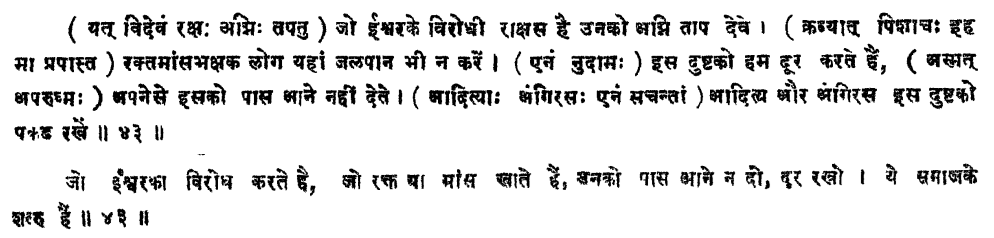
Rig Veda 7.6.3 “May the fire divine chase away those infidels, who do not perform worship and who are uncivil in speech. They are niggards, unbelievers, say no tribute to fire divine and offer no homage. The fire divine turns those godless people far away who institute no sacred ceremonies.” Tr. Svami Satya Prakash Saraswati and Satyakam Vidyalankar (Source)
Yajur Veda 7.36 “We learned persons accept as our ruler, thee, the introducer of new plans for our advancement, the master of loyal subjects, the embodiment of virtue, the most advanced in noble qualities and acts, the queller of the irreligious…” Tr. Devi Chand (Source)
Yajur Veda 7.44 “…This fourth warrior, full of delight, should subdue the irreligious foes.” Tr. Devi Chand (Source)
Yajur Veda 13.12 “O king, make progress in thy duty of administration, extend happiness to the virtuous. O terrible chastiser, burn down the irreligious foes. O splendid person, humiliate and consume utterly like dried up stubble, him, who encourages our foe.” Tr. Devi Chand (Source)
Narasima Purana 53.15-16 “…I salute god Kesava the supreme intuitive, who protects the godly persons who are religion abiding by killing the wicked and atheists through his incarnation in varied forms and in every age…” Tr. Joshi K.L. Shastri and Bindiya Trivedi (Source)
Those who commit these acts are regarded as criminals.
Vishnu Smriti 37.4 “Reviling the Veda; [30-31] Studying irreligious books; Atheism;” Tr. Juluis Jolly (Source)
Dasyu
A close reading of the Vedas reveals that several non-Aryan tribes existed during the Vedic period, each following distinct religions and customs. On multiple occasions, the Aryans are described as attacking these groups, often with the primary aim of plunder. This is evident from accounts of the massacre and looting of the Kikata and Pani tribes. In this context, Yaska Acharya defines the term Dasyu as follows:
Nirukta 7.23 “Dasyu (demon) is derived from (the root) das, meaning to lay waste.” Tr. Laxman Sarup (Source)
Swami Dayanand Saraswati defines the term Dasyu as “the wicked one.” The Vedas describe the Dasyus as followers of a different religion, people who did not perform sacrifices and were therefore labelled as godless. It is possible that they adhered to non-theistic or atheistic philosophies, similar to later traditions such as Buddhism. The Vedas explicitly instruct the Aryans to kill and plunder the Dasyus on the basis of religious difference. In presenting this argument, I have relied on Hindi translations by Pandit Ram Govind Trivedi and Ram Sharma Acharya.
Rig Veda 10.105.8 “Grind off our sins: with song will we conquer the men who sing no hymns: Not easily art thou pleased with prayerless sacrifice.” Tr. Ralph Griffith (Source)
Following is the Hindi translation by Ram Sharma Acharya.

Rig Veda 8.59.11 “The man who brings no sacrifice, inhuman, godless, infidel, Him let his friend the mountain cast to rapid death, the mountain cast the Dasyu down.” Tr. Ralph Griffith (Source)
Following Hindi translation is by Pandit Ram Govind Trivedi.
Dasyus are riteless
Rig Veda 1.33.4-5 “Thou slewest with thy bolt the wealthy Dasyu, alone, yet going with thy helpers, Indra! Far from the floor of heaven in all directions, the ancient riteless ones fled to destruction. Fighting with pious worshippers, the riteless turned and fled, Indra! with averted faces…” Tr. Ralph Griffith (Source)
Dasyus have alien laws
Rig Veda 10.22.8 “Around us is the Dasyu, riteless, void of sense, inhuman, keeping alien laws. Baffle, thou Slayer of the foe, the weapon which this Dasa wields.” Tr. Ralph Griffith (Source)
Dasyus differs from Rites and Rituals and doesn’t observe fire sacrifices
Rig Veda 8.70.11 “May your friend, the cloud, hurl that infidel down from heaven who differs from us in rites and rituals, is inhuman, who does not observe fire sacrificials, and who does not show reverence to Nature’s bounties.” Tr. Svami Satya Prakash Saraswati (Source)

Plundering the Dasyus
Rig Veda 6.14.3 “Adorable Lord takes manifold treasures of disbelievers for the preservation of the worshippers. Faithful devotees triumph over wicked and unrighteous and humble him who does not abide by the prescribed conduct of life.” Tr. Svami Satya Prakash Saraswati (Source)
The Vedas repeatedly emphasize that the Dasyus did not offer oblations to Vedic gods, did not perform sacrifices, and were riteless, lacking worship and ritual practices. This persistent stress on religious difference indicates that faith was a central factor in their persecution. The texts therefore suggest that one of the primary reasons for killing the Dasyus was their rejection of the Vedic religious system.
Punishment for Disbelievers
On Earth
Narada Purana, Uttarabhaga 21.38 “These persons are to be punished and given capital punishment- he who eschews Visnu the foremost among the gods and worships any other deity…” Tr. G.V. Tagare (Source)
Rig Veda 9.63.5 ‘‘Augmenting the strength of resplendent self, urging the waters and rejuvenating all noble acts and destroying the infidels.” Tr. Satya Prakash Saraswati and Satyakam Vidyalankar (Source)
Rig Veda 1.121.13 “O glorious resplendent sun, may you stop your yellow horses, which drag the wheel of your chariot in the opposite direction, the one of back-gear, drive them away to the opposite bank of navigable rivers where the non-worshippers, the infidels, reside.” Tr. Svami Satya Prakash Saraswati and Satyakam Vidyalankar (Source)
Rig Veda 6.67.9 “O light-divine and plasma-divine may you exterminate those who strive against you and break the laws that are agreeable and beneficial and also those divinities, and mortal, who are not dilligent in adoration, and those who work without faith and those who performing works do not worship and those who do not propitiate you.” Tr. Svami Satya Prakash Saraswati and Satyakam Vidyalankar (Source)
Rig Veda 8.45.23 “Let not the fools or those who mock, beguile you, when they seek your protection; may you not favour the unbelievers and godless.” Tr. Svami Satya Prakash Saraswati and Satyakam Vidyalankar (Source)
Rig Veda 1.33.4 “…As atheistic un-righteous persons who revile God are ruined by His Powers or germs are destroyed by the rays of the sun, in the same manner, you should endeavour to put an end to the lives of those wicked persons who forcibly take away and enjoy other’s articles and who do not perform Yajnas and other noble deeds who are utterly selfish.” Tr. Acharya Dharma Deva Vidya Martanda
In Hell
Srimad Devi Bhagavatam 11.1.25-37 “…Whatever goes clearly against the Vedas can in no way be accepted as a proof. In matters concerning Dharma, the Vedas is the Sole Proof. Therefore that which is not against the Vedas can be taken as proof; otherwise not. Whoever acts Dharma according to other proofs than what is ordained in the Vedas, goes to the hell in the abode of Yama to get his lesson. So the Dharma that is by all means to be accepted as such, is what is stated in the Vedas. The Smritis, the Purânas, or the Tantra S’âstras can be taken also as authoritative when they are not conflicting to Vedas. Any other S’âstras can be taken as authoritative when it is fundamentally coincident with the Vedas. Else it can never be accepted. Those who do injury to others even by the blade of a Kus’a grass used as a weapon, go to hell with their heads downwards and their feet upwards. Those that follow their own sweet free will, that take up any sort of dress (e. g. Bauddhas), those that follow the philosophical doctrines called Pâs’upatas, and the other hermits and saints and persons that take up other vows contrary to the religions of the Vedas, for example, the Vaikhânasa followers, those who brand their bodies by the hot Mudrâs, at the places of pilgrimages, e. g. Dvârkâ, etc., they go to hell with their bodies scorched by red hot brands (Tapta Mudrâs). So persons should act according to the excellent religions commanded by the Vedas…” Tr. Swami Vijnananda (Source)
Linga Purana Section II.11.35-37 “If people forsake Linga and begin to worship other deities they will go to the Raurava hell along with the king, their ruler. If a king ceases to be a devotee of Siva and becomes attached to other Devas, it is like the behaviour of a young woman who discarding her husband revels among her paramours.” Tr. Board of Scholars, edited by J.L. Shastri (Source)
Muni Ved Vyasa states in Mahabharata.
Mahabharata Santi Parva 12.34-35 “[Vyasa said] I shall now mention other acts that men should not do, viz., acts that are interdicted by both the world and the Vedas. Listen to me with concentrated attention. The rejection of one’s own creed, the practice of other people’s creed, assisting at the sacrifice or the religious rites of one that is not worthy of such assistance…these all have been pronounced by persons conversant with duty to be acts that no one should do.” Tr. K.M. Ganguli (Source)
Other verses in the Mahabharata describe how infidels are roasted in hell.
Mahabharata, Santi Parva 12.181.4-5 “Those that are virtuous in their acts, and possessed of faith, and that have their senses under control, become born as affluent men and repeatedly sport in festivities and heaven and happiness. Unbelievers, with their arms manacled, are sent to regions rendered inaccessible by carnivorous beasts and elephants and full of terrors in consequence of snakes and robbers. What more need be said of them?” Tr. K.M. Ganguli (Source)
Mahabharata, Santi Parva 12.323 “They that are unbelievers have to pass, with groping hands, through regions infested by beasts of prey and elephants and pathless tracts teeming with snakes and robbers and other causes of fear. What more need be said of these?” Tr. K.M. Ganguli (Source)
Kurma Purana I.12.259-61 “The hells such as Tamisra and others were created beneath the earth by god Brahma for those people who do not practise the duties prescribed in my Dharma. There is no scripture other than the Vedas which lays down what is Dharma. A person who takes delight in other things (not sanctioned by the Vedas), should not even talked to by twice-born persons viz. Brahmanas, Ksatriyas and Vaisyas. Those various scriptures which are contrary to Srutis and Smrtis seen in this world, are based on Tamo-guna or ignorance. Belief in them or practising in accordance with them is a Tamasa activity.” Tr. G.V. Tagare (Source)
Skanda Purana VII.I.3.144 “Thus the foolish ones will say, others will laugh. The non-believers, the people destined to fall into hell, get their minds overwhelmed by sins. At the advent of Kali Age, they will never gain Siddhi.” Tr. G.V. Tagare (Source)
Padma Purana V.96.49b-76a “Yama said: Those men who are averse to religion through their deeds mind and words, and who are without (i.e. who do not have) devotion to Visnu, go to hell. Those men who look upon Brahma, Sankara and Visnu as different (from one another), and who are detached from knowledge about Visnu, go to hell…A man who worships what should not be worshipped, and does not worship what should be worshipped, and is disinterested in the knowledge about Visnu, suffers in many hells…Those who, when proper time has come, do not devoutly offer sraddha through atheism or greed or delusion are roasted in hell…and who is inclined to atheism, would live in the abode of hell…Those who, even after seeing the door of (the temple of) the lord or (even after hearing) his name or the sacred text (even after seeing) his attendants, do not salute etc. become the residents of hell….” Tr. N.A. Deshpande (Source)
Who becomes an Infidel?
According to Hindu doctrine, an individual’s present status is determined by the deeds of previous lives. One is said to be born a Shudra or a Chandala as a consequence of sins such as theft committed in an earlier existence. If this framework is accepted, the question naturally arises: what, within this belief system, causes a person to become a non-Hindu?
Brahma Vaivarta Purana, Krishna Janma Khanda 85.159-169 “…One the days of the five important festivals, a man must abstain from woman, oil, fish and flesh. The great fool who violates this rule must go to the hell called ‘the tooth of thunder or adamant.’ That sinner after having lived there in great pain turns into an infidel for seven births and a chandal for seven births. A wretch who does not bow to a Brahmin or an idol remains impure all his life and is afterwards born as an infidel.” Tr. Rajendra Nath Sen (Source)
Infidels cannot act as a witness and should not be consulted
Brihaspati Smriti 7.30 Persons addicted to adultery or to drinking, gamblers, those who calumniate everybody, the insane, the suffering, violent persons, and unbelievers cannot act as witnesses.” Tr. (Source)
Brihaspati Smriti 1.33 They who are ignorant of the customs of the country, unbelievers, despisers of the sacred books, insane, irate, avaricious, or troubled (by pain or illness) should not be consulted in the decision of a cause.” Tr. (Source)
Plundering Godless/Disbelievers/Enemies
Rig Veda 1.103.6 “To him, who is the performer of all deeds, the possessor and giver of strength, the truly powerful Lord, we offer devotional prayers. He a highwayman, snatches wealth from the godless exploiters and gives it to honest devotees.” Tr. Satya Prakash Saraswati & Satyakam Vidyalankar (Source)
Rig Veda 5.4.5 “…May you come to bless our fire ritual. May you having scattered all our adversaries, bring to us the possessions of our foeman.” Tr. Satya Prakash Saraswati & Satyakam Vidyalankar (Source)
Here, the god is invoked to eliminate rivals and appropriate their wealth. Yāska comments on this verse as follows.
Nirukta 4.5 “Having destroyed all assailants, bring to us the treasures of our enemies, i.e. having destroyed the forces of our adversaries, bring to us the treasures or the food from the homes of our enemies.” Tr. Lakshman Sarup (Source)
Rig Veda 8.75.12 ‘Leave us not in this conflict as a bearer of load; snatch up the wealth of infidels and give it to us.’ Tr. Satya Prakash Saraswati (Source)
The following verse is about plundering Adeva (Godless) people.
Rig Veda 10.138.4 “He boldly cast down forts which none had e’er assailed: unwearied he destroycd the godless treasure-stores. Like Sun and Moon he took the stronghold’s wealth away, and, praised in song, demolished foes with flashing dart.” Tr. Ralph Griffith (Source)
Following is the Hindi translation by Arya Samaji scholar Shripad Damodar Satwalekar.

Following verse is about Aryans confrontation with dark race.
Rig Veda 7.5.3 “Through your fear, O universal fire, the dark evil forces, though of many minds, come under a control, having abandoned their possessions. Adorable Lord, may you shine upon all men and blaze, consuming the cities of their foes.” Tr. Svami Satyaprakash Sarasvati & Satyakam Vidyalankar (Source)
Another clear translation,
Rig Veda 7.5.3 “For fear of thee forth fled the dark-hued races, scattered abroad, deserting their possessions, When, glowing, O Vaiśvānara, for Pūru, thou Agni didst light up and rend their castles.” Tr. Ralph T.H. Griffith
Panis
Panis were a non-Vedic tribe, or possibly a group within Vedic society engaged in trade, who were repeatedly targeted and plundered by the Aryans.
Rig Veda 8.64.1-2; Atharva Veda 20.93.2 “May our hymns please you; O lord of resolute will power, please display your bounty. May you drive off the infidels. May you crush with your foot the niggard churls who offer no homage. You are powerful; there is none so powerful as you are.” Tr. Satya Prakash Saraswati & Satyakam Vidyalankar (Source)
Following is the Hindi translation by Shripad Damodar Satvalekar.
They were labelled as niggardly, likely because they did not make offerings to the Vedic gods. The following verse suggests that the Panis were beef eaters, or alternatively, that they relied heavily on cow by products for food.
Rig Veda 1.93.4 “Agni and Soma, that prowess of yours, by which you have carried off the cows that were the food of Paṇi, is (well) known to us; you have slain the offspring of Bṛsya and you have obtained the luminary (the sun), for the benefit of the many.” Tr. H.H. Wilson (Source)
Following is the Hindi translation by Pandit Ram Govind Trivedi.
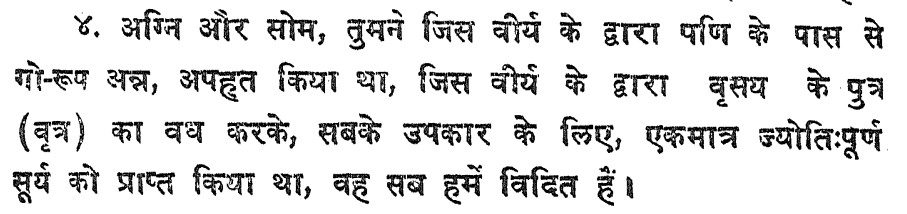
Rig Veda 9.22.7 “Thou, Soma, boldest wealth in kine which thou hast seized from niggard churls: Thou calledst forth the outspun thread.” Tr. Ralph T.H. Griffith (Source)
Following is the Hindi translation with commentary by Shripad Damodar Satvalekar.
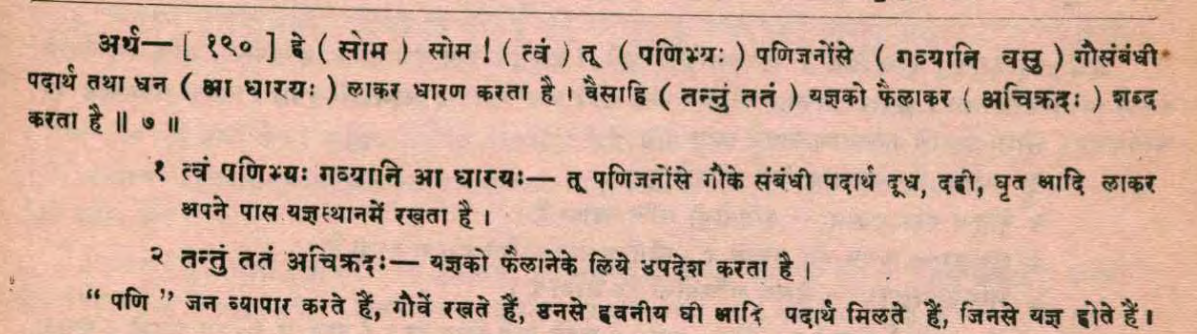
Though Shripad Damodar Satvalekar acknowledges the Panis as merchants, he attempts to soften the charge of plunder by portraying it as the mere acquisition of cow by-products, such as milk and ghee, from Pani traders.
Rig Veda 4.25.7 “(Indra), the drinker of the effused Soma, contracts no friendship with the wealthy trader who offers not any libation; he takes away his wealth; destroys him when destitute; but he is a special (friend) to him who presents the libation and oblation.” Tr. H.H. Wilson (Source)
Following is the Hindi translation by Shripad Damodar Satvalekar.

Kikata
Like the Panis, the Kikatas were a tribe during the Vedic period who did not adhere to the Vedic religion and were consequently plundered by the Vedic Aryans. Kikata kingdom is generally identified with present-day Bihar, also known as Magadha, and its ruler is named Pramagandha. The following verse explicitly urges the Vedic gods to seize the cattle of the Kikata people and to plunder the wealth of King Pramagandha. It dehumanises them by branding them as riteless and faithless, and it legitimises violence and plunder as a religiously sanctioned act.
Rig Veda 3.53.14 “O bounteous Lord, of what avail are the cattle of infidels to you. Neither they yield milk nor do these faithless persons kindle sacred fire. May you bring wealth of these unbelievers to us and give us possession of people of low mortality and crush them.” Tr. Saya Prakash Saraswati & Satyakam Vidyalankar (Source)
Yaska explained this as follows.
Nirukta 6.32 “What are the cows doing in Kikata? Kikata is the name of a country where the non-Aryans dwell. Non-Aryan tribes are (so called because it is said),’What have they done? Or their assumption is that religious rites are useless. They neither get the milk to mix with the soma, nor kindle fire.” Tr. Lakshman Sarup (Source)
Sayana considers Kikata to be Nastikas (atheists/infidels) as well as Anarya (Non-Aryan). Swami Dayanand Saraswati commented on the above verse, “As the cows do not grow among the wicked atheists, in the same manner, Dharma and other virtues do not grow among the persons lacking faith. Among the enlightened persons atheists can never have the upper hand. Therefore, good scholars should blot out atheism.” Tr. Acharya Dharma Deva Vidya Martanda
Later texts like Bhagavad Purana (Srimad Bhagavatam) too mentions Kikata kingdom.
Srimad Bhagavatam 11.21.8 “Among places, those bereft of the spotted antelope, those devoid of devotion to the brāhmaṇas, those possessing spotted antelopes but bereft of respectable men, provinces like Kīkaṭa and places where cleanliness and purificatory rites are neglected, where meat-eaters are prominent or where the earth is barren, are all considered to be contaminated lands.” Tr. Swami Prabhupada (Source)
Killing & Plundering those who make no Offerings to Vedic Gods
Rig Veda 6.44.11 “Give us not, O showerer of benefits, to the wicked. Relying upon your friendship, O Lord of riches, may we remain unharmed. Many are the boons you distribute amongst men; may you demolish those who make no libation, and root out those who present no offerings.” Tr. Satya Prakash Saraswati & Satyakam Vidyalankar (Source)
Rig Veda 1.176.4 “Slay everyone who pours no gift, who, hard to reach, delights thee not. Bestow on us what wealth he hath: this even the worshipper awaits.” Tr. Ralph Griffith (Source)
Following is the Hindi translation by Ram Sharma Acharya.

Rig Veda 1.81.9 “…Discover thou, as Lord, the wealth of men who offer up no gifts: bring thou to us this wealth of theirs.” Tr. Ralph Griffith (Source)
Following is the Hindi translation by Pandit Ram Govind Trivedi.

The following verses perhaps refer to Aryans who do not make offerings.
Atharva Veda 20.56.6 “…You, see the wealth of those persons who do not offer gifts. You, please bring to us the wealth of their.” Tr. Acharya Vaidyanath Shastri
Rig Veda 9.61.25 “The elixir of divine love flows onward, chasing the malignant, and driving off the withholders of wealth and thus it proceeds to the holy abode of the resplendent Lord.” Tr. Satya Prakash Saraswati & Satyakam Vidyalankar (Source)
Non-Hindus are Demons and Barbarians
Non-Hindus in Vedic and later Hindu texts are frequently demonised. Those outside the Vedic fold are labelled as Rakshasas, Asuras, Dasyu or Mlecchas. In Hindu scriptures, the term “demon” does not always signify a supernatural or monstrous being. It is frequently used to describe non-Hindu human communities, particularly those who existed outside the caste system.
Swami Dayanand Saraswati the founder of Arya Samaj writes, “The Dwijaas (the twice-born) – Braahmanaas, Kshatriyas, Vaishyaas are called Aryas, while the Shudras are called Anaryas, or Non-Aryas.” ATHARVA VEDA 19:62. In the face of these Vedic authorities how can sensible people believe in the imaginary tales of the foreigners. In the Devaasurawars, Prince Arjuna and King Dashrathaand others of Aryavarta used to go to the assistance of the Aryas in order to crush the Asuras. This shows that the people living outside Aryavarta were called Dasyus and Malechhaas… Besides, Manu also corroborates our position. He says, “The countries other than Aryavarta are called Dasyus and Malechha countries.” MANU 10:45, 2:23. The people living in the north-east, north, north-west were called Rakshasas.” Satyarth Prakash, by Dayanand Saraswati, Ch 8, page 266, Tr. Chrinajiva Bhardwaja (Source)
Here, Swami Dayanand, quoting the Manusmriti, states that all people living outside Aryavrata and those who do not belong to the four varnas are described as demons such as Rakshasas or Dasyus, and as barbarians or Mlecchas. According to this interpretation of Hindu Dharma, all non-Hindus are categorised as demons or barbarians. What follows is the full translation of the Manusmriti passage,
Manu Smriti 10.45 “All those tribes in this world, which are excluded from (the community of) those born from the mouth, the arms, the thighs, and the feet (of Brahman), are called Dasyus, whether they speak the language of the Mlekkhas (barbarians) or that of the Aryans.” Tr. Georg Buhler (Source)
Medhatithi comments on the above verse, “…These persons, being other than those named as the ‘four castes,’ are called ‘Dasyu.’ Tr. Ganganath Jha (Source)
Some argue that these verses do not refer to non Hindus but to caste Hindus who lost their status due to neglect of religious rites. This claim remains unconvincing, even when explanations from their own scholars are cited. Verse 43 of Chapter 10 clearly states that neglect of sacrifices causes Dvijas to degenerate into Shudras, not into Dasyus. If members of the four varnas lost their caste, the question arises why they are not described as outcastes but specifically as Dasyus. The reason is that verses 43 and 45 address different categories and are not correlated. Verse 45 is explicit in stating that tribes outside the four varnas are Dasyus, and non Hindus are not included within the four castes.
If one follows the apologetic explanation that Dasyu refers only to fallen caste Hindus, Manu Smriti 10.45 itself contradicts this position, since it allows for Dasyus to originate from within the four castes after abandoning the Vedic religion. This also refutes the claim that Dasyu refers exclusively to non human or demonic beings. Hindu scriptures from the Vedas to the Puranas repeatedly speak of demons, yet no historical or secular evidence records the existence of such beings. In this context, Dayanand Saraswati writes,
“You can still see that the description of Raakshasas given therein tallies with the ugly appearance of the negroes of today.” Satyarth Prakash, by Dayanand Saraswati, Ch 8, page 266, Tr. Chrinajiva Bhardwaja (Source)
This comparison equates Rakshasas with present day Black people, revealing that inhabitants of the north eastern and north western regions were not monsters but indigenous communities portrayed through racist and dehumanising language. Swami Prabhupada similarly writes,
Swami Prabhupada writes: “…An atheist is called a demon, and it is a fact that even a person born of good parents can turn into a demon by bad association…” Swami Prabhupada on Srimad Bhagavatam 3.3.6 (Source)
An Indologist writes about Dasyu.
“The picture of the dasyu that emerges from these passages is quite different from that of the raksas. There is nothing about taking the form of a bird and flying by night, no mention of disrupting sacrifices, and no connection with black magic. The dasyus seem to be human beings of a different race from the Aryans and of a different (adevic and abrahamanic) religion. The mention of the proper names of various dasyus who are defeated for (or by) certain Aryan princes (e.g. Dabhiti) also makes the dasyu sound more like historical figures. There are occasional mentions of taking land from the dasyus (RV 4.38.1). The mention of dasyus in connection with fortresses (pur-) is also a characteristic which is in contrast to the raksases. Raksases do not build fortresses and fight from them. It seems quite safe to agree with the general conclusion of Vedic scholars that dasyu refers to the indigenous people of the land whom the invading Aryans conquered or absorbed.” by Wash Edward Hale, p.154, Asura in Early Vedic Religion, Published by Motilal Banarsidass Publisher, 1986.
Moreover, the Aryans are portrayed as waging war against the Dasyus, with the stated justification that the Dasyus did not sing Vedic hymns, did not observe Vedic rites or fire sacrifices, followed alien laws, and were described as faithless and irreligious. The central grievance repeated in the Vedas is that the Dasyus did not offer gifts or oblations to Vedic deities, for which Indra was frequently invoked to attack them. The Vedas are claimed to be eternal. If these verses were meant to apply only to demons, then they have lost all relevance today. This raises an obvious question: why would God reveal verses with only a limited, time-bound applicability in a text that is asserted to be eternal?
The terms Dasa and Dasyu are used interchangeably in the Vedas. The term Dasyu carries multiple meanings depending on the context, one of which is explained by Medhatithi, as noted above. The Persian word Dahae maybe related to the Dasyu tribe mentioned in Vedic texts. The Dahae were a Scythian people of ancient Central Asia, a confederation of tribes including the Parni, Xanthii, and Pissuri, who inhabited regions corresponding to modern Turkmenistan. The name Dahestan or Dahistan is derived from them. The word Parni itself is widely considered an Iranian cognate of the Panis mentioned in the Vedas. This may explain why the Panis and Dasyus are frequently mentioned together, such as in Rig Veda 7.6.3 and 5.34.6. Many Indologists have therefore concluded that the Dasa or Dasyu were human tribes rather than supernatural demons.
A common apologetic response is that the Dasyus must have been demons because some Vedic verses describe them as having many eyes or hands. This argument collapses under scrutiny, since human rishis are described elsewhere as having three heads, Vedic gods are said to possess animal faces, seven tongues, and even animals are depicted as conceiving through drinking semen of Gods and Rishis. If such imagery does not render rishis and gods demonic, it cannot be selectively used to dehumanize the Dasyus.
There is also a long history of derogatory epithets being used against rival groups. The Aryans described the Dasyus as anasa, commonly translated as “noseless,” though it more accurately refers to flat-nosed people, indicating ethnic and racial othering rather than any monstrous or non-human nature. Shudras are described as Anarya which means ill-mannered, those outside the caste system are considered untouchables.
Now let us turn to the Panis tribe. Panis too are portrayed as demons, Yaska in the Nirukta explicitly identifies them as merchants (Nirukta 2.17) as well as demons elsewhere. Panis may have been a part of the Vedic society. The Panis were wealthy traders, and Vedic texts repeatedly describe Aryans attacking them, not because they were hostile, but to plunder their wealth. Apologists offer a weak defence by simply labelling the Panis as demons, while ignoring the fact that the Aryans are consistently shown as the aggressors. If the Panis were truly demonic, why were the Aryans so eager to obtain their wealth and donations? The Vedas themselves complain that the Panis did not offer gifts to Vedic deities, which raises an obvious question. Why covet the wealth of those deemed demonic unless material gain was the real motive?
A member of the Panis community named Brbhu is praised in the Rig Veda (6.45.31). Separately, Manu Smriti 10.107 states that Brbhu gifted many cows to Rishi Bharadwaja and identifies him as a carpenter. This selective praise exposes the underlying criterion at work. Panis who supported priests through donations were honoured, while those who did not were demonised. Atharva Veda 20.93.2 makes this motive explicit by condemning the Panis for bringing no gifts. The Panis were merchants, cattle rearers, artisans, and traders who accumulated wealth through commerce. These are unmistakably human characteristics, not those of demons.
The Kikata people were plundered in much the same way as the Dasyu and Panis tribes, largely because they did not follow Vedic rituals and refused to make offerings to Vedic deities. They could have been lower caste people. The Vedas also refer to Zoroastrians and portray them as demons under the label Asura. In reality, the Asuras of the Vedic texts correspond to Ahura worshippers, that is, Zoroastrians. Vedic religion and Zoroastrianism are roughly contemporaneous and share notable similarities. The Vedic Yajna corresponds to the Zoroastrian Yasna, Soma to Homa, and both traditions mention Aryans. While Devas are positive figures in the Vedas, Daevas in Zoroastrian texts are portrayed in a neutral or negative light.
Significantly, in Rig Veda Mandalas 1 to 7, Vedic deities themselves are frequently described as Asura, where the term clearly means mighty or powerful rather than demonic. This suggests that Asura was originally a title of reverence. As the Aryans migrated from Central Asia into the Indian subcontinent, they carried these older meanings with them, which explains why Asura remained a positive epithet in the early Rig Veda. Over time, however, the term underwent a semantic shift and acquired a negative connotation. It was later applied to rival groups and populations, particularly those living in eastern regions such as Bengal and Assam. Figures like the Asura king Naraka of Pragjyotishapura and Mahishasura exemplify this transformation from a respected title to a label of demonisation.
The people of Lanka in the Ramayana are consistently described as demons. Hanuman is said to have burned hundreds of these inhabitants of Lanka, even though they had no personal role in Rama’s conflict, which was specifically directed against Ravana and not against the general population. If Lanka was truly inhabited by demons, where is any evidence of their existence today? One may travel to Sri Lanka and search for demons or even their remains, yet none can be found. This raises serious doubts about whether the term demon was ever meant to describe non human beings, or whether it functioned as a dehumanising label applied to real human populations.
Now let us turn to the Puranas, which form the most crucial part of this discussion. Several Puranas, especially Vishnu Purana Book 3, Chapters 17 and 18, explicitly state that demons embraced Buddhism and Jainism. These chapters are repeatedly cited because they are entirely devoted to denigrating Buddhism and Jainism, thereby revealing how Hindu texts perceived competing religious traditions. According to the Vishnu Purana, demons adopted Buddhism, and their disciples continued to propagate this religion. However, unlike mythological traditions, the history of Buddhism is well documented. We know its founder, the approximate date of its origin, and the historical context in which it arose. Buddhism emerged in the sixth century BCE, a period when human societies had already begun recording history. This raises an obvious question. Did any Greek, Roman, or other foreign traveller ever record the existence of demons living in India who later embraced Buddhism, as claimed in Hindu scriptures? The absence of such evidence strongly suggests that this narrative represents the demonisation of religious and social opponents rather than a description of non human beings.
Hindu texts themselves acknowledge the existence of various tribes such as Dasyus, Panis, and Yavanas, yet these groups are repeatedly portrayed as demons. As stated in Manu Smriti 10.45, those who do not belong to the four varnas are classified as Dasyu and Mleccha. This classification has often been used to justify violent Vedic verses by arguing that they refer only to demons rather than to human beings. It is further claimed that these demons were hostile to humanity and opposed to the gods. However, this explanation collapses when examined closely. Rambha, the father of Mahishasura, is described as a devotee of the Vedic deity Agni. Vishnu Purana Book 3, Chapters 17 and 18, further states that demons were originally followers of the Vedic religion and could not be destroyed until they abandoned Vedic dharma and adopted Buddhism or Jainism.
These accounts demonstrate that demons were not inherently opposed to the Vedic gods or to religious practice. On the contrary, they were portrayed as legitimate Vedic followers until they embraced rival traditions. Yet, even when they followed Vedic religion, they were never recognised as fully human or Hindu, because Hinduism defines religious legitimacy through birth and restricts Vedic identity to the four castes. This directly refutes the claim that demons were hostile to humanity or divinity by nature. Instead, the evidence points to a systematic process of dehumanisation, where real human communities and religious rivals were labelled as demons in order to justify exclusion, violence, and religious supremacy.
Terrorizing the Enemies
The term terror in religious scriptures does not correspond to modern notions of terrorism. In these texts, it signifies extreme fear rather than organised political violence. These verses have been included not to equate scripture with contemporary terrorism, but as a pointed response to Hindu fanatics.
Atharva Veda 5.21.3 ‘Let this war drum made of wood, muffled with leather straps, dear to all the persons of human race and bedewed with ghee, speak terror to our foemen.”Tr. Vaidyanath Shastri
.
Rig Veda 9.19.6 ‘May you bring near to us those who stand aloof; may you strike terror into our foes; o pure flowing elixir, please transfer their riches to us.” Tr. SatyaPrakash Saraswati and Satyakam Vidyalankar (Source)
Yajur Veda 17.33 “He is an ideal commander of the army, who is swift, keeps his arms sharpened, fearless like a strong bull, a zealous killer of foes, strikes terror in men…” Tr. Devi Chand (Source)
Atharva Veda 4.31.7 “Let the King [Varuna] and Manyu, the warm emotion give us the wealth of both kinds-earned and gathered. Let our enemies overwhelmed with terror in their mind and spirit and defeated in their design run away.” Tr. Vaidyanath Shastri.
Yaska Acharya writes.
Nirukta 10.21 “…These are hemistichs. Like a spear hurled, it inspires terror (among enemies) or courage (among friends)…” Tr. Lakshman Sarup (Source)
Killing Women, Children and Family of Enemies
We have already seen examples of Shiva beheading the child Ganesha, and of entire cities and kingdoms being burned where children were not spared, such as Hanuman setting Lanka ablaze, or Shiva and Vishnu destroying Tripura, and Indra cutting up the foetus of Diti in seven parts.
The Vedas too contain verses that speak of terrorising women and children, and of killing the children and families of one’s enemies.
Yajur Veda 17.38-39 “O friendly countrymen, encourage the commander of the army, and begin the battle with him, who with his physical, mental and military strength, cleaves the enemies’ families, usurps their land, is armed with weapons, slay’s the foes, subdues the enemy in the battle, and conquers him. May the commander of the army, who, with surpassing vigour pierces in the battles the families of the enemies, is pitiless, wild with anger, unconquerable by foes, conqueror of the enemy’s forces, unequalled in fight, and victor, protect our armies.” Tr. Devi Chand (Source)
Following is the Hindi translation by Ram Sharma Acharya.
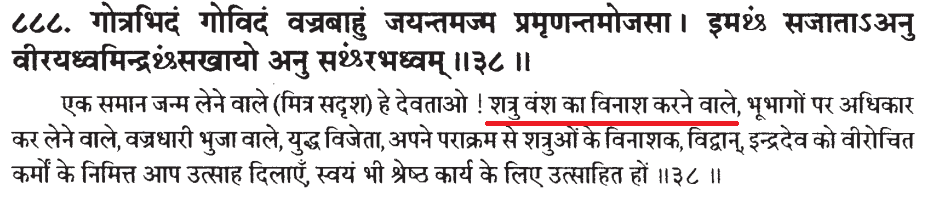
Atharva Veda 5.20.4-5 “Let this war-drum victorious in the battle, loudly roaring and becoming the means of seizing whatever may be seized, be seen by all. Let this war-drum utter wonderful voice and let the army-controlling man capture the possessions of the enemies. Amid the conflict of the deadly weapons let the woman of enemy waked by the roar and afflicted run forward in her terror hearing the resounding and far reaching voice of the wardrum, holding her son in her hand.” Tr. Acharya Vaidyanath Shastri
Following is the Hindi translation by Ram Sharma Acharya.

Atharva Veda 11.2.21 “Do not covet our cattle, our men, our goats and sheep! Bend thy course elsewhere, O strong god (ugra), slay the offspring of the blasphemers!” Tr. Maurice Bloomfield (Source)
Following is the Hindi translation by Ram Sharma Acharya.
Rig Veda 10.118.8 “So, Agni, with thy glowing face burn fierce against the female fiends, Shining among Uruksayas.” Tr. Ralph Griffith (Source)
Following is the Hindi translation by Pandit Ram Govind Trivedi.

Prayer for Destruction of Enemies
A close reading of these passages reveals that the Vedas contain explicit prayers for the destruction of enemies and of those who are said to hate the invoker. Atharva Veda 2.19.1, 10.5.15, and 10.5.25 invoke burning, violent attack, expulsion from the earth, and killing of the hated adversary, while Rig Veda 3.53.21 prays for the loss of breath and death of the foe. Yajur Veda 15.15 intensifies this imagery by placing the enemy in the jaws of lethal beings, reflecting ritualised and often gruesome appeals for annihilation rather than symbolic moral struggle.
Punishment for Apostasy
Srimad Bhagavatam 5.26.14-15 “He who bears malice towards his parents, Brahmanas and the Vedas is hurled into the hell called Kalasutra. It is a plain of a copper-sheet ten thousand Yojanas in area. The sheet of copper is heated by fire from below and the Sun from above…They (servants of Yama) throw in the hell called Arispatravana (a forest of trees with sword-like leaves) a person who, while in this world, abandons his Vedic way of life even when there was no calamity and embraces a heretic sect. They strike him with a whip. And while he runs hither and thither (to avoid whipping), all the limbs of his body are cut down by the two-edged sword-like leaves of the palm trees thereof. Crying with exceuciating pain, ‘Alas! I am killed’, he falls in a swoon at every step. A renegade from one’s faith he reaps the fruit (punishment) suitable for the sin of embracing a heretic creed.” Tr. G.V. Tagare, edited by J.L. Shastri
Other translators have rendered it in a similar manner.
Manmath Nath Dutt translates it as “…He that, when no danger threatens, forsakes the path of the Veda and follows that of a heretic, is thrown by the servants of Yama into the hell named Asipatravana, and is lashed by them. The sinner, sore afflicted, rusheth about hither and thither. The leaves of the palmyra palm growing in the wood have two sharp edges like that of swords, and these teat his body grievously. Then the wreth, suffering greatly, exclaims: ‘Ah! I am undone’; and stumbles at every step on account of the severe torment he undegoes.” (Source)
J.M. Sanyal translates it as “He that, even when no danger threatens, forsakes the path prescribed by the Vedas and follows that of a heretic, is thrown by the servants of Yama into the hellish region named Asipatravana”
Gita Press translation: “…Him, again, who actually deviates here form the path chalked out for him by the Vedas, otherwise than in an emergency (warranting such a course) and embraces a heretic creed, the servants of Yama throw into (the hell called) Asipatravana…apostate as he is, reaps the fruit of the sin attaching to heretics.” (Source)
Devi Bhagavatam 8.22.2-52 “…The man who, getting even a trifling wealth and food-stuff, does not perform the five Mahâ Yajñâs and gives not a share of that to the Devas and feeds his own belly with that like a crow, is taken by the ferocious Yamadûtas to the worst Krimibhojana Naraka for his sinful deeds. This hell is one lakh Yoyanas wide and is the reservoir of worms. It causes terror to the inhabitants of the hell. That sinner assumes the form of an insect and is eaten up on return by the insects and thus passes his time there. When a man does not give any share to the Atithis or the guests and does not offer oblations to the Fire and eats his food, he, too, goes to the above hell…He who transgresses the path of the Vedas in times other than those of calamity and danger and follows other paths even to a trifling distance, that sinner is taken by Yamadûtas to Asipatra Kânana and there whipped severely. Not being able to bear that, he runs wildly to and fro and is pierced by the sharp edged Asi leaves on both his sides. His whole body being cut asunder, he cries “Oh! I am killed!”and faints away. Then feeling himself pained very much, he tumbles down at every step. Thus the sinner suffers for violating the path of the Vedas.” Tr. Swami Vijnananda (Source)
Devi Bhagavatam 7.39.21-30. “To preserve My Commandments, I have created the Brâhmana and the Ksattriya castes. My secrets are all embodied in the S’rutis. For that reason, the words of the S’rutis are no doubt to be known and observed by the sages. O Mountain! When the Dharma (righteousness) declines and the Adharma (unrighteousness) reigns supreme, I then manifest Myself in the world as Sâkambharî, Râma, Krisna and others. Therefore, the Devas, the preservers of the Vedas, and the Daityas, the destroyers of the Vedas are classified. Whoever does not practise according to the Vedas I have created many hells for their lessons. When the sinners hear of those hells, they get extremely terrified. The king should banish those stupid persons from his kingdom and the Brâhmins should not talk with them nor take them in their own lines nor when partaking of food, those who forsake the Vaidic Dharma and go for shelter to another Dharma.” Tr. Swami Vijnananda (Source)
Atri Samhita 1.17 “The king, who punishes them who, renouncing their own religion, follow another’s, becomes glorified in the celestial region. By following his own religion even a Sudra enjoys the celestial region. Another’s religion should be renounced like the most beautiful wife of another person.” Tr. Manmatha Nath Dutt (Source)
Skanda Purana III.i.30.21 “A man who transgresses the Vedic path and goes along a despicable path is cast into Asipatravana by the servants of Yama. But if he takes his holy bath in Dhanuskoti, he is not thrown therein.” Tr. G.V. Tagare (Source)
Apart from apostasy from religion, even an ascetic is prohibited from abandoning asceticism itself.
Narada Smriti Fifth title of law, verse 39 “An apostate from asceticism shall become the king’s slave. He can never be emanicipated, nor is there any expiation of his crime.” Tr. Julius Jolly (Source)
Vishnu Smriti 5.152 “An apostate from religious mendicity shall become the king’s slave.” Tr. Julius Jolly (Source)
Vamana Purana 12.34 “He who forsakes the Vedas, sacrificial fire, preceptor, wife, and parents, is hurled down from the peaks of mountains by the servants of Yama.” Tr. Anand Swarup Gupta (Source)
Examples
There are several narratives in which demons who were previously devoted to the Devas are killed soon after abandoning the Vedic religion and embracing other traditions such as Buddhism and Jainism. One such story recounts how the sons of Raji were slain by Indra after Brihaspati deceived them into renouncing the Vedic religion and converting them to Jainism.
Matysa Purana 24.47-49 “…Brihaspati then went and deluded the other sons of Raji with false philosophy and established the Jina religion opposed to the Vedas, though himself a knower of the Vedas and Indra on finding the sons of Brihaspati propagating a religion different from the Vedas based on a show of reason only killed them with his mighty thunderbolt.” Tr. Taluqdar of Oudh, edited by B.D. Basu (Source)
Rig Veda 8.85.15 might be related to this verse from Matsya Purana.
Vishnu Purana 4.19.6-7 “…replied Vrihaspati, “I had been applied to by you before, I could have done anything for you that you wished; as it is, I will endeavour and restore you in a few days to your sovereignty.” So saying, he commenced a sacrifice for the purpose of increasing the might of Indra, and of leading the sons of Raji into error, and so effecting their downfall. Misled by their mental fascination, the princes became enemies of the Brahmans, regardless of their duties, and contemners of the precepts of the Vedas; and thus devoid of morality and religion, they were slain by Indra, who by the assistance of the priest of the gods resumed his place in heaven…” Tr. H.H. Wilson (Source)
Srimad Bhagavatam 9.17.15 “Brhaspati, then offered oblations to fire (with malevolent purpose against the sons of Raji and made them stray from the path of religion) and Indra slew them once and all as they swerved from the path (of righteousness) and not a single son (of Raji) survived.” Tr. G.V. Tagare, edited by J.L. Shastri
Also mentioned in Vishnu Purana book 4 chapter 9 which H.H. Wilson summarizes as, “Descendants of Raji, son of Áyus: Indra resigns his throne to him: claimed after his death by his sons, who apostatize from the religion of the Vedas, and are destroyed by Indra. Descendants of Pratíkshatra, son of Kshatravriddha.”
The Shiva Purana recounts the story of the burning of Tripura, which is linked to the Jina, or Jain, religion. According to this narrative, the inhabitants of Tripura initially followed the Vedic religion and were therefore immune from destruction. To overcome this, Vishnu is said to have created an illusory figure named Arihat. Once the residents abandoned the Vedic religion under this deception, they were rendered vulnerable and were subsequently burned alive.
Shiva Purana, Rudra Samhita 2, Yuddhakanda 5, chapter 4, verses 1 “[Sanathkumara said] For causing obstacles in their virtuous activities, Visnu of great brilliance, created a Purusa* born of himself. [9-12] Let your name be Arihat. You will have other auspicious names too. I shall assign to you a place afterwards. Now hear with reverence what is relevant to the context. O you who wield Maya, create a deceptive sacred text of sixteen hundred thousand verses, contrary to Srutis and Smritis wherein Varnas and Asramas shall be eschewed. Let that holy text be in Apabramsa language…I shall bestow on you the ability to create it. Different kinds of magic arts shall be subsevient to you. [18-20] O ascetic, no doubt, Vedic and Smarta rites flourish and shine there. But these shall certainly be exploded through this Vidya. O you shaven head, you shall go there for destroying the residents of the three cities. Revealing the Tamasika rites, destroy the three cities. After that, O great one, you shall go to the desert region and stay there carrying on your own duties and activities till the advent of the Kali age. When the Kali age begins let your Dharma be revealed. You shall then continue to do so by means of disciples and disciple’s disciples.” Tr. J.L. Shastri (Source)
Shiva Purana, Rudrasamhita 2, Yuddha Khanda 5, chapter 10, verse 29 “Since they had refrained from the worship of Siva, hundreds of Asuras were burnt by the fire generated by the arrow. They cried ‘Ha Ha’ in distress.” Tr. J.L. Shastri (Source)
The translator, Jagdish Lal Shastri, remarks in a footnote to Shiva Purana, Rudra Samhita 2, Yuddhakanda 5.4.1, as follows: “*According to the present context Visnu created a delusive teacher called Mayamoha who created a Mayasastra of sixteen lakhs of slokas in Apabhramsa, preaching Jina Dharma for misguiding the Asuras. Mayamoha created four sorts of preachers for the propagation of Jina Dharma. He preached non-violence, forbade Srauta and Smarta rituals, discarded Varnasrama system, created an order for women that resulted in leaving their home and leading the life of nuns. In some versions, the role is assigned to Brhaspati, the preceptor of the Gods who in the guise of their preceptor Sukra deludes the Asuras…” (Source)
The Vishnu Purana contains a similar narrative in which demons are killed after abandoning the Vedic religion and embracing Jainism and Buddhism. H. H. Wilson comments on this episode in his notes on Chapter 4, verses 17–18.
“Of heretics, or those who reject the authority of the Vedas: their origin, as described by Vaśisht́ha to Bhíshma: the gods, defeated by the Daityas, praise Vishńu: an illusory being, or Buddha, produced from his body.”
“Buddha goes to the earth, and teaches the Daityas to contemn the Vedas: his sceptical doctrines: his prohibition of animal sacrifices. Meaning of the term Bauddha. Jainas and Bauddhas; their tenets. The Daityas lose their power, and are overcome by the gods. Meaning of the term Nagna. Consequences of neglect of duty. Story of Śatadhanu and his wife Śaivyá. Communion with heretics to be shunned.” (Source)
Vishnu Purana 3.17.35-44 “…Upon the conclusion of their prayers, the gods beheld the sovereign deity Hari, armed with the shell, the discus, and the mace, riding on Garud́a. Prostrating themselves before him, they addressed him, and said, “Have compassion upon us, O lord, and protect us, who have come to thee for succour from the Daityas. They have seized upon the three worlds, and appropriated the offerings which are our portion, taking care not to transgress the precepts of the Veda. Although we, as well as they, are parts of thee, of whom all beings consist, yet we behold the world impressed by the ignorance of unity, with the belief of its separate existence. Engaged in the duties of their respective orders, and following the paths prescribed by holy writ, practising also religious penance, it is impossible for us to destroy them. Do thou, whose wisdom is immeasurable, instruct us in some device by which we may be able to exterminate the enemies of the gods.” When the mighty Vishńu heard their request, he emitted from his body an illusory form, which he gave to the gods, and thus spake This deceptive vision shall wholly beguile the Daityas, so that, being led astray from the path of the Vedas, they may be put to death; for all gods, demons, or others, who shall be opposed to the authority of the Veda, shall perish by my might, whilst exercised for the preservation of the world. Go then, and fear not: let this delusive vision precede you; it shall this day be of great service unto you, oh gods!” Tr. H.H. Wilson (Source)
Vishnu Purana 3.18.1-11 “PARÁŚARA.–After this, the great delusion, having proceeded to earth, beheld the Daityas engaged in ascetic penances upon the banks of the Narmadá river; and approaching them in the semblance of a naked mendicant, with his head shaven, and carrying a bunch of peacock’s feathers, he thus addressed them in gentle accents: “Ho, lords of the Daitya race! wherefor is it that you practise these acts of penance? is it with a view to recompense in this world, or in another?” “Sage,” replied the Daityas, “we pursue these devotions to obtain a reward hereafter; why should you make such an inquiry?” “If you are desirous of final emancipation,” answered the seeming ascetic, “attend to my words, for you are worthy of a revelation which is the door to ultimate felicity. The duties that I will teach you are the secret path to liberation; there are none beyond or superior to them: by following them you shall obtain either heaven or exemption from future existence. You, mighty beings, are deserving of such lofty doctrine.” By such persuasions, and by many specious arguments, did this delusive being mislead the Daityas from the tenets of the Vedas…” Tr. H.H. Wilson (Source)
This passage refers specifically to Digambara Jains. Even today, Digambara Jain monks carry peacock feathers, keep their heads shaven, and practise nudity as part of their ascetic tradition.
Vishnu Purana 3.18.7-14 “…might be the duty of those who go naked, or who go clothed in much raiment: and so the Daityas were seduced from their proper duties by the repeated lessons of their illusory preceptor, maintaining the equal truth of contradictory tenets; and they were called Arhatas, from the phrase he had employed of “Ye are worthy (Arhatha) of this great doctrine;” that is, of the false doctrines which he persuaded them to embrace. The foes of the gods being thus induced to apostatize from the religion of the Vedas, by the delusive person sent by Vishńu, became in their turn teachers of the same heresies, and perverted others; and these, again, communicating their principles to others, by whom they were still further disseminated, the Vedas were in a short time deserted by most of the Daitya race…” Tr. H.H. Wilson (Source)
And then reference to Buddhist monks is made.
Vishnu Purana 3.18.14-26 “…Then the same deluder, putting on garments of a red colour, assuming a benevolent aspect, and speaking in soft and agreeable tones, addressed others of the same family, and said to them, “If; mighty demons, you cherish a desire either for heaven or for final repose, desist from the iniquitous massacre of animals (for sacrifice), and hear from me what you should do. Know that all that exists is composed of discriminative knowledge. Understand my words, for they have been uttered by the wise. This world subsists without support, and engaged in the pursuit of error, which it mistakes for knowledge, as well as vitiated by passion and the rest, revolves in the straits of existence.” In this manner, exclaiming to them, “Know!” (Budhyadwam), and they replying, “It is known” (Budhyate), these Daityas were induced by the arch deceiver to deviate from their religious duties (and become Bauddhas), by his repeated arguments and variously urged persuasions, When they had abandoned their own faith, they persuaded others to do the same, and the heresy spread, and many deserted the practices enjoined by the Vedas and the laws. The delusions of the false teacher paused not with the conversion of the Daityas to the Jaina and Bauddha heresies, but with various erroneous tenets he prevailed upon others to apostatize, until the whole were led astray, and deserted the doctrines and observances inculcated by the three Vedas. Some then spake evil of the sacred books; some blasphemed the gods; some treated sacrifices and other devotional ceremonies with scorn; and others calumniated the Brahmans. “The precepts,” they cried, “that lead to the injury of animal life (as in sacrifices) are highly reprehensible. To say that casting butter into flame is productive of reward, is mere childishness. If Indra, after having obtained godhead by multiplied rites, is fed upon the wood used as fuel in holy fire, he is lower than a brute, which feeds at least upon leaves. If an animal slaughtered in religious worship is thereby raised to heaven, would it not be expedient for a man who institutes a sacrifice to kill his own father for a victim…” Tr. H.H. Wilson (Source)
Vishnu Purana 3.18.30-36 “…By such and similar lessons the Daityas were perverted, so that not one of them admitted the authority of the Vedas. When the Daityas had thus declined from the path of the holy writings, the deities took courage, and gathered together for battle. Hostilities accordingly were renewed, but the demons were now defeated and slain by the gods, who had adhered to the righteous path. The armour of religion, which had formerly protected the Daityas, had been discarded by them, and upon its abandonment followed their destruction. Thus, Maitreya, you are to understand that those who have seceded from their original belief are said to be naked, because they have thrown off the garment of the Vedas…” Tr. H.H. Wilson (Source)
Vishnu Purana 3.18.49-50 “…Let therefore a prudent person carefully avoid the conversation, or the contact, and the like, of those heretics who are rendered impure by their desertion of the three Vedas. The ancestral rite, although performed with zeal and faith, pleases neither gods nor progenitors if it be looked upon by apostates…” Tr. H.H. Wilson (Source)
Read Conversation and company with infidels, Buddhists and Jains category for more information on the above verse.
Killing those who left Shaivite Hinduism and embraced Buddhism
Shiva Purana, RudraSamhita 2, Yuddha Khanda section 5, chapter 6, verses 28 “O lord, favourably disposed towards your devotees, those Asuras have resorted to Buddha’s religion and philosophy, thanks to our good fortune and hence they have eschewed all Vedic sacred rites.[36-37] Shiva said:- But the great Asuras are my firm devotees. They shall be killed only by me, for they have been forced to abandon their excellent virtue under false persuasion. Let Visnu or any one else slay them now that they have been made to abandon their Dharma. The Asuras of the three cities have become devoid of devotion to me.” Tr. J.L. Shastri (Source)
The Vishnu Purana reveals a disturbing theological logic: the ‘demons’ (Daityas) could not be defeated as long as they remained loyal to Vedic rituals, suggesting that adherence to the faith provides a form of moral immunity regardless of one’s nature. To bypass this, the scriptures describe a divine conspiracy where Vishnu creates ‘false’ religions, Buddhism and Jainism, specifically to trick these demons into apostasy.
Vishnu himself states in Vishnu Purana 3.17.42–44 that those who are led astray from the path of the Vedas must be put to death. This statement alone makes it clear that the demons could be killed specifically because they apostatised from the Vedic religion. Furthermore, by portraying demons as the first followers of Buddhism and Jainism, the text deliberately demeans these faiths, framing them as deceptive tools used to lure the unrighteous toward their own destruction.
Sins leading to Hell
Hinduism also contains the concepts of heaven and hell, although unlike Abrahamic religions, these states are considered temporary rather than eternal. I mention this to counter a misleading claim often made by some Hindus online, namely that individuals are free to do anything without fear of being sent to hell. Hindu scriptures clearly enumerate various sins that can lead to hellish punishment. These include failing to worship the Shivling, neglecting the performance of yajnas, and refusing to follow the path prescribed by the Vedas, among others. Such prescriptions directly contradict the notion that Hinduism imposes no moral or religious consequences for human actions.
Earthly Punishment and Hell for those who reject or censure Hindu Scriptures
The following verse calls for merciless death to Brahmadvish.
Atharva Veda 12.5.62 “Rend, rend to bits, rend through and through, scorch and consume and burn to dust, the one who rejects the Vedas”
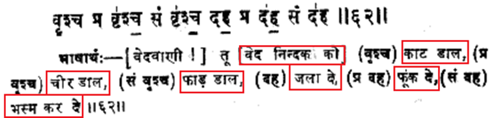
This verse is translated from the Hindi bhashya of Kshemkaran Das Trivedi (Arya Samaj) and aligns closely with Vishnu Purana 3.17, where Vishnu explicitly states, “so that, being led astray from the path of the Vedas, they may be put to death,” reinforcing the same exclusionary and violent ideological framework. Arya Samaj commentary state:
“Godly persons shall always be ready to kill irreligious people”
Kshemkarandas Trivedi (Arya Samaj) on Atharva Veda 12.5.62, page 576 (Source)
He writes on Atharva Veda 12.5.54,
‘‘Vedic followers should destroy infidels“- Kshem Karan Das Trivedi on Atharva Veda 12.5.54, page 574 (Source)
Griffith translates the term Brahmadvish as haters of prayer or haters of devotion, an interpretation that is acceptable. The term, however, carries multiple meanings, including those who hate the Vedas, those who reject Vedas, those who hate god, or those who are hostile toward Brahmins. Swami Dayanand Saraswati, the founder of the Arya Samaj, explicitly endorses this reading and assigns the following meaning to the term.
“Brahmadivsh = The enemies of Vedas and Ishwar.
[Rig Veda Dayanand Saraswati Hindi Bhasya, Mandala 2, page 323]
Acharya Dharmadeva Vidya Martanda endorsed Dayanand’s definition as well. 
[Rig Veda, By Acharya Dharma Deva Vidya Martanda, Vol 3, p.469, Published by Sarvadeshik Arya Pratinidhi Sabha, April 2002 Reprint]
Satya Prakash Saraswati defines Brahmadvish as follows. 
Rig Veda Samhita, by Satya Prakash Saraswati and Satyakam Vidyalankar, Vol 4, page no 1294, Published by Veda Pratishthana, New Delhi, 1977 (Source)
Swami Prabhupada, the founder of ISKCON, likewise interprets Brahmadvish as follows, ‘‘One who is envious of the Vedas, of a qualified Brahmana or of the Brahmana caste is called Brahma-dvis” (Source)
Rig Veda 2.23.4 “O God and learned person! you take the people to the target through the path of religion and justice and protect them. If you commit a sin, the soul or God is not infested with it. Those who denounce the Vedas and God, you cast your anger on them. Therefore, we should admire your greatness.” Tr. Acharya Dharma Deva Vidya Martanda (Arya Samaj).
The following verses are retranslated into English from Hindi renderings, all of which are by Arya Samaj translators.
Atharva Veda 20.93.1 “…destroy the enemies of Vedas.”
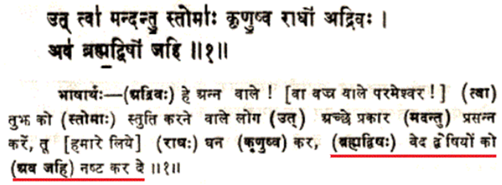
Rig Veda 6.22.8 “…burn down the enemies of God, Vedas and the malice…”
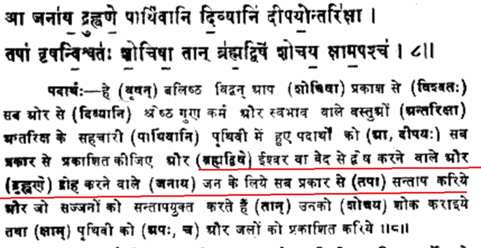
Rig Veda 6.52.3 “…cast your destroying weapon for the destruction of the enemies of Veda, wealth and crops.”
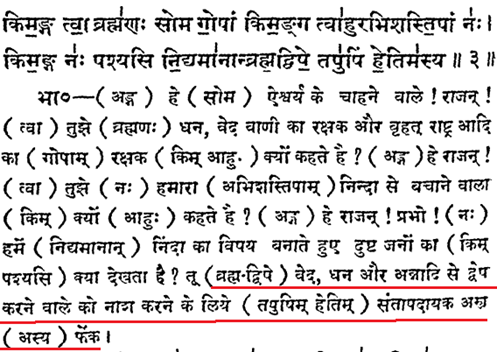
Atharva Veda 20.96.4 “…he slays, unasked, the enemies of Vedas.”
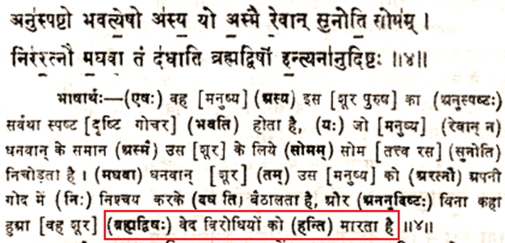
Brahma Purana 106.135 “There is a hell named Atratiṣṭha. It contains putrescent urine and faeces. Those who censure Smṛtis and the Vedas fall into it with faces downwards.” Tr. G.P. Bhatt, edited by J.L. Shastri (Source)
Mahabharata 3.31 “A rejector of proofs, a slanderer of the interpretation of the Vedic scriptures, a transgressor urged by lust and covetousness, that fool goes to hell.” Tr. K.M. Ganguli (Source)
Brahma Purana 106.135 “There is a hell named Atratistha. It contains putrescent urine and faeces. Those who censure Smrtis and the Vedas fall into it with faces downwards.” Tr. Board of Scholars, edited by J.L. Shastri (Source)
Skanda Purana I.iii(U).5.17-18 “Sinners are made to bear heavy burdens by the messengers of Yama. A Brahmana-slayer shall be (reborn as) a tuberculosis patient…He who censures the Vedas shall become a Candala.” Tr. G.V. Tagare (Source)
Vishnu Purana 2.7.11-13 “…and he who is disrespectful to his spiritual guide, who is abusive to his betters, who reviles the Vedas, or who sells them, who associates with women in a prohibited degree, into the Lavańa (salt) hell…” Tr. H.H. Wilson (Source)
Vishnu Purana 1.6.29-31 “Those, however, in whose hearts the dross of sin derived from Time (Kála) was still more developed, assented not to sacrifices, but reviled both them and all that resulted from them, the gods, and the followers of the Vedas. Those abusers of the Vedas, of evil disposition and conduct, and seceders from the path of enjoined duties, were plunged in wickedness… [36-41] For those who neglect their duties, who revile the Vedas, and obstruct religious rites, the places assigned after death are the terrific regions of darkness, of deep gloom, of fear, and of great terror; the fearful hell of sharp swords, the hell of scourges and of a waveless sea.” Tr. H.H. Wilson (Source)
Garuda Purana 4.5-12 “…Those who despise places of pilgrimage, good men, good actions, teachers and Shining Ones; those who disparage the Purāṇas, the Vedas, the Mīmāṁsā, the Nyāya and the Vedānta…” Tr. Ernest Wood and S.V. Subrahmanyam (Source)
Skanda Purana I.iii(U).5.17-18 “Sinners are made to bear heavy burdens by the messengers of Yama. A Brahmana-slayer shall be (reborn as) a tuberculosis patient…He who censures the Vedas shall become a Candala.” Tr. G.V. Tagare (Source)
Skanda Purana III.iii.22.39-41 “Men who censure a man conversant with the Puranas or the story that dispels sins, become dogs in a hundred births. The base men who talk and interrupt while the (Purana) story is progressing, will be born as donkeys first and then as chameleons. Those men who never listen to the holy story will fall into terrible hells and later be born as wild pigs.” Tr. G.V. Tagare (Source)
Skanda Purana V.ii.67.23-31 “…[Isvara said] a voice issued from the firmament as uttered by me in compassion: ‘Do not say anything out of the way. The immutable Srutis should not be censured. The Puranas spoken by Brahma, the creator of the worlds, cannot be otherwise. The atheists who censure the Puranas and Dharmasastras fall into the terrible hell and remain there till all living beings are annihilated.” Tr. G.V. Tagare (Source)
Brahma Purana 105.40-45 “…All these have death under delusion-the perjuror, he who tells lies, he who kills others and he who censures the Vedas. The attendants of Yama are terrible. They have putrid odour. They have massive iron clubs in their hands. These persons are wicked in their designs. When they appear in front of him the dead man begins to tremble. He cries incessantly calling out his mother, father and brothers, O brahmins. That word Yama is indistinct…” Tr. Board of Scholars, edited by J.L. Shastri (Source)
Earthly & Hellish Punishment for those who censure or do not worship Hindu Gods
Rig Veda 1.84.8 “Like a weed trampled by foot, when would He crush the greedy and miser who does not offer oblations to the loving resplendent Self. O Love!” Tr. Svami Satya Prakash Sarasvati & Satyakam Vidyalankar (Source)
Yaska commented on the above verse.
Nirukta 5.17 “When, with his foot, will he trample the unworshipping man like a mushroom.” Tr. Lakshman Sarup (Source)
Shiva Purana, Vidyeshvara Samhita 1, chapter 19, verse 26 “If a brahmin does not worship the earthen phallic image he shall fall in the terrible hell with a terrible trident pierced through his body.” Tr. J.L. Shastri (Source)
Devi Bhagavatam 9.35.1-44 “…If any Brâhmana does not worship with devotion the phallic emblem of S’iva, he goes to the dreadful S’ûlaprota Kunda for that heinous sin. He remains there for one hundred years; then he becomes a quadruped animal for seven births and again he becomes born a Devala Brâhmin for seven births when he becomes freed.” Tr. Swami Vijnananda (Source)
Brahma Vaivarta Purana, Krishna Janma Khanda 75.62-77 “…A Brahmin who does not worship Visnu is like a Chandal; and one who adopts the tenets of Bama (name of Gouri, Laksmi or Saraswati) goes to hell…” Tr. Rajendra Nath Sen (Source)
Brahma Vaivarta Purana, Krisna Janma Khanda 75.73-82 “…Even the worship of Siva’s male organ for one time after having constructed it with clay or cow dung and sand secures dwelling in heaven for a hundred ages: and whoever worships a hundred such organs obtains the desired meed; and whoever worships a hundred thousand such organs attains the position of S’iva, but one who does not worship S’va goes to hell. Those who slander or calumniate the venerable, and most lovely S’iva dwell in hell as long as Brahma exists and suffer endless torments.” Tr. Rajendra Nath Sen. (Source)
Brahma Vaivarta Purana, Krishna Janma Khanda 75.43-52 “…A fool who slanders Siva, Durga, Ganes’a, the Sun, a Brahmin, a Vaisnava and Visnu goes to the hell called the great Raurava. A person who does not maintain his parents, chaste wife, spiritual guide, and widowed sister, and widowed daughter goes to hell. If a Ksatriya, Vais’ya or Sudra male has no faith in Hari or a Brahmin and if a youthful woman has no faith in her husband, then these wretches undoubtedly suffer the torments of hell…” Tr. Rajendra Nath Sen (Source)
Skanda Purana III.ii.18.156-7 “She creates obstacles for a foolish one who does not worship. He will have to witness death of the couple, destruction of wealth, great fear, pain, sickness and incidents of arson. For this reason, O Brahmanas, an intelligent devotee should worship Matangi.” Tr. G.V. Tagare (Source)
Hell for those who reject Sacrifices/Rituals
Atharva Veda 11.2.23 “Homage be paid him with ten Sakvari verses who stands established in the air’s mid-region, slaying non-sacrificing God-despisers!” Tr. Ralph Griffith
Following is the Hindi translation by Arya Samaj scholar Shripad Damodar Satvalekar.

Padma Purana VI.253.36-39 “That devotee of Visnu, who does not practise the acts prescribed in the Srutis and Smrtis, becomes a heretic, and would stay in the Raurava hell. Therefore, a man should offer to the lord of the world a worship fit for his caste…” Tr. N.A. Deshpande (Source)
Brahmanda Purana 2.3.19.57b-58a “After hearing these rules and regulations regarding Sraddha, if any man does not perform it, he is an atheist and he shall fall into the terrible hell enveloped in darkness.” Tr. G.V. Tagare (Source)
Kurma Purana II.24.7 “Either due to atheistic feelings or due to lethargy, if anyone does not wish to maintain sacrificial fires, nor does he perform Yajnas, he falls into many hells.” Tr. G.V. Tagare (Source)
Narada Purana I.15.130b-131a “Those who have ceased to perform the rites and the yajnas for Pitrs (manes) and Devas, those who stay outside the part of the Vedas, are notorious as heretics. They undergo all sorts of tortures.” Tr. G.V. Tagare (Source)
Narada Purana I.15.89 “Those who have abandoned the five great sacrifices go to the hell Lalabhaksa. One who abandons worship goes to the hell Raurava. [96b-97] The person who abandons his religious duties is called a heretic by learned men. He and a person who associates with him are great sinners. They fall into hells in a serial order, in the course of thousand and millions of kalpas.” Tr. G.V. Tagare (Source)
Brahmanda Purana: Lalit-Mahatmya 33.84-86 “The glorious Maharudra who holds the trident is served by other Rudras, the chief among whom is Hiranyabahu. He is accompanied by those Rudranis too. With the tip of his trident, he pierces those persons who have neglected visiting Lalita, who are haughty, and who are reproached by elderly people. He burns them by means of fierce fires originating from his eyes. He destroys their wives, children and servants, He is the great hero who obediently carries out the behest of Lalitha.” Tr. G.V. Tagare (Source)
Brahma Purana 106.33-41 “Yama’s servants said: You have not performed sacrifices at the proper time. You have not offered gifts to the brahmins. Moreover, when something was offered to brahmins you had actively prevented it. The time for the reaping of the fruits of that sin has arrived, O base men, your assets were not burnt by fire nor did they perish in water. They had not been seized by kings or robbers. Where are they now? Why were they not handed over to brahmins…On hearing the words of Yama’s servants they lose their taste therein. They are afflicted by hunger and thirst (all the more). Thereafter they are tortured by the servants of Yama with terrible weapons. The ruthless emissaries of Yama attack them from the rear with iron clubs, iron-rods, javelins, tomaras, pattisas, bhindipalas and parighas. They are bit and pierced by arrows, axes and maces. The sinners are attacked from the front by lions, tigers etc. and are eaten up by them.” Tr. Board of Scholars, edited by J.L. Shastri (Source)
Other sins leading to hell
Skanda Purana II.iv.6.26 “Those foolish persons who revile noble-souled Vaisnavas, fall into hell named Maharaurava along with their manes.” Tr. G.V. Tagare (Source)
Varaha Purana 134.61-64 “Varaha said: O Earth, I shall tell you what happens to the man who offers forbidden flower for me…Fools alone dare to offer me like this and they fall into the hell called Raurava, and then, because of their ignorance, undergo a lot of suffering. They remain as monkeys for ten years, cats for thirteen years.” Tr. Venkitasubramonia Iyer (Source)
Shiva Purana, Uma Samhita 5, chapter 10, verses 19-20 “If men, out of greed, pluck and sniff at flowers of the temple parks, or wear them on their heads, their heads are covered with iron spikes and their noses are filled with plenty of acid and other things.” Tr. J.L. Shastri (Source)
Linga Purana Section II.18.60-62 “…The lord said thus:-‘O excellent-faced lady, a person who applies Bhasman is on a par with my son Ganesa. What is repugnant to them should be eschewed. A householder who is devoid of Brahman (Vedic knowledge) and who does not wear the caste mark Tripundra falls into the depths of hell. All his holy rites of worship, charitable gifts and holy ablutions are in vain like the Homa performed in the ashes.” Tr. Board of Scholars, edited by J.L. Shastri (Source)
Vayu Purana Section II.21.59-61 “Brhaspati said: The man who after hearing this explanation of the procedure of Sraddhas, becomes malicious, is an atheist enveloped in darkness. He will drown himself in the terrible hell. He who has perfectly controlled his mind, finds all his great ailments terminated. He who is not mindful of the Asramas (stages of life) stated in the Vedas attains the Kumbhika hell. He attains the status of a thief and gets his tongue cut. Those who censure Yoga become lumps of clay in the ocean and decay as long as earth exists. Hence, this is the Dharma (virtue) intended in the Sraddha that it should be performed by a man with faith (in it.” Tr. G.V. Tagare, edited by G.P. Bhatt (Source)
Padma Purana IV.1.8-13 “…For a man who would create an obstacle in the act of the narration of Visnu’s account, there is no escape from hell for a hundred period of Manu. For those who having hear the account (as narrated) in the Puranas, censure or scoff at it, always have the very afflicting hells on their hands (i.e. waiting for them)…” Tr. N.A. Deshpande (Source)
Teaching or Reading Scriptures to those unworthy of it
Shiva Purana Vayaviyasamhita 6, Section II, chapter 41, verse 38 “This excellent gem of Sivapurana, should not be mentioned to those who do not know the Vedas, nor should it be imparted to a disciple who is not a devotee of Siva nor to an atheist. If it is imparted to these out of delusion it yields hell.” Tr. J.L. Shastri (Source)
Blasphemy
It appears that Hindu gods were intolerant of criticism. Several texts prescribe punishment, both in this world and the hereafter, for blasphemy, including censuring the gods, the Vedas, the Puranas, and even Brahmins. The verses listed under the category Sins Leading to Hell, particularly those concerning punishment for rejecting or censuring Hindu scriptures, can also be understood as prescribing penalties for blasphemy. Krishna states:
Gita 16.18-20 “Bewildered by false ego, strength, pride, lust and anger, the demons become envious of the Supreme Personality of Godhead, who is situated in their own bodies and in the bodies of others, and blaspheme against the real religion. Those who are envious and mischievous, who are the lowest among men, I perpetually cast into the ocean of material existence, into various demoniac species of life. Attaining repeated birth amongst the species of demoniac life.” Tr. Swami Prabhupada (Source)
Gita 9.11-12 “Fools deride Me when I descend in the human form. They do not know My transcendental nature as the Supreme Lord of all that be. Those who are thus bewildered are attracted by demonic and atheistic views. In that deluded condition, their hopes for liberation, their fruitive activities, and their culture of knowledge are all defeated.” Tr. Swami Prabhupada (Source)
Kurma Purana I.16.168b-170a “Those who consider Visnu as the unmanifest Atman and who are endowed with faith, but who worship Isana with a different vision (i.e. regard him as different from Visnu) are not my beloved ones. Those deluded persons who hate the creator of the world are roasted and cooked in Raurava and other hells and are not released there from even after hundreds and crores of kalpas.” Tr. G.V. Tagare (Source)
Brahma Vaivarta Purana, Krishna Janma Khanda 40.116-141 “…A sinner who slanders Brahma, the creator of the world, the goddess Durga who is the best of female deities, Laksmi, Saraswati, Sita, Tulsi, Ganga, the Vedas, the mother of the Vedas, a vow, devotion, mystic formula pertaining to worship of the spiritual guide who gives formula will dwell in the hell called the ‘Blind well’ for half the period of the longevity allotted to Brahma, where bitten by snakes he will scream dreadfully. Whoever slanders Lord Harisikesa Visnu, literally, lord of senses) regarding him as an ordinary god or talks ill of the Puranas (which engender faith in Hair and are more praiseworthy than the S’rutis) or blames the cow herdess, Raddha, who sprang out of half of the body of Krisna or the ever-adorable Brahmins must dwell in the hell called Avatoda so long as Brahma exists. He dwells there with his feet upwards and face downwards surrounded by snakes. There, bitten by fearful snakes, he screams horribly and oppressed by hunger, he consumes saliva, ordure and urine. Then the fearful myrmidons of Yama in anger thrust torches into his mouth, chastise him in the morning, noon and evening, storm and thunder. He is then very much frightened and with the torments caused by beating he is rendered thirsty and drinks urine to quench his thrust.” Tr. Rajendra Nath Sen (Source)
Padma Purana IV.17.14-18 “Formerly in Tretayuga there was a sinful brahmana by name Sudarsana. O best brahmana, on the day of (i.e. sacred to) Visnu he would always eat (food, i.e. would not observe a fast). He always censured the sacred texts and always condemned the vows…O brahmana, when once the time of death arrived, he died. The messengers of Yama came (to his place), and binding him they took him to Yama’s abode…[22-28] Suta said: O brahmana, then, by Yama’s order his terrible messengers threw him into faeces (where he remained) for more than a hundred ages of Manu. Freed from there he became (i.e. was born as) a village pig on the earth. For a long time he would remain in hell due to his having eaten food on the day of (i.e. sacred to) Visnu…” Tr. N.A. Deshpande (Source)
Kurma Purana II.16.16 “One should not even mentally think of those people who censure the Vedas, Devas and the Brahmanas.” Tr. G.V. Tagare (Source)
Skanda Purana V.ii.68.24-33 “…Those who commit breach of trust, those who have sex with other men’s wives and those who speak ill of the Vedas, attain the state of Pisaca. Men who always decry the Puranas and Dharmasastras and who calumniate others become Pisacas…” Tr. G.V. Tagare (Source)
Skanda Purana I.iii(U).5.23 “A person with malice towards Visnu shall become a lizard and one who is malicious to Siva shall become a mouse.” Tr. G.V. Tagare
Skanda Purana IV.ii.74.120 “Those who censure Mahadeva, those senseless ones who censures the holy spot and those who censure the Purana, should never be talked to.” Tr. G.V. Tagare (Source)
Skanda Purana IV.ii.75.33-41 “A deluded fool engaged in censuring Siva, a censurer of Saivite scriptures- there is no expiation for him. No such redemption is seen in any scripture by anyone. He who performs the act of censuring Siva should be known as a soul-killer, a murderer of the three worlds. He is baser than the basest. He should not be talked to. Those who are engaged in censuring Siva in the midst of the devotees of Siva, fall into the terrible hell as long as the Sun and the Moon (shine).” Tr. G.V. Tagare (Source)
Ramcharitmanas, Uttarakanda, Chopai 130, verse 12 “A reviler of Lord Hara and his own preceptor takes the form of a frog (after his death) and his birth in that form is repeated a thousand times. A reviler of the Brāhmaṇas, after suffering tortures in a number of hells, is born on earth in the form of a crow.” Tr. Gita Press (Source)
Shiva Purana, Vidyesvarasamhita 1.24.45-46 “Fie upon the forehead that is devoid of ash. Fie upon the village that has no Siva temple. Fie upon that life that does not worship Siva. Fie upon the lore that does not refer to Siva. Great indeed is the sin accruing even from the sight of those who censure Siva who is the support of three worlds and those who censure the man wearing Tripundra on his forehead. They are on a par with pigs of rubbish, demons, donkeys, dogs, jackals and worms. Such sinful persons are hellish fiends even from their verse birth.” Tr. J.L. Shastri (Source)
Padma Purana V.20.39-44 “…Those sinners who (even) once censure the salagrama stone, are cooked in the Kumbhipaka (hell) till deluge. The mother, the father, the groups of relatives of thaat foolish man who prohibits a man on the point of worshipping (a salagrama stone), rot in hell…” Tr. N.A. Deshpande (Source)
Vamana Purana 12.3-4 “Those who always censure the Vedas, gods and the Brahmanas, and the sinners who do not respect the teachings of the Puranas and Itihasas, those who find fault with their preceptors, those who hinder the performance of sacrifices, those who prevent donor from making gifts – all fall in these hells.” Tr. Anand Swarup Gupta (Source)
Shiva Purana, Uma Samhita 5, chapter 10, verses 21-23 “Red-hot three pointed iron rods are thrust and pushed through the chest, neck, tongue, tooth-joints, palate, lips, nostrils and all the limb-joints of those persons who slander and censure the noble-preacher of virtue, devotees of the gods, fire-god and preceptor as well as the eternal scriptural texts.” Tr. J.L. Shastri (Source)
Mahabharata Vana Parva 3.31 “A rejector of proofs, a slanderer of the interpretation of the Vedic scriptures, a transgressor urged by lust and covetousness, that fool goeth to hell.” Tr. K.M. Ganguli (Source)
Markandeya Purana 25.33 “After touching or holding converse with blasphemers of the gods, pitris, and holy sastras, sacrifices, prayers and other sacred objects, one should purify one’s self by grazing at the sun.” Tr. F. Eden Pargiter (Source)
Tulsidas Ramayana (Ramcharitmanas) chaupai 116 “He who blasphemes a Brahman to hell will be hurled…” Tr. A.G. Atkins (Source)
Kurma Purana II.4.16 “I alone am the unchanging (eternal) preceptor of all Yogins; I am the protector of the virtuous and the slayer of those who hate the Vedas.” Tr. G.V. Tagare (Source)
Vayu Purana Part II.39.156-7 “He who sells the Vedas, he who blasphemes the Vedas, those who abuse or disrespect elders or hit them with wounding words and one who carnally approaches forbidden women – all these fall into hell named Sabala, A thief or a trespasser falls into the hell Vimoha… [158] … Those who hate Devas and Brahmanas, those who do not worship preceptors and those who contaminate precious gems fall into the hell Krmibhaksya.” Tr. G.V. Tagare (Source)
Kurma Purana II.16.38-40 “…One should scrupulously avoid blaspheming Devas and the Vedas. O great sages, no atonement is seen ordained in the scriptures in the case of a Brahmana who censures Devas, sages, Brahmanas, or the Vedas. If a man loudly decries or censures the preceptors, Devas or the Vedas, he shall be cooked in the hell Raurava for hundreds of crores of Kalpas and even more.” Tr. G.V. Tagare (Source)
Ramcharitmanas, Uttarakanda, Chopai 120, verse 13 “Those conceited persons who revile the gods and the Vedas are cast into the hell known as Raurava. They who delight in vilifying the saints are reborn as owls, who love the night of delusion and for whom the sun of wisdom has set.” Tr. Gita Press (Source)
Sins that are equal to Brahmin-slaughter.
Brahma Purana, Gautami-Mahatmya 94.35 “He who out of hatred censures Devas, Vedas, spiritual learning and the assemblage of virtuous brahmins shall be a brahmin-slayer.” Tr. Board of Scholars, edited by J.L. Shastri (Source)
Brahmanda Purana 2.3.19.59b-60 “One who censures and reviles at yogins, meditators and those who desire Moksa, shall fall into a terrible hell. There is no doubt that even he who listens to the same falls into the hell of terrible appearance and is enveloped in darkness al round. By reviling at leading Yogins a man never goes to heaven.” Tr. G.V. Tagare (Source)
Markandeya Purana 14.43-44 “…Those who have repeated the S’astra improperly; those who have given utterance to an evil word; those who have blasphemed the Veda, the gods, the dvijas and their guru; for so many year terrible bird with adamant beaks tear out those men’s very tongues as they are continually reproduced.” Tr. Eden Pargiter (Source)
Markandeya Purana 14.63-64 “And base men who have hearkened to blasphemy against gurus, the gods, and dvijas, and against the Vedas,-these servants of Yama continually drive iron wedges, red as fire, into the ears, of such wicked men who rejoice in such things though they bewail the while Whoever, led by anger and covetousness, have broken up and destroyed beautiful rest-houses, the abodes of gods and brahmanas, and assemblages in the temple of the gods,-Yama’s exceedingly cruel servants continually flay the skins of those men from their body by means of these sharp instruments.” Tr. Edin Pargiter (Source)
Punishment for Blasphemy on Earth
Rig Veda 6.72.1 “… ye killed all darkness and the Gods’ blasphemers.” Tr. Ralph Griffith (Source)
The following Hindi translation is by Pandit Ram Govind Trivedi.

Rig Veda 6.61.3 “Thou castest down, Sarasvati, those who scorned the Gods…” Tr. Ralph Griffith (Source)
The following Hindi translation is by Pandit Ram Govind Trivedi.
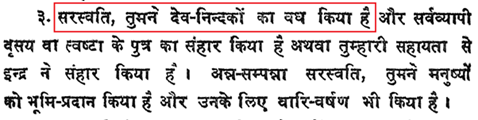
Kurma Purana II.34.87-89 “If one spits at or reviles in front of Devas and the sages, one should burn one’s tongue by means of a firebrand. Gold too should be given as gift. If any Brahmana passes urine in the garden of Devas (i.e. in the precincts of shrines) even for once, his penis should be cut off for the sake of expiation and he should perform Candrayana rite. If out of delusion, an excellent Brahmana passes urine in the sanctum sanctorum of a temple; his penis should be cut off. He should perform the Candayana rite.” Tr. G.V. Tagare (Source)
Brahma Purana Gautami Mahatmya 100.44-46 “The Vaiya said: I think that Dharma (Virtue) is the greatest thing. You can do whatever you please. The sinner who censures brahmin, preceptors, Devas, Vedas, Dharma and Visnu should not be touched. The evil-minded sinner, doer of wicked actions and base conduct, who blasphemes Dharma should be cast off and neglected.” Tr. Board of Scholars, edited by J.L. Shastri (Source)
Those who wrong a Brahmin is also condemned in the Vedas, there are prayers to destroy those who wrongs a Brahmin.
Atharva Veda 13.3.1 “…O Rohita (King) agitate destroy and entangle in snares the man doing wrong to Brahman.” Tr. Acharya Vaidyanath Shastri
Atharva Veda 12.5.52 “Rend, rend to pieces, rend away, destroy, destroy him utterly. Destroy Angirasi! the wretch who robs and wrongs the Brahmans, born.” Tr. Ralph Griffith (Source)
Ironically, Manu Smriti 8.417 permits a Brahmin to appropriate the property of a Shudra, while the Vedas contain verses that pray for the destruction of those who rob or wrong a Brahmin.
Examples
Parvati is described as commanding Hindus to kill anyone who reviles Shiva.
Shiva Purana, Rudrasamhita 2, Parvatikhanda Section III, chapter 28, verses 38-39 “[Parvati said] A person who disparages Siva is definitely worthy of being killed by Siva’s attendants. If it is a brahmin he must be dismissed or the hearer shall go away from that place immediately. This wicked man will again disparage Siva. Since he is a brahmin, he is not to be killed. He shall be abandoned. He shall not be seen at all.” Tr. J.L. Shastri (Source)
Srimad Bhagavatam 4.4.17-18 “Satī continued: If one hears an irresponsible person blaspheme the master and controller of religion, one should block his ears and go away if unable to punish him. But if one is able to kill, then one should by force cut out the blasphemer’s tongue and kill the offender, and after that one should give up his own life. Therefore I shall no longer bear this unworthy body, which has been received from you, who have blasphemed Lord Śiva. If someone has taken food which is poisonous, the best treatment is to vomit.” Tr. Swami Prabhupada (Source)
Swami Prabhupada writes “The answer to that argument is that Satī was not vilifying but defending. If possible she should have cut out Dakṣa’s tongue because he blasphemed Lord Śiva. In other words, since Lord Śiva is the protector of religion, a person who vilifies him should be killed at once, and after killing such a person, one should give up one’s life. That is the process, but because Dakṣa happened to be the father of Satī, she decided not to kill him but to give up her own life in order to compensate for the great sin she had committed by hearing blasphemy of Lord Śiva. The instruction set forth here in Śrīmad-Bhāgavatam is that one should not tolerate at any cost the activities of a person who vilifies or blasphemes an authority. If one is a brāhmaṇa he should not give up his body because by doing so he would be responsible for killing a brāhmaṇa…” Swami Prabhupada on Srimad Bhagavatam 4.4.17 Source
According to the narrative, Brahmins killed a king named Vena for committing blasphemy against Vishnu.
Srimad Bhagavatam 4.14.30-35 “My dear Vidura, all good fortune unto you. The foolish King, who thought himself very learned, thus insulted the great sages, and the sages, being broken hearted by the King’s words, became very angry at him. All the great saintly sages immediately cried: Kill him! Kill him! He is the most dreadful, sinful person. If he lives, he will certainly turn the whole world into ashes in no time. The saintly sages continued: This impious, impudent man does not deserve to sit on the throne at all. He is so shameless that he even dared insult the Supreme Personality of Godhead, Lord Viṣṇu. But for King Vena, who is simply inauspicious, who would blaspheme the Supreme Personality of Godhead, by whose mercy one is awarded all kinds of fortune and opulence? The great sages, thus manifesting their covert anger, immediately decided to kill the King. King Vena was already as good as dead due to his blasphemy against the Supreme Personality of Godhead. Thus without using any weapons, the sages killed King Vena simply by high-sounding words. After all the sages returned to their respective hermitages, the mother of King Vena, Sunīthā, became very much aggrieved because of her son’s death. She decided to preserve the dead body of her son by the application of certain ingredients and by chanting mantras [mantra-yogena].” Tr. Swami Prabhupada (Source)
This was the same King Vena who had embraced Jainism.
Hindu Gods are Murderers
Hindu gods are frequently portrayed as having killed large numbers of people who are described as innocent or undeserving of such punishment. According to Hindu belief, these gods incarnated on earth in physical form to guide humanity. Yet, the narratives often depict one god engaged in lecherous conduct, while another spends more than a decade pursuing the recovery of his wife. It is difficult to discern what moral example such actions were meant to set for humanity.
Hindu deities are commonly represented wielding weapons, accompanied by fierce and intimidating expressions. These weapons are repeatedly shown being used to shed innocent blood. Numerous scriptural stories glorify such acts of violence without adequately addressing the moral implications of killing those who posed no direct threat.
The following section presents several examples from Hindu scriptures in which gods are depicted as killing innocent individuals. This discussion begins with Vishnu and his avatars. Let us first examine the words attributed to the demon himself.
Vishnu
Matsya Purana 178.6-22 ”He is my enemy. He is the destroyer of my elders, He lived in the oceans, destroyed the demons Madhu and Kaitabha. It can be said that as long as he lives, the war between us will not end. There will be a most fearful fight between Him and me. He has killed many demons in this battle. He is very cruel. He has not shown His clemency even to the children and the woman of the demons killed. He is shameless. He is Visnu. He is the heaven of the Devas. He sleeps on the Sesa serpent…” Tr. Taluqdar of Oudh, Edited by B.D. Basu (Source)
In Hindu scriptures, the term demon does not necessarily refer to beings with monstrous or non-human appearances. In many cases, communities and tribes that did not follow the Vedic religion were labelled as demons. Within this framework, the killing of demons often implies violence directed against non-Vedic groups rather than supernatural entities.
Certain narratives explicitly state that Vishnu killed not only enemy demons but also their women and children. In one account, Vishnu, acting at the behest of Indra, is said to have beheaded the wife of the sage Bhrigu. As a consequence of this act, Bhrigu pronounced a curse upon Vishnu, condemning him to take repeated incarnations on earth.
Valmiki Ramayana, Uttara Kanda, chapter 51. “Learn, O king, what happened formerly during the conflict between the Devas and Asuras. The Daityas, whom the Suras threatened, took refuge with the consort of Bhrigu and she, having given them a haven, they dwelt there in safety. Seeing them thus succoured, the Chief of the gods, enraged with his sharp-edged discus severed the head of Bhrigu’s wife. Beholding the murder of his consort, Bhrigu, in his wrath, instantly cursed Vishnu, the destroyer of enemy hosts, saying:- ‘Since in thine insensate fury, thou has slain my spouse, who should never have died thus, thou shalt take birth in the world of men, O Janardana, and there thou shall live separated from thy consort for many years.” Tr. Hari Prasad Shastri (Source)
Matsya Purana Part I, 47.101-105 “At that, both Indra and Visnu were overcome with fear and began to contrive some means of escape. Visnu said to Indra:- ‘How shall we escape from her?’ Indra replied:- ‘Lord! kill her before she consumed me. I am solely protected by you, destroy her soon without delay.’ Visnu thought over the great sin of killing a woman, in spite of that, he took up his Sudarsana Chakra to free Himself from that impending calamity. Trembling with fear, on thinking over the consequences of her anger and being afraid of the consequences of His own wrath, He severed her head with His Chakra. The sage Bhrigu then cursed Visnu for killing his wife.” Tr. Taluqdar of Oudh, edited by B.D. Basu (Source)
According to Brahmanda Purana 2.3.72.139–140, Vishnu pierced the woman’s head with his weapon and severed it into three parts. The narrative occurs in the context of a war between the Devas and the Daityas. After suffering heavy losses, only a few Daityas survived. Seeking protection, Shukra advised them to take refuge in the house of his father, the sage Bhrigu, until he could obtain a boon from Shiva that would enable them to defeat the Devas.
The Daityas accordingly sought shelter with Bhrigu’s wife, who assured them safety. Indra and Vishnu later arrived at the hermitage with the intent of killing the Daityas. However, Shukra’s mother resisted the attack, as she possessed immense spiritual power and was on the verge of incinerating both Indra and Vishnu. At this point, Indra urged Vishnu to kill her, and Vishnu beheaded her using the Sudarshana Chakra.
When Bhrigu returned and discovered that his wife had been killed by Vishnu, he pronounced a curse upon him. Different Puranic sources provide varying conclusions to the episode. According to the Devi Bhagavatam, Vishnu later resurrected Bhrigu’s wife, whereas the Matsya Purana 1.47.108–111 states that Bhrigu himself restored her to life.
What is significant in this account is that Vishnu and Indra had alternatives. They could have fled from the scene or neutralised her powers without killing her. Instead, they chose to kill a woman who had granted refuge, an act that raises serious moral concerns. This episode becomes even more troubling when read alongside a verse in the Bhagavata Purana, which states that Vishnu’s Sudarshana Chakra causes miscarriages in the wives of demons.
Srimad Bhagavatam 5.24.15 When the Sudarśana disc enters those provinces, the pregnant wives of the demons all have miscarriages due to fear of its effulgence.” Tr. Swami Prabhupada (Source)
Vamana
There was an Asura king named Mahabali, who is depicted in Hindu scriptures as a just, generous, and righteous ruler. Despite his virtues, Vishnu incarnated as Vamana to undermine him and ultimately killed Mahabali in order to secure the kingship of the Devas. Following this, Mahabali was deprived of his kingdom and sent to the lower world. This account is found in the Srimad Bhagavatam, Canto 8, Chapters 18–20. (Source)
Parashurama
Parashurama was the sixth avatar of Vishnu. According to Hindu scriptures, he beheaded his own mother, Renuka, as well as his brothers on the command of his father, Jamadagni. In the Mahabharata, Parashurama is also referred to as Rama, so this figure should not be confused with Rama, the killer of Ravana.
Mahabharata Vana Parva 3.116.13-14 “And then Rama, the slayer of hostile heroes, came to the hermitage, last of all. Him the mighty-armed Jamadagni, of great austerities, addressed, saying, ‘Kill this wicked mother of thine, without compunction, O my son.’ Thereupon Rama immediately took up an axe and therewith severed his mother’s head.” Tr. K.M. Ganguli (Source)
The context of the episode is as follows. Renuka went to bathe in a river and, on her return, happened to witness King Chitraratha of Martikavata engaged in sexual relations with his wives. This sight aroused desire in her mind. When Renuka returned to the hermitage, her husband Jamadagni became aware of this lapse. Enraged, he ordered his sons to kill her. All of them refused, considering the command immoral. Parashurama alone obeyed his father’s order and beheaded his mother. Jamadagni then commanded Parashurama to kill his brothers as punishment for their disobedience, and Parashurama complied, killing them as well. Pleased with his obedience, Jamadagni granted Parashurama a boon. At Parashurama’s request, Renuka and his brothers were restored to life, and he further asked that they retain no memory of these events.
Srimad Bhagavatam 9.16.6 “Jamadagni then ordered his youngest son, Paraśurāma, to kill his brothers, who had disobeyed this order, and his mother, who had mentally committed adultery. Lord Paraśurāma, knowing the power of his father, who was practiced in meditation and austerity, killed his mother and brothers immediately.” Tr. Swami Prabhupada (Source)
Brahmanda Purana 2.3.23.65 contains an indirect reference to Parashurama’s killing of his own mother.
What was Renuka’s sin? That she felt momentary sexual desire after witnessing a king engaged in intercourse with his wives. Even if this is accepted as a moral lapse, it was hardly a crime deserving death. Yet she was beheaded by her own son, Parashurama, the sixth incarnation of Vishnu, who carried out the act without hesitation simply because it was his father’s command. This episode raises serious questions about the moral example set by Hindu gods and avatars.
Parashurama’s violence did not end there. He is said to have annihilated the entire Kshatriya race because his father Jamadagni was killed by Kartavirya Arjuna, a Kshatriya king. Instead of punishing the individual responsible, Parashurama allegedly slaughtered Kshatriyas indiscriminately across the land. Hindu texts claim that he carried out this massacre twenty-one times, an act that amounts to collective punishment and mass killing rather than justice.
Srimad Bhagavatam 9.16.10-12 “Once when Paraśurāma left the āśrama for the forest with Vasumān and his other brothers, the sons of Kārtavīryārjuna took the opportunity to approach Jamadagni’s residence to seek vengeance for their grudge. The sons of Kārtavīryārjuna were determined to commit sinful deeds. Therefore when they saw Jamadagni sitting by the side of the fire to perform yajña and meditating upon the Supreme Personality of Godhead, who is praised by the best of selected prayers, they took the opportunity to kill him. With pitiable prayers, Reṇukā, the mother of Paraśurāma and wife of Jamadagni, begged for the life of her husband. But the sons of Kārtavīryārjuna, being devoid of the qualities of kṣatriyas, were so cruel that despite her prayers they forcibly cut off his head and took it away.” Tr. Swami Prabhupada (Source)
Srimad Bhagavatam 9.16.16 Thus lamenting, Lord Paraśurāma entrusted his father’s dead body to his brothers and personally took up his axe, having decided to put an end to all the kṣatriyas on the surface of the world. [18-19] With the blood of the bodies of these sons, Lord Paraśurāma created a ghastly river, which brought great fear to the kings who had no respect for brahminical culture. Because the kṣatriyas, the men of power in government, were performing sinful activities, Lord Paraśurāma, on the plea of retaliating for the murder of his father, rid all the kṣatriyas from the face of the earth twenty-one times. Indeed, in the place known as Samanta-pañcaka he created nine lakes filled with their blood.” Tr. Swami Prabhupada (Source)
Brahma Purana 104.110-111 “The Earth where crores of Ksatriyas remained scattered about, the Earth that is adorned by the mountains Meru and Mandara was rid of Ksatriyas twenty-one times by the lord. After making the Earth devoid of Ksatriyas, Parasurama of great fame performed a horse sacrifice in order to dispel his sins.” Tr. Board of Scholars, edited by J.L. Shastri (Source)
Mahabharata Adi Parva 1.2.1-7 “The Rishis said, ‘O son of Suta, we wish to hear a full and circumstantial account of the place mentioned by you as Samanta-panchaya.'”Sauti said, ‘Listen, O ye Brahmanas, to the sacred descriptions I utter O ye best of men, ye deserve to hear of the place known as Samanta-panchaka. In the interval between the Treta and Dwapara Yugas, Rama (the son of Jamadagni) great among all who have borne arms, urged by impatience of wrongs, repeatedly smote the noble race of Kshatriyas. And when that fiery meteor, by his own valour, annihilated the entire tribe of the Kshatriyas, he formed at Samanta-panchaka five lakes of blood. We are told that his reason being overpowered by anger he offered oblations of blood to the manes of his ancestors, standing in the midst of the sanguine waters of those lakes. It was then that his forefathers of whom Richika was the first having arrived there addressed him thus, ‘O Rama, O blessed Rama, O offspring of Bhrigu, we have been gratified with the reverence thou hast shown for thy ancestors and with thy valour …” Tr. K.M. Ganguli (Source)
Parashurama is also said to have burned entire cities along with their inhabitants.
Brahmanda Purana 2.3.46.20-26 “A battle took place once again between Rama and the kings, wherein the infuriated sage of high intellect, killed a hundred kings. After killing Surasena and others along with their armies and vehicles, he made the entire group of Ksatriyas fall on the ground in a moment. The kings who survived, whose wishes had been frustrated and whose vehicles and armies has been killed fled in all directions. After routing the armies, killing the enemies and winning the battle, Rama killed hundreds of kings and heroes by means of the fire from his excellent arrows. Overwhelmed with fury and desirous of burning the entire city, Bhargava discharged a missile that had a lustre similar to that of Kalagni (the fire of world-destruction). The fire from that missile burned the city along with elephants, horses and men. The flames enveloped the clusters of the entire rampart-wall of the city. On seeing the city being burned and desirous of saving his own life, Prince Virihotra became frightened and fled quickly for the sake of life.” Tr. G.V. Tagare (Source)
Parashurama is also said to have burned entire cities along with their inhabitants. This raises an obvious question: how could all Kshatriyas in the world have been engaged in sinful activities? The narrative suggests collective guilt, where an entire class was condemned and destroyed for the actions of a few. As noted earlier, whatever Hindu gods opposed was often demonized in the scriptures.
Parashurama exterminated the Kshatriyas to avenge his father’s murder, even though the crime was committed by only a handful of Kshatriyas. Each time the Kshatriya men were wiped out, Kshatriya women are said to have approached Brahmins to practise Niyoga. The children born through this arrangement were still regarded as Kshatriyas, even though they were biologically the offspring of Brahmins.
Krishna
Krishna is said to have beheaded a washerman merely for refusing to give him clothes and for speaking rudely.
Srimad Bhagavatam 10.41.36-37 “Fools, get out of here quickly! Don’t beg like this if You want to stay alive. When someone is too bold, the King’s men arrest him and kill him and take all his property. As the washerman thus spoke brazenly, the son of Devaki became angry, and then merely with His fingertips He separated the man’s head from his body.” Tr. Swami Prabhupada (Source)
This episode is summarized in Brahma Vaivarta Purana, Krishna Janma Khanda 132.62–75, and is also mentioned in Agni Purana 12.23. According to the narrative, Krishna and Balarama visited the city of Mathura and encountered a washerman who was carrying garments belonging to the king. When they asked him for the clothes, the washerman, apparently mistaking them for ordinary wanderers, refused outright. Enraged by this refusal, Krishna beheaded the washerman and then took the clothes. The episode closely resembles crimes in which individuals are killed for their possessions, raising serious moral questions about the act.
Krishna is also portrayed as being unable to tolerate criticism. He beheaded King Shishupala solely because Shishupala verbally abused him. This incident occurred during a royal sacrifice performed by the Pandavas at Indraprastha, where Shishupala was present. Despite Shishupala’s offence being verbal in nature, Krishna responded with execution, reinforcing the portrayal of extreme punishment for dissent or insult.
Padma Purana VI.252.13-20 “All those, protected by Krsna, having saluted and praised Krsna, went to their respective countries. Then, going to Indraprastha with the two (i.e. Bhima and Arjuna), Krsna made Yudhisthira perform the Rajasuya sacrifice. There, after the sacrifice was over, the chief honour was given to Krsna with the consent of Bhisma. There Sisupala spoke many abusive words to Krsna. Krsna too cut off his head with the Sudarsana (disc)…” Tr. N.A. Deshpande (Source)
Srimad Bhagavatam 10.74.39-44 “Upon hearing such intolerable blasphemy of the Lord, several members of the assembly covered their ears and walked out, angrily cursing the King of Cedi. Anyone who fails to immediately leave the place where he hears criticism of the Supreme Lord or His faithful devotee will certainly fall down, bereft of his pious credit. Then the sons of Pāṇḍu became furious, and together with the warriors of the Matsya, Kaikaya and Sṛñjaya clans, they rose up from their seats with weapons poised, ready to kill Śiśupāla. Undaunted, Śiśupāla then took up his sword and shield in the midst of all the assembled kings, O Bhārata, and hurled insults at those who sided with Lord Kṛṣṇa. At that point the Supreme Lord stood up and checked His devotees. He then angrily sent forth His razor-sharp disc and severed the head of His enemy as he was attacking. When Śiśupāla was thus killed, a great roar and howl went up from the crowd. Taking advantage of that disturbance, the few kings who were supporters of Śiśupāla quickly left the assembly out of fear for their lives.” Tr. Swami Prabhupada (Source)
Krishna was killed accidentally by a hunter named Jara. Although Jara caused Krishna’s death and therefore cannot be described as innocent, this episode contradicts the modern Hindu claim that Krishna was invariably merciful. According to the narrative, even after Jara begged for forgiveness, Krishna took revenge by killing him, though he is also said to have granted Jara entry into heaven.
Vishnu Purana 5.37.60-69 “Respecting the words of the Brahman, the imprecation of Durvásas, the illustrious Krishńa sat engaged in thought, resting his foot upon his knee. Then came there a hunter, named Jará, whose arrow was tipped with a blade made of the piece of iron of the club, which had not been reduced to powder; and beholding from a distance the foot of Krishńa, he mistook it for part of a deer, and shooting his arrow, lodged it in the sole. Approaching his mark, he saw the four-armed king, and, falling at his feet, repeatedly besought his forgiveness, exclaiming, “I have done this deed unwittingly, thinking I was aiming at a deer! Have pity upon me, who am consumed by my crime; for thou art able to consume me!” Bhagavat replied, “Fear not thou in the least. Go, hunter, through my favour, to heaven, the abode of the gods.” As soon as he had thus spoken, a celestial car appeared, and the hunter, ascending it, forthwith proceeded to heaven.” Tr. H.H. Wilson (Source)
Balrama
Balarama the brother of Krishna is sometimes regarded as an avatar of Vishnu. According to Hindu texts, he was addicted to gambling. He is said to have played dice with Rukmi, the brother of Krishna’s wife Rukmini. Rukmi, seeking revenge for his sister’s elopement with Krishna, challenged Balarama to a game of dice. Balarama accepted the challenge without hesitation, despite not being skilled in gambling. He lost several wagers to Rukmi but eventually won the final bet, which involved a very large stake. A dispute then arose when Rukmi accused Balarama of cheating and claimed himself to be the true winner. Unable to tolerate this accusation, Balarama killed Rukmi over what was essentially a petty argument.
Vishnu Purana 5.23.10-28 “After the wedding had been solemnized, several of the kings, headed by him of Kalinga, said to Rukmin, “This wielder of the ploughshare is ignorant of the dice, which may be converted into his misfortune: why may we not contend with him, and beat him, in play?” The potent Rukmin replied to them, and said, “So let it be:” and he engaged Balaráma at a game of dice in the palace. Balaráma soon lost to Rukmin a thousand Nishkas: he then staked and lost another thousand; and then pledged ten thousand, which Rukmin, who was well skilled in gambling, also won. At this the king of Kalinga laughed aloud, and the weak and exulting Rukmin grinned, and said, “Baladeva is losing, for he knows nothing of the game; although, blinded by a vain passion for play, he thinks he understands the dice.” Halayudha, galled by the broad laughter of the Kalinga prince, and the contemptuous speech of Rukmin, was exceedingly angry, and, overcome with passion, increased his stake to ten millions of Nishkas. Rukmin accepted the challenge, and therefore threw the dice. Baladeva won, and cried aloud, “The stake is mine.” But Rukmin called out as loudly, that he was the winner. “Tell no lies, Bala,” said he: “the stake is yours; that is true; but I did not agree to it: although this be won by you, yet still I am the winner.” A deep voice was then heard in the sky, inflaming still more the anger of the high-spirited Baladeva, saying, “Bala has rightly won the whole sum, and Rukmin speaks falsely: although he did not accept the pledge in words, he did so by his acts (having cast the dice).” Balaráma thus excited, his eyes red with rage, started up, and struck Rukmin with the board on which the game was played, and killed him… When Krishńa heard that Rukmin had been killed by his brother, he made no remark, being afraid of Rukminí on the one hand, and of Bala on the other…” Tr. H.H. Wilson (Source)
Rama
The execution of Shambuka by Rama highlights the rigid and violent enforcement of the Varna system. In this account, Shambuka, a Shudra, is beheaded not for any moral or criminal wrongdoing, but for pursuing spiritual practice. His penance and possible recitation of Vedic mantras, acts reserved for upper castes, were treated as a threat to the prescribed social order or Dharma.
Ramayana of Valmiki, Uttara Kanda 7, Chapters 75-76 ”On this that Prince born of Raghu approached the one who had given himself up to rigorous practices and said:- ”Blessed art thou, O Ascetic, who art faithful to thy vows! From what caste art thou sprung, O Thou who hast grown old in mortification and who art established in heroism. I am interested in this matter, I Rama, the son of Dasaratha. What purpose hast thou in view? Is it heaven or some other object? What boon dost thou seek by means of this hard penance? I wish to know what thou desirest in performing these austerities, O Ascetic. May prosperity attend thee! Art thou a brahmin? Art thou an invincible Kshatriya? Art thou a Vaishya, one of the third caste or art thou a Shudra? Answer me truthfully!”…Hearing the words of Rama of imperishable exploits, that ascetic, his head still hanging downwards, answered:- ”O Rama, I was born of a Shudra alliance and I am performing this rigorous penance in order to acquire the status of a God in this body. I am not telling a lie, O Rama, I wish to attain the Celestial Region. Know that I am a Shudra and my name is Shambuka.” As he was yet speaking, Raghava, drawing his brilliant and stainless sword from its scabbard, cut off his head. The Shudra being slain, all the Gods and their leaders with Agni’s followers, cried out, ”Well done! Well done!” overwhelming Rama with praise, and a rain of celestial flowers of divine fragrance fell on all sides, scattered by Vayu.” Tr. Hari Prasad Shastri (Source)
Ramayana of Valmiki, Uttara Kanda 7, Chapters 75-76 “O Kakutstha be happy! This very day that child has received new life and has been restored to his parents. The child was resuscitated at the instant that the head of the Shudra fell.” Tr. Hari Prasad Shastri (Source)
According to the narrative, the death of a Brahmin boy in Rama’s kingdom was interpreted as a sign that some unrighteous act was disturbing the social order. Rama set out to identify the cause and encountered Shambuka, who was performing severe penance while hanging upside down from a tree. Rama questioned him about his caste and the purpose of his ascetic practice. When Shambuka stated that he was a Shudra and was performing penance to attain a divine status while still embodied, Rama beheaded him. This episode strongly emphasises caste, suggesting that Shambuka was punished not for an evil intention, but for transgressing caste restrictions on ascetic practice. Apologetic claims that Shambuka sought a malicious boon appear inconsistent, since Shambuka himself states his motive openly and no such scrutiny was applied to figures like Ravana, a Brahmin, whose actions were far more destructive (according to Hindu belief).
In a related episode, Lakshmana, acting on Rama’s command, mutilated Shurpanakha by cutting off her nose and ears after she approached Rama expressing her desire for him and later displayed hostile intentions towards Sita. This incident further reflects the harsh and violent responses sanctioned within these narratives.
Valmiki Ramayana, Aranya Kanda 3.18.20-21 “She is freakish, knavish and overtly ruttish, oh, tigerly man, it will be apt of you to deface this paunchy demoness” Thus Rama said to Lakshmana. Thus said to that mighty Lakshmana he infuriately drew sword and chopped off her ears and nose before the very eyes of Rama.” Tr. Desi Raju Hanumanth Rao (Source)
Srimad Bhagavatam 10.47.17 ”He is so very wily that in his incarnation as Rama, he had killed the king of monkeys, (Vali) like a hunter. Also, being brought under the control of his wife he cut off the nose of a woman Shurpanakha by name, who had come to him being stricken with amorous desire.” Tr. J.M. Sanyal
Also mentioned in Agni Purana 7.5.
According to later tradition, Shurpanakha is said to be reborn as Kubja, the hunchback woman, while Rama is reborn as Krishna. In this narrative, Kubja and Krishna are depicted as having a sexual relationship, which I have discussed separately in the article Hinduism and Lust.
Brahma Vaivarta Purana, Krishna Janma Khanda 115.93-102 “Kubja, in her previous birth, was the sister of the wicked Ravana. Her name was Surpanakha. Actuated by lust, she desired the society of Rama. Lakshamana, the chief of the pious men, cut off her nose….” Tr. Various Sanskrit Scholars, Edited by B.D. Basu (Source)
It is often claimed that Shurpanakha intended to kill Sita, while another version states that when she approached Rama, he redirected her to Lakshmana, who then cut off her nose and ears. However, the Ramayana narrative itself appears more authoritative in this regard. Lakshmana’s mutilation of Ravana’s sister is presented as the immediate provocation for Ravana’s act of revenge. Ironically, Ravana is consistently demonised despite being a Brahmin and a devoted worshipper of Shiva, solely because he abducted Rama’s wife, Sita. In contrast, similar acts of abduction, coercion, or sexual violence committed by Hindu gods do not render them villains within these texts.
There are other narratives as well in which women who expressed desire were brutally punished, including the story of Ayomukhi, whom Lakshmana deformed after she approached him professing her love.
Valmiki Ramayana Aranya Kanda 3.69.15-17 “Closeting Soumitri in her embrace she told him this sentence, “I am Ayomukhi, by my name… you won me by your heroic personality, by that way, none can win me over… thus, you alone are my lover… oh, hero, oh, my husband… you will romance with me on mountaintops, in rivers, and on sandy isles, till the end of this life…” So is the love prattle of that demoness Ayomukhi. When said that way that enemy-suppressor Lakshmana became furious, and upraising his sword he sheared off her nose, one ear, and one of her breasts.” Tr. Desi Raju Hanumanth Rao (Source)
Some may argue that this is merely the same story presented with variations in names. However, this claim does not withstand scrutiny. In the same Valmiki Ramayana, Shurpanakha is clearly identified as Ravana’s sister, while Ayomukhi is named separately. Such a variation cannot reasonably occur within a single text without clarification. Moreover, Shurpanakha expressed her desire for Rama, whereas Ayomukhi expressed her desire for Lakshmana. The punishments described are also different. There is no mention of Shurpanakha’s breasts being cut off, whereas this detail is explicitly present in the account of Ayomukhi. Most importantly, the mutilation of Ayomukhi is said to have taken place after Sita’s abduction, while Shurpanakha’s mutilation occurred before Ravana abducted Sita. These chronological and narrative differences make it clear that they are treated as distinct episodes. Ayomukhi’s ears, nose, and breasts were cut off by Lakshmana solely because she expressed her love, highlighting the extreme and brutal response sanctioned in these narratives.
Hanuman
In the Valmiki Ramayana, Hanuman is said to have set Lanka ablaze, destroying large parts of the city along with its inhabitants. The people of Lanka are repeatedly described as demons. However, as is evident from many Hindu texts, non-Hindus were often labelled as demons. A visit to present-day Sri Lanka makes it clear that the inhabitants were human beings, not monstrous creatures. The verses also acknowledge that the people of Lanka possessed immense wealth, further indicating that this was a prosperous human society rather than a realm of mythical beings.
Valmiki Ramayana Sundara Khanda 5, Sarga 54, Verses 24- “The demons, who were running hither and thither to protect their houses and who lost their spirits and abundant wealth, created a tumultuous nose, saying “Alas! The fire-god has come really in a form of this monkey! Some women crying and carrying their suckling’s with their hair dishevelled, fell down from their houses, which were enveloped with fire, and shone like flashes of lightning falling from clouds in the sky. As the fire does not get satisfied with any amount of firewood and straw fed to it, Hanuma was not wearied in killing any number of demons. The earth was not then wearied in receiving the number of demons killed by Hanuma (in her lap).” Tr. K.M.K. Murthy (Source)
Kalki
According to Hindu texts, the Kalki avatar is prophesied to kill Shudra kings, Buddhists, and other so-called heretics. These texts also state that he plunders their wealth. This portrayal frames violence, persecution, and plunder as divinely sanctioned acts against those who fall outside the Vedic religious order.
Vayu Purana I.58.76-83 “He will be called Pramiti. He was born of a part of Visnu formerly in the Svayambhuva Manvantara. He wandered over the earth for full twenty years. He led an army consisting of cavalry, chariots and elephants. He was surrounded by hundreds and thousands of Brahmanas armed with weapons. He killed Mlecchas in thousands. He went everywhere. After killing the kings born of Sudra women, he exterminated the heretics. He killed thousands of persons who were not religious and righteous. He killed those born of mixed castes as well as those who depended on them. He killed the Udicyas (northerners), Madya Desyas (people of the Middle Land), mountain-dwellers, easterners, westerners, dwellers in Vindhya and Aparanta. He killed the southerners, Dravidas, Simhalas, Gandharas, Paradas, Pahlavas, Yavanas, Tusaras, Barbaras, Cinas, Sulikas, Daradas, Khasas, Lampakas, Ketas, and the different tribes of Kratas.” Tr. G.V. Tagare, edited by G.P. Bhatt (Source)
Brahmanda Purana 1.2.31.88-90 “Annihilating every thing by his ruthless activity, he made only seeds to remain on the earth. He managed to subdue the Vrsala who were generally sinful, by making them angry with one another on sudden provocations. Thereafter, in the region between the Ganga and the Yamuna, he established his camp of rest along with his followers. Thereafter, when the Kalpa elapsed, he went back to his eternal abode along with his army after exterminating Mleccha kings by thousands.” Tr. G.V. Tagare (Source)
Matsya Purana 144.51-59 “King Pramati of the Bhrigu family and Chandramasa gotra was born at the end of Svayambhuva Manu in the Sandhyamsa period, to inflict proper punishment on the sinners. That king travelled all over the earth for 30 years and collected arms and ammunitions, elephants, horses and chariots and marched with a vast army consisting of horses and elephants and accompanied by 100,00 Brahmana soldiers armed with various kinds of weapons, against the Mlecchas and destroyed them. After killing all the Sudra kings he annihilated all the hypocrites. After destroying all the sinners and subduing the people living in the North, central regions, the mountaineers, the inhabitants in the East and West, the residents on the Vindhyas, the Deccanis, the Dravidians, the Singhalese, the inhabitants of the Mleccha countries (Kabul and Kandhara), the Paradas, the Pahlavas, the Yavanas, the Sakas, the Tusaras, the Svetas, the Pulindas, the Barbaras, the Khasas, the Lampakas, the Andhrakas, the Daradas, the Ifalikas, he exterminated the Sudras. King Pramati was born of Visnu’s part in Manu’s family and was famous as Chandramasa.” Tr. Taluqdar of Oudh, edited by B.D. Basu (Source)
This theme is also found in Brahmanda Purana 1.2.31.77–80 and Vayu Purana I.58.76–83, which I have discussed under the category Intolerance within Castes and Sects, and it is repeated in Linga Purana, Section I.40.50–56. It would have been understandable if these verses stated that Kalki, or Pramati, killed sinners or wrongdoers. Instead, they explicitly speak of killing people born of mixed castes and kings born to Shudra mothers, which is an overtly casteist position. The claim that all people living in the north, south, east, and west were unrighteous is also illogical, especially when several of the tribes mentioned are historically traceable.
The Kalki avatar is portrayed as annihilating human populations and forcibly subduing those identified as lower castes.
Brahmanda Purana 2.3.73.111-116 “The lord Visnu who had been born in the previous birth as a powerful one, Pramiti by name, will be born in the Gotra of Candramas when the Kaliyuga is complete. Thus these ten incarnations of the lord are remembered. he accepts different wombs in the three worlds partially, adopting at different periods of time, different physical bodies, and different purposes for the manifestations. He will be born in the twenty-fifth Kalpa. For twenty-five years he will be exterminating the living beings and all human beings (?). With this cruel act, he will render the Earth left with only the seeds. He will subdue Vrsalas (low caste people) and almost those evil-doers. Thereafter, Kalki will become contented along with his army. Those who are not killed in this action, those who achieve something, will become deluded suddenly and fight with one another.” Tr. G.V. Tagare (Source)
Please refer to Kalki Purana 13.39–44 and Kalki Purana 16.1, which I have already cited in this article under the category Kalki & Tara are Murderers of Buddhists. I will quote these verses once again here.
Kalki Purana 16.1 “Suta Gosvami said. After killing the Buddhists and mlecchas of Kikatapura, Lord Kalki took their wealth and returned to His capital, along with His vast army” Tr. Bhumipati Das edited by Purnaprajna Das (Source)
Kalki Purana 13.39-44 “Lord Kalki appeared to flourish, being surrounded by all these family members. Once, Lord Kalki’s father, Visnuyasa, who was on the level of Lord Brahma, decided to perform a horse sacrifice. Understanding the intention of His father, Lord Kalki said: My dear father, I will go out and defeat all other kings in battle and thus bring you sufficient wealth so that you can conduct the horse sacrifice properly. Lord Kalki, who was certainly capable of conquering all other kings, offered His obeisances to his father and then set out with his army to first conquer Kikatapura…” Tr. Bhumipati Das edited by Purnaprajna Das (Source)
This indicates that his primary objective was plunder. Anyone familiar with Indian history would recognise Kikata as present-day Bihar, a region that was once dominated by Buddhism. Some historians even suggest that the name Bihar is derived from Vihara, meaning a Buddhist monastery or temple. It is therefore likely that Buddhism was the prevailing religion in Kikata at the time the Kalki Purana was composed, and these narratives were framed with that context in mind. Alternatively, they may have been shaped by Hindu eschatological predictions of Kali Yuga, which portray people as turning into so-called heretics, namely Buddhists and Jains. It is also possible that the depiction of plundering Kikata in the Kalki Purana was influenced by earlier Vedic verses in which Vedic gods are described as plundering the Kikata tribe solely because they did not offer oblations to them.
Shiva
Shiva is said to have burned Tripura, the three cities, along with their inhabitants, including women and children. Tripura was inhabited by Asuras, and Shiva, with the assistance of other gods such as Agni, Vishnu, the Ashvinkumaras, Yama, Kala, the Gandharvas, and Brahma, destroyed not only the cities but also those who lived within them. While the killing of combatant Asuras could be framed as an act of war, these accounts go further by describing the destruction of non-combatants, including women and children. The verses that follow depict a level of violence that is difficult to reconcile with any notion of moral restraint.
Matsya Purana 188.1 “Marakandeya said:- Hear from me, Yudhisthira! what you have asked me to explain. The spot on the banks of the Narmada where the Lord is enshrined is renowned as Mahesvara in all the three worlds and at the very same place He devised His plans of annihilating Tripura. [6-15] …In that way, Siva waited for thousands of years after making such preparations. When the three Puras (cities) fell in one line the Lord let out His arrow on Tripura when the inmates of Tripura became helpless and many kind of destructive omens occurred there…Then the wind Sambartaka that blows at the close of a cycle commenced…It produced fire on account of which the trees of Tripura began to crumble down. There was chaos everywhere. All the gardens were burnt down in an instant…[25-40] The pleasure gardens smiling with lotus beds were also burnt down along with the swans and cranes…The fire of the Lord’s fury burnt down quite unsparingly several children, cows, birds, horses, women, and many people sleeping as well as awake. The nymph like beauties of Tripura fell down burnt with their young ones hugged to their breasts. Some ladies wearing garlands of pearl and gold fell down on the ground consumed by flames and suffocated by smoke. Some beauties seeing their Lord lying on the ground jumped down from the upper storey of their mansion and were instantly eaten up by the flames…Some ladies of the cloudy hue wearing garlands and armlets, some fair-complexioned beauties giving milk to their dear little ones were also consumed by fire. Some ladies seeing their children eaten up by the fire sent forth shrilling wails. Some ladies wearing diamond and emerald necklaces and shining like the moon with their children in their lap, fell down on the ground after being charred. Some moon faced beauties waking up from their sleep found their mansion on fire and began to lament on realizing their children being burnt. Some ladies adorned with golden ornaments fell down on the ground holding their consumed children in their arms… [41-48] Some overcome by the fury of the fire with their hands folded and uplifted began to pray as follows:- ‘Agni! if thou art angry with the male population hostile to thee; what is the fault of the women confined in the houses like so many domesticated Kokilas pent up in cages…[51-53]…Hearing such speech of the ladies the Agni said ‘I am not consuming you of my own will. I have been born to cause destruction. I have no mercy. I make my way everywhere freely through the glory of Siva…” Tr. Taluqdar of Oudh, edited by B.D. Basu (Source)
Shiva Purana, Rudrasamhita 2, Yuddha Khanda 5, chapter 10, verse 35 “Other Asuraas too, children and old men were completely burnt out, O Vyasa, at the bidding of Siva and speedily reduced to ashes. Just as the universe is burnt at the end of a Kalpa so also every thing and everyone there, whether woman or man or vehicles, was reduced to ashes by that fire.” Tr. J.L. Shastri (Source)
Only those who worshipped Shiva and Ganesh were spared from being burned. All others who opposed God, that is, those who did not worship Shiva, were burned alive, including children, women, and the elderly.
Matsya Purana 140.59-69 “The women folk in the amorous embraces of their lords in their residences and pleasure groves, were also reduced to ashes. No women could go away elsewhere. They were also consumed by fire in the company of their lords. Some of them cried out with folded hands and with tears in their eyes ‘O Agni! I am the wife of another; O Thou, the holy witness of all the things in the three worlds! You ought not to touch me. O Deva! my husband and myself are asleep; I have not done any thing vicious and sinful; therefore, go away by another path leaving my home with my beloved. One woman holding her infant stood, facing the fire and said ‘Agni! I have obtained this infant after great privations and it does not behove thee to burn this darling of mine‘. Some of the women folk threw themselves into the waters of the ocean after forsaking their husbands. Many of the women shivered under the destructive influence of fire and exclaimed with bewildering excitement, ‘O, father! O, husband! O, mother! O, maternal uncle! etc. ‘As the heat emanating from the houses withers the lotuses springing in the ponds thereof, so consumed the fire at Tripura the lotus-like faces of those women along with their bodies…There was a great uproar when the women flew with their jingling ornaments and cried out in great consternation, on account of the fire produced form the destructive arrow of Siva.” Tr. Taluqdar of Oudh, edited by B.D. Basu (Source)
Other verses show that the Devas were engaged in the total annihilation of the Asuras. Verses from the Matsya Purana indicate that even non-combatant Asuras, including children, women, and old people, were burned to death.
Matsya Purana 148.1-7 “Tarakasura said:- ‘Hearken, O, valiant Asuras! every one should direct his intelligence to his well being. Danavas! all the Devas are the annihilators of our race. They are our ancient enemies. Our family religion is, therefore to establish firmly our eternal enmity with them. Today we shall certainly make a move to check the advance of the Devas and conquer them by the strength of our arms. But I do not consider it proper to fight with the Devas without practising austerities, I shall, therefore, first practise severe austerities; then we will conquer the Devas and enjoy the three worlds…” Tr. Taluqdar of Oudh, edited by B.D. Basu (Source)
The following verses describe the city of Tripura.
Matsya Purana 140.53-57 “The arrow burnt the three cities as fire burns heaps of straw…The Tripura fort looked then like a good family brought to ruin by a wicked son. Afterwards, the houses of Tripura looking like the peaks of Sumera, Mandarachala and Kailasa, the beautiful places with gateways and perforated works and balconies, the pleasure rendezvous full of lovely ponds, the abodes of demons decorated with banners, buntings and wreaths of gold were eaten up by the thousand tongue fire.” Tr. Taluqdar of Oudh, edited by B.D. Basu
From these verses, together with Matsya Purana 188.1, it becomes evident that the Asuras are portrayed as far more civilised than the Devas. The enemy city is described with remarkable admiration, reflecting a highly developed civilisation. Tripura is depicted as having lofty buildings, splendid palaces adorned with golden wreaths, gardens with beautiful ponds, and Asura women wearing ornaments of gold and diamonds. After reading such descriptions, it is difficult to accept the simplistic label of “demons” imposed upon its inhabitants. One verse even records a woman pleading, “Agni, if you are enraged with the male population hostile to you, what fault lies with the women confined within their houses, like domesticated kokilas trapped in cages?” Yet this appeal does not restrain Agni, who proceeds to consume them regardless.
Indra
Indra hardly merits the status of a god. Even the most licentious behaviour attributed to humans cannot compare with the acts ascribed to Indra in Hindu scriptures. He is portrayed as lusting after other men’s wives, committing rape and adultery, indulging in intoxicants, and killing innocent beings. One of the most disturbing episodes describes Indra entering the womb of Diti and mutilating the foetus, cutting it into several pieces in order to kill the unborn child.
Shiva Purana, Rudra Samhita 2, Parvati Khanda 3, Chapter 14, verses 8-14 ”My son Marici begot Kasyapa who married thirteen daughters of Daksa. The eldest of them Diti bore two sons: Hiranyakasipu the elder and Hiranyaksa the younger. When these two began to harass the gods, Visnu assumed the forms of Man lion and Boar and killed them. Then gods became fearless and happy. The distressed Diti sought refuge in Kasyapa and serving him with devotion and observing the sacred rites she conceived. On coming to know of it, Indra entered her womb forcibly and cut it off many a time with his thunderbolt. By the power of her sacred rites, the child in the womb did not die as she was sleeping at that time, by a stroke of good luck. They were cut into seven pieces and so she had seven sons. These sons became gods by the name of Maruts.” Tr. J.L. Shastri (Source)
This episode is also recorded in Vayu Purana 6.102–103, Agni Purana 19.19–20, Valmiki Ramayana, Bala Kanda 1.46, and Brahmanda Purana 2.3.5.68, which explicitly states that Indra entered the womb through the vaginal passage. I am presenting below a summary of this story by Desi Raju Hanumanth Rao to clarify the context and sequence of events.
“Diti seeks for a son to kill Indra because Indra and other gods have killed her sons in the battle after churning Milk Ocean. But Indra, being her stepson arrives at her place of asceticism, with view to destroy that Indra-killer. On a fateful day when Diti failed to maintain the procedure of vow, Indra enters her womb and dissects the foetus into seven fragments, which later become sapta marut gaNa-s, The Seven Wind-gods.” (Source)
Indra is also said to have killed the sage Trisira, also known as Vishwarupa, while he was engaged in meditation.
Devi Bhagavatam 6.2.1-11. “Vyâsa said:- The extremely covetous Indra, then, mounted on his Airâvata elephant and determined to kill the Muni. He went to him and saw him immersed in deep Samâdhi, firmly seated in his posture and with his speech controlled. At that time, a halo of light emanated from his body and he looked like a second Sun and a blazing fire. Indra became very sad and dejected when he saw that. Indra then thought within himself thus :– “Oh! Can I slay this Muni, free from any vicious inclinations, and endowed with the power of Tapas, blazing like a fire! This is quite against the Dharma. But, Alas! He wants to usurp my position; how can I, then, neglect such an enemy?” Thus cogitating, Indra hurled at the Muni his swift going, infallible thunderbolt, the Muni remaining engaged in his penance and shining like the Sun and Moon. The ascetic, struck thus, fell on the ground and died, like a mountain peak struck by thunder falling on the ground and presenting a wondrous sight. Indra became very glad when he killed the Muni…” Tr. Swami Vijnananda (Source)
This episode is mentioned in the Mahabharata, Udyoga Parva, Book 5, Section 9, as well as in the Satapatha Brahmana 1.6.3.1–2. Trisira was called so because he had three heads, one devoted to the recitation of the Vedas, another for eating, and a third for observing his surroundings. Indra feared that Trisira’s severe penance might enable him to usurp Indra’s own position. Initially, Indra sent apsaras such as Urvashi, Menaka, Rambha, Ghritachi, and Tilottama to distract the sage through song, dance, and seduction, but their efforts failed. Ultimately, Indra chose to kill him. Even after striking Trisira with a thunderbolt, Indra doubted that he was dead and therefore instructed a woodcutter named Taksa to sever the sage’s heads with an axe.
Devi Bhagavatam 6.2.1-14. “…Indra, then, went back soon to his own abode; on the other hand, the high-souled Muni, though killed, looked as it were, living by the lustre of his own body. Indra, then, seeing him lying like a living man thought that the Muni might get alive and so became very sad. While he was thus arguing in his mind, he saw before him a wood cutter named Taksa and began to speak to him for his own selfish ends thus “O Artisan! Cut all the heads of this Muni and keep my word; this highly lustrous Muni is looking as it were alive; therefore, if you sever his heads, he cannot be alive.” Taksa then cursed him and spoke thus. “O King of the Devas! The neck of this Muni is very big and therefore cannot be severed; my axe is not at all fit for this work. Specially I cannot do such a blameable act. You have done a very heinous crime, quite against the law of the good persons; I fear sin; I will not be able to cut the heads of a dead man. This Muni is lying dead; what use is there in severing his head again? O Pâkas’âsana! The killer of the demon Pâka! Why do you fear in this?” Tr. Swami Vijnananda (Source)
The woodcutter was initially reluctant to carry out the act, but Indra persuaded him by promising a share in the sacrificial merit. After this inducement, the woodcutter cut off the three heads of Trisira.
Devi Bhagavatam 6.2.21 “Vyâsa said:– O King! That Taksâ became very glad when he heard thus from Indra and struck off the heads of the Muni with his very strong axe.” Tr. Swami Vijnananda (Source)
In response, Vishwakarma, the father of Trisira, created a son named Vritra in order to avenge the killing of his child.
Devi Bhagavatam 6.2.21-53 “When Vis’vakarmâ heard that his virtuous son had been killed, he became very angry (in his mind) and said that as Indra had killed his qualified son engaged in asceticism without any offence, he would create another son to kill Indra. Let the Devas see his strength and power of Tapasyâ and let Indra, too, reap the far-reaching effects of his own Karma. Thus saying, Vis’vakarmâ distressed with anger, offered oblations in the sacrificial Fire, reciting Mantram from the Atharvan Vedas, with the object of producing a son. When Homa was performed for eight nights consecutively, a man quickly came out of that burning fire, as if he was the Incarnate of Fire itself…Father! Of what avail is that to his father when he is not able to remove his sorrows!” O Father! Shall I drink the ocean or crumble the mountains to dust or shall I obstruct the passage of the rising Sun or shall I kill Indra, Yama, or the other host of Devas or shall I root out the earth and throw it with all beings into the ocean?” O King! Hearing thus the sweet words of his son, Vis’vakarmâ gladly told his mountain-like son “O my Son! You are capable to save me from troubles (Vrijina) hence you are named Vritra. O highly Fortunate One! Your brother, named Tris’irâ, was a great ascetic; his three faces were all very strong. He was thoroughly conversant with the Vedas and the Vedangâs and well versed in all the other knowledges. He remained always engaged in practising asceticism, surprising to the three worlds. Indra killed my qualified son with his thunderbolt; that wicked soul severed the three heads without any offence. Therefore, O Best of beings! Kill that vicious, shameless, deceitful, wicked Indra guilty of the sin of Brahmahattyâ…” Tr. Swami Vijnananda (Source)
Indra slaying Vritra is praised in Vedas and many Puranas also. But in some Vedic verses, it is in metaphor. Wherein Indra means Sun and Vritra means cloud. It could be possible that Vedic verses were composed praising the killing of Vritra by Indra. Vritra was born to avenge the murder of his brother and still, Indra is praised in Vedas. But Vritra seems to be a kind-hearted man who entered into a truce with Indra. But the vicious Indra decided to kill him in a deceitful way. Indra sent Rambha to seduce Vritra so that he may be distracted and that will help Indra to kill Vritra. Indra’s plan was successful, Vritra fell into this trap and was killed with Indra’s thunderbolt. The following verse state that they had entered into a truce,
Devi Bhagavatam 6.1.1-12 “…The powerful Vritra entered into a treaty and kept himself peaceful when Indra and Visnu violated truth and treacherously killed him by Jalaphena (the watery foams)…” Tr. Swami Vijnananda (Source)
The Rig Veda and the Mahabharata state that Indra sought the assistance of Vishnu, who advised him to befriend Vritra, thereby enabling Indra to treacherously kill him.
Rig Veda 6.20.2 “Even as the power of Dyaus, to thee, O Indra, all Asura sway was by the Gods entrusted, When thou, Impetuous! leagued with Viṣṇu, slewest Vṛtra the Dragon who enclosed the waters.” Tr. Ralph Griffith (Source)
Mahabharata 5.10.1-43 “Indra said, This whole indestructible universe, O gods, hath been pervaded by Vritra. There is nothing that can be equal to the task of opposing him. I was capable of yore, but now I am incapable. What good betide you, can I do? I believe him to be unapproachable. Powerful and magnanimous, possessing immeasurable strength in fight, he would be able to swallow up all the three worlds with the gods, the Asuras, and the men. Therefore, hear ye dwellers of heaven, this is my resolution. Proceeding to the abode of Vishnu, in company with that high-souled Being must we consult, and ascertain the means of slaying this ruthless wretch.’ “Salya continued, ‘Indra having thus spoken, the gods with that host of Rishis repaired to the mighty god Vishnu to place themselves under the-protection of that protector of all. And afflicted with the dread of Vritra, they said unto the Supreme Lord of the deities. Thou hadst in former times covered the three worlds with three steps. Thou hadst procured the ambrosial food, O Vishnu, and destroyed the Asuras in battle. Thou didst bind the great Asura Vali and hadst raised Indra to the throne of heaven. Thou art the lord of the gods, and this entire universe is pervaded by thee. Thou art the God, the mighty Deity, saluted by all persons. Be thou the refuge of all the celestials together with Indra, O best of gods. The whole universe, O slayer of Asuras, hath been pervaded by Vritra. And Vishnu said, ‘I am no doubt bound to do what is for your good. I shall, therefore, tell you of a contrivance whereby he may be annihilated. Do ye with the Rishis and the Gandharvas repair to the place where Vritra that bearer of a universal form is and adopt towards him a conciliatory policy. You will thus succeed in overthrowing him. By virtue of my power, victory, ye gods, will be won by Indra, for, remaining invisible, I shall enter into his thunderbolt, that best of weapons. O foremost of gods, depart ye with the Rishis and the Gandharvas. Let there be no delay in effecting a peace between Indra and Vritra.’…If I do not kill Vritra, this great and mighty Asura of gigantic frame, even by deceit, it will not go well with me.’ And as Indra thought of all this, bearing Vishnu in mind he beheld at that instant in the sea a mass of froth as large as a hill. And he said, ‘This is neither dry, nor wet, nor is it a weapon; let me hurl it at Vritra. Without doubt, he will die immediately.’ And he threw at Vritra that mass of froth blended with the thunderbolt. And Vishnu, having entered within that froth, put an end to the life of Vritra. And when Vritra was killed, the cardinal points were free from gloom; and there also blew a pleasant breeze; and all beings were much pleased…” Tr. K.M. Ganguli (Source)
The following verses from the Padma Purana present a slightly different version of the episode, illustrating the manner in which Indra killed him.
Padma Purana II.24.34-43 “He thought of a stratagem to kill him. He sent Rambha (after telling her:) ”With this or that trick, delude the great demon. O auspicious one, do that to delude the great demon, so that by killing him I shall get happiness.”…[44b-51] very wise Vrtra, confiding (in Indra) in all matters, and knowing Indra to be a great friend, was not afraid of him. Moving (i.e. he moved) in the great auspicious forest…Vrtra, having come there, saw that Rambha, with charming, large eyes with his mind full of sexual desire.” Tr. N.A. Deshpande (Source)
Padma Purana II.25.11-20 “[Vrtra said] O you beautiful lady, I have sought your shelter. Protect me form the (disturbance caused by) sexual desire. O you of large eyes, resort to me, who am, O dear one, distressed by sexual desire. Rambha said: There is no doubt that today I shall submit myself to you; O hero, you should do whatever I tell you to do…Having thus established a relation with her, the very powerful best demon enjoyed in that very meritorious forest. The great demon was very much stupefied by her singing, dancing, charming smile and sexual intercourse (with her). She said to that noble and best demon: ‘(Please) drink wine; (please) drink madhu-madhavi (a kind of intoxicating drink)… But that respectable lady Rambha lovingly gave wine to him against his will. Due to civility for her he drink wine at that time. When he was extremely stupefied by the wine, and lost his senses, just then Indra struck him with his thunderbolt. Then that killer of Vrtra (i.e. Indra) was tainted with such sins as killing a brahmana.” Tr. N.A. Deshpande (Source)
The Dharm Shastra state that Indra transferred a portion of the sin of Brahmin-slaughter to women.
Vasistha Dharma Shastra 5.7. “For it has been declared in the Veda, ‘When Indra had slain (Vritra) the three-headed son of Tvashtri, he was seized by Sin, and he considered himself to be tainted with exceedingly great guilt. All beings cried out against him (saying to him), ‘O thou slayer of a learned Brâhmana! O thou slayer of a learned Brâhmana!’ He ran to the women for protection (and said to them), ‘Take upon yourselves the third part of this my guilt (caused by) the murder of a learned Brâhmana.’ They answered, ”What shall we have (for doing thy wish)?’ He replied, ‘Choose a boon.’ They said, ‘Let us obtain offspring (if our husbands approach us) during the proper season, at pleasure let us dwell (with our husbands until (our children) are born.’ He answered, ‘So be it.’ (Then) they took upon themselves (the third part of his guilt). That guilt of Brâhmana-murder appears every month as the menstrual flow. Therefore let him not eat the food of a woman in her courses; (for) such a one has put on the shape of the guilt of Brâhmana-murder.” Tr. Georg Buhler (Source)
The account of Indra’s betrayal of Namuchi illustrates that within Vedic mythology, the violation of peace treaties was a legitimate tactic if it served to eliminate a perceived threat. Even though Namuchi had entered into a peace treaty with Indra specifically out of fear of being killed, Indra disregarded this pact and assassinated him. This demonstrates that ‘divine’ conduct was often predicated on treachery rather than honor.
Rig Veda 8.14.13 “With waters’ foam thou torest off, Indra, the head of Namuci, Subduing all contending hosts.” Tr. Ralph Griffith (Source)
Satapatha Brahmana 12:7:3:1-3 “By means of the Surâ-liquor Namuki, the Asura, carried off Indra’s (source of) strength, the essence of food, the Soma-drink. He (Indra) hasted up to the Asvins and Sarasvatî, crying, ‘I have sworn to Namuki, saying, “I will slay thee neither by day nor by night, neither with staff nor with bow, neither with the palm of my hand nor with the moist!” and yet has he taken these things from me: seek ye to bring me back these things!. They spake, ‘Let us have a share therein, and we will bring them back to thee.’–‘These shall be) in common to us,’ he said, ‘bring them back, then!’ . 3)The Asvins and Sarasvatî then poured out foam of water (to serve) as a thunderbolt, saying, ‘It is neither dry nor moist;’ and, when the night was clearing up, and the sun had not yet risen, Indra, thinking, ‘It is neither by day nor by night,’ therewith struck off the head of Namuki, the Asura.” Tr. Julius Eggeling (Source)
Mahabharata 9.43.32-46 “Vaishampayana said, “Listen to that history, O ruler of men! Hear of those occurrences as they happened! Hear how Vasava, in days of yore, broke his treaty with Namuchi! The Asura Namuchi, from fear of Vasava, had entered a ray of the Sun. Indra then made friends with Namuchi and entered into a covenant with him, saying, ‘O foremost of Asuras, I shall not slay thee, O friend, with anything that is wet or with anything that is dry! I shall not slay thee in the night or in the day! I swear this to thee by truth. Having made this covenant, the lord Indra one day beheld a fog. He then, O king, cut off Namuchi’s head, using the foam of water (as his weapon). The severed head of Namuchi thereupon pursued Indra from behind, saying unto him from a near point these words, ‘O slayer of a friend, O wretch!’ Urged on incessantly by that head, Indra repaired to the Grandsire and informed him, in grief, of what had occurred. The Supreme Lord of the universe said unto him, ‘Performing a sacrifice, bathe with due rites, O chief of the celestials, in Aruna, that tirtha which saveth from the fear of sin!” Tr. K.M. Ganguli (Source)
The episode of Indra and Namuchi entering into a peace treaty, followed by Indra violating it and killing Namuchi, is also recorded in Panchavimsha Brahmana 12.6.8-9. Both the Mahabharata and the Panchavimsha Brahmana present essentially the same version of this narrative, which strengthens its textual credibility. However, an alternative account appears in the Brahma Purana, where Indra is said to have fled the battlefield, been pursued by Namuchi, and killed him during that pursuit.
Brahma Purana: Gautami-Mahatmya 54.33-40 “Brahma said: Formerly, there was a very powerful leader of Daityas named Namuci. His enmity towards Indra was terrible. It caused hairs to stand on end. Once Namuci, the heroic leader of Daityas, saw Indra abandoning the battle and going off. Then he pursued him. On seeing him coming Indra became overwhelmed with fear. Leaving off Airavata, Indra entered the foam of water. The thunderbolt-armed Indra instantly killed his enemy through the foam…” Tr. Board of Scholars, edited by J.L. Shastri (Source)
Rishi Mandavya
According to the account, a Brahmin couple was travelling at night when the husband, Kaushik, fell seriously ill. His wife, Sandili, carried him on her back, but due to exhaustion and darkness she stumbled and struck a pole or trident on which the sage Mandavya was performing penance, injuring him. Enraged, Mandavya cursed Kaushik to die at sunrise. To avert this fate, Sandili prevented the sun from rising, disrupting the cosmic order. Eventually, through divine intervention, the curse was lifted and Kaushik’s life was restored.
Skanda Purana, Avantya Khanda 5, Reva Khanda 3, chapter 171, verses 40-54 “When those leading Brahmanas went out of sight, the female ascetic Sandili came there on the second day. She was carrying her husband on her head and wandering about at night. She did not see the sage (Mandavya). O Yudhisthira, she was staggering due to the excess of burden. The Brahmana on the stake was not noticed by her. The chaste lady faltered and slipped down against the knees of the Brahmana on the stake. Due to the fall of the faltering lady much pain was caused to the sage…The sages said: Moving about at will, you appear to be unaware of other people’s distress and pain. In the morning as soon as the sun rises your husband will die. O low-born woman, only your own misery you know and not that of any other person. Sandili became chagrined at those terrible words. Afflicted with grief…” Tr. G.V. Tagare (Source)
This is also mentioned in Markandeya Purana 16.14-30.
War Tactics and Questionable Conduct of Hindu Gods
Hindu gods are often depicted as brave warriors, yet the texts also show moments when these so-called brave figures feared their enemies and even fled the battlefield. Despite being gods, they employed the same war tactics as human beings, including retreat in the face of defeat. The following verses describe how Vishnu, Shiva, and Brahma were defeated by a Danava and fled in fear.
Fearful Hindu Gods
Fearing for his life, Krishna ran away from army.
Devi Bhagavatam 5.7.4-11. “Seeing the Dânava, Vâsudeva Hari raised his discus in anger and attacked him with great force to kill him. Just when Hari struck the Dânava violently with his Chakra, the powerful Dânava quitted immediately his lion-form, assumed the buffalo form and struck Hari with his two horns. Vâsudeva, thus pierced in his breast with the horns, became confounded and fled away as best as he could till he reached his own abode, Vaikuntha. Seeing Hari thus fleeing away, S’ankara, too, thought him invulnerable and fled to his Kailâs’a mountain with fear. Brahmâ, too, fled to his own abode with terror; but the powerful Vâsava took patience and remained steady in the battle. Varuna taking his S’akti waited patiently for battle. Yama, too, with his staff remained there ready to fight. Kuvera, the Lord of the Yaksas, remained very busy in close fighting with the Dânavas; Fire, taking S’akti, also waited. The Sun and Moon, the Lord of the stars, both remained in firm resolve to fight with Mahisa, the lord of the Dânavas…” Tr. Swami Vijnananda (Source)
During the encounter with the Yavana army, Krishna took the spoils of war. When the Yavana forces pursued him, he fled and hid in the mountains. The enemies then set the mountain on fire, and Krishna, fearing for his life, jumped from the mountain to escape.
Srimad Bhagavatam 10.52.5-8 “The Lord again returned to the city of Mathura which was still besieged by the Yavana army. He annihilated the Yavana army and carried of their wealth as spoils to Dvaraka. While the wealth was being transported on the backs of men and oxen under the direction of the Imperishable Lord, Jarasandha, commanding an army of twenty three aksauhinis arrived on the scence. Observing their violent onrush of inimical forced, Balarama and Krsna, the descendants of Madhu adopted the human way of life and quickly began to run, Oh king. Though dauntless, they left the vast treasure (the spoils from the Yavana army) and similating terrified cowards, they ran for many yojanas on foot, tender like lotuspetals.” Tr. G.V. Tagare, edited by J.L. Shastri (Source)
Srimad Bhagavatam 10.52.10-12 “Apparently exhausted after fleeing a long distance, the two Lords climbed a high mountain named Pravarṣaṇa, upon which Lord Indra showers incessant rain. Although he knew They were hiding on the mountain, Jarāsandha could find no trace of Them. Therefore, O King, he placed firewood on all sides and set the mountain ablaze. The two of Them then suddenly jumped from the burning mountain, which was eleven yojanas high, and fell to the ground.” Tr. Swami Prabhupada (Source)
Shiva granted the asura Bhasmasura (Vrikasura) a boon that anyone whose head he touched would instantly burn to ashes. When Bhasmasura attempted to use this power against Shiva himself, Shiva fled in fear and sought refuge at Vishnu’s abode, where Vishnu ensured his safety and intervened to help him. In other versions, Bhasmasura lusted after Shiva’s wife after receiving the boon, yet Shiva still fled the scene, leaving his wife behind.
Srimad Bhagavatam 10.88.23-24 “To test Lord Śambhu’s benediction, the demon then tried to put his hand on the Lord’s head. Thus Śiva was frightened because of what he himself had done. As the demon pursued him, Lord Śiva fled swiftly from his abode in the north, shaking with terror. He ran as far as the limits of the earth, the sky and the corners of the universe.” Tr. Swami Prabhupada (Source)
Treacherously Killing Enemy
Indra treacherously killed the Brahmin sage Trisira (Vishwarupa) out of fear of losing his position, and he also violated a peace treaty to kill Namuchi. As per Shiva Purana Rudra Samhita 2, Kumarakhanda IV, ch 16, verses 7-8, Shiva with the help of Vishnu killed Ganesha using deception.
Rama killed Bali while Bali was engaged in combat with Hanuman. Rama shot him with an arrow from concealment, hiding behind a tree. This incident is recorded in the Valmiki Ramayana, Kishkindha Kanda, chapter 16.
Vishnu beheads the demons by deceiving them, assuming the form of a woman to gain their trust before killing them.
Agni Purana 3.11-15 “Taking ambrosia from his hands the Daityas gave half of it to the gods and went away with the other half. Vishnu, the root of creation, then assumed the form of a (beautiful) damsel. Beholding her endued with beauty, the Daityas, overcome with fascination, said ‘Be our wife, take this ambrosia, O fair one and make us partake of it.’ Saying ‘So be it’ Hari took it from them and made the celestials drink of it. Assuming the form of the moon Rahu drank up the portion offered to the sun and moon and therefore his head was severed off his head by his enemy Hari. He then said to Hari, the giver of boon. ‘By thy mercy I have attained immortality.” Tr. M.N. Dutt (Source)
Hindu Gods Mercilessly killing the Enemy
Hindu gods are portrayed as killing their enemies with extreme brutality. The texts describe beheadings, flaying of skin, severing of limbs, dismemberment, and burning, presenting violence that is merciless and excessive rather than restrained or just.
The following verses from the Agni Purana instruct kings to act opportunistically, advising them to make peace when they are weak and to attack when they are strong. They openly promote deception and psychological warfare, encouraging rulers to frighten enemies through fake divine signs, simulated bloodshed, and the public display of severed heads to break the enemy’s morale and force submission.
Agni Purana 234.8-16 “A king should make peace with his enemy, only when he would find that his enemy would be able to do him injury in battle… Now I shall describe the measures of illusion to be practised by a king in frightening away the hearts of a hostile army, to show that the God is on the side of his countrymen…Similarly the quarters of the enemy should be denuded with showers of simulated blood, and a similar severed head of the adversary should be exhibited at the terrace of the palace.” Tr. M.N. Dutt (Source)
Krishna Yajur Veda 6.2.10 “…Here do I cut off the neck of the Raksas, who hateth us, and whom we hate’, he says; there are two people, he whom he hates and he who hates him; verily straightway he cuts their necks…” Tr. Arthur Berriedale Keith (Source)
Atharva Veda 1.7.7 “O Agni, bring thou hitherward the Yatudhanas bound and chained. And afterward let Indra tear their heads off with his thunder-bolt.” Tr. Ralph Griffith (Source)
Following is the Hindi translation by Shripad Damodar Satvalekar.

Rig Veda 6.26.3 “Thou didst impel the sage to win the daylight, didst ruin Śuṣṇa for the pious Kutsa. The invulnerable demon’s head thou clavest when thou wouldst win the praise of Atithigva.” Tr. Ralph Griffith (Source)
Following is the Hindi translation by Pandit Ram Govind Trivedi.
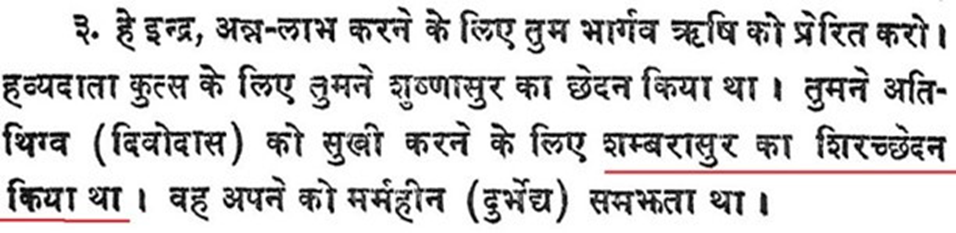
Rig Veda 8.14.13 “With waters’ foam thou torest off, Indra, the head of Namuci, Subduing all contending hosts.” Tr. Ralph Griffith (Source)
Following is the Hindi translation by Pandit Ram Govind Trivedi.

The following verses describe how Kali justifies the beheading of two Asuras as a sacrificial act, personally decapitates them, and drinks their blood, after which the act is praised and rewarded.
Devi Bhagavatam 5.26.62-65 “Vyâsa said:- O King! Hearing thus the words of Ambikâ, Kâlikâ spoke to Her again:- “In this war-sacrifice there is this axe which is like a sacrificial post; I will offer these two as victims to Thy sacrifice. Thus no act of envy will be committed (i.e., killing in a sacrifice is not considered as envy).” Thus saying, the Kâlikâ Devî cut off their heads with great force and gladly drank their blood. Thus seeing the two Asuras killed, Ambikâ said gladly:- Thou hast done the service to the gods; so I will give Thee an excellent boon. O Kâlikâ! As Thou hast killed Chanda and Munda, henceforth Thou wilt be renowned in this world as Châmundâ.” Tr. Swami Vijnananda (Source)
The following passage narrates how Vishnu kills multiple demons by severing their heads with his discus, presenting decapitation as a routine divine act of warfare.
Srimad Bhagavatam 8.10.57 “Thereafter, two very powerful demons named Mālī and Sumālī were killed by the Supreme Lord, who severed their heads with His disc. Then Mālyavān, another demon, attacked the Lord. With his sharp club, the demon, who was roaring like a lion, attacked Garuḍa, the lord of the birds, who are born from eggs. But the Supreme Personality of Godhead, the original person, used His disc to cut off the head of that enemy also.” Tr. Swami Prabhupada (Source)
These verses describe Mahamaya unleashing relentless violence, piercing armour and cutting the bodies of the Danavas into pieces through continuous attacks.
Devi Bhagavatam 5.14.40-56 “…Mahâ Mâyâ then, became very angry and began to hurl arrows after arrows so incessantly that all the armours of all the Dânavas became pierced and were cut down to pieces…” Tr. Swami Vijnananda (Source)
The following verse shows Krishna, acting on Shiva’s command, mutilating Bana by cutting off several of his arms during battle.
Shiva Purana, Rudrasamhita 2, Yuddha Khanda section V, chapter 55, verse 30 “At the bidding of Siva, lord Krsna, the destroyer of heroic enemies, chopped off several arms of Bana by means of Sudarsana.” Tr. J.L. Shastri (Source)
The verses below depict Krishna dismembering enemy warriors by severing their heads, arms, thighs, and legs, and consigning them to Yama’s realm.
Srimad Bhagavatam 10.59.14 “The Lord severed the heads, thighs, arms, legs and armor of these opponents led by Pīṭha and sent them all to the abode of Yamarāja. Narakāsura, the son of the earth, could not contain his fury when he saw the fate of his military leaders. Thus he went out of the citadel with elephants born from the Milk Ocean who were exuding mada from their foreheads out of excitement.” Tr. Swami Prabhupada (Source)
The following verse narrates how the Goddess decapitates Mahisha, stands upon his severed head, and dances over his corpse in triumph.
Skanda Purana I.iii(P).11.27 “Then, the Goddess who tormented Mahisa, cut off his head with a sharp-edged sword and stood on his head and danced.” Tr. G.V. Tagare (Source)
The verses below describe Rama cutting off both arms of Dushana, rendering him helpless before his fall on the battlefield.
Valmiki Ramayana Aranya Kanda 3, Sarga 26, verses 13-15 “Neverthless, as Dushana rushed upon him, Rama cut off both his arms with his arrows, and that mace, loosed from his grasp, fell forward on the field like unto the banner of Indra, Whilst Dushana, bereft of it, his arms severed, sank to the earth like a mighty elephant that, stripped of its tusks, succumbs.” Tr. Hari Prasad Shastri (Source)
The following passage recounts how Vishnu decapitates Madhu and Kaitabha using his discus after exploiting a vulnerable spot on his own body.
Mahabharata Vana Parva 3.202.35 “Markandeya continued, ‘Then Govinda began to reflect but uncovered space found he none and when he could not discover any spot that was uncovered on earth or in the sky, that foremost Deity then beheld his thighs to be absolutely uncovered. And there, O king, the illustrious Deity cut off the heads of Madhu and Kaitabha with his keenedged discus!'” Tr. K.M. Ganguli (Source)
The verse below narrates how Krishna’s Sudarshana discus severs the head of the demon Nikumbha in a single strike.
Harivamsa Purana 2.85.62 “The discuss Sudarshana released from the hand of Narayana (Krishna), sparkling like the sun cut off the head of Nikumbha, decorated with the best earrings.”
These verses describe Pradyumna repeatedly cutting off the heads, bodies, and limbs of demons and scattering the body parts across the battlefield.
Harivamsa Purana 2.93.48-49 “Pradyumna cut off the heads of many demons, which were shining, decorated by diadems. He cut off the heads of some demons, along with hair and ear rings. Pradyumna with high splendor, cut off the heads, bodies, and body-pieces of the demons and scattered them on earth.”
The following verses narrate how the Goddess beheads Nisumbha and then proceeds to cut off his limbs until the demon finally collapses lifeless.
Devi Bhagavatam 5.30.37-64. “Vyâsa said :– O King! Thus saying the Chandikâ Devî instantly cut off the head of Nis’umbha by Her axe with great caution. The head thus severed from the body by the blow of the Devî, the headless Demon began to roam there with great force with club in his hand. The Devas then got very much frightened; The Devî, then, cut off the hands and feet of that headless Demon with sharpened arrows. That vicious wretch fell down lifeless, on the ground like a mountain…” Tr. Swami Vijnananda (Source)
Hindu Gods fighting each other
Beyond the slaughter of innocents, Hindu scriptures frequently depict the deities engaged in violent conflict with one another. These internal battles raise significant questions regarding the moral clarity and emotional maturity of such ‘divine’ beings. If two gods are in conflict, the concept of absolute righteousness becomes impossible, suggesting that these entities lack the basic discernment to resolve disputes through diplomacy or forgiveness. Rather than providing a moral example for humanity, these narratives suggest a primitive reliance on physical force, leaving followers with a blueprint of aggression rather than peace or intellectual resolution.
Shiva Vs Yama
Brahma Purana 35.11 “Obeisance to one who annihilated the god of Death…” Tr. Board of Scholars, edited by J.L. Shastri (Source)
The translator Jagdish Lal Shastri writes in the footnotes, “Annihilated the god of death. Siva gave Mrkandu a boon that a pious son would be born to him but he would live only for sixteen years. The child was born and named Markandeya. He was educated in Vedas and Sastras. When the hour of his death arrived, the boy embraced the linga idol of Siva. When Yama, the god of death came to fetch him, the angry Siva arose out of the idol and killed Yama. At the request of gods Yama was revived to life but Markandeya was granted youth for ever.” (Source)
Brahma Purana: Gautami-Mahatmya 24.9-21 “Brahma said: Then Mrtyu with the noose in his hand entered the place where that brahmin was worshipping Siva. The brahmin was not at all aware of either Yama’s servants or Mrtyu himself…Then Mrtyu thew up the noose against Sveta. O great sages, Nandin then became angry. Nandin hit Mrtyu with the baton given by Siva. Mrtyu fell on the ground. Then the messengers saw that Mrtyu was struck down. They intimated the incident to Yama. Then Dharma whose vehicle is buffalo and who controls all addressed his attendants and associates…’Hurry up, hurry up’, said Yama to them and himself proceeded ahead, surrounded by these and others, to the place where Sveta the excellent brahmin was worshipping Siva…Karttikeya pierced the servants of Yama by means of his javelin. He killed Yama, the powerful ruler of southern quarter.” Tr. Board of Scholars, edited by J.L. Shastri
Shiva’s Virabhadra Vs Gods
Daksha organized a yajna and invited all the gods and sages, but deliberately excluded his son-in-law Shiva and openly insulted him. Distressed by this humiliation, Shiva’s wife urged him to destroy Daksha’s sacrifice. In response, Shiva created the fierce being Virabhadra. Virabhadra stormed the sacrificial arena, demolished the ritual, assaulted the sages, paralyzed and killed several Devas, severed Agni’s tongue, plucked out Bhaga’s eyes, and committed other acts of extreme violence. The episode culminated in the beheading of Daksha.
Kurma Purana I.15.35-42 “Sri Devi said: O Sankara, Daksa who had been my father in the previous birth is performing a Yajna after censuring your status and your own self…Please destroy that sacrifice immediately…Thus implored by the goddess, the great Lord, the Lord of Devas, created Rudra immediately with a desire to destroy the Yajna of Daksa. He was highly infuriated. He had a thousand heads, a thousand eyes and huge arms, a thousand in number. He was invincible. He resembled the fire at the close of the Yugas. He was terrible due to his curved fangs. He could not be seen (directly) due to his glaring brilliance. He held a conch and a discus. He had a staff in his hand. He roared loudly. He held a horn in his hand and was beautified with Bhasma (ashes). He became famous as Virabhadra…Siva spoke to him thus: ‘O Ganesvara (leader of the attendants). Blessings unto you. After censuring me, Daksa is performing a Yajna, at Gangadvara, (near the source of the river Ganga). Destroy that sacrifice of Daksa.’ Then the sacrifice of Daksa was destroyed by Virabhadra playfully like a single lion released from bondage… [59b-67a] The leaders of Ganas became infuriated. They uprooted the sacrificial posts and threw them here and there. The Ganesvaras, all of whom were terrible ones, took the sacrificial horse along with the Prastotr and Hotr (the priests) and hurled them into the currents of Ganga. Even Virabhadra whose mind was ablaze with wrath, paralysed the hand of Indra as he raised it to strike and did the same to other gods. Sportively he plucked out the eyes of Bhaga by the tip of his finger nails. Hitting with his fist he felled down the teeth of Pusan. The mighty leader of Ganas sportively and smilingly kicked Lord Moon with the big toe of his leg. O excellent sages, he cut off the pair of hands of fire and playfully plucked out his tongue. Then he kicked sages on their heads. The mighty one then pierced Visnu, who had been coming thither on his Garuda with sharp arrows after stunning Sudarsana. The powerful Garuda stared at the Gana and suddenly hit him with his wings and roared like the ocean.” Tr. G.V. Tagare (Source)
This episode is also mentioned in Linga Purana, Section I, 82.98–103, and Varaha Purana, chapter 21. After Daksha was beheaded, he was later resurrected by fixing a goat’s head to his body, as described in Devi Bhagavatam 7.30.39–50. According to Linga Purana, Section I, 82.98–103, the violence did not end there, as Saraswati’s lips and nose were also cut off. The version preserved in the Linga Purana is notably more graphic and violent than other retellings of the same narrative.
Linga Purana I.82.98.103 “…He beheaded Yakṣa; he destroyed the tooth of Pūṣan; he removed the hand of the fire-god; he caused the eye of Bhaga to fall down; he pounded the limbs of Soma by the big toe of his foot; he is the bodyguard of Upendra, Indra, Yama and other Devas; he cut off the nose and lips of the great goddess Sarasvatī. May the lord of Gaṇas dispel my sin.” Tr. Board of Scholars, edited by J.L. Shastri (Source)
Linga Purana Section I.100.15-19 “…Virabhadra of great splendour and undistressed soul made the hands of Indra and other Devas stunned as they raised them. He uprooted the eyes of Bhaga sportively with the tip of his finger. With his fist he hit the teeth of Pusan and made them fall. He kicked the moon with the toe of his foot. He cut off the head of lord Indra. After cutting off the hands of Agni and after uprooting his tongue sportively he kicked him on his head with his leg. He cut off the staff of Yama. He hit lord Isana a guardian of the quarters of great strength by means of his trident. Without any difficulty he killed thirty three Devas thus. Sportingly he killed three thousand three hundred and thirty three Devas along with the three leading Devas. He killed the leading sages too. This lord killed those Devas who stood in readiness for fighting. Lord Rudra hit them with his fist, swords, arrows and other things. Then Visnu of great splendour and intensified strength lifted up his discus, and fought with Rudra. A terrible fight ensured between them. It made hairs to stand on end.” Tr. Board of Scholars, edited by J.L. Shastri (Source)
Shiva Purana, Rudra Samhita 2, Satikhanda Section 2, chapter 1, verses 32-34 “They worked a great havoc there. Virabhadra chastised everyone and spared none. After defeating Visnu and the Devas with strenuous effort, the chief of Ganas cut off the head of Daksa and consigned it to the sacrificial fire. Working great havoc he destroyed the sacrifice. Then he came back to the mountain and bowed to Lord Siva” Tr. J.L. Shastri (Source)
There is another narrative that may refer to a separate incident, but its details closely resemble this episode, making it appear to be a variant or alternate retelling of the same event.
Skanda Purana V.ii.64.19b-25 “The share of Sambhu was not appropriated by Brahma in his sacrifice. Mahadeva is the annihilator of the universe. (But,) O king, he (too) was deluded by his sense-organs and he became angry with Suras (Devas). The Suras are the Vibhutis (empowered parts) of Siva. All the three worlds are solely intended for his sport. Yet, by him the bow was strung well for the sake of a share! The teeth of Pusan were shattered. Divakara (the Sun) was made unconscious. The eyes of Bhaga were plucked and the god of Yajna in the form of an antelope was hit. The Devas turned into Pasus (animals). The sages were denied the Vedas. The Dharmasastras of the sages were taken away by the all powerful Lord…” Tr. G.V. Tagare (Source)
Shiva Vs Ganesha
Shiva Purana Rudrasamhita 2, Kumara Khanda IV, ch 13, verses 15-20 “Once when Parvati was taking her bath, Sadasiva rebuked Nandin and came into the inner apartment. The mother of the universe, seeing the untimely arrival of Siva in the midst of her bath and toilet stood up. The beautiful lady was very shy then…At the time when the incident occurred, Parvati, the great Maya, the great goddess, thought as follows. ‘There must be a servant of my own who will be expert in his duties. He must not stray from my behest even a speck.’ Thinking thus the goddess created a person with all the characteristics, out of the dirt from her body. [30-37] Thus placing her son at the doorway, Parvati began to take bath with her friends, unworried. O excellent sage, at this very moment Siva who is eagerly indulgent and an expert in various divine sports came near the door. Not knowing that he was lord Siva, the consort of Parvati, Ganesa said ‘O sir, without my mother’s permission you shall not go in now. My mother has entered the bath. Where are you going now? Go away’ saying thus, he took up his staff to ward him off. On seeing him Siva said ‘O foolish fellow, whom are you forbidding? O wicked knave, don’t you know me? I am Siva, none else’. Thereupon Ganesa beat Siva with the staff. Siva expert in various sports became infuriated…When lord Siva tried to enter the house, Ganesa became infuriated, O brahmin, and struck him with his staff once again.” Tr. J.L. Shastri (Source)
Shiva Purana Rudra Samhita 2, Kumarakhanda IV, ch 16, verses 7-8 O sage, after fighting for a long time along with the army and seeing him terrific, even Siva was greatly surprised. Thinking withing himself ”He has to be killed only by deception and not otherwise” he stayed in the midst of the army. [11-12] Then Ganesa the heoioc son of Sakti following the course of heroes, at first worshipped (i.e., struck) Visnu with his staff, Visnu who confers happiness to all. ”I shall cause him delusion. Then let him be killed by you, O lord. Without deception he cannot be killed. He is of Tamasika nature and inaccessible.” [29-35] After remembering the lotus like feet of Siva, Visnu took up his discus and split the iron club by means of discus. Ganesa hurled the piece of iron club at Visnu which was caught by the bird Garuda and rendered futile. Thus for a long time the two heroes Visnu and Ganesa fought with each other. Again the foremost among heroes, the son of Parvati took up his staff of unrivalled power remembering Siva and struck Visnu with it. Struck with that unbearable blow he fell on the ground. But he got up, quickly and fought with Parvati’s son. Securing this opportunity, the Trident-bearing deity came there and cut off his head with his trident. O Narada, when the head of Ganesa was cut off, the armies of the gods and the Ganas stood still.” Tr. Board of Scholars, edited by J.L. Shastri (Source)
What kind of gods are these? One, Ganesha, does not recognise his own father. Another, Shiva, who is revered as the great destroyer, is unable to defeat a child and instead, with the help of Vishnu, resorts to deception and beheads him. Such narratives raise serious questions about the moral authority, wisdom, and conduct attributed to these deities.
Shiva Vs Brahma
Varaha Purana 97.1-7 “Varaha said: O Earth, now listen to the origin of Rudra Vrata, by knowing which one gets freed from all sins. The red-eyed and tawny coloured Rudra who was created by Brahma in his third birth, was borne by him in pleasure on his shoulder. When he was thus on the shoulder, the fifth head of Brahma told Rudra the Atharvan mantra by which release is obtained. ‘O Kapalin, Rudra, Babhru, Bhava, Kairata, Suvrata, my valiant and broad-eyed son, do protect this world’. When Rudra was thus addressed by the names which he would be getting in future he was angry at the word ‘Kapala’ used and clipped off that (fifth) head. The head was clipped off by the nail in the left thumb, but it got to the hand.” Tr. Venkitasubramonia Iyer, edited by J.L. Shastri (Source)
All Puranas are unanimous that Shiva beheaded Brahma, though they differ on the reason for this act. According to some versions cited above, Shiva was enraged when Brahma addressed him as Kapala. In contrast, Kurma Purana II.31.1–32 states that Brahma and Shiva were engaged in a dispute over supremacy, and Shiva, perceiving Brahma as arrogant, cut off his head in anger. Several other variants of this episode also exist. Shiva’s beheading of Brahma is further mentioned in Skanda Purana V.iii.173.1–5, Brahma Purana (Gautami Mahatmya) 43.19–23, and Shiva Purana, Vayaviya Samhita 6, Section I, 30.19.
There is another account in the Shiva Purana which presents a different motive altogether. In this version, Shiva is said to have intended to kill Brahma because Brahma looked upon his own wife with lust and even discharged semen.
Shiva Purana, Rudrasamhita 2, Satikhanda 2, ch 19, verses 43-45 “Lord Siva said:- O patriarch Daksa what has just been requested by Visnu my great devotee and agreed to by me shall be done here. ‘O lord, whoever stares at Sati lustfully shall be killed by you.’ I Shall make these words of Visnu true by killing Brahma. Why did Brahma stare at Sati lustfully? Moreover he has committed a sin by discharging his semen. Hence I shall kill him.” Tr. J.L. Shastri (Source)
Brahma then begs for mercy, and Vishnu intervenes as a mediator, pacifying Shiva and urging him not to kill Brahma, to which Shiva ultimately agrees. Another version of this episode is found in the Vamana Purana.
Vamana Purana 2.35-37 “Discerning forthwith the faces resembling the Sun, the face of Brahman remarked thus, ‘Bubbles are formed when water is disturbed, Is there any valour in them’? The great Sankara who was enraged to hear this severed with the tip of his nail the head of Brahman which had spoken to him rudely. Thus chopped, the head fell on the left paml of Sankara himself and never dropped down from his hand.” Tr. Anand Swarup Gupta (Source)
Shiva Vs Aurva
This episode does not involve a direct confrontation between gods. Shiva is said to have burned the hermitage of the sage Aurva, an act that provoked Aurva to curse Shiva in response.
Varaha Purana 147.9-14 “Then in that famous tirtha known as Goniskramana, lord Siva came near him. Aurva was then going to the river Ganga to gather lotus flowers. Knowing him thus out of the hermitage, Siva entered it. It was auspicios, beautiful and full of fruits and flowers. But it was soon reduced to ashes by the heat of the halo of Siva. After burning that hermitage, Siva quickly returned to (his abdode in) the Himalayas. [19-] From that moment Siva, although he is the lord of the world, began to be tormented by great heat, and he told Parvati: ‘Seeing the penance of Aurva, the gods were afraid and they told me: ‘The heat of the penance of this Aurva affects the whole world. But he does not desire anything. How can we remedy thiss?’ When told thus, I caste my eye on his hermitage. In a moment it was burnt down, and we returned. Being sorry and angry at this, Aurva cursed me, and that has resulted in this torment of mine.” Tr. Venkitasubramonia Iyer, edited by J.L. Shastri (Source)
Krishna Vs Shiva
In another narrative, Aniruddha, the grandson of Krishna, falls in love with Usha, the daughter of the Asura king Banasura. Aniruddha secretly follows her to her palace, where he is captured by Banasura’s guards. When Aniruddha fails to return for several months, Sage Narada informs Krishna that he has been imprisoned by Banasura. This leads to a battle between Krishna and Banasura. Banasura was a devoted follower of Shiva, and several of Shiva’s attendants were reportedly harmed during the conflict, prompting Shiva to intervene on Banasura’s behalf. Kartikeya, Shiva’s son, also joins the battle. Despite this support, Banasura and Shiva are overpowered by Krishna. Shiva then requests Krishna to spare Banasura’s life, and Krishna complies by merely severing Banasura’s arms instead of killing him.
Srimad Bhagavatam 10.63.12-14 “Lord Śiva, wielder of the trident, shot various weapons at Lord Kṛṣṇa, wielder of Śārṅga. But Lord Kṛṣṇa was not in the least perplexed: He neutralized all these weapons with appropriate counterweapons. Lord Kṛṣṇa counteracted a brahmāstra with another brahmāstra, a wind weapon with a mountain weapon, a fire weapon with a rain weapon, and Lord Śiva’s personal pāśupatāstra weapon with His own personal weapon, the nārāyaṇāstra. After bewildering Lord Śiva by making him yawn with a yawning weapon, Lord Kṛṣṇa proceeded to strike down Bāṇāsura’s army with His sword, club and arrows.” Tr. Swami Prabhupada (Source)
Srimad Bhagavatam 10.63.22-25 “After Lord Śiva’s followers had been driven away, the Śiva-jvara, who had three heads and three feet, pressed forward to attack Lord Kṛṣṇa. As the Śiva-jvara approached, he seemed to burn everything in the ten directions. Seeing this personified weapon approach, Lord Nārāyaṇa then released His own personified fever weapon, the Viṣṇu-jvara. The Śiva-jvara and Viṣṇu-jvara thus battled each other. The Śiva-jvara, overwhelmed by the strength of the Viṣṇu-jvara, cried out in pain. But finding no refuge, the frightened Śiva-jvara approached Lord Kṛṣṇa, the master of the senses, hoping to attain His shelter. Thus with joined palms he began to praise the Lord. The Śiva-jvara said: I bow down to You of unlimited potencies, the Supreme Lord, the Supersoul of all beings. You possess pure and complete consciousness and are the cause of cosmic creation, maintenance and dissolution. Perfectly peaceful, You are the Absolute Truth to whom the Vedas indirectly refer.” Tr. Swami Prabhupada (Source)
Also mentioned in Brahma Purana chapter 97; Brahma Vaivarta Purana, Krishna Janma Khanda 54.12-23 and Agni Purana chapter 12.
Shiva Vs Krishna (Vishnu)
Another confrontation is described between Shiva and Krishna. In this episode, Shiva supports King Kasiraja and is ultimately defeated by Krishna. However, the Skanda Purana presents a variant in which the conflict is framed as a battle between Shiva and Vishnu, with Krishna’s discus manifesting as Vishnu himself.
The narrative begins with a king named Paundraka, who falsely proclaims himself to be Vasudeva. This claim provokes Krishna, who prepares to confront the imposter. Paundraka is supported by his ally Kasiraja, the king of Kasi. As a devoted worshipper of Shiva, Kasiraja performs austerities to seek Shiva’s assistance in the impending battle against Krishna, and, acting like a mercenary, Shiva consents to aid him.
Skanda Purana II.ii.12.14-18 “…Nila mountain is in the third Yojana (i.e. 3X12 Kms.). This is the holy spot of the Lord of Gauri named Ekamrakavana. Not far off, O king, is the place where, being afraid, he sought refuge. Indradyumna said: Why was the Lord of Gauri (Siva) frightened? With whom did he seek refuge?” Tr. G.V. Tagare (Source)
Skanda Purana II.ii.12.45-57 “O king, many king ruled over that city. Formerly in Dvapara Yuga, there was a king there (commonly) called Kasiraja. By means of severe penance he propitiated Lord Sambhu with this aim in his mind: ‘I will excel in war Acyuta (Krsna), the conquerer of kings, the chief of whom is Jaraasandha.’ The Pinaka-bearing Lord (Siva) who was propitiated, granted him that boon: ‘O suppressor of enemies, you will conquer the Slayer of Kamsa in battle. For your sake I shall fight seated on my Bull, along with (my attendants) Pramathas…That Lord (Krsna) who is the immanent soul (of all), knew the incident of that sort, and sent his Discus for killing Kasiraja. The infuriated Discus that was very fierce in appearance, had the refulgence of a thousand suns. It knew the power of the mind of Visnu. It cut off the head of Kasiraja and burned to ash his army as well as that city. On seeing that extremely violent action Pasupati (Siva) became furious. Surrounded by his Ganas and seated on his Bull, the Pinaka-bearing Lord rushed at it. Then Sambhu looked at the Sudarsana Discus at the outset and discharged his Pasupata missile in front of it, like an ominous calamity. Formerly Sambhu had secured a boon from Visnu who had been pleased by his devotion: ‘On being remembered by you I shall invigorate your missile. But if you go against me, it will become lustreless (and ineffective.’ When this Pasupata missile which was (usually) terrible, became futile and when Varanis was burned, the Bull-bannered Lord became afraid. Then he eulogized the Primordial Purusottama, the cause of all the worlds.” Tr. G.V. Tagare (Source)
Skanda Purana II.ii.12.65-77 “When (the Lord) who burned the Tripuras eulogized thus, Adhoksaja (Visnu) manifested himself after casting off the form of the Discus. His face (indicated that he was) delighted. The glorious Lord held the conch, the discus and the iron club. He was seated on Garuda as if on a lotus seat…Though he was an ocean of mercy, he spoke the husband of Girija (who was) firghteneed, as if he waas angry with him. Sri Bhagavan said: How has such an evil-mindedness beset you at this time? O Sambhu, for the sake of an insect (i.e. an insignificant) king, you have come to fight with me! How many examples of my power have not been known to you, O Durjati (Siva). It is true that your Pasupati missile cannot be vanquished by Suras and Asuras. The Discus is a form of my anger. I t cannot spare even you…Now if you wish to sport about with Gauri here for a long time, if you wish that this city of Varanasi should stay for a long time (do as follows). On the shore of the Southern Sea there is a holy spot well known after my name, viz. Sripurusottama. It is adorned by Nila mountain…O annihilator of Tripuras, stay there fearlessly along with Parvati.” Tr. G.V. Tagare (Source)
Skanda Purana II.ii.12.80-83 “Narada said: On being told thus by Vasudeva the Three-eyed Lord bent down his head. With palms joined in reverence he spoke to the slayer of Madhu: Mahadeva said: O Lord of Devas, O Lord of the universe, O Lord, O dispeller of the agony of those who bow down (to you) carrying out your behest will be the cause of my welfare, O Lord of the worlds. On account of my stupidity, O Lord, I had been arrogant. There, O Lord, your own blessing is the cause of my fickleness. Since you command me, O Lord of Devas, to proceed to Purusottama, I shall carry out your behest reverently and proceed to the auspicious holy place that bestows salvation” Tr. G.V. Tagare (Source)
Krishna beheads Kasiraja with his Sudarshan Chakra as mentioned in Srimad Bhagavatam 10.66.22.
Shiva (in Bull form) Vs Vishnu
There is another episode describing a conflict between Shiva and Vishnu. In this account, Vishnu’s three sons were causing destruction in the world. To stop them, Shiva assumed the form of a bull and killed the three sons. Vishnu, unaware that the bull was actually Shiva, confronted it in battle. Vishnu was defeated in this encounter, and only afterwards did it become known that the bull was Shiva himself.
Shiva Purana, Satarudra Samhita 3, chapter 23, verses 3-12 “Then the bull attacked Visnu’s sons wielding their bows for fighting, deluded by Siva’s Maya and proud of their great strenght and exploit. O excellent sage, the sons of Visnu becamame furious. Those heroes roared loudly and rushed against Siva. Rudra in that form of a bull was furious at those sons of Visnu who rushed at him. He kicked them with his hoofs and tore them with his horns. When their limbs were split by Rudra, they swooned and lost their lives. They were immediately destroyed. When they were killed Visnu the foremost of the strong came out shouting loudly and hastened towards Siva. On Seeing Siva in the form of the bull going along after killing his sons, Visnu hit him with divine arrows and missiles. Then the infuriated Siva, the highly powerful one in the form of a bull stood like a mountain and caught hold of all those milssiles of Visnu…The lord leaped up suddenly and kicked the infuriated Visnu who was deluded and could not realise him. The lord then tore him with his horns. Unable to bear the onslaught, Visnu deluded by Maya was exhausted and utterly shattered.” Tr. J.L. Shastri (Source)
Shiva Purana, Satarudra Samhita 3, chapter 23, verses 13-16 “When his pride fell off, Visnu was dejected, and dispirited. He then realised that Siva was sporting about in the form of a bull. Then on realising that Siva himself had come in the form of a Bull, Visnu spoke in a shrill voice with drooping shoulders and palms joined in reverence. Visnu said: O lord of the gods, O ocean of mercy, O lord Siva, I had been deluded by your Maya and my mind had been confused. O lord, I fought with you, Siva. Taking pity on me, O lord, let this offence be excused.” Tr. J.L. Shastri (Source)
Shiva’s Virabhadra Vs Vishnu’s Narasimha
The story of Vishnu’s Narasimha avatar killing Hiranyakashipu by placing him on his lap and tearing him apart with his claws is widely known. In Vaishnavite Puranas, the narrative concludes with the death of Hiranyakashipu. However, Shaivite Puranas introduce an additional episode that presents a very different theological perspective. According to these texts, Narasimha did not calm down after killing Hiranyakashipu. Instead, he became uncontrollable, unleashing devastation and threatening to annihilate the entire universe.
Alarmed by this cosmic destruction, the gods approached Shiva, revered as “The Destroyer,” and implored him to intervene and restore balance. In response, Shiva first manifested his Virabhadra form to pacify Narasimha. Virabhadra praised Narasimha and urged him to restrain his fury, reminding him that the role of universal destruction belonged solely to Shiva. These attempts failed. Narasimha grew even more enraged and seized Virabhadra.
At this moment, the Virabhadra form vanished, accompanied by ominous changes in the environment, signaling the manifestation of Shiva’s most fearsome form, Sharaba. In Shaivite Puranas, Sharaba confronts Narasimha and ultimately subdues or destroys him, a conclusion found exclusively in Shaivite traditions and clearly intended to assert Shiva’s supremacy over Vishnu. This formidable form of Shiva is described in the following verses.
Shiva Purana, Satarudrasamhita 3, chapter 12, verses 2-11 “Nandisvara said: Thus admonished by Virabhadra, the Man-lion became furious. He roared and began to seize him with force. In the meantime, the splendour of Siva rose up unbearably enveloping the sky all around. It was terrible and cause for imminent fear. Then in a trice the form of Virabhhadra became invisible…Even as all the gods stood watching with the auspicious shouts of victory, Lord Siva became manifest in the form the Annihilator. He had a thousand hands and wore matted hair. His head was adorned with wings and beak. His body was fierce and fully developed. His fangs were very sharp. Adamantine claws were his weapons. His neck was black in colour. He had a huge arms and four legs. He was blazing like fire. His voice was resonant and terrible like the rumbling sound of the clouds that gather at the end of a Yuga. His three eyes were as wide and blazing as the fire of the evil spirit of great fury. His fangs and lips were clearly visible. He was producing a hissing sound of Humkara. Siva of such a form appeared in sight.” Tr. J.L. Shastri (Source)
The following verses describe Virabhadra’s attempt to pacify Narasimha, an effort that instead intensified Narasimha’s rage and destructive fury.
Shiva Purana, Satarudrasamhita 3, chapter 11, verses 25-27 “[Virabhadra says] O lord Narasimha, O soul of the universe, subdue this extremely terrible body yourself in my presence. Nandisvara said; Urged thus with quiet peaceful words of Virabhadra, the arrogant man-lion assumed a more terrible anger…The Man-lion said: Go back the way you have come from. Do not speak offending words. I am now going to annihilate the universe of the mobile and immobile beings.” Tr. J.L. Shastri (Source)
The following verses narrates how Narasimha was ultimately slain and flayed, his skin being taken as a garment.
Shiva Purana, Satarudrasamhita 3, chapter 12, verses 12-36 “At his very vision Visnu lost his strength and exploit. He assumed a lustre of the flickering glow-worm beneath the sun. Fluttering with his wings, and tearing the navel and legs he bound the legs of the Man-lion with his tail and his hands with his own hands. He struck his chest, caught hold of Visnu. It expanded in the sky along with the gods and sages. Like a vulture seizing a serpent he fearlessly caught hold of Visnu, lifted him up and fell him to the ground. At the time of flight he was excessively oppressed being hit with the wings. Then Lord Siva took Visnu and flew him. All the gods followed him eulogising him with the words of obeisance. Brahma and other sages bowed to him with reverence and love. Being led thus Visnu was helpless. His face was pallid and sorrowful. With palms joined in reverence he eulogised Lord Siva with prayers of simple words. After eulogising Mrda with the hundred and eight names of the lord, Nrsimha requested lord Sarabha again. ‘O great lord, whenever my ignorant mind becomes defiled by arrogance, it shall be removed by you alone’ Nandisvara said: Thus saying with love to Siva, the Man-lion turned submissive and bowed to him. Visnu was utterly defeated and came to the end of his life…Lord Virabhadra, the leader of the Ganas, of great strength, peeled off the hide of the Man-lion and went to the mountain taking it with him. From that time Siva began to wear the hide of the Man-lion. His head was the leading bead in his necklace of skulls.” Tr. J.L. Shastri
According to the Linga Purana, only Narasimha’s bones and face remained after his destruction, whereas the Shiva Purana states that Virabhadra, or Sharabha, used Narasimha’s severed head as a bead in his necklace of skulls. The episode of Sharabha killing Narasimha is also attested in several other texts. In the Skanda Purana, Brahma explicitly states,
Skanda Purana I.iii(U).16.17 “If you had not killed Nrhari (Man-lion) by assuming the form of Sarabha (i.e. a fabulous eight footed animal) alone, he would have destroyed the universe like Hiranyakasipu.” Tr. G.V. Tagare (Source)
Indra Vs Shiva
Mahabharata, Drona Parva 7, Section 202, Verses 82-84 “When the triple city began to burn, the goddess Durga went to see the sight, with a child on her lap having only five clumps of hair on its head. Uma then asked the gods who that child was. The malevolent Indra then tried to strike him with the thunder-bolt. Thereupon the all-powerful Lord of all the worlds, possessed of the six excellent qualities the Bhagas, smilingly paralysed the arm of the enraged Indra wielding the thunder bolt.” Tr. Manmatha Nath Dutt (Source)
Maruts Vs Indra
Rig Veda 1.170.2 “The Maruts are thy brothers. Why, O Indra, wouldst thou take our lives? Agree with them in friendly wise, and do not slay us in the fight.” Tr. Ralph Griffith (Source)
Rig Veda 1.171.6 “Do thou, O Indra, guard the conquering Heroes, and rid thee of thy wrath against the Maruts…” Tr. Ralph Griffith (Source)
Krishna Vs Indra
Vishnu Purana 5.30.51-68 “…and Indra accordingly, attended by the army of the celestials, marched to attack Hari, in defence of the Parijata tree. The gods were armed with clubs, swords, maces, and darts; and Indra wielded the thunderbolt. As soon as Govinda saw the king of the gods advancing against him on his elephant, attended by the immortals, he blew his shell so that the sound filled all the regions, and he showered smilingly myriads of arrows upon his assailants…The son of Devaki thew his mace at the club of Yama, and cast it broken upon the ground: he cut in bits the litter of the lord of the sun: he severed Agni into a hundred parts with his arrows, and scattered the Vasus through the realms of space: with his discus he cut off the points of tridents of Rudras, and cast themselves upon the earth: and with the shafts shot from his bow he dispersed the Sadhyas, Visvas, Maruts, and Gandharbas, like fleeces of cotton from the pods of the wings and nails, and bit and bruised and scratched the deities who opposed his lord…When all other weapons had been cut to pieces, Indra stood armed with his thunderbolt, and Krshna with the discus Sudarsana. Beholding them thus prepared to fight, all the people of the three spheres exclaimed, ‘Alas! alas!’ Indra launched his bolt, but in vain, for Hari caught and arrested it…” Tr. H.H. Wilson (Source)
H.H. Wilson summarizes this as,
“Krishńa restores her earrings to Adití, and is praised by her: he visits the gardens of Indra, and at the desire of Satyabhámá carries off the Párijáta tree. Śachí excites Indra to its rescue. Conflict between the gods and Krishńa, who defeats them. Satyabhámá derides them. They praise Krishńa.”
Vishnu Vs Lakshmi
Consider this a celestial warning label for husbands, ridicule your wife or make light of other women, and you may lose more than just an argument, even gods have lost their heads over it. Hindu scriptures narrate that Lakshmi beheaded Vishnu through a curse after he laughed at her without cause. Even the preserver of the universe was not spared the consequences of disrespect toward his wife.
Devi Bhagavatam 1.5.74-86 “Does anything take place in this world without any cause? Now hear why Hari’s head was cut off. Once on a time, seeing the beautiful face of His dear wife Laksmî Devî, Hari laughed in presence of Her. At this Laksmî Devî came to understand that “He has seen surely something ugly in my face and therefore He laughed; otherwise why my Husband would laugh at seeing me. But what reason can there be as to see ugliness in my face after so long a time. And why shall He laugh without seeing something ugly, without any cause. Or it may be, He has made some other beautiful woman as my co-wife“. Thus arguing variously in her mind, Mahâ Laksmî gradually got angry and Tamo guna slowly possessed Her. Then, by turn of Fate, in order that god’s work might be completed, very fierce Tamas Sakti entered into Her body. She got very angry and slowly said:– “Let Thy head fall off”. Thus, owing to feminine nature and the destiny of Bhagvan, Laksmî cursed without any thought of good or bad, causing Her own suffering. By the Tâmasî S’akti possessing Her, she thought that a co-wife would be more painful than Her widowhood and thus She cursed Him. Falsehood, vain boldness, craftiness, stupidity, impatience, over-greediness, impurity, and harshness are the natural qualities of women. Owing to that curse, the head of Vasudeva has fallen into the salt ocean. Now I will fix the head on His body as before…” Tr. Swami Vijnananda (Source)
Vishnu Vs Gods
The scriptures narrate that the gods, either accidentally or deliberately, caused the severing of Vishnu’s head. Vishnu was resting with his head placed at the end of a bow. The gods then created white ants and entered into an agreement with them, promising a reward if they gnawed through the bowstring. When the ants did so, the bow snapped, and the recoiling string severed Vishnu’s head.
Satapatha Brahmana 14.1.1.6-9 “Now he who is this Vishnu is the sacrifice; and he who is this sacrifice is yonder Âditya (the sun). But, indeed, Vishnu was unable to control that (love of) glory of his; and so even now not every one can control that (love of) glory of his. Taking his bow, together with three arrows, he stepped forth. He stood, resting his head on the end of the bow. Not daring to attack him, the gods sat themselves down all around him. Then the ants said–these ants (vamrî), doubtless, were that (kind called) ‘upadîkâ ‘–‘What would ye give to him who should gnaw the bowstring?’–‘We would give him the (constant) enjoyment of food, and he would find water even in the desert: so we would give him every enjoyment of food.’–‘So be it,’ they said. Having gone nigh unto him, they gnawed his bowstring. When it was cut, the ends of the bow, springing asunder, cut off Vishnu’s head.” Tr. Julius Eggeling (Source)
Devi Bhagavatam 1.5.23-36 “Brahmâ said :– We will give you, too, share in this our Yajña (sacrifice); so hear me; do our work and rouse Visnu from His sleep. During the time of performing Homa whatever ghee will fall outside the Homa-Kund (the sacrificial pit) will fall to your share; so be quick and do this. Sûta said:– Thus ordered by Brahmâ, the Vamrî insect soon ate away the fore end of the bow that rested on the ground. Immediately the string gave way and the bow went up; the other end became free and a terrible sound took place. The Devas bcame afraid; the whole universe got agitated; the earth trembled. The sea became swollen; the aquatic animals became startled; violent wind blew; the mountains shook; ominous meteors fell. The quarters assumed a terrific aspect; the Sun went down the horizon. In that time of distress the Devas became anxious what evil might come down. O ascetics! while the Devas were thus cogitating, the head with crown on it of the Devadeva Visnu vanished away ; no body knew where it fell. When the awful darkness disappeared, Brahmâ and Mahâdeva saw the disfigured body of Visnu with its head off. Seeing that headless figure of Visnu they were greatly surprised; they were drowned in the ocean of cares and, overwhelmed with grief, began to weep aloud…” Tr. Swami Vijnananda (Soruce)
INDRA VS ARJUNA
Although Arjuna was not a god, his advisor and also his boyfriend was Krishna, which makes the story relevant here. The conflict was not strictly between Arjuna and Indra, but between Arjuna and Ashwasena. However, Indra intervened when he saw that his friend’s son, Ashwasena, was about to be killed by Arjuna.
Mahabharata Adi Parva 1.229 “But Aswasena, the mighty son of Takshaka, was there. He made great efforts to escape from that fire; but confined by Arjuna’s shafts he succeeded not in finding a way. It was then that his mother, the daughter of a snake, determined to save him by swallowing him first. His mother first swallowed his head and then was swallowing his tail. And desirous of saving her son, the sea-snake rose (up from the earth) while still employed in swallowing her son’s tail. But Arjuna as soon as he beheld her escaping, severed her head from her body by means of a sharp and keen-edged arrow. Indra saw all this, and desiring to save his friend’s son, the wielder of the thunderbolt, by raising a violent wind, deprived Arjuna of consciousness.” Tr. K.M. Ganguli (Source)
Indra Vs Sagara’s Sons
Indra employed cunning tactics against the sons of King Sagara. According to Srimad Bhagavatam 9.8, King Sagara, an ancestor of Ram, had 60,000 sons. Following sage Aurva’s instructions, Sagara performed the Ashvamedha sacrifice, but Indra stole the sacrificial horse and placed it in sage Kapila’s ashram. Indra then caused Sagara’s sons to lose their intelligence and insult the sage. When Kapila opened his eyes during meditation, the sons were instantly burned by the fire emanating from their own bodies.
Indra Vs Vishwarupa
Another version of Indra killing Vishvarupa highlights his ruthlessness. The rishi Vishvarupa, fond of his mother, who was an Asura, secretly gave a portion of sacrificial oblations to her kin. Detecting this treachery, Indra cut off Vishvarupa’s three heads. This account appears in both the Srimad Bhagavatam and Devi Bhagavatam.
Srimad Bhagavatam 6.9.4 “Indra, the king of gods, noticed his contempt and faithlessness to gods and his sham righteousness. Being afraid (lest Asuras should be powerful) he immediately cut down (Visvarupa’s) heads in wrath.” Tr. G.V. Tagare (Source)
Devi Bhagavatam 3.12.25 mentions that Vishvarupa would recite Mantras beneficial to the gods in their presence, but in their absence, he prayed for the welfare of the Daityas.
Indra Vs Muni Dadhyam
Devi Bhagavatam 7.36.28. “O Best of Mountains! It is very difficult to acquire Brahma Jñâna. Hear a story. A Muni named Dadhyam of Atharvana family went to Indra and prayed to him to give Brahma Jñâna. Indra said: “I would give you Brahma-Jñâna, but if you impart it to any other body, I would sever your head.” Dadhyarna agreed to this and Indra gave him the Brahma-Jñâna. After a few days, the two As’vins came to the Muni and prayed for Brahma Vidyâ, The Muni said:– “If I give you the Brahma-Vidyi, Indra, will cut off my head.” Hearing this the two As’vins said:– “We will cut your head and keep it elsewhere and we will attach the head of a horse to your body. Instruct us with the mouth of this horse and when Indra will cut off your this mouth, we will replace your former head.” When they said so, the Muni gave them the Brahma-Vidyâ. Indra cut off his head by his thunderbolt. When the horse-head of the Muni was cut off, the two physicians of the Devas replaced his original head. This is widely known in all the Vedas.” Tr. Swami Vijnananda (Source)
For more information read the article Head transplant in Vedic period.
Vashishtha Vs Vishwamitra
Vishwamitra visited Sage Vashishtha’s hermitage, where Vashishtha kept a magical cow, likely Kamadhenu, that could grant all desires. Fascinated by the cow, Vishwamitra requested it in exchange for many cows, but Vashishtha refused. Enraged, Vishwamitra sought to seize it by force. After Vashishtha killed Vishwamitra’s sons, Vishwamitra undertook severe austerities to please Shiva, also called Vrishadwaja. Pleased, Shiva granted him mastery over archery, including its mantras, techniques, and weapons. Armed with this boon, Vishwamitra then attacked Vashishtha’s hermitage.
Ramayana of Valmiki, Bala Kanda 1, Sarga 55, verses 5-7 “Beholding their entire army exterminated by the power of Shri Vasishtha, King Vishvamitra’s hundred sons bearing mighty arms and with various thought-propelled weapons rushed angrily at the holy Sage Vasishtha. Shri Vasishtha merely uttered the sound “H’m!” and they were all immediately consumed. By the great Sage Vasishtha, the infantry, cavalry and chariots, together with the sons of King Vishvamitra, were instantly burned to ashes.” Tr. Hari Prasad Shastri (Source)
Vishwamitra incited Rakshasas to kill Vashishtha’s sons, and they were slain. Overcome with grief, Vashishtha attempted suicide several times. He jumped from a mountain but landed on a heap of cotton, tried to immolate himself in a forest but remained unharmed, and even tied a weight to his neck to drown in water, yet survived. Learning that his daughter-in-law was pregnant, he abandoned all thoughts of ending his life.
Mahabharata Adi Parva 1.178.41-49 “Beholding Saktri thus slain and devoured, Viswamitra repeatedly urged that Rakshasa (who was within the monarch) against the other sons of Vasishtha. Like a wrathful lion devouring small animals, that Rakshasa soon devoured the other sons of the illustrious Vasishtha that were junior to Saktri in age. But Vasishtha, learning that all his sons had been caused to be slain by Viswamitra, patiently bore his grief like the great mountain that bears the earth. That best of Munis, that foremost of intelligent men, was resolved rather to sacrifice his own life than exterminate (in anger) the race of Kusikas. The illustrious Rishi threw himself down from the summit of Meru, but he descended on the stony ground as though on a heap of cotton. And, O son of Pandu, when the illustrious one found that death did not result from that fall, he kindled a huge fire in the forest and entered it with alacrity. But that fire, though burning brightly, consumed him not. O slayer of foes, that blazing fire seemed to him cool. Then the great Muni under the influence of grief, beholding the sea, tied a stony weight to his neck and threw himself into its waters. But the waves soon cast him ashore. At last when that Brahmana of rigid vows succeeded not in killing himself by any means, he returned, in distress of heart, to his asylum.” Tr. K.M. Ganguli (Source)
Others
Emperor Bharat son of Dushyant.
Srimad Bhagavatam 9.20.30 “During his expedition for the conquest of the world, he defeated the tribes Kiratas, Hunas, Yavanas, Andhras, Kankas, Khasas and Sakas and killed the Mleccha kings who were inimical to Brahmins or Vedas.” Tr. G.V. Tagare, edited by J.L. Shastri
Rig Veda 4.30.8-11 describes Indra killing Usha, and Rig Veda 4.18.12 narrates Indra killing his own father. While these verses are often interpreted allegorically, they remain striking, unsettling, and worthy of close reflection.