Written by Sulaiman Razvi
Women in India have endured long periods of social and religious discrimination. Hindu scriptures portray women as inferior, at times equating them with property or placing them in a status comparable to that of Shudras. Such readings have often been used to justify denying women equal rights and autonomy. For instance, in the observance of Karvachauth, only the wife is expected to fast for her husband’s well being, while no similar obligation is imposed on the husband. Married women are required to wear symbols such as the mangalsutra and apply sindoor to signify their marital status, whereas men are not bound by comparable visible markers.
Superstitious beliefs have also contributed to gender based inequality. A girl born under certain astrological conditions may be labelled as Manglik, and it is believed that her husband may face early death. In some cases, this has led to ritual practices such as marrying the girl to a tree or a dog before her actual marriage. Traditional norms have further required widows to live a life of strict celibacy after the death of their husbands, and in earlier times, some were even expected to commit Sati. In contrast, widowers have historically been free to remarry and, in some contexts, to practice polygamy. Moreover, customary restrictions have often allowed only sons to perform the last rites of their parents, excluding daughters from this significant responsibility.
Overall, Hindu society has often been characterized as male dominated, with women expected to remain submissive while men assume positions of authority and control.
Preference of Son over Daughter
Setting aside the broader issue of equal rights, even the textual tradition reflects a clear preference for male offspring. Verses that explicitly pray for the birth of a daughter are rare in the Vedas, whereas numerous passages and even dedicated hymns express the desire for a son. Hindu texts assert that a son rescues his father from the hell known as Put, and for this reason he is called Putra. In contrast, the term Duhita, used for a daughter, is often interpreted in a negative sense as meaning one who does bad, reinforcing the idea that daughters are less desirable. The following verses, along with the subcategories listed below, demonstrate Hinduism’s marked preference for sons over daughters.
Atharva Veda 6.11.3 “Prajāpati, Anumati, Sinivāli have ordered it. Elsewhere may he effect the birth of maids, but here prepare a boy.” Tr. Ralph Griffith (Source)
The Grihya Sutras reiterate the same preference.
Sankhayana Grihya Surtra 1.19.6 “…Pragapati has created him, Savitar has shaped him. Imparting birth of females to other (women) may he put here a man…” Tr. Hermann Oldenberg (Source)
There are specific hymns and numerous verses in the Vedas that explicitly pray for the birth of a son, such as Atharva Veda 6.11, 3.23, and 7.48, as well as Atharva Veda 14.1.22, 12.3.47, 2.36.3, 14.2.72, and Rig Veda 3.31.1 and 10.85.42-45. In contrast, there are hardly any comparable rituals or clearly defined invocations in the Vedas dedicated to the birth of a daughter. This imbalance indicates a structured ritual preference for male offspring within the Vedic tradition.
In response, apologists often cite Yajur Veda 22.22 to argue that the Vedas also pray for the birth of a daughter. However, the verse merely refers to a woman born being skilled in domestic affairs. Notice that it speaks of a woman, not a daughter. It does not function as a ritual invocation for the birth of a daughter in the same way that the cited passages explicitly seek the birth of a son. Even if this interpretation is accepted for the sake of argument, the numerical imbalance remains evident. A single ambiguous verse cannot outweigh the numerous and direct invocations for the birth of male offspring found throughout the Vedic corpus.
The Krishna Yajur Veda contains references that suggest female infanticide in the Vedic period, including instances where female infants were reportedly abandoned.
Krishna Yajur Veda 6.5.10.3 “…Therefore they deposit a daughter on birth, a son they lift up…” Tr. Arthur Berriedale Keith (Source)
Religious Prescriptions for the Birth of a Son
Following is the reference about Kashyap Rishi recommending Pumsavan,
Srimad Bhagavatam 6.18.54 “Kaśyapa Muni continued: If you perform this ceremony called puṁsavana, adhering to the vow with faith for at least one year, you will give birth to a son destined to kill Indra. But if there is any discrepancy in the discharge of this vow, the son will be a friend to Indra.” Tr. Swami Prabhupada (Source)
Sankha Samhita 2.1 “On the full manifestation of the signs of pregnancy, the rite of Nisheka should be performed (an encicnte); the wise should perform the rite of Pumsavanam (rite for the causation of the birth of a male child) unto her, as soon as she would be quick with the child.” Tr. Manmatha Nath Dutt (Source)
Brahma Purana 113.75-76 “In the case of the people of all castes, a woman in her monthly course should be avoided for the first four nights. To prevent the birth of a female child, one shall avoid the fifth night also. Thereafter he shall carnally approach her on the sixth or other excellent nights even in number. Boys will be born (if intercourse is carried out) on even nights and girls on nights odd in number.” Tr. Board of Scholars, edited by J.L. Shastri (Source)
Garuda Purana I.178.27 “A woman desiring to beget a male child must drink ghee medicated with seeds of Matulunga and roots of Eranda.” Tr. Board of Scholars, edited by J.L. Shastri (Source)
Manu Smriti 3.262-3 “The (sacrificer’s) first wife, who is faithful and intent on the worship of the manes, may eat the middle-most cake, (if she be) desirous of bearing a son. (Thus) she will bring forth a son who will be long-lived, famous, intelligent, rich, the father of numerous offspring, endowed with (the quality of) goodness, and righteous.” Tr. Georg Buhler (Source)
Narada Purana 266-8 “The devotee shall worship at night, a jar filled with the boiling decotion of (the pieces of twigs) of a milk exuding tree and on the next day in the morning he shall repeat the mantra ten thousand times. For twelve days the woman should be bathed with that water. If this is performed, even a barren woman shall beget sons of longevity in life. The woman who is desirous of a son shall silently drink in the morning the water charged with the mantra in a leaf of the holy fig tree. The mantra should be repeated hundred and eight times. The procedure should be continued for a month. Even a barren woman will beget a son with all good makrs.” Tr. G.V. Tagare (Source)
Skanda Purana III.i.15.47-51 “…There is a Tiirtha there, well-known in the worlds as Hanumatkunda. It suppresses all great miseries. It yields the benefit of heavenly pleasures and salvation. It subdues the suffering in hells (Narakas). It liberates (people) from poverty. It bestows sons on those who are sonless and wives on those who have no wives.” Tr. G.V. Tagare (Source)
Atharva Veda 6.81.3 “The Amulet which Aditi wore when desirous of a son, Tvashtar hath bound upon this dame and said, Be mother of a boy.” Tr. Ralph Griffith (Source)
Rig Veda 10.63.15 “Vouchsafe us blessing in our paths and desert tracts, blessing in waters and in battle, for the light; Blessing upon the wombs that bring male children forth…” Tr. Ralph Griffith (Source)
Sankhayana Grihya Sutra 1.19.3-6 When he has finished, let him murmur, ‘Into thy breath I put the sperm, N.N.!’ Or, ‘As the earth is pregnant with Agni, as the heaven is with Indra pregnant, as Vayu dwells in the womb of the regions (of the earth), thus I place an embryo into thy womb, N.N.!’ Or, ‘May a male embryo enter thy womb, as an arrow the quiver; may a man be born here, a son after ten months. ‘Give birth to a male child; may after him (another) male be born; their mother shalt thou be, of the born, and (to others) mayst thou give birth… (Source)
If the birth of a single male child was considered sufficient, why was there a continued insistence on begetting more sons? Even Dayanand Saraswati, the founder of Arya Samaj, recommended the practice of Niyoga for procuring a son when a couple had only a daughter. This raises a serious question about the extent of discrimination embedded within the tradition regarding the birth of daughters.
Various other texts, including Sankhayana Grihya Sutra 1.16.11, Narada Purana II.56.320 to 325, and Brihadaranyaka Upanishad 6.4.20, contain prayers and ritual instructions explicitly intended to secure the birth of a male child.
Supersession of Wives Who Bear Only Daughters
The Garuda Purana goes a step further by stating that a wife who gives birth only to daughters should be abandoned.
Garuda Purana 1.115.64 “A barren woman shall be abandoned in the eighth year after marriage; a woman whose children die in infancy shall be abandoned in the ninth year; a woman who gives birth only to daughters shall be abandoned in the eleventh year and a woman who speaks unpleasant words shall be abandoned immediately.” Tr. Board of Scholars, edited by Jagdish Lal Shastri (Source)
The Dharma Shastras state that a wife who drinks liquor, is barren, hates her husband’s relatives, or bears only female children may be superseded. Here, supersession refers to taking another wife in a polygamous arrangement.
Yajnavalkya Smriti verse 73 “The liquor drinker, the diseased, the cunning, the barren, the killer of wealth, the unpleasant spoken, who bears female children should be superseded, so also (one) who hates people.” Tr. Srisa Chandra Vasu (Source)
Vijnanesvara comments on the above verse as follows:
“…’The bearer of female children’ who gives birth to female children (only)…The phrase ‘should be superseded’ applies to every one of the above. ‘Adhivedana or supersession’ means taking another wife.” Vijnanesvara in Mitakshara on Yajnavalkya Smriti verse 73, Tr. Srisa Chandra Vasu (Source)
Manu Smriti 9.81 “A barren wife may be superseded in the eighth year, she whose children (all) die in the tenth, she who bears only daughters in the eleventh, but she who is quarrelsome without delay.” Tr. Georg Buhler (Source)
Medhatitih comments on the above verse as follows:
“The text proceeds to lay down the supersession of other kinds of wives. Among these, the barren one should be superseded in the eighth year; in the tenth, she whose children die off. By marrying a second wife the man shall save himself from the contingency of disobeying the injunction regarding the Laying of Fire (to which a childless person is not entitled), and that regarding the begetting of children,—to which he would be liable by reason of his wife being childless. Because, the Laying of Fire is not found to be prescribed for a sonless person. The same holds good regarding the wife that bears only daughters; as also she whose children” Medhatithi on Manu Smriti 9.81, Tr. Ganganath Jha (Source)
The following verse instructs the husband not to show affection toward a wife who bears only female children.
Narada Smriti 12.94 “Let not a husband show love to a barren woman, or to one who gives birth to female children only, or whose conduct is blamable, or who constantly contradicts him; if he does (have conjugal intercourse with her), he becomes liable to censure (himself).” Tr. Julius Jolly (Source)
Condemnation of Sonless Women in Sacred Texts
It is mentioned in the Shatapatha Brahmana that a wife who has no son is regarded as discarded and associated with misfortune and destruction.
Satapatha Brahmana 5.3.1.13 “And on the following day he goes to the house of a discarded (wife), and prepares a pap for Nirriti;–a discarded wife is one who has no son…hail!’ For a wife that is without a son, is possessed with Nirriti (destruction, calamity)…” Tr. Julius Eggeling (Source)
Brahma Vaivarta Purana Ganesha Khanda 2.16-31 “…The life of a woman who has no son, is useless…” Tr. Rajendra Nath Sen
Himavat and Mena, the parents of Parvati, said,
Skanda Purana I.i.20.60-63 “…For the accomplishment of the task of Devas a good daughter has to be begotten. It is for the benefits of Devas, sages and ascetics. (Of course) the birth of a daughter may not be pleasing to women. Still, O lady of splendid face, a daughter has to be procreated. Mena laughed and spoke to her husband Himalaya: ‘What has been spoken by you (is true). Let my words be heard by you now. O my lord, a daughter is the cause of misery unto men. So also, O highly intelligent one, she causes sorrow unto women. Hence ponder over this for a long time yourself with your keen intellect. Let what is conducive to our welfare to our welfare be told, o lord of Mountains.” Tr. G.V. Tagare (Source)
A Sonless Man Will Not Attain Heaven
Devi Bhagavatam 2.6.36-48 “…Once while he was listening to the religious discourses of the Munis, he heard unmistakeably the Munis telling that the man who is sonless can never go to the Heavens; so he must get a son somehow or other…” Tr. Swami Vijnananda (Source)
Devi Bhagavatam 1.4.15-27 There is no prospect in the after birth of the sonless; never, never will Heaven be his. Without son, there is none other who can be of help in the next world. Thus in the Dharma S’âstras, Manu and other Munis declare that the man who has sons goes to Heaven and the sonless one can never go to Heaven. The man possessing a son is entitled to the Heavenly pleasures can be vividly seen, rather than imagined. The man with son is freed from sins; this is the word of the Vedas…” Tr. Swami Vijnananda (Source)
Skanda Purana V.iii.103.121-140 “…A son saves the father from the Naraka called Put. So he is called Putra by the Self-born Lord himself. The house of a man without a son is a void…King Raghava (i.e. Dasaratha) convened an assembly of sages for the sake of (obtaining) a son since the seat of Indra occupied by him was purified by sprinkling water. Residence in Svarga is not (possible) without a son, O son of Pandu. Hence Dasaratha performed an excellent Yajna for the sake of sons. Rama, laksmana, Satrughna and Bharata were born to him…” Tr. G.V. Tagare (Source)
Female Feticide
When highest authoritative text like Vedas doesn’t wish for daughter, we can conclude why female foeticide was prevalent in ancient India and still many Hindus prefer son over daughter. When asked, Hindus reply that they prefer son because it’s only the son that can perform certain rites like funeral rite of parents, the son looks after the parents in their old age etc. As a result of these verses female infanticide is still in practice. India looses millions of unborn female baby every year,
– Selective abortion in India could lead to 6.8m fewer girls being born by 2030.
By analysing birth rates and the gender of last-born children, the report also estimated that more than 21 million Indian girls are not wanted by their families. (TheGuardian)
– UK report says Indian-origin parents maybe aborting female foetuses.
UK government analysis reveals a significant imbalance in birth sex ratios among Indian-origin families, with 113 males per 100 females for third or subsequent births. This aomaly suggests potential sex-selective abortions… (TimesofIndia)
– Over Two Lakh Young Girls Die Every Year in India Because of Their Gender. (TheWire)
– 10 million foetuses aborted in India. (TheGuardian)
– India loses 3 million girls in infanticide. (Source)
– Female foeticide: Death before birth. (Source)
– India is the most dangerous place in the world to be born a girl, with females almost twice as likely to die before reaching the age of five, according to new UN figures. (Source)
Purpose of Creating Women
Brahma Vaivarata Purana, Krishna Janma Khanda 61.22-41 “…There can be no creation without a woman. This is why at the command of Lord Krisna, Brahma created the woman to entice the heart of lustful people. The beauty of a woman is the seat of illusion, the bar or bolt (or obstacle) in the way of a man’s act or Karma, the impediment of meditation and the harbour of evil…” Tr. Rajendra Nath Sen (Source)
Srimad Bhagavatam 3.31.40 “The woman, created by the Lord, is the representation of maya, and one who associates with such maya by accepting services must certainly know that this is the way of death, just like a blind well covered with grass.” Tr. Swami Prabhupada (Source)
Maya is commonly understood to mean illusion, deceit, or fraud. Manu writes that after creating women, God assigned to them traits such as dishonesty, malice, and immoral conduct.
Manu Smriti 9.17 “(When creating them) Manu allotted to women (a love of their) bed, (of their) seat and (of) ornament, impure desires, wrath, dishonesty, malice, and bad conduct.” Tr. Georg Buhler (Source)
Mahabharata 13.40 “The Sruti declares that women are endued with senses the most powerful, that they have no scriptures to follow, and that they are living lies. Beds and seats and ornaments and food and drink and the absence of all that is respectable and righteous, indulgence in disagreeable words, and love of sexual companionship,–these were bestowed by Brahman upon women.” Tr. K.M. Ganguli (Source)
According to the Mahabharata, women were created as a means to lead men away from righteousness.
Mahabharata 13.40 “Bhishma said, ‘It is even so as thou sayest, O thou of mighty arms. There is nothing untrue in all this that thou sayest, O thou of Kuru’s race, on the subject of women. In this connection I shall recite to thee the old history of how in days of yore the high-souled Vipula had succeeded in restraining women within the bounds laid down for them. I shall also tell thee, O king, how women were created by the Grandsire Brahman and the object for which they were created by Him. There is no creature more sinful, O son, than women. Woman is a blazing fire. She is the illusion, O king, that the Daitya Maya created. She is the sharp edge of the razor. She is poison. She is a snake. She is fire. She is, verily, all these united together. It has been heard by us that all persons of the human race are characterised by righteousness, and that they, in course of natural progress and improvement, attain to the status of deities. This circumstance alarmed the deities. They, therefore, O chastiser of foes, assembled together and repaired to the presence of the Grandsire. Informing Him of what was in their minds, they stood silent in his presence, with downcast eyes. The puissant Grand sire having ascertained what was in the hearts of the deities, created women, with the aid of an Atharvan rite. In a former creation, O son of Kunti, women were all virtuous. Those, however, that sprang from this creation by Brahman with the aid of an illusion became sinful. The grandsire bestowed upon them the desire of enjoyment, all kinds of carnal pleasure. Tempted by the desire of enjoyment, they began to pursue persons of the other sex. The puissant lord of the deities created Wrath as the companion of Lust. Persons of the male sex, yielding to the power of Lust and Wrath, sought the companionship of women. Women have no especial acts prescribed for them. Even this is the ordinance that was laid down. The Sruti declares that women are endued with senses the most powerful, that they have no scriptures to follow, and that they are living lies.” Tr. K.M. Ganguli (Source)
Woman is a Child Production Machine
Mahabharata 5.39 “The fruits of the Vedas are ceremonies performed before the (homa) fire; the fruits of an acquaintance with the scriptures are goodness of disposition and conduct. The fruits of women are the pleasures of intercourse and offspring.” Tr. K.M. Ganguli (Source)
Narada Smriti 12.19 Women have been created for the sake of propagation, the wife being the field, and the husband the giver of the seed. The field must be given to him who has seed. He who has no seed in unworthy to possess the field.” Tr. Julius Jolly (Source)
Manu Smriti 9.96 “Women were created for the purpose of child-bearing, and men for the purpose of procreation. hence it is that Religious Rites have been ordained in the Veda as common between the man and his wife.” Tr. Ganganath Jha (Source)
Skanda Purana V.iii.103.9-16 “[Atri said]…It is cited by expounders of the Vedas that a woman is one who gives sexual pleasure and a son…” Tr. G.V. Tagare (Source)
Brihadaranyaka Upanishad 6.4.2 “Prajapati thought, ‘Well, let me make an abode for it,’ and he created woman. Prajapati, the Creator, thought, ‘Since the seed is thus the quintessence of all beings; what can be a fit abode for it’? Thinking thus he created woman.” Tr. Max Muller (Source)
Women are of Sinful Birth
Gita 9.32 “For those who take refuge in Me. O Partha, though they be of sinful birth- women, Vaisyas, and Sudras even they attain the Supreme Goal.” Tr. Swami Nikhilananda (Source)
Mahabharata 14.19.61 “By adhering to this religion, even they who axe of sinful birth, such as women and Vaisyas and Sudras, attain to the highest goal.” Tr. K.M. Ganguli (Source)
Mahabharata 13.40 “There is no creature more sinful, O son, than women. Woman is a blazing fire. She is the illusion, O king, that the Daitya Maya created. She is the sharp edge of the razor. She is poison. She is a snake. She is fire. She is, verily, all these united together.” Tr. K.M. Ganguli (Source)
Srimad Bhagavatam 2.7.46 “Surrendered souls, even from groups leading sinful lives, such as women, the laborer class, the mountaineers and the Siberians, or even the birds and beasts, can also know about the science of Godhead and become liberated from the clutches of the illusory energy by surrendering unto the pure devotees of the Lord and by following in their footsteps in devotional service.” Tr. Swami Prabhupada (Source)
Srimad Bhagavatam 7.7.54 “O my friends, O sons of demons, everyone, including you (the Yakṣas and Rākṣasas), the unintelligent women, śūdras and cowherd men, the birds, the lower animals and the sinful living entities, can revive his original, eternal spiritual life and exist forever simply by accepting the principles of bhakti-yoga.” Tr. Swami Prabhupada (Source)
Shiva Purana, Uma Samhita 5.24.16 “There is none more sinning and more sinful than women. Women are at the root of all sins…” Tr. J.L. Shastri (Source)
Shiva Purana, Uma Samhita 5.24.3 “O sage, women are light-minded. They are at the root of all troubles. Attachment towards them should not be pursued by wakeful persons who desire liberation.” Tr. J.L. Shastri (Source)
Reprehensible Remarks on Women
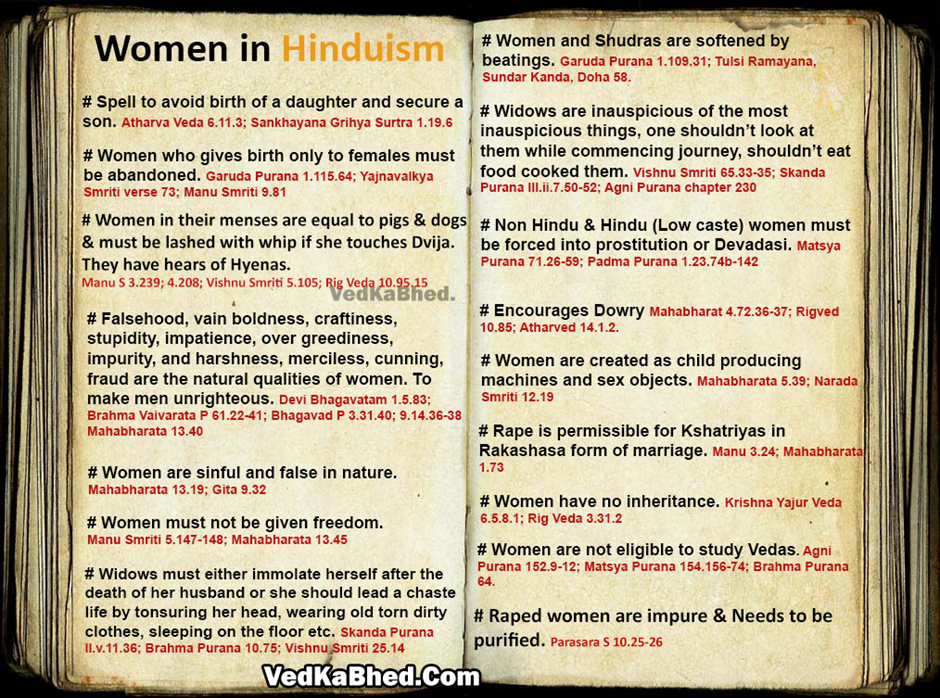
Rig Veda 10.95.15 “Nay, do not die, Pururavas, nor vanish: let not the hideous wolves devour thee. Female friendships do not exist. With women there can be no lasting friendship: hearts of hyenas are the hearts of women.” Tr. Ralph Griffith (Source)
Srimad Bhagavatam 9.14.36-38 “Urvasi said: My dear King, you are a man, a hero. Don’t be impatient and give up your life. Be sober and don’t allow the senses to overcome you like foxes. Don’t let the foxes eat you. In other words, you should not be controlled by your senses. Rather, you should know that the heart of a woman is like that of a fox. There is no use making friendship with women. Women as a class are merciless and cunning. They cannot tolerate even a slight offense. For their own pleasure they can do anything irreligious, and therefore they do not fear killing even a faithful husband or brother. Women are very easily seduced by men. Therefore, polluted women give up the friendship of a man who is their well-wisher and establish false friendship among fools. Indeed, they seek newer and newer friends, one after another.” Tr. Swami Prabhupada (Source)
Garuda Purana 1.109.33-34 “The diet of a woman is twice as much as that of a man; shrewdness four times, energy is six times and amorousness is eight times as much as that of a man. It is impossible to overcome sleep by sleeping it off; to overpower a woman by loving her; to smother a flame by adding fuel and to quench thirst by drinking wine.” Tr. Board of Scholars, edited by J.L. Shastri (Source)
Chanakya Neeti Shastra 1.17 “Women have hunger two fold, shyness four fold, daring six fold, and lust eight fold as compared to men.”
Brahma Vaivarta Purana, Brahma Khanda 23.14-39 “…The heart of women is keen like the edge of a razor…Immodesty and daring characterise their conduct, and their deeds are tainted with defect and hypocrisy. O Lord of the universe the lust of a woman is eight times as great; hunger twice as great and cruelty, four times as great as the lust, hunger and cruelty of a man…” Tr. Rajendra Nath Sen (Source)
Manu 7.150 “(Such) despicable (persons), likewise animals, and particularly women betray secret council; for that reason he must be careful with respect to them.” Tr. Georg Buhler (Source)
Satapatha Brahmana 3:2:4:6 “…Wherefore even to this day women are given to vain things: for it was on this wise that Vâk turned thereto, and other women do as she did. And hence it is to him who dances and sings that they most readily take a fancy.” Tr. Julius Eggeling (Source)
Chanakya Neeti Shastra 12.18 “Courtesy should be learned from princes, the art of conversation from pandits, lying should be learned from gamblers and deceitful ways should be learned from women.”
Chanakya Niti Shastra 2.1 Untruthfulness, rashness, guile, stupidity, avarice, uncleanliness and cruelty are women’s seven natural flaws.
Nature of Women
Manu Smriti 2.213-214 “It is the nature of women to seduce men in this (world); for that reason the wise are never unguarded in (the company of) females. For women are able to lead astray in (this) world not only a fool, but even a learned man, and (to make) him a slave of desire and anger.” Tr. Georg Buhler (Source)
Mahabharata 13.19 “Women, in particular, the Rishis have said, are false in behaviour. When human beings are such, and when women in particular have been declared in the ordinances to be false, how, O sire, can there be a union between the sexes for purposes of practising all duties together? In the very Vedas one may read that women are false.” Tr. K.M. Ganguli (Source)
Lakshmana addresses Sita in the following way,
Valmiki Ramayana, Aranya Kanda, Sarga 45.29-30 “Thou art a very Goddess unto me, I therefore dare not answer thee. What thou hast spoken, O Maithili, is nothing surprising for females. Such is the nature of womankind on this earth. Women by nature are crooked, fickle, devoid of religious knowledge, and bring about difference between father and sons.” Tr. M.N. Dutt (Source)
Devi Bhagavatam 1.15.1-67 “…The fools do not understand how the women suck the blood out of persons like leeches, for they get themselves deluded by their gestures and postures! The lady of the house, whom the people call kântâ, the beautiful one, steal away the semen virile, the strength and energy in the way of giving them happiness as sexual intercourse, and their minds and wealth and everything by their crooked love conversations; so see what greater thief can there be than a woman? In my opinion, those that are ignorant are certainly deluded by the Creator; they accept wife to destroy their own pleasure of happiness. They can never understand that the women can never be the source of pleasure; they are the source of all miseries…” Tr. Swami Vijnananda (Source)
Garuda Purana 1.109.14 “Implicit trust in rivers, clawed beasts, horned animals, armed men, women and scions of royal families is never to be encouraged.” Tr. Board of Scholars, Edited by J.L. Shastri (Source)
Varaha Purana 177.17-22 “Looking at Narada, Krsna bent down his face in shame. He then told Narada in detail about the nature of women and their conduct leading to sin. ‘They have no consideration of time, of secrecy of what they do. Still they pass to be virtous. Women irrespective of their age, whether they be girls, teenagers, middle-aged or advanced in age, get their passion excited at the sight of a handsome man. O great sage, this is natural to them.” Tr. Venkitasubramonia Iyer, J.L. Shastri (Source)
Devi Bhagavatam 1.5.83 “Falsehood, vain boldness, craftiness, stupidity, impatience, over-greediness, impurity, and harshness are the natural qualities of women.” Tr. Swami Vijnananda (Source)
How to determine the nature of a woman
If one is wondering how to identify whether a woman is a prostitute, an adulteress, or even the murderer of her husband, the Garuda Purana claims to provide a list of physical and behavioural traits that supposedly reveal her nature.
Garuda Purana 1.65.112 “If the palm is placed on the ground and the little finger and the ring finger do not touch the ground, she is surely a whore.” Tr. Board of Scholars edited by J.L. Shastri (Source)
Garuda Purana 1.65.115 “stout neck: she becomes very fierce. Squint in the eyes, dark blue or tawny in the eyes, roving eyes: absence of chastity.” Tr. Board of Scholars edited by J.L. Shastri (Source)
Garuda Purana 1.65.116 “If when she smiles two dimples are seen in the cheeks, she is surely one adulteress.” Tr. Board of Scholars edited by J.L. Shastri (Source)
Garuda Purana 1.65.117 “…if the buttocks hang down, she kills her husband. A mustache-like growth of hair above the upper lip is inauspicious for the husband.” Tr. Board of Scholars edited by J.L. Shastri (Source)
Garuda Purana 1.65.118 “Hairy breasts are inauspicious and uneven ears too are inauspicious.” Tr. Board of Scholars edited by J.L. Shastri (Source)
Women are Sex-Maniacs
Skanda Purana VII.I.101.28 “On seeing an excellent man, the excellent organ of generation of women becomes moistened and dump even if they are observing celibacy or are Yoginis.” Tr. G.V. Tagare (Source)
Skanda Purana V.iii.121.7-9 “Ordinarily sexual appetite is very strong in women. Especially during menses, they are afflicted all the more by the arrows of Kama. Shunned or neglected by their husbands, women naturally think about paramours.” Tr. G.V. Tagare (Source)
Mahabharata 13.19 “Verily, women are exceedingly fond of sexual congress. Among a thousand women, or, perhaps, among hundreds of thousands, sometimes only one may be found that is devoted to her husband. When under the influence of desire, they care not for family or father or mother or brother or husband or sons or husband’s brother (but pursue the way that desire points out). Verily, in pursuit of what they consider happiness, they destroy the family (to which they belong by birth or marriage) even as many queenly rivers eat away the banks that contain them. The Creator himself had said this, quickly marking the faults of women.” Tr. K.M. Ganguli (Source)
Chanakya Neeti Shastra 16.2 “The heart of a woman is not united; it is divided. While she is taking with one man, she looks lustfully at another and thinks fondly of a third in her heart.” (Source)
Padma Purana II.53.11b-20 “…O lord of gods, the vulva, and also the tips of the breasts of women, throb. They do not have patience…” Tr. N.A. Deshpande (Source)
Shiva Purana, UmaSamhita 5.24.16-36 “There is none more sinning and more sinful than women. Women are at the root of all sins…Women usually do not observe the limitations of conventional decency. If at all they stand by them with their husbands it is because no man makes advances to them or because they are afraid of their husbands…They carry on their dalliances with any man ugly or beautiful…Even women of noble families aspire for the life of lascivious women who in their prime of youth adorned with lovable ornaments and beautiful wearing garments move about frivolously…Women become desperate when they do not get men…women are not satiated with the number of men they cohabit with. O excellent sage, there is another secret of all women that immediately on seeing a man their vaginal passage begins to exude slimy secretions. On seeing a man fresh and clean from his bath with his body perfumed with sweet scents, the vaginal passage of women begins to exude like water dripping from a leather bag…on hearing her words Narada was satisfied in his mind. Considering it to be the truth. Tr. J.L. Shastri (Source)
Garuda Purana 1.109.35-40 “A delicious fatty meat diet, pleasing dress, glowing wine, fragrant scented pastes, and sweet smelling flowers kindle passion in women. It can be said with certainty that even during the period of celibacy the god of love is busily active. On seeing a man pleasing to her heart the vagina of a woman becomes wet with profuse secretion. O Saunaka, it is true, definitely true that the vaginal passage of a woman begins to secrete profusely on seeing a well dressed man whether a brother or a son. Rivers and women are of similar nature in their love of freedom to choose their own course. The rivers erode the banks and the women undermine their own families. The river undermines the banks and the woman causes the fall of the family. The course of rivers and women is wayward and cannot be checked. A blazing fire cannot be satiated with sufficient supply of fuel; the ocean can never be filled to satiety by rivers flowing into it; the god of death is never satiated by the living beings (whom he smites) and a passionate woman is never satiated with man.” Tr. Board of Scholars, edited by J.L. Shastri (Source)
No Remarriage for Women
Does Hinduism allow widow remarriage? To put it simply, the answer is no. However, it would be improper to reach such a conclusion without examining the sources. Although the Indian Constitution permits widow remarriage, explicit support for it is largely absent in many traditional Hindu scriptures. The status of widows in India has historically been miserable. A woman’s head was often shaved after the death of her husband, and she was forced to live a life of social degradation.
Even these harsh conditions were considered preferable to the extreme practice known as Sati Pratha, in which a widow was expected to immolate herself on her husband’s funeral pyre. This inhumane practice stands as a dark chapter in history. It was eventually banned some Muslim rulers, later prohibited by the British administration, and remains illegal under the present Government of India. The degrading condition of widows in ancient India is also mentioned in the Baudhayana Shastra. There is no formal concept of divorce in traditional Hindu law, yet certain texts do mention the abandonment of a wife. However, whether in the event of her husband’s death or if she seeks separation, she is generally not permitted to remarry under these circumstances.
Baudhyana Dharma Shastra 2.2.4.7-9 “A widow shall avoid during a year (the use of) honey, meat spirituous liquor, and salt, and sleep on the ground. Maudgalya (declares that she shall do so) during six months.” Tr. Georg Buhler (Source)
Let us examine what Hindu scriptures have to say about widow remarriage. Rishi Dirghatama said,
Mahabharata 1.104.31-32 “Dirghatamas [Rishi] said, ‘I lay down from this day as a rule that every woman shall have to adhere to one husband for her life. Be the husband dead or alive, it shall not be lawful for a woman to have connection with another. And she who may have such connection shall certainly be regarded as fallen. A woman without husband shall always be liable to be sinful.” Tr. K.M. Gangui (Source)
Garuda Purana ch 95 “A girl should be given only once in marriage…”Tr. M.N. Dutt (Source)
The following verses explicitly prohibit the remarriage of widows.
Vamana Purana 12.35 “Those who remarry widows and those that defiles unmarried girls, and the ancestors of the offsprings of such unions are made to eat worms and ants.” Tr. Anand Swarup Gupta (Source)
Manu Smriti 9.47 “Once is the partition (of the inheritance) made, (once is) a maiden given in marriage, (and) once does (a man) say,’ I will give;’ each of those three (acts is done) once only.” Tr. Georg Buhler (Source)
Chanakya Neeti Shastra 4.11 “King speak for once, men of learning once, and the daughter is given in marriage once. All these things happen once and only once.”
Brahan Naradiya Purana “The gift in remarriage to another of a girl once given away in marriage is prohibited in the Kaliyuga”
Yajnavalkya Smriti chapter 3, verse 52 “Without breaking (the rules) of studentship, let him marry a woman with auspicious characteristics who has not belonged to another man, who is lovely, who is not a Sapinda and who is younger (than himself).” Tr. Srisa Chandra Vasu (Source)
Vijnanesvara comments on the above verse as follows:
“…Ananyapurvika (Not Anyapurvika), one who has not been accepted by any other man either by way of gift, or enjoyment.” Tr. Srisa Chanda Vasu (Source)
Balambhatta comments on the above verse as follows:
“One should not marry a woman who has already been enjoyed by another person. Or, says Baudhayana that seven kinds of women are called Punarbhus:- ‘1. A bride already promised to another; 2. a bride who has already elected another mentally, 3. who has gone round the fire ceremony, 4. who has performed the seven steps ceremony, 5. who has enjoyed by another, 6. who is pregnant, and 7. who has given birth to a child before marriage. By marrying these seven kinds of girls, the debt one owes to his ancestors is not discharged, nor is the offspring legal.’ The first two sorts of bride may be re-married, if there is some defect in the bridegroom.” Tr. Srisa Chandra Vasu (Source)
Some apologists cite Yajnavalkya 1.67, which uses the term Punarbhu for a remarried woman, as evidence in support of widow remarriage. However, Vishnu Smriti 15.8 defines a Punarbha as a virgin who is married for the second time. According to certain Hindu texts, the remarriage that is permitted applies specifically to a virgin widow rather than to widows in general.
Manu Smriti 9.65 “In the sacred texts which refer to marriage the appointment (of widows) is nowhere mentioned, nor is the re-marriage of widows prescribed in the rules concerning marriage.” Tr. Georg Buhler (Source)
Manu Smriti 5.157 “At her pleasure let her emaciate her body by (living on) pure flowers, roots, and fruit; but she must never even mention the name of another man after her husband has died.” Tr. Georg Buhler (Source)
Hindu texts prohibit widow remarriage while simultaneously permitting the remarriage of a widower.
Manu Smriti 5.168 “Having thus, at the funeral, given the sacred fires to his wife who dies before him, he may marry again, and again kindle (the fires).” Tr. Georg Buhler (Source)
The following verses illustrate the social exclusion of remarried widows and of men who marry widows, demonstrating that widow remarriage was regarded as a taboo and was rarely practiced, and indicating that the stigma attached to it is deeply rooted within the traditional Hindu social framework.
Skanda Purana III.ii.21.15-17 “It is mentioned by Kasyapa that these burn the family like fire: The daughter of a widow who marries again should be always avoided. She is the lowliest born…one who has gone round the fire and one who is a child of a widow remarried – all these burn the family like fires (says Kasyapa).” Tr. G.V. Tagare (Source)
Kurma Purana II.21.30 “Those who sell their sons, those who are born as sons of remarried widow, those who perform the Yajnas of even ordinary persons – all these are spoken of as fallen ones.” Tr. G.V. Tagare (Source)
Skanda Purana V.iii.85.64-70a “…If a remarried widow, Vrsali and Sudri frequent anyone’s abode, he (such a Brahmana) should be abandoned even from a distance by one who wishes for one’s welfare…” Tr. G.V. Tagare (Source)
Skanda Purana VII.I.167.35-36 “I shall narrate other means of sustenance of which the Bhutas are always fond. These are your permanent residences: the places where there are thorny trees, the creeper of Nispava (?), where someone’s wife (widowed?) marries again and where there is Valmika (an ant-hill).” Tr. G.V. Tagare (Source)
The broader consensus of Hindu Dharma Shastras prohibits widow remarriage for women, and this prohibition remained socially dominant until the codification of Hindu law during the British period. Despite this historical reality, some modern apologists attempt to portray Hinduism as inherently progressive by reinterpreting selected passages to claim that widow remarriage was always permitted. Such readings differ from the dominant textual tradition and appear to reflect modern reinterpretations rather than the standard position found in classical sources.
Claim: Hinduism permits widow remarriage when the husband is dead, when the husband has gone abroad and tidings of him have been obtained, when the husband has become a Sanyasi, when the husband is impotent, when the husband is excommunicated.
Response: This argument is taken out of context. Apologists should honestly present the specific circumstances under which widow remarriage is considered permissible. According to Hindu texts, remarriage of a widow is allowed only if the marriage had not been consummated.
Mahabharata 13.44.52 “Some say that the virgin wife or widow,–one, that is, whose marriage has not been consummated with her husband by actual sexual congress in consequence of his absence or death,–may be allowed to unite herself with her husband’s younger brother or such other relation. The husband dying before such consummation, the virgin-widow may either surrender herself to her husband’s younger brother or betake herself to the practice of penances.” Tr. K.M. Ganguli (Source)
Baudhyana Dharma Sutra 4.1.16 “If, after (a damsel) has been given away, or even after (the nuptial sacrifice) have been offered, the husband dies, she who (thus) has left (her father’s house) and has returned, may be again wedded according to the rule applicable to second weddings, provided the marriage had not been consummated.” Tr. Georg Buhler (Source)
Vasistha Dharma Shastra 17.74 ‘If a damsel at the death of her husband had been merely wedded by (the recitation of) sacred texts, and if the marriage had not been consummated, she may be married again.’ Tr. Georg Buhler (Source)
Mahanirvana Tantra 13.66-67 “If a girl be married to an impotent man, then the King should cause her to be married again, even if the fact is discovered after the lapse of some time. This is Shiva’s injunction. If a girl becomes a widow before consummation of marriage, she also ought to be remarried by her father. This also is the command of Shiva.” Tr. Arthur Avalon (Source)
It is mentioned in the Manu Smriti that a virgin wife is considered eligible for remarriage.
Manu Smriti 9.176 “If she be (still) a virgin, or one who returned (to her first husband) after leaving him, she is worthy to again perform with her second (or first deserted) husband the (nuptial) ceremony.” Tr. Georg Buhler (Source)
Translator Ganganath Jha writes in the footnotes on above verse,
“It is quoted in Vīramitrodaya (Saṃskāra, p. 740) to the effect that re-marriage is permitted only so long as the girl is still ‘akṣatayoni’, ‘virgin’…” (Source)
An impotent man cannot consummate a marriage, therefore, some Dharma Shastra permit the remarriage of a widow whose husband was impotent.
Baudhayana Dharma Sutra, Prasna 2, Adhyaya 2, Kandika 3, verse 27 “He (is called the son) of a twice married woman (paunarbhava) who is born of a remarried female, (i,e.) of one who, having left an impotent man, has taken a second husband.” Tr. Georg Buhler (Source)
Swami Dayanand Saraswati also held the same view.
”Q ~Can one party re-marry when the other is dead? A. ~ Yes. Says the sage Manu on this subject ” A man or a woman, who has simply gone through the ceremony of joining hands but whose marriage has not been consummated, is entitled to re-marry.” MANU 9:179 But re-marriage is absolutely prohibited in the case of a twice born man or woman (i.e., one belonging to a Brahman, Kshatriya or Vaishya Class who has had sexual intercourse with his or her consort.”- Satyarth Prakash, Swami Dayanand Saraswati, Ch 4, p.129, Tr. Chiranjiva Bhardwaja.
Markandeya Purana seems to prohibit marrying a virgin widow too,
Markandeya Purana 14.82 “Those men who have married virgin widows and have grown old to the full extent of life, these turned into worms are consumed by ants.” Tr. Eden Pargiter (Source)
Despite these references, some Hindu apologists continue to argue that widow remarriage is permitted. They cite verses that allow remarriage when the husband’s whereabouts are unknown, when he is impotent, or when he has renounced the world and taken Sanyas. Their argument relies on the absence of any explicit mention of consummation in these passages, from which they infer that remarriage is generally permissible.
However, this interpretation conflicts with the views of Balambhatta, Swami Dayanand, and Mitra Mishra in Viramitrodaya, who maintained that remarriage is allowed only if the girl remains a virgin. Medhatithi writes,
“…The meaning of the teaching is as follows:—Though the man is permitted (in 167) to take to another wife, yet that does not permit of the woman taking another husband; because according to the injunction—‘she shall not disregard him when he is dead’, there can be no possibility of her marrying again...” Medhatithi on Manu Smriti 5.163-4, Tr. Ganganath Jha (Source)
Based on Manu Smriti 8.226, Medhatithi explicitly argues against the performance of a marriage ceremony for a non–virgin girl. In his commentary, he maintains that the prescribed rites of marriage are intended for a virgin.
“‘Pāṇigrahaṇa’ is marriage, the taking of a wife; in connection with the ritual of marriage, there are certain mantra – texts—such as ‘kanyā agnimayakṣata, etc.’ (‘the virgin offered a sacrifice to Agni’)—which indicate that it is virgins alone that can undergo the ceremonies of marriage. In fact, the very injunction of marriage itself says—‘one should marry a virgin,’ and it is this that is reiterated in the mantra-texts; and the mere fact of the term ‘virgin,’ being found in these mantra-texts could not be regarded as indicative of the restriction of marriage to virgins only; and this for the simple reason that mantra-texts, by their very nature have no injunctive force.” Medhatithi on Manu Smriti 8.226, Tr. Ganganath Jha (Source)
In his commentary on Manu 9.76, Medhatithi rejects Parasara Smriti and appears to block remarriage altogether, whether the girl is a virgin or not. He argues that the word Pati in the Parasara passage does not mean a “husband” in the marital sense, but simply a “protector” or “guardian” (palaka), similar to terms like Gramapati or Senapati. On that basis, he says the verse does not permit a woman to take a new husband or sexual partner, but only allows her to place herself under another man’s protection for survival, even in a menial role such as a “toilet-maid.” In doing so, he effectively empties the Parasara verse of its apparent support for remarriage and recasts it as a rule about economic dependence rather than marital freedom.
Medhatithi also rejects the idea that long absence or abandonment dissolves a marriage. He cites Manu 9.46, “Neither by sale nor by repudiation is the wife released from her husband,” to argue that the marital bond is permanent in principle. What stands out is that he grounds this permanence in the sacramental nature of the marriage itself, not in physical consummation. By leaning on the “non-release” clause, he makes it clear that the ritual tie, not the sexual act, creates the binding relationship. In his view, whether the woman is “unconsummated” or technically still a virgin does not change her legal status. She remains the wife of the absent or deceased husband. He even dismisses the suggestion that she may be “married by another man according to the practice of widow remarriage” if the husband fails to return. As he bluntly puts it, “This however is not right,” insisting that the husband may reclaim her even after a long waiting period. You can read his commentary here.
Widows and Barren Women are Considered Degraded
Hindu texts portray barren women and widows as socially degraded and inauspicious.
Skanda Purana III.ii.7.50-52 “A widow is more inauspicious than all inauspicious things. Never can there be accomplishment of anything when a widow is sighted. All widows except one’s mother are devoid of auspiciousness. A wise man must avoid their blessings, like serpents. At the time of the marriage of a girl, the Brahmanas shall recite thus: ‘She shall be the constant companion of her husband whether he is alive or not.” Tr. G.V. Tagare (Source)
Hindu texts assert that prostitutes are reborn as widows or barren women in their next life.
Brahma Vaivarta Purana, Krishna Janma Khanda 85.105-116 “…A whore after having suffered the torments of hell called Raurava for a long time attains the form of a useless worm for a century and by turns for seven birth she attain the condition of a widow, a barren woman, an untouchable woman of low class and a woman with her nose cut…” Tr. Rajendra Nath Sen (Source)
Hindu texts go further and state that one should avoid the sight of a widow or a barren woman, placing them in the same category as illegitimate offspring and thieves.
Agni Purana chapter 230.1-5 “…a pregnant woman, widow and oil-cake, etc., dead (body), husk, ash, skull and bone and broken vessel are not commendable (to be seen). The sounds of musical instruments that are broken, frightening and harsh are also not commendable. The sound ‘come on’, (heard) in front of the person undertaking a journey is commendable…” Tr. N. Gangadharan (Source)
Vishnu Smriti 65.33-35 “Having seen an insane, intoxicated or deformed person he shall turn back in his journey…Similarly, having seen persons clad in Kashaya (yellow-tinged) or dirty clothes as well as Kapilas, barren women, eunuchs, haunch-backed persons one shall refrain from starting on a journey.” Tr. M.N. Dutt (Source)
Brahma Vaivarta Purana, Krishna Janma Khanda 78.33-41 “O father, now I am going to describe to you things whose sight is sinful. Bad dream is the root of sin and sole cause of calamity. The sight of the following…the cook of a S’udra, one who burns the corpse of a S’udra, a Brahmin who eats food prepared in connexion with the funerals of a S’udra…a S’udra, a widow, a Candal…a bastard, a thief, a liar…a Brahmin who is the husband of a barren woman, a S’udra who commits adultery with a Brahmin woman…” Tr. Rajendra Nath Sen (Source)
The following verses state that one must avoid food prepared or offered by a childless woman, and especially by a widow, including a widow who has remarried, which is presented as further evidence that widow remarriage was not accepted in Hindu scriptures.
Kurma Purana II.17.14 “One should particularly avoid the food served by a widowed woman who has remarried…” Tr. G.V. Tagare (Source)
Padma Purana III.56.4-15 “…(He should avoid) the food of women having no children…(He should) especially (avoid) the food of a widow who is remarried, so also of the husband of a woman who is married twice…” Tr. N.A. Deshpande (Source)
Brahma Vaivarta Purana, Prakriti Khanda 29.42-53 “…Whoever eats food offered by a childless widow or a woman in her menses dwells in the pit of red hot iron for a century. Afterwards born by turns” (Source)
Devi Bhagavatam 9.33.20-50 “…He who takes the food of a childless widow and the same of any woman that has just bathed after menstruation goes for one hundred years to the hot Lauha Kunda (where iron is in a molten condition). For seven births he becomes then a crow and for seven births he becomes born of a washerwoman, full of sores and boils, and poor. Then he gets purified.” Tr. Swami Vijnananda (Source)
Apastamba Dharma Shastra 9.24 “Boiled rice should not be partaken of in the house of a barren woman. He, who unknowingly eats at such a house, is consigned to the hell of Puyasam, after death.” Tr. M.N. Dutt (Source)
Brahma Vaivarta Purana, Krishna Janma Khanda 85.53-61 “…O lord of the Vraja, a Brahmin who accidently uses food offered by a woman in her menses, a whore, or a childless widow undoubtedly consumes odour. He always leads an impure life as long as he lives…” Tr. Rajendra Nath Sen (Source)
The mentioned verses outline prescriptive guidelines on how a widow should conduct her life, including references to the practice of tonsuring widows.
Brahma Vaivarta Purana, Krishna Janma Khanda 83.92-124 “A Brahmin widow should daily take boiled rice with ghee at sunset and never cherish lust in her heart as the S’astras hold. Such a widow must not put on fine clothes; she should avoid the use of spices, incense, oil, wreath, sandal, conch-shell, vermillion and ornaments. She should put on dirty clothes and remember Narayana alone. She should not use sweet-meat and must avoid riches (or splendour)….A widow sleeping on a bedstead causes the downfall of her husband; and if she mounts a car, she goes to hell. A widow ought not to polish her hair or cleanse her body. And if the clusters of her hair be knotted, she may shave them off even in places not meant for pilgrimage. A widow should not anoint her body with oil. She should not see her face in the looking-glass or behold the face of any other man. She should not witness an opera, dance, a grand festival or see the face of a dancer, a singer or a well-dressed man. She should always listen to pious narratives as recited in the Sama Veda…” Tr. Rajendra Nath Sen (Source)
Skanda Purana II.v.11.36 “A kingdom without Vaisnavas is like a widow with tresses of hair not removed or like Vrata (without taking) holy bath or like Dvadasi with Dasami overlapping it.” Tr. G.V. Tagare (Source)
Skanda Purana IV.i.4.74 “The braided tresses of hair of a widow cause disaster to the husband. Hence a woman shall always get her hair shaved off.” Tr. G.V. Tagare (source)
Skanda Purana III.ii.7.67-68 “A widow who habitually lies on a couch causes the downfall of her husband. Hence she should resort to the habit of lying on the ground, if she desires for the ultimate happiness of her husband. Cleansing of the body with fragrant unguents should never be indulged in by a widow. She would never make use of sweet scents.” Tr. G.V. Tagare (Source)
Women’s Testimony Deemed Invalid
A woman is permitted to give testimony only in matters concerning women, just as a Shudra may testify for a Shudra and a Dvija for a Dvija. However, in certain cases where testimony from any person is ordinarily admissible, a woman’s testimony is declared invalid altogether. This restriction is mentioned in the Manu Smriti.
Manu Smriti 8.77 “One man who is free from covetousness may be (accepted as) witness; but not even many pure women, because the understanding of females is apt to waver, nor even many other men, who are tainted with sin.” Tr. Georg Buhler (Source)
Kulluka Bhatta comments on the above verse as follows:
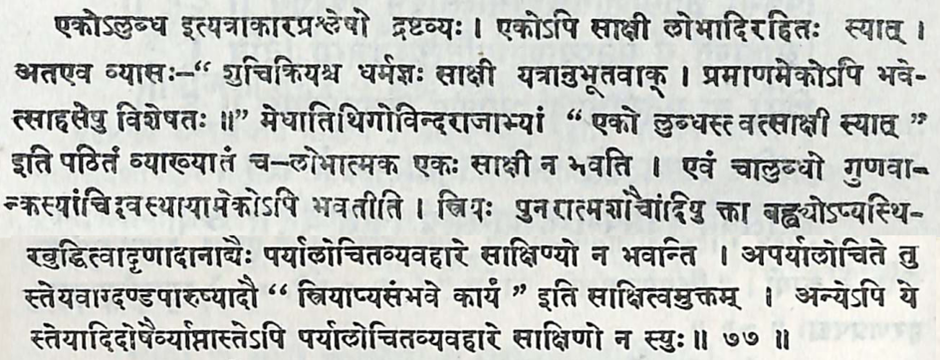
“…Regarding women, however, the text maintains that even in large numbers, they are disqualified from serving as witnesses in deliberated legal proceedings—such as those involving debt recovery—purportedly due to an inherent instability of intellect. Their testimony is traditionally restricted to matters concerning personal or internal purification. Nevertheless, in unpremeditated or sudden occurrences such as theft, verbal abuse, or physical assault, the precept “in the absence [of others], the task may be performed even by a woman” is invoked, thereby granting them the capacity to act as witnesses. Similarly, any other individuals tainted by vices such as theft are likewise barred from serving as witnesses in formal, deliberated legal affairs.” Kulluka Bhatta on Manu Smriti 8.77
Medhatithi argues that women are not admissible as witnesses, even if virtuous, because they are considered inherently fickle and unreliable. He further maintains that their testimony may be accepted only in rare and immediate situations, since their minds are believed to be easily influenced over time.
“…But women are never admissible,—be they one or many,—‘even though pure’—possessed of high qualifications; and the reason for this is that ‘the understanding of women is not steady’; fickle-mindedness is the very nature of women; while other qualifications are acquired, and as such liable to lapses through carelessness, idleness and so forth; so that their inherent fickleness remains as a constant factor. Just as in the case of a dyspeptic,—even though a certain amount of appetite may have been regained by the use of butter and other things, yet even the least neglect on their part, brings on the inherent Dyspepsia again. Consequently, on account of this uncertainty, there can be no confidence in women, even though they be highly qualified. As for the declaration (in 70) that ‘in the event of no witnesses being available, women may be made witnesses,’—that refers to cases where they can be immediately questioned, and there is no possibility of their mind being tampered with by any person. When however there has been an interval of time, it is quite possible that they may be won over by the party whoso case is weak and who is in fear of losing it. So that in such cases their evidence is not admissible at all…” Medhatithi on Manu Smriti 8.77, Tr. Ganganath Jha (Source)
Chanakya Neeti Shastra 1.15 “One should never trust those with claws/nails and homs and those with arms in hand, [as also] the rivers, the women and the members of the royal households.” Tr. Satya Vrat Shastri (Source)
Katyayana Smriti verse 351 “Women should bear witness for women (when women are litigants)…” Tr. P.V. Kane (Source)
Women Deemed Devoid of Intellect
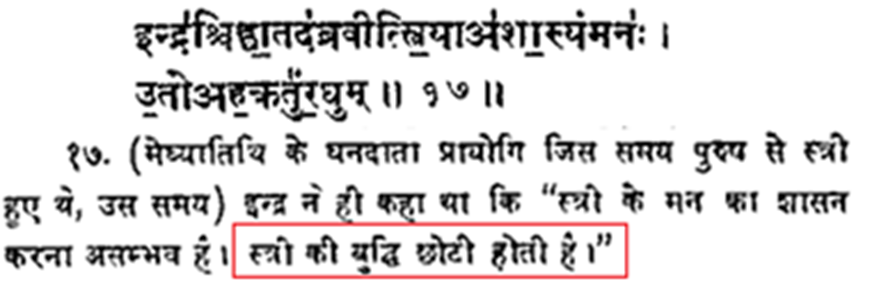
Rig Veda 8.33.17 “Indra himself hath said, The mind of woman brooks not discipline, Her intellect hath little weight.” Tr. Ralph Griffith (Source)
Following is the Hindi translation by Pandit Ram Govind Trivedi.
Sayana commented on the above verse as follows:

“…The phrase “Indra indeed” signifies that Indra himself certainly uttered those words. The passage asserts that the feminine mind—or consciousness—is essentially “uninstructible,” implying that it is beyond the capacity of a man to discipline or govern due to its inherent intensity and overwhelming nature. Furthermore, the text characterizes the female intellect as being fundamentally “slight” or unstable.” Sayana on Rig Veda 8.33.17
Manu Smriti 9.18 “For women there is no dealing with the sacred texts; such is the rule of law; the fact is that, being destitute of organs and devoid of sacred texts, women are ‘false”’ Tr. Ganganath Jha (Source)
Acharya Medadithi writes on Manu Smriti 9.18,
“Destitute of Organs.’- ‘Organ’ here stands for strength; courage, patience, intelligence, energy and so forth are absent in women” Tr. Ganganath Jha (Source)
Devi Bhagavatam 9.38.1-6 “…O Bhagavân! The woman kind has been created by the Creator as devoid of any Tattvajñâna or true knowledge…” Tr. Swami Vijnananda (Source)
Swami Prabhupada founder of ISKCON writes,
“Here is a difference between male and female that exists even in the higher statuses of life — in fact, even between Lord Śiva and his wife. Lord Śiva could understand Citraketu very nicely, but Pārvatī could not. Thus even in the higher statuses of life there is a difference between the understanding of a male and that of a female. It may be clearly said that the understanding of a woman is always inferior to the understanding of a man. In the Western countries there is now agitation to the effect that man and woman should be considered equal, but from this verse it appears that woman is always less intelligent than man.” Swami Prabhupada on Srimad Bhagavatam 6.17.34-35 (Source)
He also said, “We are speaking of ordinary woman. Because Kṛṣṇa says, in another place, striyo vaiśyas tathā śūdraḥ [Bg. 9.32]. They are considered, women, vaiśya, the mercantile community, and śūdra, and the worker class, they are less intelligent.” Swami Prabhupada, Lectures Bhagavad-gītā 1.40 — London, July 28, 1973 (Source)
He stated elsewhere,
“To understand Brahman is not the business of teeny brain. Alpa-medhasam (BG 7.23). There are two Sanskrit words: alpa-medhasa and su-medhasa. Alpa-medhasa means having little brain substance. Physiologically, within the brain there are brain substance. It is found that the brain substance in man is found up to sixty-four ounce. They are very highly intellectual persons. And in woman the brain substance is not found more than thirty-four ounce. You’ll find, therefore, that there is no very great scientist, mathematician, philosopher among women. You’ll never find, because their brain substance cannot go. Artificially do not try to become equal with men. That is not allowed in the Vedic śāstra. Na striyaṁ svatantratām arhati (Manu-saṁhitā). That is called śāstra.” Swami Prabhupada, Lecture on BG 16.7, 2-3-1975, Hawaii (Source)
He stated elsewhere,
“…Generally women are very much passionate and are less intelligent…” Swami Prabhupada on Srimad Bhagavatam 4.27.1 (Source)
Also see the category Women’s Testimony Deemed Invalid, where commentators such as Kulluka Bhatta state that women possess an unstable intellect.
Women are treated as equivalent to Dogs and Pigs
Hindu texts often mention women and Shudras alongside dogs and pigs, especially in the case of a menstruating woman, thereby placing them on the same level as pigs and dogs.
Manu Smriti 3.239 “A Kandala, a village pig, a cock, a dog, a menstruating woman, and a eunuch must not look at the Brahmanas while they eat.” Tr. Georg Buhler (Source)
Atharva Veda 4.5.2 “…Lull all the women, lull the dogs to sleep, with Indra as thy friend.” Tr. Ralph Griffith (Source)

The Satapatha Brahmana states that the dog, the Shudra, and the woman are associated with untruth.
Satapatha Brahmana 14.1.1.31 “And whilst not coming into contact with Sûdras and remains of food; for this Gharma is he that shines yonder, and he is excellence, truth, and light; but woman, the Sûdra, the dog, and the black bird (the crow), are untruth: he should not look at these, lest he should mingle excellence and sin, light and darkness, truth and untruth.” Tr. Julius Eggeling (Source)
Samvarta Samhita verses 181 “By being touched by a dog or by another woman in her menses, a woman in menses should fast for the remaining days [of the menstrual period] and get herself purified by drinking clarified butter after bathing [at the end of the menstrual period].” Tr. Manmatha Nath Dutt (Source)
Women in her Menses
The Sabarimala Temple declared that it would allow women to enter only after a scanning machine is developed to ensure that no woman entering the temple is menstruating. (Source: Dailymail)
Another humiliating incident occurred when a woman entered the Shani Shingnapur Temple for worship, after which the idol and the temple premises were ritually purified with cow urine. (Source: IndiaTimes)
Hinduism even states that a woman who, during her menses, touches a Dvija must be lashed with a whip.
Vishnu Smriti 5.105 “If a woman in her courses (touches a member of a twice-born person), she shall be lashed with a whip.” Tr. Julius Jolly (Source)
The following verses portray women, especially menstruating women, as ritually impure, requiring purification through bathing or the consumption of Panchagavya. They also place menstruating women alongside animals and socially marginalised group.
Garuda Purana ch 231 “A Brahmana having touched a dog, a Sudra, or any other beast, or a woman in her menses, before washing his face after a meal, shall regain his purity by fasting for a day, and by taking Panchgavyam.” Tr. M.N. Dutt (Source)
Devi Bhagavatam Purana 9.33.20-50 “He who takes the food of a childless widow and the same of any woman that has just bathed after menstruation goes for one hundred years to the hot Lauha Kunda (where iron is in a molten condition). For seven births he becomes then a crow and for seven births he becomes born of a washerwoman, full of sores and boils, and poor. Then he gets purified.” Tr. Swami Vijnananda (Source)
Markandeya Purana 35.28 “If a man touches a woman in her menses, a horse, a jackal, a woman, who has of late given birth to a child, the offspring of a Chandala, or an undertaker, he should bathe for the purpose of being purified.” Tr. (Source)
Brahma Purana 113.140-7 “…A person who is conversant with righteousness becomes purified by taking a bath if he touches these: a medicant who is not worthy of being fed (?), a heretic, a cat, an ass, cook, a fallen man, an outcaste (a person ostracised), a Candala and those who bear dead bodies, a country pig and a woman in her monthly course…” Tr. Board of Scholars, edited by J.L. Shastri (Source)
Kurma Purana II.17.26 “One shall avoid an article once smelt by a dog and cooked again. So also the article seen by a Candala, or a woman in her menses, or smelt by a cow, or seen by a fallen men, shall be avoided.” Tr. G.V. Tagare (Source)
Manu Smriti 4.208 “Nor that at which the slayer of a learned Brahmana has looked, nor that which has been touched by a menstruating woman, nor that which has been pecked at by birds or touched by a dog,” Tr. Georg Buhler (Source)
The following verses impose severe restrictions on menstruating women, equating them with outcastes and sinners and prescribing social isolation and ritual avoidance.
Linga Purana 1.89.100 “Hence, one shall assiduously avoid conversing with a woman in her monthly course. On the first day, she has to be avoided like a cāṇḍāla woman.” Tr. J.L. Shastri (Source)
Linga Purana 1.89.104-107 “A woman in her monthly course shall avoid bath, toilet, singing, crying, laughing, going in vehicles, applying collyrium, playing dice, applying unguents, sleeping during the daytime, washing the teeth, sexual intercourse, worship of deities whether mental, verbal or physical as well as bowing down. A woman in her monthly course shall avoid touching another woman in her monthly course and talking to her also. She shall assiduously avoid changing her garments. A woman in her monthly course shall not touch another man after her bath.” Tr. J.L. Shastri (Source)
Shiva Purana ShivaPurana-Mahatmya 7.14 “He shall not look at women in their menstrual period. He shall not converse with fallen people, nor talk to haters of brahmins or unbelievers in the Vedas.” Tr. J.L. Shastri (Source)
Garuda Purana 2.32.9 “A woman in her menses is an outcaste on the first day, a slayer of brahmana on the second day and a washerwoman on the third. She becomes pure on the fourth day.” Tr. J.L. Shastri (Source)
Krishna Yajur Veda 2.5.1.5-6 “therefore one should not converse with (a woman) with stained garments, one should not sit with her, nor eat her food, for she keeps emitting the colour of guilt…” Tr. Arthur Berriedale Keith (Source)
Women Cannot Rule
Garuda Purana 1.115.62 “One shall not reside in a land where there is no leader or where there are many leaders or where the leadership is vested in a woman or in a child.” Tr. J.L. Shastri (Source)
Garuda Purana 1.115.59 “The prosperity of a kingdom comes to an end with the curse of a brahmana; the spiritual power of a brahmana comes to an end with his sin; all decency in conduct of life comes to an end if residence is taken near cowsheds; the family is ruined if women rule.” Tr. Board of Scholars, edited by J.L. Shastri (Source)
Women should not be Given Freedom
Hinduism state that a woman is inherently dependent and unfit for independence. They portray her as someone who must remain under male guardianship throughout her life. Similarly, Swami Prabhupada, the founder of ISKCON, asserted that women should never be given independence, must always remain under control, and are not fit to rule.
“In India we have got little experience. The female is always controlled. Female is never given the position of controller. Nowadays it is going on. Just like Indira Gandhi, she has given the position of controller. This is artificial. In the history of India, greater India, Mahābhārata, you will never find that a woman has been given a position of controller. No. It is not possible. We have to take things from the śāstra. In the Bhagavad-gītā also woman’s position has been equated with śūdra. Striyaḥ śūdrās tathā vaiśyas te ‘pi yānti parāṁ gatim.” Swami Prabhupada, Lectures Bhagavad-gītā 1.21-22 — London, July 18, 1973 (Source)
He also stated, “… woman is not supposed to take sannyāsa. So-called spiritual societies concocted in modern times give sannyāsa even to women, although there is no sanction in the Vedic literature for a woman’s accepting sannyāsa. Otherwise, if it were sanctioned, Kardama Muni could have taken his wife and given her sannyāsa. The woman must remain at home. She has only three stages of life: dependency on the father in childhood, dependency on the husband in youth and, in old age, dependency on the grown-up son, such as Kapila. In old age the progress of woman depends on the grown-up son.” A.C. Bhaktivedanta Swami Prabhupada on Srimad Bhagavatam 3.24.40 (Source)
Yogi Adityanath, the Mahant of Gorakhnath Math, had said, “Shastras have talked about giving protection to women. Just like urja (energy) left free and unchecked causes destruction, women also don’t need independence, they need protection. Their energy should be channelised to be used productively.” (Source)
Narada Purana, Uttarabhaga 24.46-47a “O Brahmanas, the following fall into hell: viz.- a woman who behave according to her own sweet will…” Tr. G.V. Tagare (Source)
Manu Smriti 5.147-148 “By a girl, by a young woman, or even by an aged one, nothing must be done independently, even in her own house. In childhood a female must be subject to her father, in youth to her husband, when her lord is dead to her sons; a woman must never be independent.” Tr. Georg Buhler (Source)
Medhatitih comments on the above verses as follows:
“The sense of the teaching is that under no circumstances should there be independence for women. The mention of the various stages of her age, is meant only to indicate where she has to be dependent upon others, and no significance is meant to attach to it.” Medhatithi on Manu Smriti 5.145, Tr. Ganganath Jha (Source)
Yajnvalkya Smriti I.85 “When a maiden, her father; when married, her husband; and when old, her sons, should protect her. In their absence, the kinsmen (should take care of her.) The women are never independent.” Tr. Srisa Chandra Vasu (Source)
Vijnanesvara comments on the above verse as follows:
“Besides, before marriage, ” the father should protect the maiden from committing improper acts. After marriage the husband, in his absence, the sons, and in old age as well as in the absence of those mentioned above, the kinsmen should protect her. In the absence of the kinsmen, the king, on account of the following text of Angirasa: — ‘On the failure of both sides (the husband’s and the father’s relations), the king is the supporter and master of women.’ Therefore for women there is never any independence.” Vijnanesvara in Mitakshara on Yajnavalkya Smriti I.88, Tr. Srisa Chandra Vasu (Source)
Mahabharata 13.45 “There is the well-known declaration of the scriptures that women are incompetent to enjoy freedom at any period of their life.” Tr. K.M. Ganguli (Source)
Mahabharata 13.20 “Ashtavakra said, ‘Women can never be their own mistresses. This is the opinion of the Creator himself, viz., that a woman never deserves to be independent.” Tr. K.M. Ganguli (Source)
Garuda Purana 1.115.63 “The father protects her in childhood, the husband in youth and the son in old age. A woman is not to be allowed to stay independently.” Tr. J.L. Shastri (Source)
Vishnu Smriti 25.12-13 “Not to act by herself in any matter; To remain subject, in her infancy, to her father, in her youth, to her husband; and in her old age, to her sons.” Tr. Julius Jolly (Source)
Baudhayana Dharma Shastra 2.2.3.44-5 Women do not possess independence. Now they quote also (the following verse): ‘Their father protects (them) in childhood, their husband protect (them) in youth, and their sons protect (them) in old age; a woman is never fit for independence.’ Tr. (Source)
Padma Purana 1.52.25 “As cooked food, in the absence of protection, is controlled by (i.e. eaten by) dogs and crows, in the same way, a young woman would become corrupt due to freedom.” Tr. N.A. Deshpande (Source)
Vasistha Dharma Shastra 5.1 “A woman is not independent, the males are her masters. It has been declared in the Veda, ‘A female who neither goes naked nor is temporarily unclean is paradise.” Tr. Georg Buhler (Source)
Narada Smriti 13.30 “It is through independence that women go to ruin, though born in a noble family. Therefore the Lord of creatures has assigned a dependent condition to them.” Tr. Julius Jolly (Source)
The following verses restrict women’s freedom in both public and domestic spheres, subjecting them to continuous oversight.
Brihaspati Smriti 24.2 “A woman must be restrained from slight transgressions even by her relations; by night and by day she must be watched by her mother-in-law and other wives belonging to the family.” Tr. Julius Jolly (Source)
Gautama Dharma Shastra 18.1 “A wife is not independent with respect to (the fulfilment of) the sacred law.” Tr. Georg Buhler (Source)
Shiva Purana 3.54.24 “Without the permission of her husband she shall not go even on pilgrimage. She shall eschew the desire to attend social festivities.” Tr. J.L. Shastri (Source)
Women are Bad Luck
Garuda Purana 1.64.8 “Woman with hairy sides and breasts and high lips: husband dies soon.” Tr. Board of Scholars, edited by J.L. Shastri (Source)
Garuda Purana 1.64.11-12 “little finger and thumb of a woman placed on the ground do not rest there: she will become a widow and of ill repute. Woman who shakes the ground as she treads, kills her husband quickly and lives like a mleccha woman.” Tr. Board of Scholars, edited by J.L. Shastri (Source)
Garuda Purana 1.65.57-60 (Samudrika) a round face: prosperity, lady will beget son, a long face: poverty, misfortune, great sorrow, a square face: coward, sinner, rogue, a depressed face: issuelessness, a short face: miserliness” Tr. Board of Scholars, edited by J.L. Shastri (Source)
Garuda Purana 1.65.114 “long neck of woman: destruction of family.” Tr. Board of Scholars, edited by J.L. Shastri (Source)
Beat Woman
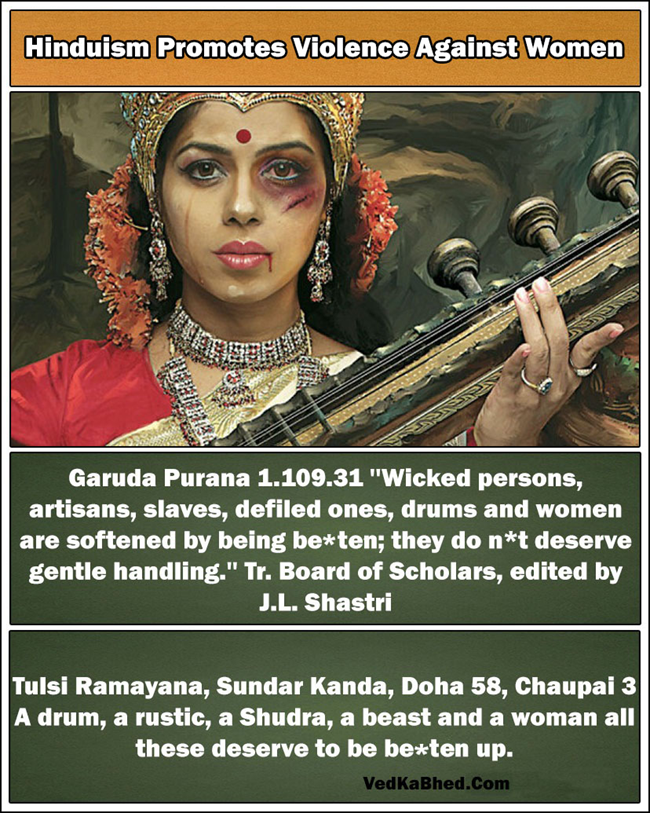
Garuda Purana 1.109.31 “Wicked persons, artisans, slaves, defiled ones, drums and women are softened by being beaten; they do not deserve gentle handling.” Tr. Board of Scholars, edited by J.L. Shastri (Source)
Tulsi Ramayana reiterates the same,
ढोल गवाँर सूद्र पसु नारी। सकल ताड़ना के अधिकारी।।३
Tulsi Ramayana, Sundar Kanda, Doha 58.3 “A drum, a clown, a churl, a beast, and a woman are all fit subjects for beating.” Tr. (Source)
Hindu scholar Bhagavatananda Guru comments on the above verse as follows: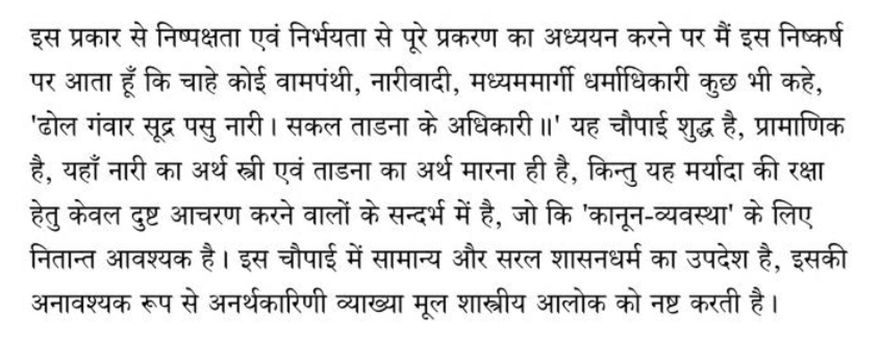
“By studying the entire matter with such impartiality and fearlessness, I reach the conclusion that regardless of what any leftist, feminist, or moderate theologian says, ‘A drum, a rustic, a Shudra, an animal, and a woman; all these are deserving of chastisement/beating.’ This chaupai (quatrain) is correct and authentic; here, the meaning of ‘Nari’ is woman and the meaning of ‘Tadna’ is indeed beating. However, for the protection of decorum/dignity, this is only in the context of those who commit wicked conduct, which is absolutely necessary for ‘law and order.’ In this chaupai, there is an instruction of common and simple governance; its unnecessarily harmful interpretation destroys the original scriptural light.” Bhagavatananda Guru, Moorakh Hriday Na Chet, page 418 (Source)
The following verse from the Brihadaranyaka Upanishad encourages marital rape of a woman after assaulting her with a stick.
Brihadaranyaka Upanishad 6.4.7 “If she does not willingly yield her body to him, he should buy her with presents. If she is still unyielding, he should strike her with a stick or with his hand and overcome her, repeating the following mantra: “With power and glory I take away your glory.” Thus she becomes discredited.” Tr. Swami Nikhilananda (Source)
Manu Smriti 8.299-300 “A wife, a son, a slave, a pupil, and a (younger) brother of the full blood, who have committed faults, may be beaten with a rope or a split bamboo, But on the back part of the body (only), never on a noble part; he who strikes them otherwise will incur the same guilt as a thief.” Tr. Georg Buhler (Source)
Medhatithi comments on the above verse as follows:
“As a matter of fact, beating is a form of hurt, and as such is forbidden by the general law—‘no living beings shall be injured’; but an exception to this is made in the case of transgressions by the wife and other persons.
All these are relative terms; hence the meaning is that the wife is to be chastised by him whose wife she is, the slave is to be chastised by him who is his master, and so forth… ‘Split bamboo’—the bark of the bamboo. This has been mentioned only as illustrative of the lotus-fibre and other such objects which cause only slight pain.” Medhatithi on Manu Smriti 8.299, Tr. Ganganath Jha (Source)
Kulluka Bhatta comments on Manu Smriti 8.299 as follows:

“Wives, sons, and others, having committed an offense, should be beaten with a rope or a very light split bamboo cane. Because this rule of beating is for the purpose of instruction, there is an exception to punishment here [for the striker].” Kulluka Bhatta on Manu Smriti 8.299
Matsya Purana 227.154 “Wife, sons, servants, disciples, brothers should be beaten on their back with a rope or a cane when they commit a fault. They should never he beaten on their heads.” Tr. Taluqdar of Oud, edited by B.D. Basu (Source)
Agni Purana 227.43-47 “…One’s wife, sons, servants, pupil and brother having done an offence should be beaten with a rope or with a piece of bamboo...” Tr. N. Gangadharan (Source)
Swami Prabhupada endorsed wife beating.
“Prabhupāda: Dull, dull. Dhol guṇār, dhol means drum and guṇār means dull. Śūdra, and the laborer class. Three. Dhol, guṇār, śūdra, and paśu, household animals, just like cows, dogs. Brahmānanda: Pet. Prabhupāda: Pet, like that. Dhol guṇār śūdra paśu and narī. Nari means woman. (laughs) Just see. He has classified the narī amongst these class, dhol, guṇār, śūdra, paśu, narī. Ihe sab śaśan ke adhikārī. Sasan ke adhikārī means all these are subjected for punishment. And what about the guest? Govinda dāsī: Oh, the guest? It’s coming. Prabhupāda: So śaśan ke adhikārī means they should be punished. (laughs) Punished means, just like dhol, when the, I mean to say, sound is not very hard, dag-dag, if you beat it on the border, then it comes to be nice tune. Similarly, paśu, animals, if you request, “My dear dog, please do not go there.” Hut! (laughter) “No, my dear dog.” Hut! This is the way.(?) Similarly, woman. If you become lenient, then she will be troublesome. So in India still, in villages, whenever there is some quarrel between husband wife, the husband beats and she is tamed. (laughs) In civilized society, “Oh, you have done this?” Immediately some criminal case. But in uncivilized society they don’t care for court or civilized way of… Kicharī. (prasādam being served)” Room Conversation — April 12, 1969, New York (Source)
By contrast, no reciprocal provision exists that allows a wife to strike or discipline her husband,
Shiva Purana, Rudra Samhita 2, Parvatikhanda section III, ch 54, verses 53-55 “If she desires to beat her husband in retaliation, she becomes a tiger or a wild cat. She who ogles at another man becomes squint eyed. She who partakes of sweet dish denying the same to her husband becomes a pig in the village or a wild goat eating its own dung. She who addresses her husband in a singular becomes dumb. She who is jealous of a cow-wife becomes ill-fated in matrimony again and again.” Tr. J.L. Shastri (Source)
Skanda Purana III.ii.7.43 “On being struck, if she were to strike him back, she is reborn as a tigress or a cat…” Tr. G.V. Tagare (Source)
Shiva Purana, Rudra Samhita 2, Parvatikhanda section III, ch 54, verse 19 “A chaste lady shall never mention her husband’s name. If the husband scolds or rebukes her she shall not abuse him in return. Even when beaten by him she shall remain glad and say “I may even be killed, O lord. Be kind to me.” Tr. J.L. Shastri (Source)
Barred from Studying Vedas, to Perform Sacrifice and to Worship
Before a student is permitted to study the Vedas, the Upanayana ceremony must be performed, after which the initiate wears the sacred thread as a mark of eligibility. While Brahmin men are commonly seen wearing this thread, women are excluded from this rite under the traditional consensus of Hindu scriptures. Since only those who have undergone Upanayana are considered qualified to study the Vedas, this exclusion effectively bars women from Vedic learning. Although there are occasional conflicting references, the dominant consensus among Hindu scriptures and traditional scholars bars women from the study of the Vedas. The Agni Purana mentions this restriction.
Agni Purana 152.9-12 “…The women are not entitled to utter the Veda Mantras, and hence they are not invested with the holy threads, but their marriage ceremonies should be celebrated by repeating the sacred hymns of the Vedas.” Tr. M.N. Dutt (Source)
It is mentioned in the Bhagavata Purana that Vyasa composed the Mahabharata out of compassion for women and Shudras, since they were barred from the study of the Vedas.
Srimad Bhagavatam 1.4.25 “The degenerated twice-borns, the Sudras and women are barred from the holy truths of the Vedas, and, out of compassion for them, Maharshi Vyasa composed the Mahabharata.” Tr. J.M. Sanyal (Source)
Swami Prabhupada comments on the above verse as follows:
“…The śūdras and the woman class do not have to undergo any saṁskāra save and except the ceremony of marriage…” Swami Prabhupada on Srimad Bhavatam 1.4.25 (Source)
Viraraghavacharya comments on the above verse as follows:
“Even though the sage Vyasa had acted in this manner [compiling the Vedas], [he considered that] for women, Shudras, and the ‘friends of the twice-born’ (dvija-bandhus)—who are merely the semblances of the three higher castes (traivarṇikābhāsānām)—the Trayi (the three Vedas, distinct as Rig, etc.) is not śrutigocarā, meaning it is not a subject within the scope of their hearing.
Because Vedic study is a limb dependent upon the Upanayana (sacred thread ceremony), and the Upanayana belongs to the three higher castes (Traivarnikas), there is no fitness or eligibility for the study of the Vedas for women, Shudras, and the like.
Therefore indeed, regarding karma-shreyasi—meaning the welfare that is accomplished by Vedic ritual actions—they are bewildered (mūḍhānām), meaning they are destitute of knowledge regarding the four goals of human life and the means to attain them. Thinking, ‘Otherwise [without the Mahabharata] their welfare would not occur, but in this way it would occur,’ and thus considering this cause [he acted]. Out of mercy, the historical narrative known as the Bharata was created, O twice-born…” Viraraghavacharya on Srimad Bhagavatam 1.4.25
Matsya Purana 154.156-74 “Women are by their nature meek and weak, women cannot study the Sastras.” Tr. Taluqdar of Oudh, edited by B.D. Basu (Source)
Devi Bhagavatam 1.3.18-24 “…knowing this in every Dvâpara Yuga Bhagavân expounds the holy Purâna Samhitas. The more so because women, S’udras, and the lower Dvijas are not entitled to hear the Vedas; for their good, the Purânas have been composed…” Tr. Swami Vijnananda (Source)
Brahma Purana 64.19 “In regard to the people of the first three castes the rite of holy bath and the reception of Mantras is in the manner mentioned in the Vedas. The utterance of the Vedic passage is to be avoided by women as well as Sudras.” Tr. J.L. Shastri (Source)
Manu states that marriage for a woman is equivalent to the study of the Vedas, implying that she is not expected to pursue Vedic learning independently.
Manu Smriti 2.66-67 “This whole series (of ceremonies) must be performed for females (also), in order to sanctify the body, at the proper time and in the proper order, but without (the recitation of) sacred texts. The nuptial ceremony is stated to be the Vedic sacrament for women (and to be equal to the initiation), serving the husband (equivalent to) the residence in (the house of the) teacher, and the household duties (the same) as the (daily) worship of the sacred fire.” Tr. Georg Buhler (Source)
Kulluka Bhatta comments on the above verses as follows:
“This specific sequence of rites, beginning with Jatakarma (birth ceremonies), is stated to be performed for the sanctification of the body of women at the prescribed times, but without the recitation of Vedic mantras. Having reached the topic of the Upanayana (initiation) through the previous context, he [Manu] states a specific distinction: For women, the rite of marriage itself is remembered by Manu and others as the Vedic sacrament equivalent to the Upanayana. Serving the husband is considered the equivalent of residing with a Guru in a Gurukula for Vedic study… Therefore, because marriage and other duties are ordained in place of the Upanayana, there is a cessation of the actual Upanayana rite for women.” Kulluka Bhatta on Manu Smriti 2.66-67
Certain Hindu texts prescribe severe consequences, including punishment in hell, for those who recite or teach the Vedas in the presence of women and Shudras.
Narada Purana I.15.100-1 “I shall mention the fruits of sins accruing to those who engage themselves in the recitation and study of the Vedas in the vicinity of women and Sudras. Listen to it attentively. They are compelled to stand with their heads down and legs upwards. Thus, they are nailed to two pillars and are compelled to inhale smoke continuously in this posture. They stay thus for the period of year of god Brahma.” Tr. G.V. Tagare (Source)
Manu clearly states,
Manu Smriti 9.18 “For women no (sacramental) rite (is performed) with sacred texts, thus the law is settled; women (who are) destitute of strength and destitute of (the knowledge of) Vedic texts, (are as impure as) falsehood (itself), that is a fixed rule.” Tr. Georg Buhler (Source)
Kulluka Bhatta comments on the above verses as follows:
“The established rule of the Shastra is that for women, rites such as Jatakarma are performed without mantras. Consequently, due to the absence of a group of sacraments performed with mantras, they [women] do not possess hearts purified of sin. Since they lack the authority of the senses and are devoid of the knowledge of the Vedas (Shrutis) and Smritis—which are the authorities of Dharma—they are not knowers of Dharma. Being ‘mantra-less,’ they are incapable of purging even a committed sin because they are excluded from the recitation of mantras that remove sin. The rule of the Shastra is that women are as inauspicious as falsehood itself. Therefore, the essential meaning is that they must be guarded with great effort.” Kulluka on Manu Smriti 9.18
Some apologists argue that because certain Vedic verses are attributed to Rishikas, female seers, there was no prohibition against women studying the Vedas. However, this argument often relies on isolated examples that are removed from their broader ritual and legal context.
The Vedas also contain verses attributed to figures such as Urvashi in Rig Veda 10.95. Urvashi is described as an Apsara in the Nirukta 5.13, and Swami Prabhupada refers to her as a prostitute of the heavenly realm. Yet the presence of a verse spoken by a prostitute does not mean that ordinary women were expected to engage in prostitution. The mere attribution of a hymn to a female or even marginal figure does not necessarily imply that ordinary women were institutionally permitted to study or recite the Vedas within the orthodox framework.
“Mitra and Varuṇa chanced to meet Urvaśī, the most beautiful prostitute of the heavenly kingdom, and they became lusty…” Swami Prabhupada on Srimad Bhagavatam 9.13.6 (Source)
Devi Bhagavatam states,
Devi Bhagavatam 9.1.96-143 “…those that are sprung from Tamo Guna are recognised as worst and belonging to the unknown families. They are very scurrilous, cheats, ruining their families, fond of their own free ways, quarrelsome and no seconds are found equal to them. Such women become prostitutes in this world and Apsaras in the Heavens…” Tr. Swami Vijnananda (Source)
This is a common strategy adopted by some Hindu apologists. They cite verses praising goddesses and present them as evidence that the Vedas uphold the dignity of ordinary women. However, glorification of divine feminine figures does not automatically translate into social equality for women in general.
Some may argue that Urvashi was not a prostitute, yet even within traditional narratives she is associated with moral transgression. When attempting to demonstrate caste equality, apologists also claim that Vasistha was born of a prostitute and later became a Rishi. However, the tradition itself maintains that he was born from the mind of Urvashi, not from her womb. Such shifting interpretations suggest a selective reading shaped by apologetic motives. The renowned Hindu scholar Madhvacharya addressed and refuted this claim long ago. Madhvacharya writes that the study of scripture is restricted to certain exceptional women such as Urvashi, Yami, Sachi, and other goddesses,
“…And in the Vyoma Samhita, it is said thus — “Even those of the lowest caste devoted to the Lord are eligible for initiation in respect of the knowledge of the sacred names of the Lord; while women, Sudras, and vile Brahmans are allowed to obtain knowledge from Tantra works as explained in part by others, but not from a regular study of such works. Those of the first three castes who are sincerely devoted to the Lord Hari (the purifier) are fit to acquire knowledge as given in the Vedic texts. And the women (of the celestial order) are also eligible for the study of Scripture; and they are Urvasi, Yami (the wife of Yama), Sachi and other goddesses, (as also the wives of Rishis)…” Madhvacharya on Brahma Sutra Adhyaya 1, Pada 1.1, Tr. S. Subba Rau (Source)
Scholars on Women Studying the Vedas
Krishna says in Gita,
Gita 9.32 “For those who take refuge in Me. O Partha, though they be of sinful birth- women, Vaisyas, and Sudras even they attain the Supreme Goal.” Tr. Swami Nikhilananda (Source)
Sridhara Swami comments on the above verse,
“…This is being confirmed here that those born sinfully out of wedlock, those born in the poorest and most degraded of families such as mleccha or meat eaters, those who are vaisyas the mercantile class engaged only in business, sudras the menial class, women and all others who are devoid of Vedic knowledge…” (Source)
Kesava Kashmiri writes,
“…This includes those of vile birth such as untouchables, mleechas or meateaters, those born illegitimately, those without education, vaisyas or the mercantile class which is situated below women and above sudras which is the menial class. All these lack the qualification for Vedic knowledge and thus destitute of righteous conduct are only eligible to exist on the lowest path of existence…” Kesava Kashmiri Gita 9.32 (Source)
Hindu scholar Swami Swarupananda writes,
“Of inferior birth…Shudras because by birth, the Vaishyas are engaged only in agriculture, etc., and the women and Shudras are debarred from the study of the Vedas.” Swami Swarupananda on Gita 9.32(Source)
Swami Nikhilananda writes,
“The Vaisyas are engaged in agriculture and trade; women and Sudras are debarred from the study of the Vedas. Therefore all these classes of people remain outside the Vedic scheme of salvation…” Swami Nikhilananda on Gita 9.32 (Source)
Swami Sivananda writes,
“…Women and Sudras are debarred by social rules from the study of the Vedas…” Swami Sivananda on Gita 9.32
Swami Prabhupada the founder of ISKCON, stated in one of his lectures,
“So dealing with woman… Especially instruction are given to men. All literatures, all Vedic literatures, they are especially meant for instruction to the men. Woman is to follow the husband, that’s all. The husband will give instruction to the wife. There is no such thing as the girl should go to school to take brahmacārī-āśrama or go to spiritual master to take instruction. That is not Vedic system. Vedic system is a man is fully instructed, and woman, girl, must be married to a man. Even the man may have many wives, polygamy, still, every woman should be married. And she would get instruction from the husband. This is Vedic system. Woman is not allowed to go to school, college or to the spiritual master. But husband and wife, they can be initiated. That is Vedic system.” Swami Prabhupada, Śrīmad-Bhāgavatam 1.3.13, Sept. 18, 1972 — Los Angeles (Source)
Barred from Sacrifices, Rituals and Japas
Women are barred from leading worship and are permitted to perform sacrifices only alongside their husbands. Certain texts further prohibit them from chanting Vedic mantras and engaging in Japa.
Mahabharata 3.204 “[Markandeya Rishi said] As regards women again, neither sacrifice nor sraddhas, nor fasts are of any efficacy. By serving their husbands only they can win heaven.” Tr. K.M. Ganguli (Source)
It is mentioned in the Linga Purana that women are not authorized to perform worship, that is, to lead prayers or sacrifices.
Linga Purana Section II 20.1-3 “Rudra, Mahadeva, the grandfather stationed in the mystic diagram is worthy of being worshipped by the Brahmins, Ksatriyas and Vaisyas as well. For the Sudras the service rendered to a worshipper is enough. Undoubtedly women are not authorised to perform worship. If the worship is conducted through leading Brahmins, women and Sudras shall derive the same benefit.” Tr. Board of Scholars, Edited by J.L. Shastri (Source)
Padma Purana V.20.23-27 “A woman should never worship a salagrama. If a woman who is a widow or whose husband is alive, who desires her well-being in heaven, touches through ignorance a salagrama, she would, even though she is endowed with good character and virtues, be deprived of her collection of religious merit and would quickly go to hell…” Tr. N.A. Deshpande (Source)
Vishnu Smriti 25.15 “No sacrifice, no penance, and no fasting is allowed to women apart from their husbands; to pay obedience to her lord is the only means for a woman to obtain bliss in heaven.” Tr. Julius Jolly (Source)
Certain scriptures state that women are not permitted to utter Om or perform Vedic Japa,
Narada Purana, Uttarabhaga 61.51-53 “The procedure for the holy dip and the repetition of Japas is, in regard to the three castes, the same as mentioned in the Vedas. O fair lady, in regard to the Sudras and the women the repetition of the Vedic texts is to be avoided…” Tr. G.V. Tagare (Source)
Narada Purana III.70.72-73 “This is called Visnu Gayatri which removes all sins. Tara=om., hrt=namah, then bhagavan ending in the dative case, then vausdevaya. This great mantra consisting of twelve syllables gives enjoyment and salvation. This is to be used without tara=om by women and sudras but by the twice born it is used with tara=om.” Tr. G.V. Tagare (Source)
Skanda Purana V.iii.228.9 “The following six things cause downfall of women and Sudras: japa, penance, pilgrimage, renunciation of the world, practice of Mantras and initiation for the adoration of a deity” Tr. G.V. Tagare (Source)
Vishnu Smriti 27.13-14 “For female children the same ceremonies, (beginning with the birth ceremony, should be performed, but) without Mantras. The marriage ceremony only has to be performed with Mantras for them.” Tr. Julius Jolly (Source)
Manu Smriti 5.155-6 “No sacrifice, no vow, no fast must be performed by women apart (from their husbands); if a wife obeys her husband, she will for that (reason alone) be exalted in heaven. Afaithful wife, who desires to dwell (after death) with her husband, must never do anything that might displease him who took her hand, whether he be alive or dead.” Tr. Georg Buhler (Source)
Kulluka Bhatta comments on the above verses as follows:
“Just as a husband’s sacrifice is completed by another wife even if one wife is absent due to menstruation or other reasons, similarly, for women, there is no fulfillment of a sacrifice without the husband. Nor are there any vows or fasts for her without the husband’s permission. Rather, by the service of the husband alone, a woman is honored in the heavenly world.” Kulluka on Manu Smriti 5.155-6
Women are like Shudras
Women belonging to the upper three castes are not classified as Shudras, yet they are frequently treated in a similar manner within the scriptural framework. Many Hindu texts place women alongside Shudras in matters of ritual restriction and access to sacred knowledge, effectively positioning them at a comparable social and religious level.
Manu Smriti 5.139 “Let him who desires bodily purity first sip water three times, and then twice wipe his mouth; but a woman and a Sudra (shall perform each act) once (only).” Tr. Georg Buhler (Source)
Manu Smriti 11.153 “But he who has eaten the food of men, whose food must not be eaten, or the leavings of women and Sudras, or forbidden flesh, shall drink barley (-gruel) during seven (days and) nights.” Tr. Georg Buhler (Source)
Brahmanda Purana 2.3.15.56 “The leavings of food from a Sraddha should not be given to women or Sudras.” Tr. G.V. Tagare (Source)
Mahabharata 13.128 “That man who thinks it all right when a Sudra ignites the fire upon which he is to pour libations or who does not see any fault when women who are incompetent to assist at Sraddhas and other rites are allowed to assist at them, really becomes stained with sin.” Tr. K.M. Ganguli (Source)
Manu also states that during the observance of a vow, one must not, under any circumstances, speak to a woman, a Shudra, or an outcaste.
Manu Smriti 11.224 “Let him bathe three times each day and thrice each night, dressed in his clothes; let him on no account talk to women, Sudras, and outcasts.” Tr. Georg Buhler (Source)
Duties of a Wife
Devi Bhagavatam 6.18.7-24 “…The eternal Dharma of women is to serve their husbands; whether the husband be a saint or a sinner, the woman, desirous of her welfare, should serve her husband in every way…” Tr. Swami Vijnananda (Source)
Padma Purana 1.50.55b-57a “In (performing) duty, she is (like) a maid-servant; in (giving) sexual pleasure she is (like a prostitute); in (serving) a meal she is (like) a mother; she is a counsellor to her husband in his difficulties. Such is a chaste woman. That woman is loyal to her husband (i.e. is a chaste woman), who never disobeys her husband by speech, body or deeds, and who eats after her husband has eaten.” Tr. N.A. Deshpande (Source)
Baudhayana Dharma Shastra “2.2.3.47 Those (women) who strive (to do what is) agreeable to their husbands will gain heaven.” Tr. (Source)
The same is reiterated in Vishnu Smriti 25.15-17.
Garuda Purana 1.95.24-26 ‘‘The highest duty of a woman is to carry out the behests of her husband. Sixteen nights subsequent to the month menstrual flow are the nights of rut for women. The husband shall restrain himself during the parvan (full moon and new moon days), when the stars Magha and Mula are ascendant and on the first four nights. Thereafter, on even nights, he will be able to beget a healthy son of auspicious traits. If the woman is in a mood to receive him on any night he should satisfy her remembering that lust in women is terrible.” Tr. J.L. Shastri (Source)
Devi Bhagavatam 3.19.11 “The women are able to attain heaven and emancipation, if they serve their husbands…” Tr. Swami Vijnananda (Source)
Mahabharata 13.59 “As women have one eternal duty, in this world, viz., dependence upon and obedient service to their husbands, and as such duty constitutes their only end, even so is the service to Brahmanas Our eternal duty and end.” Tr. K.M. Ganguli (Source)
Ritual Humiliation of the Wife
Women are instructed to eat only after their husbands have finished their meals and, in some texts, to consume the remnants of their husbands’ food and even drink the water used to wash their feet.
Shiva Purana, Rudra Samhita 2, Parvati Khanda 3, ch 54, verse 25 “If a women wants holy water she shall drink the same with which her husband’s feet have been washed. All holy rivers are present in that water.” Tr. J.L. Shastri (Source)
Brahma Viavarta Purana Krishna Janma Khanda 57.20-21 “He is immensely chaste and happens to be lord Krsna in the form of husband. Therefore, such of the women who consume the food taken by her husband and sip the water of his feet, the gods are always anxious to have an audience with such women. With the touch of such women all the holy places are relieved of all the sins.” Tr. Shanti Lal Nagar (Source)
Shiva Purana, Rudra Samhita 2, Parvati Khanda 3, ch 54, verse 16 “A chaste lady shall take food only after her husband has taken it. O Śivā, if he stands, the woman too shall remain standing.” (Source)
Shiva Purana, Rudra Samhita 2, Parvati Khanda 3, ch 54, verse 26 “She shall partake of the leavings of her husband’s food or whatever is given by him saying “This is thy great grace.” Tr. J.L. Shastri (Source)
Sanctification of Female Submission in Marriage
Hindu texts state that a wife must remain devoted to her husband even if he is foolish, lacking in virtue, abusive, impotent, or involved in extra marital affairs. Such prescriptions reinforce an asymmetrical marital ethic in which the wife’s loyalty is demanded unconditionally, regardless of the husband’s conduct.
Manu Smriti 5.154 “Though destitute of virtue, or seeking pleasure (elsewhere), or devoid of good qualities, (yet) a husband must be constantly worshipped as a god by a faithful wife.” Tr. Georg Buhler (Source)
Skanda Purana II.iv.4.74 “Even if the husband is poor, fallen, foolish or wretched, he is the refuge unto his wife. By abandoning him a woman falls into hell.” Tr. G.V. Tagare (Source)
Brahma Viavarta Purana Brahma Khanda 9.70-73 “A lady born in an evil family always remains environs her husband because her mind always remains unstable and she feels attracted towards the evil and wicked people. But the chaste ladies serve her husbands even when he is mean, degraded, sickly, wicked, poor deprived of virtues and whether young or old.” Tr. Shanti Lal Nagar (Source)
Skanda Purana III.ii.7.15-44 “…The duties of chaste women have been enumerated by Sage Vyasa. She takes food after the husband has taken food; when he stands, she stands up together. She goes to bed after he has gone to sleep, and gets up before him…She does not speak out the name of her husband in order to give him long life. She never mentions the name of another man too. Even when dragged by him, she does not cry aloud. Even if she is beaten by him, she continues to be gracious. When he says, ‘Do this’, she reples, ‘My lord, be assured that it is done.’ When she is called, she leaves off the work on hand and goes to him quickly (and says) ‘Wherefore, O lord have I been called? Be pleased to tell me that…She partakes of the leavings of her husband’s food, fruit etc. liked by him. She completely avoids watching community festivals etc. (if he is not accompanying her). She should not exhibit bold wilfulness in anything except during sexual dalliance. She should always express her interest and delight whenever her husband shows his interest. She should never transgress the words of her husband… She should never stray from her husband even if he is impotent, miserably placed, sickly, senile, infirm or unsteady…If a woman transgresses the injunction of her husband and performs holy rites, fasts and other observances, she takes away the longetivity of her husband. After her death, she falls into a hell. A hot-tempered woman who, when addressed, gives rude reply, is reborn as a bitch in a village or as a vixen in a desolate forest. This is said to be the greatest and only sacred observance of women that they should resolve to take their food only after worshipping the feet of their husbands. (A chaste woman) should not occupy a seat higher (than that of her husband)…On being struck, if she were to strike him back, she is reborn as a tigress or a cat…She who sets aside her husband and partakes of sweet dishes alone, is reborn in a village as a female pig or a bat feeding on faeces.” Tr. G.V. Tagare (Source)
Punishment for Disobeying Husband
The following verse states how women are punished if they disobey their husbands or use harsh words against them.
Narada Purana I.14.17 “If, out of wickedness, a woman does not render physical service to her husband, she must be punished by abandoning her for twelve years, without giving her financial assistance.” Tr. G.V. Tagare (Source)
Devi Bhagavatam 9.35.1-44 “If any woman, being very furious with anger, chastises and uses harsh words to her husband, she goes to Ulkâmukha Kunda for as many years as there are hairs on his body. My servants put fiery meteors or torches in her mouth and beat on her head. At the end of the term, she becomes a human being but she has to bear the torments of widowhood for seven births. Then she is again born as diseased; when at last she gets herself freed. The Brâhmana woman, enjoyed by a S’ûdra, goes to the terrible dark Andhakûpa hell, where she remains, day and night, immersed in the impure water and eats that for fourteen Indra’s life periods. Her pains are unbounded and My messengers beat her severely and incessantly.” Tr. Swami Vijnananda (Source)
Valmiki Ramayana Ayodhya Kanda 2, Sarga 24, verse 25 “Even if a woman is interested in religious vows and fastings in addition to being the best of the excellent; if she does not obey her husband she will become ill-fated!” Tr. Desiraju Hanumanta Rao (Source)
Proud wife should be Punished
Matsya Purana 225.132 “The woman who is disobedient to her husband on account of being proud of her brothers, etc., should be driven out of the house by the king.” Tr. Taluqdar of Oudh, Edited by B.D. Basu (Source)
Manu 8.371 “If a wife, proud of the greatness of her relatives or (her own) excellence, violates the duty which she owes to her lord, the king shall cause her to be devoured by dogs in a place frequented by many.” Tr. Georg Buhler (Source)
Can’t Choose Husband
In general, women in Hinduism are not permitted to choose their husbands independently. The right of selection appears only in limited contexts, such as a princess in a Swayamvara or in cases where a girl’s family fails to arrange her marriage, after which she may choose a husband. These exceptions, however, do not reflect a broader norm of female autonomy in marriage.
Devi Bhagavatam 6.22.31-36 “…The girl must accept him to whom the father betrothes. The girl is under every circumstances dependent. Never do they get any independence…” Tr. Swami Vijnananda (Source)
Manu Smriti 5.151 Him to whom her father may give her, or her brother with the father’s permission, she shall obey as long as he lives, and when he is dead, she must not insult (his memory)” Tr. Georg Buhler (Source)
Objectification and Scrutiny of Women in Marriage Texts
Hindu texts provide detailed lists of the types of girls who must be avoided in marriage, yet they offer no comparable guidance on how a girl should choose her husband.
Narada Purana I.26.3-14 “A twice-born should marry a virgin who is endowed with good features and beauty, who is born of a good family, who possesses good qualities, whose conduct and habits are good and who practises righteous activities. The intelligent Brahmana should marry a girl beyond the seventh remove his father and fifth remove from his mother; otherwise he is on a par with the defiler of the preceptor’s bed. A sensible man should not marry a girl who is sickly, whose eyes are round, who is born in a family of ailing persons (i.e. with unhealthy heredity), who has too much of hair or who has no hair at all or who is garrulous. A wise person should not marry a girl who is hot-tempered, too short, too tall (in stature), who is wanting in any limb, who has an extra limb (i.e. physically handicapped or abnormal), who is mad, or slanderous. One should not marry a girl with heavy, big ankles or long shanks or has masculine features with traces of moustache and beard and is hunchbacked. A prudent person should not marry a girl who laughs without reason, who stays in others’ houses always, is habitually contentious, wayward and ruthless. A sensible man should not marry a voracious girl whose teeth and lips are too large and thick, who snorts and grumbles, who is very dark or red in complexion, or who is cunning and mischievous. One should not marry a girl who is always given to weeping, is of pallid complexion, who is despicable, a chronic patient of cough and Asthma or of somnolent nature. A sagacious man should not marry a girl who habitually speaks worthless and meaningless words who is interested in antagonizing the world, who is in the habit of scandalising others or is a thief. A worldly-wise man should by no means marry a girl whose nose is too long, who is a liar, and a cheat, whose body is covered with hair, who is arrogant or a religious hypocrite. If the marriage had taken place during childhood when the real nature had not been realised and if her defect is realized after maturity, he should by all means forsake her. If any woman is always harsh and ruthless to the husband and children but is favourably disposed towards others, he (the husband) should by all means forsake her.” Tr. G.V. Tagare (Source)
Manu and Dayanand Saraswati expressed similar views on the qualifications and disqualifications of women in marriage.
“Let a man never marry one who is pale and anaemic, nor one who is altogether a bigger and stronger person than himself or has a redundant member,*nor one who is an invalid, nor one either with no hair or too much hair or too much hair, nor one immoderately talkative, nor one with red eyes.” MANU 3: 8. “Nor one with the name of star, of a tree, or of a river, or of a mountain, nor one bearing a name denoting low origin, or servility, nor one named after a bird, a snake, nor one whose name inspires terror.” MANU 3: 9. These names are despicable and belong to other things as well.
“Let him choose for his wife, a girl who has a graceful figure without any deformity, who has a pretty name, who walks gracefully like a swan or an elephant, who has fine hair and lovely teeth, and whose body is exquisitely soft.” MANU 3: 10.” Satyarth Prakash, Ch 4, p.89-90, by Swami Dayanand Saraswati, Tr. Dr. Chiranjiva Bhardwaja (Source)
The same is reiterated in Vishnu Smriti.
Vishnu Smriti 24.12-16 “Nor one diseased; Nor one with a limb too much (as e. g. having six fingers); Nor one with a limb too little; Nor one whose hair is decidedly red; Nor one talking idly.” Tr. Julius Jolly (Source)
Widow Burning
Garuda Purana 10.42 “When a woman burns her body with her husband’s, the fire burns her limbs only, but does not afflict her soul” Tr. Ernest Wood and S.V Subrahmanyam, Edited by B.D. Basu (Source)
Brahma Purana, Gautami Mahatmya 10.75 “Dying Immediately after the husband is the greatest duty of women. This is the path laid down in the Vedas. [77] The woman who follows her husband shall stay in heaven for as many years as there are hairs in a man’s body, viz. three and a half crores of years.” Tr. Board of Scholars, Edited by J.L. Shastri (Source)
Parasara Smriti 4.28 “A widow, who immolates herself on the same funeral pile with her deceased husband, resides in heaven for ten millions of years, which is the number of hairs on the human body.” Tr. M.N. Dutt (Source)
For more information read the article Sati Pratha: The burning of widows.
Dowry
According to the NCRB, nearly one woman dies every hour in dowry related violence in India. One study reports that 87 percent of the women who died in such cases were Hindus, while another places the figure as high as 90 percent. This social evil has deep roots in Hindu texts that encourage or legitimize the practice of dowry.
The Valmiki Ramayana records the dowry bestowed by King Janaka at the marriage of Sita and Rama.
Valmiki Ramayana, Bala Kanda 1, Sarga 76, verses 3-6a “Then that king Janaka of Mithila, the one from Videha lineage, gave innumerable patrimonial riches. He has also given umpteen number of cows, millions of excellent shawls and silk dresses, and elephants, horses, chariots, foot soldiers, besides hundreds of highly decorated girls, divine in their mien, as unexcelled chambermaids and handmaidens to the brides. King Janaka gave beau idéal bridal riches in gold, silver, pearls and corals even, for he is very highly gladdened as Seetha’s marriage came true.” Tr. Desiraju Hanumanta Rao (Source)
Mahabharata Adi Parv details the dowry provided by Krishna and Balrama on the marriage of their sister Subhadra.
Mahabharata, Adi Parva 1, section 223 “Krishna gave unto the Pandavas a thousand cars of gold furnished with rows of bells, and unto each of which were put four steeds driven by well-trained charioteers. He also gave unto them ten thousand cows belonging to the country of Mathura, and yielding much milk and all of excellent colour. Well-pleased, Janardana also gave them a thousand mares with gold harnesses and of colour white as the beams of the moon. He also gave them a thousand mules, all well-trained and possessing the speed of the wind, of white colour with black manes. And he of eyes like lotus-petals also gave unto them a thousand damsels well-skilled in assisting at bathing and at drinking, young in years and virgins all before their first-season, well-attired and of excellent complexion, each wearing a hundred pieces of gold around her neck, of skins perfectly polished, decked with every ornament, and well-skilled in every kind of personal service. Janardana also gave unto them hundreds of thousands of draft horses from the country of the Valhikas as Subhadra’s excellent dower. That foremost one of Dasarha’s race also gave unto Subhadra as her peculium ten carrier-loads of first class gold possessing the splendour of fire, some purified and some in a state of ore. And Rama having the plough for his weapon and always loving bravery gave unto Arjuna, as a nuptial present, a thousand elephants with secretions flowing in three streams from the three parts of their bodies (the temple, the ears, and the anus) each large as a mountain summit, irresistible in battle, decked with coverlets and bells, well-adorned with other golden ornaments, and equipped with excellent thrones on their backs.” Tr. K.M. Ganguli (Source)
For more information, read the article The Menace of Dowry and its Origin.
No Inheritance for Women
Krishna Yajur Veda 6.5.8.1 “Women are powerless, have no inheritance, and speak more humbly than even a bad man.” Tr. Arthur Berriedale Keith (Source)
Baudhayana Dharma Shastra 2.2.3.46 “The Veda declares, ‘Therefore women are considered to be destitute of strength and of a portion.’ Tr. Georg Buhler (Source)
Rig Veda 3.31.2 ‘‘The son does not transfer paternal wealth to his sister. He makes her receptacle of the embryo of her husband. When parents procreate children of either sex, one (the male) becomes the performer of holy rites (he is the legal inheriter), the other (the female) is to be enriched with gifts.” Tr. Svami Satya Prakash Sarasvati (Source)
Following is the Hindi translation by Ram Sharma Acharya.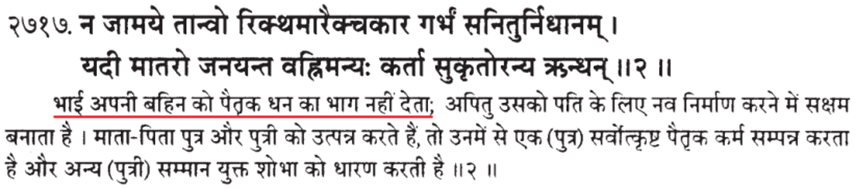
Yaska Acharya comments on the above verse as follows:
Nirukta 3.6 ‘Na Jamaye’ means not for the sister. Jamih (sister) is (so called because) others beget ‘Ja’, i.e. offspring, on her, or the word may be derived from (the root) jam, meaning to go : she has mostly to go (to the husband’s family). The legitimate, i.e. one’s own son, left, i.e. gave, wealth. He made her the place of depositing the seed of her husband, i.e. the man who accepts her hand. If the mothers have engendered Vahni, i. e. a son, and Avahni, i.e. a daughter, one of them, i.e. the son and the heir, becomes the procreator of children, and the other, i.e. the daughter, is brought up and given away (in marriage) to another person.” Tr. Lakshman Sarup (Source)
Sayana explicitly confines inheritance to sons and excludes daughters, except in the limited case of Putrikakarana, the appointment of a daughter as a son. Even in that arrangement, the daughter does not inherit in her own right. She functions primarily as a means to produce a male successor who will carry forward the lineage and claim the estate. Sayaṇa further addresses the claim that sons and daughters, being equally born of the same parents, should enjoy equal inheritance, and then offers a rationale for maintaining their unequal status.
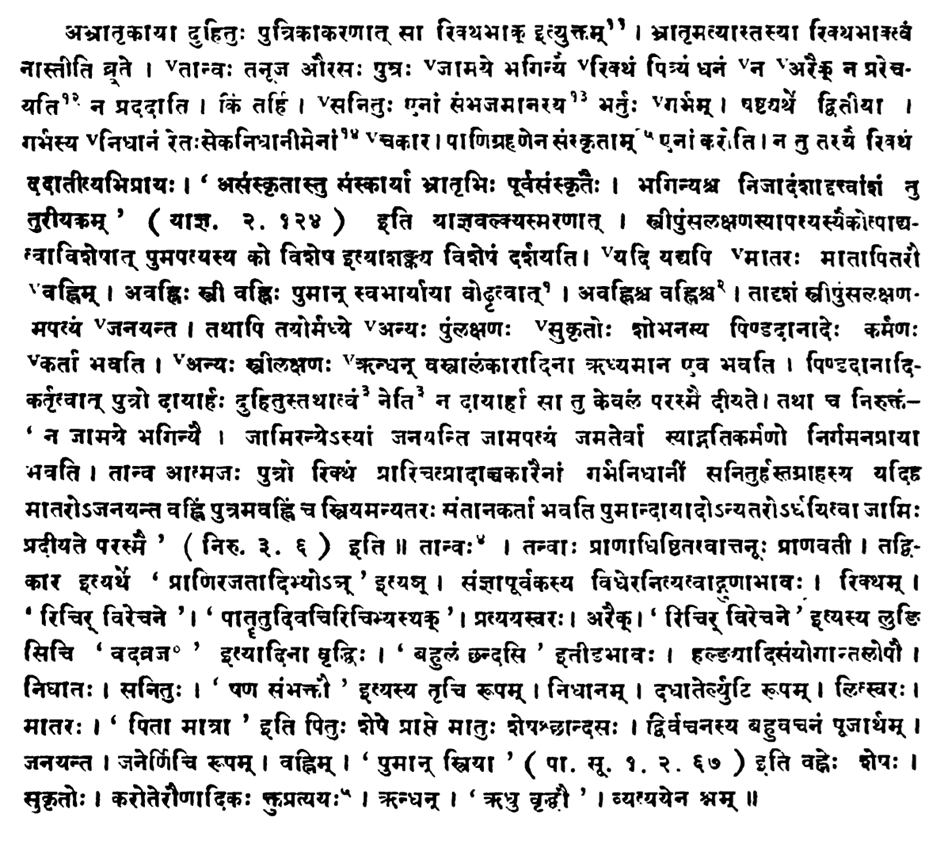
“It has been established that the brotherless daughter, through the mechanism of Putrikakarana (appointment as a daughter-son), is a participant in the inheritance. Conversely, it is stated that a daughter who possesses a brother does not hold the status of an heir. The Tanva—the legitimate son born of the body—does not relinquish, empty, or transfer the inheritance, representing the paternal wealth, to the Jami (the sister). Instead, he prepares her to be the repository of the embryo for the husband who accepts and enjoys her. He ensures her consecration through the rite of panigrahana (the ritual grasping of the hand). The underlying intent is that he does not provide her with the inheritance.
This aligns with the tradition of Yajnavalkya (2.124) regarding the consecration of sisters by previously consecrated brothers and the provision of a specific fourth share for that purpose. Addressing the potential objection that no distinction should exist between male and female offspring as they are both progeny, the text delineates the specific difference. Even if both parents produce a Vahni (male/carrier) and an Avahni (female/non-carrier)—the male being the Vahni as the protector and bearer of his wife—it is the one possessing male characteristics who becomes the performer of efficacious rites, such as the offering of the pinda. The female, by contrast, is merely a recipient of adornments like clothing and jewelry. Consequently, by virtue of his role in ancestral offerings, the son is the rightful heir, whereas the daughter is not; she is essentially destined for another. As recorded in the Nirukta (3.6): “Not to the sister… the legitimate son does not give the inheritance… of the two produced by the parents, the male becomes the continuer of the lineage and the heir, while the female is adorned and given to another...” Sayana on Rig Veda 3.31.2
Hindu law is traditionally governed by the Mitakshara and Dayabhaga schools of law. In a Hindu Undivided Family, the head of the family is known as the Karta. The Karta is usually a male member, and traditionally only male members enjoy coparcenary rights. After the death of the Karta, the eldest son succeeds to the position and takes control of the property, as stated in the Manu Smriti. However, property may also be divided during the lifetime of the Karta. Maharishi Manu himself is said to have divided his property among his sons while he was still alive, as mentioned in the Krishna Yajur Veda 3.1.9.
Under the traditional framework of Hindu law, a daughter could inherit property only in the absence of a brother, and even then only if her father formally designated her as an Appointed Daughter. In such a case, if she gave birth to a son, that son would become the legal heir of his maternal grandfather and was treated as though adopted into his lineage.
Rig Veda 3.31.1 “WISE, teaching, following the thought of Order, the sonless gained a grandson from his daughter…” Tr. Ralph Griffith (Source)
Yaska comments on the above verse as follows:
Nirukta 3.5 “One should not marry a brotherless maiden, for his (the husband’s) son belongs to him (to the father of the girl). From this, the prohibition of marrying a brotherless maiden and the father’s right to appoint his daughter as a son are evident. When a father selects a husband for his unmarried daughter, he unites himself with a tranquil mind.” Tr. Lakshman Sarup (Source)
Pandit Jaydev Sharma (Arya Samaj) comments on Rig Veda 3.31.1 as follows:
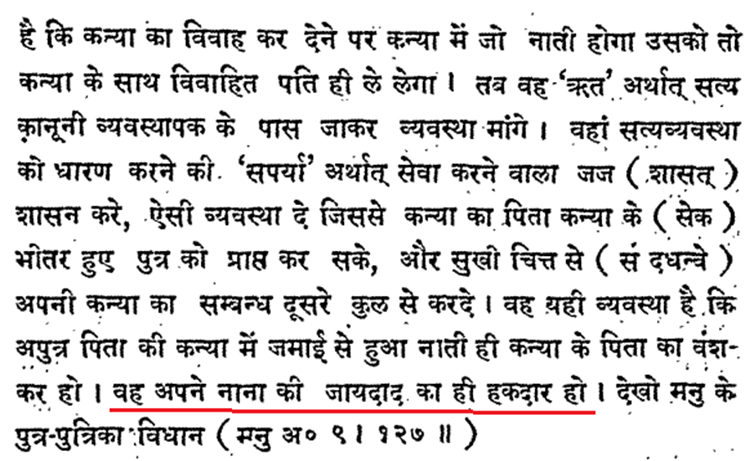
“…that upon the marriage of a daughter, the grandson born to her would typically be claimed by the husband married to that daughter. In such a case, he [the father] should approach the administrator of ‘Rta’—meaning the true legal legislator—and seek a decree. There, the judge (Shasitr), who upholds the true order and performs ‘Saparya’ (service), should govern and provide such a ruling whereby the daughter’s father may obtain the son born within the daughter (offspring), and with a happy heart (Sam Dadhve), establish his daughter’s connection with another family. This very provision ensures that for a sonless father, the grandson born to his daughter from the son-in-law becomes the perpetuator of the daughter’s father’s lineage. He alone should be the rightful heir to his maternal grandfather’s property. See Manu’s regulation regarding the son of a daughter (Putrika): (Manu Chapter 9, Verse 127).” Pandit Jaydev Sharma on Rig Veda 3.31.1
Srimad Bhagavatam 10.57.37 “Since Satrajit had no sons, his daughter’s sons should receive his inheritance. They should pay for memorial offerings of waler and pinda, clear their grandfather’s outstanding debts and keep the remainder of the inheritance for themselves.” Tr. Swami Prabhupada (Source)
Manu Smriti states,
Manu Smriti 9.131 “But whatever may be the separate property of the mother, that is the share of the unmarried daughter alone; and the son of an (appointed) daughter shall take the whole estate of (his maternal grandfather) who leaves no son.” Tr. Georg Buhler (Source)
The verse does not state that the daughter herself inherits the estate. Rather, it specifies that the son born to an appointed daughter succeeds to the property. In effect, the daughter is legally sidelined. Her role is reduced to that of producing a male heir, the Putrika Putra, who will continue her father’s line in the absence of a son. The property passes to the grandson through the daughter only when the man is sonless, and even then it is not the daughter who inherits in her own right. Here, the expression “separate property of the mother” does not refer to productive assets such as land, cattle, or income yielding resources. It denotes limited personal gifts, typically ornaments or movable items, and even these are generally reserved for an unmarried daughter. A married daughter is treated as having been transferred to her husband’s lineage, and therefore is considered to be maintained within that new household.
It is evident that the Vedas do not confer inheritance rights upon women. Neither the Vedas nor the Brahmanas grant a daughter an independent claim to ancestral property. Even in the case of an appointed daughter, her right is only temporary, as the property ultimately passes to the son she bears, who is then treated as the true heir. In this structure, inheritance is firmly reserved for sons, and the continuity of property is anchored in the male line.
Only the later Dharma Shastra texts introduce limited concessions, such as granting a share to an unmarried sister or recognising her right to receive gifts. Even this remains problematic, as it provides no corresponding share to a married sister or daughter. In cases where a man died without a son, his property could pass to his widow. If there was no son but there was a daughter, the estate could devolve upon the daughter.
The Vishnu Smriti states that sons are the natural inheritors, possessing a birthright to the family estate. The daughter, by contrast, is treated as a residual heir. She is permitted to inherit only to prevent the property from passing to distant relatives or to the king through escheat, and even then, strictly in the absence of a primary male heir.
Vishnu Smriti 17.1-9 “If a father makes a partition with his sons, he may dispose of his self-acquired property as he thinks best. But in regard to wealth ‘inherited of the paternal grandfather, the ownership of father and son is equal. (Sons), who have separated from their father, should give a share to (a brother) who is born after partition. The wealth of a man who dies without male issue goes to his wife; On failure of her, to his daughter; On failure of her, to his father; On failure of him, to his mother; On failure of her, to his brother; On failure of him, to his brother’s son.” Tr. Julius Jolly (Source)
The same principle is reiterated in Apastambha Dharma Shastra. It states that a man’s property should be divided among his sons during his lifetime, and only if he is sonless does the inheritance pass to other male relatives, spiritual teachers, or pupils. The daughter is permitted to inherit strictly in the absence of sons and other primary male heirs.
Apastambha Dharma Shastra 2.6.14.1-5 “He should, during his lifetime, divide his wealth equally amongst his sons, excepting the eunuch, the mad man, and the outcast. On failure of sons the nearest Sapinda (takes the inheritance). On failure of them the spiritual teacher (inherits); on failure of the spiritual teacher a pupil shall take (the deceased’s wealth), and use it for religious works for the (deceased’s) benefit, or (he himself may enjoy it); Or the daughter (may take the inheritance). On failure of all (relations) let the king take the inheritance.” Tr. Georg Buhler (Source)
It further states,
Apastamba Dharma Shastra 2.6.14.9-15 According to some, the share of the wife consists of her ornaments, and the wealth (which she may have received) from her relations. That (preference of the eldest son) is forbidden by the Sâstras. For it is declared in the Veda, without (marking) a difference (in the treatment of the sons): Manu divided his wealth amongst his sons. Now the Veda declares also in conformity with (the rule in favour of the eldest son) alone…Therefore all (sons) who are virtuous inherit. But him who expends money unrighteously, he shall disinherit, though he be the eldest son.” Tr. Georg Buhler (Source)
Both Manu Smriti and Mahabharata state that if a man, having no son, appoints his daughter as a son and later a biological son is born to him, the estate must be divided equally between the two.
This also makes the underlying rule clear. If a son already exists before any such appointment, he alone inherits the entire property. The daughter’s elevation to the status of a son operates strictly in the absence of a natural male heir, not alongside one.
Mahabharata 13.45 “If the maternal grandfather happens to die without leaving sons, the daughter’s son should inherit it. The daughter’s son offers pindas to his own father and the father of his mother. Hence, in accordance with considerations of justice, there is no difference between the son and the daughter’s son. When a person has got only a daughter and she has been invested by him with the status of a son, if he then happens to have a son, such a son (instead of taking all the wealth of his sire) shares the inheritance with the daughter. 4 When, again, a person has got a daughter and she has been invested by him with the status of a son, if he then happens to take a son by adoption or purchase then the daughter is held to be superior to such a son (for she takes three shares of her father’s wealth, the son’s share being limited to only the remaining two).” Tr. K.M. Ganguli (Source)
Manu Smriti 9.134-5 “But if, after a daughter has been appointed, a son be born (to her father), the division (of the inheritance) must in that (case) be equal; for there is no right of primogeniture for a woman. But if an appointed daughter by accident dies without (leaving) a son, the husband of the appointed daughter may, without hesitation, take that estate.” Tr. Georg Buhler (Source)
Some apologists cite Manu Smriti 9.194 and Agni Purana 209.27 to argue that women have the right to claim property. However, these verses refer primarily to gifts given to a woman on specific occasions, particularly at the time of marriage, rather than to an equal share in inheritance. Terms such as Kanyadhana, Adhyagni, Stridhana, and Yakauta denote categories of gifts that constitute her personal property, not a general proprietary right within the family estate. Some apologists also cite Nirukta 3.5 to argue that Yaska supported inheritance rights for daughters. This reading is misleading. Yaska is not endorsing a general right of inheritance for daughters, he is simply recording differing opinions on the matter. Moreover, the passage he comments upon concerns inheritance through the mechanism of the appointed daughter of a sonless father.
Women are Considered Fields
Some Hindus cite certain Quranic verses to argue that the Quran refers to women as “fields,” often overlooking the metaphorical context. However, it is worth noting that several verses in their own scriptures also employ similar terms such as “fields” or “soil” when referring to women.
Atharv Veda 14.2.14 “This dame hath come, an animated corn-field: there sow, thou man, the seed of future harvest…” Tr. Ralph Griffith (Source)
Manu Smriti 9.33 “By the sacred tradition the woman is declared to be the soil, the man is declared to be the seed; the production of all corporeal beings (takes place) through the union of the soil with the seed.” Tr. Georg Buhler (Source)
Medhatithi comments on the above verse as follows:
“‘The woman’ is as if it were ‘the soil’. ‘Soil’ stands for that part of the Earth where corns are grown; and the woman is like that: Just as the seed sown and held in the soil sprouts up, so also the semen deposited in the woman…” Medhatithi on Manu Smriti 9.33, Tr. Ganganath Jha (Source)
For more information, read the article, Does Islam consider Women Tilth?